






Abstract
Mothers facing stressors or lacking adequate support often find parenting more challenging and less enjoyable. This study examined the mechanisms through which contextual variables might influence perceptions of parenting. Participants were 153 mothers of toddlers who completed interviews and questionnaires on life adversity, social support, negative affect, and parenting stress. Life adversity was positively associated with parenting stress and this association was mediated through negative affect. Emotional support moderated the association between adversity and negative affect. Life adversity appeared to promote negative affect, which in turn led mothers to regard their child as more obstinate and demanding and their interactions with their children as less enjoyable. Adversity had little effect on parental perceptions among mothers with adequate emotional support.
Parenting a toddler is a challenging process. Toddlers' curiosity and increased mobility compel high parental involvement, and the child's desire for self-determination frequently puts the mother and child at odds (Laible & Thompson, 2002). Such high demands for vigilance and patience may be an obvious source of parenting stress, but previous research has shown that a mother's life outside of parenting also will shape her experience of the parenting process (Ostberg & Hagekull, 2000). What remains unclear is how contextual factors such as income, level of education, life adversity, and social support influence parenting stress; whether they alter perceptions of parenting directly or whether their effects follow a stress spillover process, mediated by changes in the parent's global affective state.
Parenting Stress
Parenting stress is a cognitive and emotional reaction to childrearing demands that are experienced as taxing or overwhelming a parent's resources (Lazarus & Folkman, 1984). Parenting stress is a broad construct, and encompasses negative parenting experiences ranging from exasperation with a child's behavior and unhappiness with parent-child interactions to a desire for fewer parental responsibilities and feelings of incompetence (Deater-Deckard, 1998). Although some stress is considered a normative or even an inevitable part of raising children (Deater-Deckard & Scarr, 1996), high parenting stress appears to be deleterious for both mother and child. Stress in the parenting domain is associated with insecure child attachment (Holden & Banez, 1996), excessively punitive parenting (Deater-Deckard & Scarr, 1996), and decreased parental involvement (Adamakos, Ryan, Ullman, Pascoe, Diaz, & Chessare, 1986). Even modest elevations in parenting stress are associated with diminished family functioning and increased child behavior problems (Crnic & Greenberg, 1990). Furthermore, in addition to the implications for children, perceptions of parenting are important in their own right. Raising children is considered by many parents to be one of the most meaningful parts of their lives (Wilson, Sandoz, Kitchens, & Roberts, 2011) and parenting stress is negatively correlated with life satisfaction overall (Crnic & Greenberg, 1990).
Stress Spillover
Understanding the mechanisms through which contextual factors (life stressors, social support, socioeconomic variables) influence parenting stress may be integral to minimizing their potentially negative effects. One promising mechanism is the stress spillover process, which has been explored extensively in the marriage and couples literature. Stress spillover occurs when stress (a negative affective state) generated in response to difficulties within one domain of a person's life persists throughout engagement in other, nominally distinct domains. Couples researchers have consistently demonstrated that stressors from outside the relationship have negative effects on relationship satisfaction (Brock & Lawrence, 2008), and Conger, Rueter, and Elder (1999) have shown that these effects are mediated through spouses' global emotional distress.
With respect to perceptions of parenting, stress spillover would occur when stressful events or circumstances from outside the parenting domain (e.g., problems at work, discord with extended family members) engender a negative affective response that continues while the parent is interacting with or thinking about her children. Impressions of the child and of parenting in general are thus shaped in the context of the parent's negative affective state and may be influenced by the parent's affect in a variety of ways. From a behavioral perspective, increases in negative affect may elevate a mother's sensitivity to aversive stimuli (Eshel & Roiser, 2010) such as a child's distress or unwillingness to eat. Increased negative affect may also diminish sensitivity to appetitive stimuli (Eshel & Roiser, 2010) present, for instance, in playful interactions with the child. From a cognitive perspective, elevated negative affect may promote negative perceptions of life in general, including unfavorable perceptions of parenting specifically (see Neff & Karney, 2004 for evidence of this process in the marital relationship).
Several findings support the application of the stress spillover model in explaining the effects of contextual factors on parenting stress. General manifestations of negative affect such as anxiety and depression appear to influence mothers' perceptions of their children. For example, depression during pregnancy has been shown to predict postpartum parenting stress (Misri, Kendrick, Oberlander, Norris, Tomfohr, Zheng, et al., 2010), and a treatment trial showed that mothers randomized to psychotherapy for depression reported lower parenting stress at follow-up than waitlist controls (Forman, O'Hara, Stuart, Gorman, Larsen, & Coy, 2007). Studies also have documented stress spillover effects on other aspects of parenting, such as parenting behaviors (Repetti & Wood, 1997) and parent-child relationships (Galambos, Sears, Almedia, & Kolaric, 1995). However, these studies have frequently failed to distinguish between stressors (events and circumstances in the environment) and stress (the psychological reaction to such events). This distinction is important in differentiating between direct and spillover effects of contextual factors.
The Psychosocial Context of Parenting
Demographic factors.—Some researchers have found that low income and limited education were associated with elevated parenting stress (Deater-Deckard & Scarr, 1996). With respect to the direct effects of income and education on parenting stress, limited access to material resources may inhibit the resolution of some difficulties encountered in childrearing, and the financial burden of raising a child may be especially onerous for those with little money. It is also possible that child-related adversity may be managed poorly among mothers with less education (McLeod & Kessler, 1990). Alternatively, given that both low income and limited education are associated with elevated symptoms of depression (Smith-McKeever, Rowe, & Gao, 2012), these demographic factors may primarily influence views of parenting by promoting overall negative affect.
Life adversity.—Life adversity (also referred to as life stress or stressors), both in the form of discrete events (Ostberg & Hagekull, 2000) and chronic difficulties (Creasey & Reese, 1996), is also associated with elevated parenting stress. Life adversity constitutes the cumulative challenges posed by an individual's environment (Monroe & Roberts, 1990) and may be contrasted with “stress,” which is a possible reaction to life's challenges. Mothers dealing with significant life events may have less time and energy to devote to parenting (e.g., Buck & Neff, 2012) and certain stressors may drain financial resources that might otherwise be devoted to children. However, life adversity may also exert its effects on parenting stress through stress spillover, and there is evidence that adversity plays a causal role in the genesis of depression and anxiety (Kendler & Gardner, 2011).
In order to compare the direct effects of life adversity on parenting stress with its indirect effects mediated through negative affect, three limitations of previous research need to be addressed. Firstly, researchers who have studied adversity and parenting stress have tended to rely upon self-reported life events checklists to measure adversity. Checklists often fail to capture relevant life events (Duggal, Malkoff-Schwartz, Birmaher, Anderson, Matty, Houck, et al., 2000) and encourage respondents to endorse events that do not fit researchers' conceptions of sufficiently intense experiences (Lewinsohn, Rohde, & Gau, 2003). Secondly, despite evidence that stress-prone individuals actively contribute to their own experience of elevated life adversity (Hammen, 2006), previous studies on life events and parenting stress have not controlled for participants' histories of affective symptoms. Finally, the extant research on life adversity and parenting stress has relied upon adversity measures that include events from both inside and outside the parenting domain. The inclusion of parenting stressors in these measures has obfuscated the association between parenting stress and adversity from outside other areas of the parent's life.
Social support.—Negative elements of a mother's psychosocial environment are linked to parenting stress, but positive elements (or the extent to which they are lacking) may be influential as well. Some previous investigations have found that higher social support is associated with lower parenting stress (McConnell, Breikreuz, & Savage, 2010) and at least one intervention directed at improving mothers' support was shown to decrease parenting stress (Telleen, Herzog, & Kilbane, 1989). As Belsky (1984) has suggested, social support may reduce parenting stress directly if other individuals help with childcare tasks or commend the parent's handling of childcare issues. Social support may also reduce parenting stress indirectly in so much as help, love, and encouragement from others improves overall affective symptoms. Additionally, at least one study found that support moderated the effects of life adversity on parenting stress, such that parents with more support were less likely to experience increased stress in the face of environmental challenges (Koeske & Koeske, 1990). Other investigators, however, have found no substantial association between support and parenting stress (e.g., Pearson & Chan, 1993; Rodgers, 1993; Anderson, 2008).
Objectives
The primary objective of this study was to compare the direct association between a number of contextual factors (income, education, life adversity, social support) and parenting stress with an indirect, stress spillover model in which negative affect played a mediating role. The methods employed improved upon previous studies on parenting stress and life adversity by using a rigorous, interview-based assessment of life adversity, excluding parenting stressors, and controlling for the potentially confounding effects of past negative affect. Given inconsistent findings on social support and parenting stress, multiple types of relations among these constructs were systematically examined in order to identify what role, if any, social support might play.
Method
Participants
The participants were 153 mothers with toddlers between the ages of 16 and 21 months (M = 17.9, SD = 1.2). The sample was from the Midwestern United States and was predominately Euro-American (n = 120, 94%). Most were married (n = 130, 87%), working either part- or full-time (n = 97, 65%), had at least a bachelor's degree (n = 102, 67%), and had an annual household income greater than $50,000 (n = 106, 69%). Almost half were first-time mothers (n = 69, 46%) and another 30% (n = 46) had two children, including the target child. Only two mothers had a child younger than the target child. The participants ranged in age from 19 to 43 years (M age = 31 yr.)
Measures
Contextual variables.—Life adversity and social support were measured with the Contextual Assessment of the Maternity Experience (Bernazzani, Conroy, Marks, Siddle, Guedeny, & Bifulco, et al., 2004). The Contextual Assessment of the Maternity Experience is a suite of scales administered through a semi-structured interview in which both standardized and ad hoc questions are used to probe a given experience. The recent life adversity module measures significant life events and chronic life difficulties mothers have experienced since giving birth. Interviewers rate descriptions of stressors provided by mothers on a four-point severity scale from 1: Marked to 4: Little/none, based on comparisons with case examples in the instrument's manual. Chronic difficulties must last at least one month to be rated as a stressor. Adversity measured through the Contextual Assessment of the Maternity Experience has been found to predict subsequent onset of depressive episodes (Bernazzani, et al., 2004).
The Contextual Assessment of the Maternity Experience also contains scales measuring emotional and practical social support. These scales measure the quality and frequency of support the mother usually receives from two close confidants (including a cohabiting partner, if applicable) and the mother's support network more broadly. Emotional support is scored based on the extent to which the mother confides in her support figures and the interviewer's evaluation of the responses she receives. The practical support score is determined by the amount of help the mother receives with childcare, housework, finances (except from her spouse), and other practical tasks. Like life adversity, practical and emotional support from each source are scored on a four-point scale from 1: Marked to 4: Little/none with reference to exemplar descriptions in the instrument's manual. Social support measured with the Contextual Assessment of the Maternity Experience has been found to relate both to current depressive symptoms and to future depressive episodes (Bernazzani, Marks, Bifulco, Siddle, Asten, & Conroy, 2005).
Ten percent of the interviews conducted with the Contextual Assessment of the Maternity Experience (n = 16) were randomly selected to be coded by a second rater for the purposes of estimating inter-rater reliability. Inter-rater reliability was estimated in SPSS Version 21 through two-way random effects intraclass correlations using the absolute agreement definition. This intraclass correlation model accounts for both systematic differences between raters and unsystematic measurement error (McGraw & Wong, 1996). The inter-rater reliability for the aggregated adversity variable used in these analyses was excellent (ICC = .90). After support was aggregated across sources, inter-rater reliability was good for emotional support (ICC = .83) and excellent for practical support (ICC = .94).
Parenting stress.—For all four of the parenting stress indicators, mothers reported on their perceptions of and feelings toward their toddler (the target child) specifically. Two scales from the short form of the Parenting Stress Index (Abidin, 1995) were used to measure the mother's negative perceptions of raising children. The 12-item Difficult Child scale measures the parent's perception of how easily her child becomes upset and how difficult the child is to socialize (e.g., “Sometimes my child does things that bother me just to be mean”). The 12-item Dysfunctional Interactions scale measures the parent's disappointment and dissatisfaction with the ways in which her child interacts with her (e.g., “My child rarely does things for me that make me feel good”). Respondents rate these items on a five-point scale from 1: Strongly disagree to 5: Strongly agree. Both scales show good six-month test-retest reliability and are highly correlated with their full-length counterparts (Abidin, 1995). They have been used in studies with toddlers and have shown concurrent validity through significant correlations with maternal depression and observational measures of parenting behaviors (Whiteside-Mansell, Ayoub, McKelvey, Faldowski, Hart, & Shears, 2007). In the present sample, internal consistencies were α = .80 for the Difficult Child scale and α = .88 for the Dysfunctional Interactions scale.
Two items from the maternal feelings and attitudes module of the Contextual Assessment of the Maternity Experience were used as additional measures of parenting stress. The Difficult Child (mother's assessment) score is derived from the mother's responses to a series of questions about her perception of how often and for what duration her child displays problems with eating, sleeping, crying, and any other difficulties she reports spontaneously. The Antipathy towards Child score is rated based on the mother's descriptions of how much she is bothered by her child's behavior and how often she wishes her child were not around. Both items are scored on a four-point scale from 1: Marked to 4: Little/none. Bernazzani, et al., 2005 demonstrated that the measure of maternal attitudes in the Contextual Assessment of the Maternity Experience was related to maternal sensitivity and adequacy of the home environment as well as to maternal depression. Inter-rater reliability in the present study was good for both the Difficult Child (ICC = .83) and the Antipathy towards Child (ICC = .84) items.
Negative affect.—Depression was measured at both time points with the 20-item general depression scale from the Inventory of Depression and Anxiety Symptoms (Watson, O'Hara, Simms, Kotov, Chmielewski, McDade-Montez, et al., 2007). The items on the Inventory of Depression and Anxiety Symptoms (e.g., “I felt depressed”) measure depressive symptoms on a five-point scale with anchors 1: Not at all and 5: Extremely over the preceding two weeks. This scale has demonstrated good one-week test-retest reliability (r = .84) and is highly correlated with clinician-determined diagnoses of depression (Watson, et al., 2007; Watson, O'Hara, Chmielewski, McDade-Montez, Koffel, Naragon, et al., 2008). The depression scale has also demonstrated good discriminant validity though multitrait-multimethod analyses showing that the depression scale correlated more strongly with interviewer rating of depression than with interviewer ratings of other internalizing symptoms. This scale demonstrated an internal consistency of α = .91 for the first time point and α = .88 at follow-up.
Interviewer-rated measures of negative affect were also administered at both time points. The Hamilton Rating Scale for Depression (Hamilton, 1960) was conducted at Time 1. Interviewers using the Hamilton Rating Scale for Depression rate the severity of participants' depression and anxiety symptoms over the preceding week on items with three- to five-point scales. Each of the measure's 24 items are scored based on the participant's responses to a series of questions about a given symptom. This interview has demonstrated good test-retest reliability (Cicchetti & Prusoff, 1983) and good convergent validity through good correspondence with the Structured Clinical Interview for DSM-IV (Aben, Verhey, Lousberg, & Honig, 2002). It has also shown good discriminant validity insomuch as it distinguishes individuals with clinical diagnoses of depression from individuals with clinical diagnoses of bipolar disorder (Rehm & O'Hara, 1985) and is more strongly related to self reports of depression than self reports of anxiety (Beck, Epstein, Brown, & Steer, 1988). Ten percent of the interviews used in these analyses were re-coded (n = 16), and both the depression (ICC = .90) and anxiety (ICC = .93) scales derived from the Hamilton Rating Scale for Depression showed excellent inter-rater reliability.
At follow-up, the depression and generalized anxiety scales from the Interview for Mood and Anxiety Symptoms (Kotov, Gamez, & Watson, 2007) were used. The Interview for Mood and Anxiety Symptoms is a semi-structured interview that allows interviewers to rate the severity of a respondent's depression and generalized anxiety by determining the presence and severity of the symptoms of each disorder. The items of the Interview for Mood and Anxiety Symptoms are rated on a three-point scale with anchors 1: Absent/sub-threshold and 3: Above threshold where the severity ranges for each item are defined in the interview's manual. One of the 28 items on the depression scale is, “Have you had a period of time lasting several days or longer when most of the day you felt sad, empty or depressed?” One of the 12 items on the generalized anxiety scale is “Did you worry a lot more days than not?” These scales have demonstrated good convergent and discriminate validity through multitrait-multimethod analyses showing that they are more strongly correlated with self-reported general distress than with self reports of specific forms of fear or anxiety (Watson, O'Hara, Naragon-Gainey, Koffel, Chmielewski, Kotov, et al., 2012). Ten percent of these interviews (n = 18) were re-coded, and inter-rater reliability was near perfect for both the depression (ICC = .99) and generalized anxiety (ICC = .97) scales.
Procedure
All procedures were approved by the Institutional Review Board at the first author's university, and consent was obtained from all participants. Participants were recruited through advertisements in local media outlets, in-person recruiting in the department of obstetrics and gynecology at a local hospital, and letters mailed to patients of nearby obstetrics and gynecology practices and a mental health clinic. The first time-point of data collection took place when the women were pregnant or recently delivered. The 304 women who participated in this phase of data collection ranged from seven weeks pregnant to 14 weeks postpartum (M = 23.8 weeks since conception, SD = 11.6 weeks). They completed a packet of questionnaires which contained the Inventory of Depression and Anxiety Symptoms and returned the packet by mail. They also completed a telephone interview that included the Hamilton Rating Scale for Depression. The interviewers were graduate students and masterslevel professional staff, who all had previous experience administering the Hamilton in previous studies.
These women were re-contacted at 16 months postpartum for a follow-up assessment. Women who agreed to take part in the follow-up were mailed a packet of questionnaires containing the Inventory of Depression and Anxiety Symptoms and the Parenting Stress Index. They also completed two phone interviews. The two interviews assessed mood symptoms and psychosocial variables, respectively, and were conducted separately so that the interviewers who conducted and scored each assessment were blind to their respondent's answers to the other interview. The interviewers at this time point were graduate students. They were trained to conduct the Interview for Mood and Anxiety Symptoms by the interview's developer (R. Kotov). They were trained to conduct the Contextual Assessment of the Maternity Experience by another member of the laboratory who had previous experience administering that interview. Consultation with both trainers was maintained throughout this stage of assessment. Out of the 304 women eligible to participate in the follow-up, 153 completed all follow-up assessments. There were no statistically significant differences between the 153 mothers who comprised the sample for the final model and those who contributed incomplete data on average age (t290 = −0.46, p = .64); income (t285 = −0.63, p = .53); education (t293 = 0.67, p = .29); or initial level of depressive symptomatology (t291 = −1.58, p = .12).
Analysis
Computation of study variables.—Scores on items from the Contextual Assessment of the Maternity Experience were reverse-coded so that higher scores reflected higher levels of each construct. Life adversity within a given domain was operationalized as the sum of the severity ratings for all life events experienced in the preceding six months and all chronic life difficulties that the respondent was experiencing at the time of the interview. The six-month time frame for life events was chosen based on previous findings in which severe life events showed measureable associations with depression for up to six months (Kendler, Karkowski, & Prescott, 1998). Adversity directly related to reproduction or childrearing (e.g., a child's illness) was excluded in order to examine the association between parenting stress and stressors from outside the parenting domain. Practical and emotional support were each operationalized as the sum of the standardized scores corresponding to the rating for all three support sources. Two variables modeling the interaction between practical support and life adversity and emotional support and life adversity consisted of the product of the standardized scores for total practical or emotional support and adversity.
Interviewer-rated anxiety and depression at Time 1 were operationalized using depression and anxiety scales (five items each) derived from the meta-analytic factor structure of the Hamilton Rating Scale for Depression found by Shafer (2006). Interviewer-rated anxiety at follow-up was operationalized using the generalized anxiety scale from the Interview for Mood and Anxiety Symptoms but excluding four items that measured symptoms identical to those in the measure's depression scale.
Factor analysis.—Using SPSS Version 21, principal components analysis was conducted for each of the latent factors in the measurement models. Bartlett's test of sphericity was run to assess whether the corresponding matrices were appropriate for factor analysis, and eigenvalues were examined to determine whether the hypothesized number of latent factors best accounted for the variance in the observed indicators. Confirmatory factor analysis was then run in in Mplus 6.1 (Muthén & Muthén, 2010) to evaluate the overall fit of the measurement models (McDonald & Ho, 2002).
Structural equation modeling.—Structural equation modeling techniques were then used to examine the effects of demographic variables, life adversity, and social support on parenting stress. As recommended by MacKinnon, Lockwood, and Williams (2004), bias-corrected confidence intervals for indirect effects were calculated through bootstrapping using 5,000 draws per analysis. Simple slopes analyses were conducted for statistically significant interaction terms using the formulas provided by Edwards and Lambert (2007). All analyses were conducted in Mplus 6.1 (Muthén & Muthén, 2010). Because the parenting stress items on the Contextual Assessment of the Maternity Experience took only four values, these two variables were treated as categorical. Unweighted least squares parameter estimates with standard errors and a mean- and variance-adjusted chi-square test statistic with a full weight matrix (the ULSMV estimator) were used when models contained categorical variables and maximum likelihood estimation with robust standard errors (the MLR estimator) was used when categorical variables were absent. These estimators were chosen because some of our variables were right skewed and leptokurtic (Table 1) and ULSMV and MLR are robust with respect to non-normality (Yuan & Bentler, 2007). Missing data were assumed to be missing at random (MAR). Cases for which data were missing on exogenous variables (i.e., life adversity, social support, education, or income) were excluded from analysis. Models with data missing on endogenous variables were adjusted for missing data using full information maximum-likelihood (FIML) estimation. Root-mean-square error of approximation (RMSEA) < .06 and comparative fit index (CFI) > .95 indicate good model fit (Hu & Bentler, 1999).
Variable Means, Standard Deviations, Skewness, and Kurtosis (N = 153)

Results
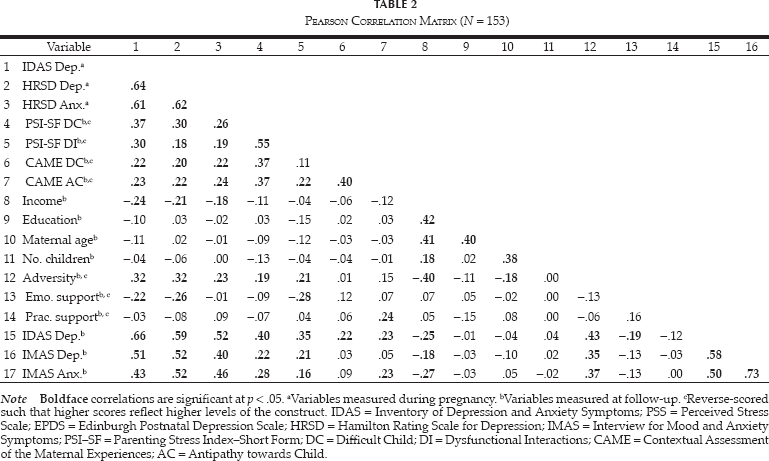
Common adversity reported by the participants included chronic health problems, loss of employment, persistent financial difficulties, and depression or substance abuse in their partners. About 23% of the women in the present sample had experienced adversity of sufficient severity to be rated on the Contextual Assessment of the Maternity Experience scale. Means, standard deviations, skewness, and kurtosis for the variables in the study are presented in Table 1. Pearson correlations between the variables are presented in Table 2.
Pearson Correlation Matrix (N = 153)
Direct Effects on Parenting Stress
Parenting stress measurement model.—Parenting stress was operationalized as a latent variable defined by the Difficult Child and Dysfunctional Interactions scales from the Parenting Stress Index and the Difficult Child and Antipathy towards Child items from the Contextual Assessment of the Maternity Experience. Principal components analysis revealed that Bartlett's test of sphericity supported the use of factor analysis (χ2[6] = 111.39, p < .01) and that only a single eigenvalue was above 1. The first component accounted for 50.9% of the variance in the four indicators. Confirmatory factor analyses revealed that this measurement model showed an equivocal fit, RMSEA = .10, CFI = .95. Inspection of the residual correlation matrix indicated that modeling method variance by allowing the residuals of the self-report indicators to correlate would generate a model that better fit the data. This change resulted in a significant improvement [Δχ2(1) = 17.83, p < .01] and a good model fit (RMSEA = .06, CFI = .99).
Direct effects.—The direct effects of education and income on parenting stress were examined first, found to be nonsignificant, and removed from the model. When life adversity, emotional support, and practical support were examined concurrently as predictors of parenting stress, life adversity showed a significant effect on parenting stress and emotional support showed a trendlevel inverse effect (Table 3. Step 1). Product terms for the interaction between emotional support and life adversity and between practical support and life adversity were examined along with the above covariates and were non-significant (Table 3, Step 2).
Direct Effects for Putative Predictors on Parenting Stress (N = 153)

Mediating Effects of Negative Affect
Negative affect measurement model.—The measurement model for negative affect was constructed with two correlated latent variables representing negative affect at Time 1 and follow-up, respectively. Negative affect at Time 1 was defined by the Inventory of Depression and Anxiety Symptoms depression scale and the anxiety and depression scales from the Hamilton Rating Scale for Depression. Follow-up negative affect was defined by the Inventory of Depression and Anxiety depression scale and the depression and generalized anxiety scales of the Interview for Mood and Anxiety
Symptoms. Principal components analysis showed that Bartlett's test supported factoring the matrices both at Time 1 [χ2(3) = 164.59, p < .01] and follow-up [χ2(3) = 180.0, p < .01]. A single eigenvalue was greater than 1 for both time-points and the first component accounted for 74.8% of the variance in the indicators at Time 1 and 74.5% of the variance in the indicators at follow-up. As in the case of the measurement model for parenting stress, the initial model for negative affect showed a equivocal fit (RMSEA = .12, CFI = .93). Again, accounting for shared method variance by allowing the residual variances of the two interviewer-rate scales for each model to correlate resulted in a significantly improved [Δχ2(1) = 16.60, p < .01] and adequate model fit (RMSEA = .03, CFI = 1.00).
Mediating effects.—A mediational model for the effects of life adversity on parenting stress was constructed such that parenting stress was regressed on adversity and follow-up negative affect while follow-up negative affect was regressed on adversity and negative affect at Time 1. The model fit the data well (RMSEA = .06, CFI = .95). In this model, adversity had a significant effect on follow-up negative affect (B = 3.56, 95%CI = 2.67, 4.44) when controlling for Time 1 negative affect. There was a significant indirect effect from adversity through follow-up negative affect on parenting stress (B = 1.20, 95%CI = 0.14, 1.82) and the direct effect for adversity on parenting stress was near zero (B = −0.11, 95%CI = −0.73, 0.52), suggesting that negative affect mediates the association between adversity and parenting stress (MacKinnon, Fairchild, & Fritz, 2007).
Emotional Support and Moderated Mediation
Given previously documented direct and buffering effects demonstrated for social support on negative affect (Cohen & Wills, 1985), emotional support, practical support, and their respective interaction terms with life adversity were reintroduced as predictors of follow-up negative affect. Practical support showed no direct (B = −0.33, 95%CI = −1.43, 0.77) or interactive (B = 0.12, 95%CI = −0.61, 0.86) effect on negative affect. Emotional support did not demonstrate any direct effect on negative affect (B = 0.03, 95%CI = −0.93, 0.99). However, it showed a significant interaction with life adversity (B = −0.84, 95%CI = −1.36, −0.32) such that more emotional support weakened the association between adversity and negative affect. The direct effect for adversity on affect remained significant (B = 3.24, 95%CI = 2.31, 4.16). This model matched the Edwards and Lambert (2007) criteria for first stage moderated mediation. In the final model, the variable for practical support, its interaction term, and the direct path from life adversity to parenting stress were removed. In order to control for potential confounds, income, education, mother's age, and the number of children living with the mother were included as predictors of negative affect. The paths for these covariates were not significant, and their inclusion did not substantively alter the other parameters in the model. The final model, illustrated in Fig. 1, demonstrated a good fit to the data (RMSEA = .05, CFI = .96). It is adjusted for income, education, mother's age, and the number of children living with the mother, but the non-significant paths for these covariates are not depicted.

Mediated Moderation in the Prediction of Parenting Stress. All coefficients are standardized. Negative affect is also regressed on income, education, maternal age, and number of children—all four paths are nonsigificant. †p < .01. All factor loadings are statistically significant.
Because the magnitude of the indirect effect of adversity on parenting stress was found to vary as a function of emotional support, it is appropriate to say that adversity has a conditional indirect effect on parenting perceptions. Simple slopes analyses were run on the conditional indirect effect shown in Fig. 1. Emotional support (which had been standardized) was held at 1, 0, and −1 (Fig. 2). These analyses showed that adversity had a substantial and statistically significant effect on parenting stress for mothers with average and low support but a small, non-significant effect for mothers with high support.

Simple slopes analysis for the conditional indirect effects of life adversity on parenting stress. Conditional indirect effects of life adversity through negative affect as moderated by emotional support. All slopes are standardized, variables are expressed in terms of their standard deviations, and all models control for Time 1 negative affect, income, education, maternal age, and number of children. LoSup = low emotional support, 1 standard deviation below the mean; MedSup = medium, mean level social support; HiSup = high emotional support, 1 standard deviation above the mean. †p < .01.
Alternate Model
Given that the path from negative affect to parenting stress was cross-sectional in nature, it was relevant to test a model in which mothers' perceptions of their child were hypothesized to influence their affective symptoms. This model was identical to the model in Fig. 1 with the exception that follow-up negative affect was regressed on parenting stress. It fit the data poorly (RMSEA = .14, CFI = .68) until parenting stress and negative affect at Time 1 were allowed to correlate [Fig. 3, Δχ2(1) = 24.79, ρ < .01, RMSEA = .06, CFI = .94]. In this model, the path from parenting stress to negative affect was small and not statistically significant (B = 0.36, 95%CI = −0.29, 1.01). Subsequent analyses revealed that it was primarily time 1 negative affect that accounted for the covariance between follow-up negative affect and parenting stress.

Alternate Model: Negative Affect Regressed on Parenting Stress. All coefficients are standardized. †p < .01. All factor loadings are statistically significant.
Discussion
Previous research on the context of parenting has suggested that parents in adverse life circumstances are more likely to view their children as especially difficult and irritating and to view their interactions with those children as unpleasant. The objective of the current investigation was to compare the direct and spillover effects of income, education, life adversity, and social support on perceptions of parenting.
Mothers who had experienced a greater number and intensity of life stressors in the preceding six months reported greater parenting stress (B = 1.18, 95%CI = 0.23, 2.14). Consistent with the stress spillover model, the effects of these extraparental circumstances on parenting stress were mediated by negative affect (B = 1.20, 95%CI = 0.14, 1.82). More life adversity often led to more depression and anxiety, which in turn was associated with a tendency for the mother to view her child as more obstinate and demanding and their interactions as less enjoyable.
Current emotional support was found to buffer the effects of adversity on follow-up negative affect (B = −0.84, 95%CI = −1.36, −0.32). Mothers who confided in their partners, friends, and other support figures—and who received sympathetic and constructive responses in return—were less likely to experience negative affect when faced with significant adversity. For these mothers, the possible progression from adversity to negative affect to parenting stress was thereby limited at its first stage. Unlike some previous studies, parenting stress was not significantly associated with education, income, or practical support. Overall, the stress spillover model provided an excellent explanation for how relevant contextual factors might be related to parenting stress.
Implications of the Findings
Many stressors are practically unavoidable, and many others are accepted for the sake of one's career, marriage, family, or education. Yet, although some life adversity is inevitable, the progression from life adversity to parenting stress is not. Adversity appears to elevate parenting stress only in so much as it increases general negative affect. Romantic partners and other close confidants can do much to mitigate the effects of adversity by responding to mothers' emotional needs. Support-based interventions may also be appropriate given that parenting support groups (Telleen, et al., 1989) and home-visiting programs (Armstrong, Fraser, Dadds, & Morris, 1999) have been shown to reduce parenting stress.
Other research has provided evidence that psycho-education on the transition to parenthood (Matthey, Kavanagh, Howie, Barnett, & Charles, 2004) and the emotions children elicit from their parents (Nicholson, Anderson, Fox, & Brenner, 2002) can reduce parenting stress. Psychoeducation on the potential effects of life adversity also may be helpful for new mothers. Mothers who are aware that their mood and life circumstances can influence their perceptions of their children may be more mindful when appraising their children's behavior and less likely to view their children as particularly difficult when they themselves are especially distressed. A mother who is better able to correctly attribute her negative affect to extra-parental stressors may be less likely to use excessively punitive parenting strategies or engage with the child in other adversarial interactions.
Strengths of the Present Study
The methods employed in this study had a number of strengths. The interview-based assessment of life stress generated scores that reflected the severity of maternal stressors based on a thorough understanding of the context in which each stressor occurred. Also, parenting stress and negative affect were measured both through interviews and questionnaires. Operationalizing these two constructs through latent factors defined by variables derived through different methods increases the likelihood that the associations between these variables were not mere products of shared-method variance but reflected genuine covariation between the constructs (Eid, Nussbeck, Geiser, Cole, Gollwitzer, & Lischetzke, 2008). A final strength was the measurement of negative affect at multiple time-points. Controlling the path between life adversity and follow-up negative affect reduced the likelihood that this association was observed merely because women who were previously depressed and anxious tended to experience more adversity and remain depressed and anxious at follow-up.
The relatively high socioeconomic status of the sample in this study presents both limitations and strengths. The restricted range in the sample's income and education would have attenuated the correlations between these variables and the outcomes in the study to some extent and may partly explain why no substantive associations were observed between these demographic factors and parenting stress. Other studies of predominately middle class parents also have found parenting stress not to be statistically significantly related to income and education (Streisand, Braniecki, Tercyak, & Kazak, 2001) Leigh & Milgrom, 2008), whereas some studies of economically disadvantaged parents have found significant associations between parenting stress and these variables (Gyamfi, Brooks-Gunn, & Jackson, 2001; Reitman, Currier, & Stickle, 2002). Ultimately, statistically significant findings from a large (n = 21,260), nationally representative sample suggest that parenting stress is associated with income (r = −.11) and education (r = −.06) but that these associations are very weak (Gershoff, Aber, Raver, & Lennon, 2007). Additionally, the study's evidence from a sample of middle-class mothers indicates that stress spillover into parenting is a pervasive and robust phenomenon. It appears that fairly moderate adversity can lead to elevations in negative affect and possibly alter one's perceptions of one's child and the experience of parenting.
Although this sample targeted mothers specifically, a number of studies have found that contextual variables show similar associations with parenting outcomes for mothers and fathers (e.g., Deater-Deckard & Scarr, 1996) and the processes demonstrated here are likely to function similarly for both parents. This study's replication of the meditational model presented in Conger, et al. (1999) whose outcome of interest was marital satisfaction suggests that this paradigm may be broadly applicable to the understanding of contextual influences on domain-specific stress and satisfaction. Individuals' appraisals of their jobs, hobbies, and social relationships may also be influenced by contextual stressors through the effects of those stressors on negative affect.
Limitations and Future Research
The primary limitation of the design employed by this study was that it was not fully longitudinal and causal effects must be tentatively inferred. The events and difficulties subsumed in the adversity variable had happened or began before measurement of follow-up negative affect and parenting stress. However, participants reported on their affect and parenting stress for contemporaneous periods. Subsequent analyses showed that parenting stress did not appear to influence mothers' affect after controlling for Time 1 affect, but it is still possible that difficult child behavior might be causing both parenting stress and affective symptoms. Nevertheless, the association observed between negative affect and parenting stress was quite high compared with associations for these constructs with child behavior as measured by investigator observations (Nilsen, 2007), teacher reports (Podolski & Nigg, 2001), or children's own self reports (Owen, Thompson, & Kaslow, 2006). It is unlikely, therefore, that child behavior could entirely account for the association observed between negative affect and parenting stress.
Another limitation of the study was the fact that the participants were the sole informants on their mood and perceptions of parenting. Some mothers may have failed to notice or remember their recent affective experiences and others may have been reluctant to express the full extent of their depression, anxiety, or negative feelings toward their child. Finally, the study's sample size of 153 was somewhat low given the complexity of the final model. The sample size was diminished through a relatively high level of attrition (about 50%) between the first and second time points. Although no statistically significant differences on demographics were observed between the participants who dropped out and the participants who continued with the study, this rate of attrition represents a limitation. Replication of these findings with a larger sample would strengthen the conclusions drawn here about the stress spillover process.
Previous research on several other constructs suggests interesting variables for inclusion in future studies. Emotional support was identified in this study as one effective buffer against the detrimental effects of life adversity but other studies have found that coping strategies such as acceptance (Shallcross, Troy, & Mauss, 2010) and cognitive reappraisal (Troy, Wilhem, Shallcross, & Mauss, 2010) also can moderate the effect of environmental stressors. Future research should examine the role of coping in moderating the stress spillover process. Additionally, objective measures of parenting-specific stressors (e.g., observer ratings of child behavior) should also be incorporated in future studies. Including such measures would allow investigators to compare the relative contributions of child characteristics and contextual factors in the determination of parenting stress.
With regard to the statistically non-significant effects observed for practical support on parenting stress, it should be noted that both practical and emotional support were operationalized as the total support received from the mother's network. If support specific to parenting was separated from support with housework, cooking, and other practical tasks, it is possible that childrearing support would have shown a significant association with parenting stress. It is also possible that practical support reduces parenting stress but that increases in parenting stress lead to greater requests for practical support. These two competing processes, pulling the correlation between practical support and parenting stress in negative and positive directions, respectively, could conceivably operate simultaneously and generate a non-significant linear association between the two constructs. Additionally, given that support was measured largely in terms of quantity rather than quality, it is possible that the measure used in this study did not accurately capture the active ingredient in practical support. Furthermore, the Contextual Assessment of the Maternity Experience does not measure social support derived from purely pleasurable social interactions or from physical affection, admiration, or appreciation given when the interviewee is not in emotional distress. Future research should investigate whether these forms of social support also might buffer the effects of life adversity.
Conclusion
Much remains to be learned about how different contextual variables influence and interact with each other to affect parents' perceptions of childrearing. However, the current investigation represents an advancement in the understanding of these processes. Life adversity from sources other than one's children may lead to increases in parenting stress through elevations in negative affect but this progression can be moderated by emotional support. Future studies should further explore the effects of this process on children as well as additional means of successfully mitigating the effects of adversity on parenting stress.