






Abstract
121 freshman through graduate college students (68 men, 53 women; M age = 23.3 yr., SD = 7.8) in 10 different math classes were administered the Wide Range Achievement Test Fourth Edition (WRAT-4) Math Computation Test in their first (pre-course) class. Predictive validity coefficients were calculated relative to the criterion of the final class grade. The validity coefficient for the pre-course WRAT score was statistically significant. The WRAT-4 Math subtest can be used by instructors to examine performance on specific items to judge the appropriateness of a student's placement in either entry-level math courses. However, high school grades are a better predictor of completing the college curriculum.
Identifying the factors related to why students drop out of college after failing math courses is an important goal in colleges nationwide. With the current shortage of computer programmers, engineers, and scientists, dropout is a costly liability. Students have increased lifetime earnings potential upon graduation from college, with improved standard of living and increased productivity and efficiency. Student retention has been studied intensively, but with little improvement in graduation rates. Given that student engagement and interest is the single most important factor in staying in college through the first year (Tinto, 2006), and that college math is one of the more difficult endeavors in the freshman year (Parker, 2004), proficiency in algebra and math, staying in college, and graduation are linked.
If reliable and valid objective information concerning math achievement predictive of success in college math courses were available, progress could be made toward correct placement and better retention of students. This is not only for the benefit of the college student, but also for assistance to college admission committees' selections of those best suited for careers in curricula where math is crucial. Historically, some colleges admit by qualified open admission those applicants who do not have course prerequisites. Other colleges use admissions testing (Lavin, Alba, & Silberstein, 1981; King, Rasool, & Judge, 1994; Armstrong, 1999; Hoyt, 1999; Byrd & McDonald, 2005) to place students. The latter strategy may deny admission to potentially successful students, or admit students who eventually do not experience classroom success. It is difficult to evaluate potential success in math (Parker, 2004; Attewell, Lavin, Domina, & Levey, 2006; James, 2006).
University administrators must be cautious when placing students in remedial or developmental programs, regardless of the pressure to admit under-prepared applicants into university programs and help them work toward degrees. Remedial placements may discourage students or discourage them due to the increased time required to achieve their goals (Attewell, Lavin, Domina, & Levey, 2006). However, placing the student in the instructional range at the beginning of studies and predicting likelihood of success is of benefit to both the student and the college (Wilhelm, 2009), whether the placement be in a remedial, entry-level, or advanced class. As only 30% of those who attend remedial math courses pass them, mathematics skills are clearly the central problem for under-prepared college students (Lavin & Calcagno, 2008). For example, Johnson and Kuennen (2004) demonstrated that being under prepared in mathematics influenced grades in economics.
This study was designed to assess the potential of the Wide Range Achievement Test-Fourth Edition (WRAT-4) Math Computation Subtest as a quantitative predictor of final grades (successful outcome) in freshman and other undergraduate-level math courses. Such a predictor would provide instructors with an assessment of mathematics skill to compare with high school achievements prior to math course placement. This would provide the instructor qualitative and quantitative information as to whether the current course placement in a remedial, entry-level, or advanced math course is an appropriate match for the student.
Hypothesis 1. WRAT-4 Math Computation Subtest scores before beginning math courses will be a valid predictor of final course grade.
Method
Participants
Data were gathered from a convenience sample of 121 students (68 men, 53 women; M age = 23.3 yr., SD = 7.8; 32 freshmen, 30 sophomores, 33 juniors, and 25 seniors at a private, Midwestern university. 2 Among these students, ultimately 22 failed and 99 passed their classes. There were 31 African Americans, 1 Asian American, 51 Euro-Americans, and 38 Hispanic Americans. Socioeconomic status (SES) was assessed by family income, as self-reported on statements to obtain financial assistance; 56 were low SES while 65 were middle SES. The number of years of education was typical for college freshmen (M education = 13.4 yr., SD = 1.2). All research participants were admitted to college through conventional qualified open admissions processes.
The combined demographic characteristics were compared with the U.S. population by percentages and χ2 analyses. The sample was similar to the U.S. population on sex, age, race, and education (Table 1). The purpose of the χ2 comparisons is to give the reader some idea of the generalizability of the results. Chi-square values were calculated between the samples' and U.S. population's sex ratios, ages, races, socioeconomic classes, and education levels; two of these comparisons indicated statistically significant differences, due to sampling methods and the makeup of the university's student body.
Comparison of Demographic Characteristics of College Math Students with U.S. Population: Percentages and Chi-Squared Values (N = 121)

Measures
The Wide Range Achievement Test-Fourth Edition (WRAT-4) Math Computation Subtest (Wilkinson & Robertson, 2004). Test-retest reliability was .87 for the two alternate forms used. The WRAT-4 is a measure of basic academic skills necessary for effective learning, communication, and thinking, including reading and spelling words and performing basic math calculations. The WRAT-4 contains subtests of Letter and Word Recognition, Sentence Comprehension, Spelling, and Math Computation; only the latter was administered in this study. Math Computation taps the individual's ability to perform basic math skills through counting, identifying numbers, solving simple oral problems, and calculating written math problems in addition, subtraction, multiplication, division, fractions, decimals, and algebra. It is based on a representative national sample of over 3,000 individuals age 5 to 94 years, selected according to a stratified national sampling procedure with proportionate allocation controlled for age, gender, ethnicity, geographical region, and educational attainment as an index of SES.
The WRAT-4 has scaled scores, percentiles, stanines, normal curve equivalents, Rasch ability scaled scores, age-based, and grade-based norms, increasing the usefulness of the tests in Grades K-12. The age-based norms start at 5 yr. and extend to a maximum age of 94 yr. With easy administration and scoring, a significant amount of information is gained from a relatively brief investment of testing time. The alternate forms can be used interchangeably with comparable results or combined into a single examination. Administration time for 5-to 7-year-olds is 15 to 20 minutes, and for 8 years and older, 30 to 45 minutes. The WRAT-4 allows for collecting initial data, screening large groups, diagnosis of specific learning disorders, evaluating cognitive disorders, pre- and post-testing, assessing academic progress, and determining minimal proficiency for educational and/or vocational settings. For the WRAT-4 Math Computation Subtest, Cronbach's α = .87. Concurrent validity with the Wechsler Individual Achievement Test Second Edition (WIAT-II) has been reported as r = .92 (p < .01; Wechsler, 2001).
Grades.—Raw test scores on the WRAT-4 Math Computation Subtest on both alternate forms were obtained. At the end of the semester, final grades were calculated by the course instructor and submitted, in accordance with the course syllabus and college catalogue.
Procedure
The WRAT-4 Math Computation subtest was administered on the first day of the semester. The alternate form was administered on the last day of the semester. Participants' math course grades were compared with the results of the pre-course WRAT-4 Math Computation Subtests. Scores from the WRAT-4 Math Computation Subtest met the assumptions of multiple regression analysis, namely, being normally distributed with statistically significant (p < .01) homogeneity of variance. The pre-course scores were subjected to hierarchical multiple regression analysis, with the final numerical course grade as the criterion. Attention should be called to the fact that the use of multiple regression with WRAT-4 Math Computation Subtests is subject to some difficulty, due to some overlapping items in the alternate forms. Thus, caution must be exercised in interpretation of the weights assigned to predictor variables.
Results
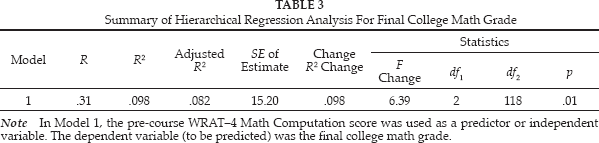
As shown in Table 2, correlations and beta coefficients are consistent with the fact that the pre-course WRAT-4 Math Computation Subtest was a statistically significant predictor of success in these college mathematics courses. Pre-course WRAT-4 Math Computation Subtest scores accounted for a statistically significant (p < .01) proportion of the criterion variance (8.3%). The mean pre-course WRAT-4 Math Computation Subtest raw score for the group of students who passed was 42.71 (SD = 5.29), and for those who failed 39.14 (SD = 4.92) (t = 2.07, ns).
Coefficients For Variables Entered Hierarchically Into Regression Analysis to Predict Final College Math Grade

Summary of Hierarchical Regression Analysis For Final College Math Grade
Discussion
The results of this study are consistent with the hypothesis that the WRAT-4 Math Computation Subtest is a valid predictor of passing a college level math course. However, given that overall high school grades have a correlation coefficient of .37 with college grades (Zwick & Sklar, 2005), as compared with the .29 found in this study, continued use of the WRAT-4 Math Computation Subtest as a screening test for students taking different college level math courses may not seem warranted. Since the university already uses an objective test at admission for verbal and math achievement, perhaps adding another test may be redundant. Although the WRAT-4 Math Computation Subtest only takes 10 to 15 minutes to administer in the first session of a course and its cost is minimal, its overall simple prediction of a pass/fail outcome is not as good as high school grades, which explain approximately 40% of the variance in completing college classes successfully (Zwick & Sklar, 2005).
Since the WRAT-4 Math Computation Subtest material is similar to what is learned in high school curricula, the individual's ability to perform basic math skills through counting, identifying numbers, solving simple oral problems, and calculating written math problems in addition, subtraction, multiplication, division, fractions, decimals, and algebra, is of qualitative value for instructors, who can examine the test booklets to see if individual college students can perform such problems. Thus, the instructor can act as a safeguard by assigning additional practice on specific types of problems, or offering tutoring to individual students, or explaining to students the value of moving to a lower-level class.
The major limitation of this study was the small, non-random sample. The findings here may not generalize to all U.S. college students taking mathematics. Predicting college success is challenging, but some of the problems associated with admitting unprepared students may be ameliorated by allowing instructors to use additional testing and to advise specific students to obtain tutoring or take preparatory classes.
Footnotes
2
Classes and numbers of students were 9 different mathematics classes and 5 specific courses [beginning (n = 13; n = 15) or intermediate algebra (n = 13; n = 14; n = 14), business (n = 14), developmental math (n = 14; n = 14), and integrative math concepts (n = 10)].