






Abstract
The present study explores the strategic use of translation in learning English by undergraduate students in Bahrain. The Arabic Version of the Inventory for Translation as a Learning Strategy (AITLS) was prepared by the author and was administered randomly to 360 undergraduate students who majored in English at the College of Arts of the University of Bahrain. The student response to the AITLS items revealed two contradictory tendencies toward using translation as a learning strategy: the tendency to demonstrate medium support for the use of translation to learn English vocabulary to read, to write, and check comprehension; and the tendency not to use translation to learn English idioms, phrases, expressions, proverbs, and grammatical rules. The pedagogical implications of the results for English language teaching are discussed.
Translation is an activity that aims to facilitate the communication process by interpreting the information received in one language (L1) into another language (L2), and vice versa. The basic function of translation is to transmit appropriate meaning of a word or a sentence linguistically semantically and pragmatically. If this complex process is carried out on a professional level, then, it is possible to say that translation has reached its ultimate goal.
Since translation studies basically rely on a concept of meaning, different approaches in these studies refer to different types of meaning: while some researchers study lexical patterns in source texts and their translations (Malahat, 2010), other scholars put emphasis on how the text utterances function within their immediate contexts (Nord, 1997). Some researchers, however, examine the effect of the text as a whole on its audience or society (Venuti, 1998), while other researchers consider philosophy of language as a means to look at meaning in translation (Malmkjær, 1993).
Foreign language learners frequently use translation to facilitate language learning and to acquire the new language. Despite the fact that translation has played different roles in various methods of language teaching accommodated for students from different social backgrounds, most educators agree that translation is a powerful tool to help the student more confidently understand foreign words and expressions and express ideas in the target language. Nevertheless, some educators argue against using the native language in the class, considering it as a serious barrier to effective language learning.
As a form of literary experimentation, translation can be seen as a form of writing under constraint. This implies that the translator has to rewrite the original text, e.g., the text in one's native language, in the target language, which is different from the original language. Within this context, translation is not just a mechanical reproduction of the text but also a creative process, in which the text is “re-localized,” so to speak, within the boundaries and specific features of the target culture.
As a strategy for language learning, translation can be used as an effective medium for developing the learners' communicative competence and for teaching properties and types of meaning underlying semantic relationships, communicative language functions, sentential information structure, and discourse values. Seen from this perspective, translation is a cognitive activity that assists students in learning new phrases and expressions in the target language, and using them to communicate meaning to others, on the one hand, and a problem-solving exercise, in which the students develop their capabilities in data analysis and processing, on the other hand. Within this framework, O'Malley, Chamot, Stewner-Manzanares, Kupper, and Russo (1985) identified 11 cognitive strategies to learn English, and found that translation constituted 11.3% of all strategy uses by beginner and intermediate ESL learners, preceded only by well-known strategies, such as repetition (19.6%), note-taking (18.7%), and imagery (12.5%). Moreover, Horwitz (1988) investigated the students' views about translation and concluded that 70% of students learning German and 75% of students learning Spanish largely perceived learning a foreign language as a matter of learning to translate from English. Drawing upon the role of mental translation in reading texts in second language (L2), Kern (1994) emphasized that language instructors and learners consider translation as an undesirable supporting pillar for learning the target language.
As translation contributes to the formation of a global identity and shared understandings between people worldwide, translation from English into another language, say Arabic, and vice versa, of valuable sources of modern knowledge in all fields of inquiry is considered as a pressing task that needs to be seriously addressed. Based on this understanding, some Arab bilingual educators (e.g., Al-Jarf, 2008) argue that Arabic is facing a serious threat by the dominance of English at higher education institutions in Arab world. Hence, they suggest that a consortium of translation centers in Arab countries be established and made available on the internet, and that university students' “ability to translate Arabic technical terms need to be developed” (p. 207). Translation from English into Arabic, however, is an exhausting enterprise due to the “right-to-left orientation, multiplicity of scripts, frequent omission of vowels, and complex morphological structure” of the Arabic language, not to mention that “the number of different characters in use is close to 100” (Abu-Salem & Chan, 2006, 22).
Despite the advantages of translation as a means of communication using the foreign language (Cook, 2010), it is, however, considered as a poor learning strategy when it comes to the communicative language teaching (CLT) approach, where the best way for the learner to gain aptitude in the target language is to think, particularly, in that language, an act that can increase proficiency in the target language (Husain, 1995). Many studies, however, showed that the extent to which the students are fluent in the target language (L2) and are able to prevent possible interference from the native language (L1) is largely influenced by the strategy use of translation to learn the target foreign language (Chamot, 1987; Omura, 1996).
Analysis of the available literature on the strategic use of translation in English learning (Husain, 1995; Liao, 2006; Bagheri & Fazel, 2011; Karimian & Talebinejad, 2013) allows identifying the following strategies:
Enhancing English skills, particularly reading, writing, listening, and speaking: Bagheri and Fazel (2011) found that translation assists students in acquiring writing, facilitates their comprehension, helps them develop and express ideas in another language, and increases their motivation to learn English. Students also tend to make more gains in learning vocabulary, phrases, idioms, and grammar. With this understanding in mind, Karimian and Talebinejad (2013) noted that implementing retrieval strategy that requires using the keyword mnemonic to recall the meaning of an English idiom or word would help students memorize that word in their native language and, consequently, would assist them in remembering its meaning easily and quickly.
Referring to the native language (L1) while learning a new language (L2), some educators (e.g., Weschler, 1997) argue against the common belief that thinking in the mother tongue might deter thinking directly in the target language, that excessive use of the first language will lead to the emergence of odd combinations of the native and second languages that students could not use in daily life, and that the class time spent on the first language would have been spared for learning the new language. Furthermore, Naiman, Frohlich, Stern, and Todesco (1978) found that this strategy was successfully exercised by Good Language Learners (GLS) who “make effective cross-lingual comparisons at different stages of language learning” (p. 14). Hence, learning by linking the new word to its mother-language equivalent is more effective than learning vocabulary in context (Prince, 1996).
Avoiding using the native language (L1): In an attempt to elaborate the differences between high and low achievers in using translation as a learning strategy, Wen and Johnson (1997) found that, contrary to the beliefs of low achievers, the use of L1, as perceived by high achievers, would negatively affect their progress in English learning. Hence, they concluded that the use of translation to L1 should be prohibited in English classes, which corroborated Husain's (1995) finding that higher-level students had least benefited from using L1 in learning the second language.
Using learning and technology aids: Students' use of dictionaries, notes, electronic translation machines, etc., obviously plays a facilitative role in learning English as a second language. Wang (2005) argues that the integration of internet technology into language classrooms is inevitable as it “demonstrates the shift in educational paradigms from a behavioral to a constructivist learning approach,” which suggests that “the best way to learn a language is in interactive, authentic environments” (p. 39). Also, the Internet provides a stage for the real world where students observe, think, and question while learning the new language.
Interaction with other students: Through collaborative activities, students are able to learn the new language easier and faster. In this sense, the use of translation is considered as a social strategy, where students are in direct contact with the activities carried out in language classes, using communication as a powerful tool to learn the target language together in a friendly classroom environment, in which they may collectively support each other in learning the target language (Donato & McCormick, 1994).
Even though the strategic use of translation in English learning might shape the students' thinking and thus affect the way learning occurs, as well as the quality of learning, only a few studies (Liao, 2006; Bagheri & Fazel, 2011; Karimian & Talebinejad, 2013) have investigated the students' use of translation as a strategy in learning English as a second language.
In his comprehensive study, Liao (2006) used a developed survey to explore the beliefs of 351 Taiwanese junior college students about the role of translation in English learning, to identify the strategies of translation that students employ to learn English, to investigate the relationships between students' beliefs and use of translation, and to assess the extent to which learners' background variables relate to their beliefs about translation and its strategic use. To achieve these goals, survey questionnaires and qualitative interviews were used. The author found that students most frequently use translation to learn English vocabulary words, idioms, phrases, and grammar, to read, write, and speak English, and to check their reading and listening comprehension. The findings suggested that “learners used a variety of strategies involving translation, including cognitive, memory, compensation, social and affective strategies,” and that “more proficient learners tended to report negative beliefs about translation and less use of translation, compared with their less-proficient peers” (p. 208).
Bagheri and Fazel (2011), in turn, explored the use of translation by Iranian university students as a strategy in writing. For this purpose, 40 randomly selected students who were learning English as a foreign language at Shiraz Azad University participated in the study that employed two questionnaires and one interview guide, originally developed by Liao (2006), having adjusted them to the Iranian context. Results of the study showed that university students in Iran believed that translation from Farsi “contributed substantially to the acquisition of their writing skill,” and they demonstrated medium to high use of translation as a learning strategy to learn writing in English. Although these results are consistent with the findings of Liao (2006), the authors identified some negative aspects of using translation to write in English. Among them is that “translation can be erroneous because of multiple meanings of certain terms” and that “students are likely to produce Persian-style English,” and may “depend heavily on translation which may impede their progress in learning English writing” (p. 207).
Finally, in a related study, Karimian and Talebinejad (2013) recently investigated Iranian English learners' use of translation as a strategy to learn English so as to explore how they make use of their mother tongue as a learning strategy. Participants were 170 students taking English courses in language schools. Qualitative interviews with students were used along with the (ITLS) questionnaire, firstly developed by Liao (2006). The findings of the study indicated that Iranian students use translation for memorizing and retrieving English, language comprehension, self-assessment, and as a social strategy to interact with other people in English. In addition, these strategies are sometimes performed to “remove the learners' class anxieties and worries and make them fell more self-confident and relaxed” (p. 609). As to the use of the mother-tongue language to learn English, the authors found that referring to Persian-English dictionary helped the students understand the teacher and allowed them to ask questions in EFL classes and increased their sense of security to learn what they did not know in English.
Given that the results of previous studies do not lend support to the findings of Kobayashi and Rinnert's (1992) study that university students prefer direct composition in English to translation, and to the results of Cohen and Brooks-Carson's (2001) study that direct writing in the target language may be more effective in language learning than writing in the first language and then translating into the target language, and also do not conform with the communicative method of learning English that rejects the use of the learners' first language in English classes (Kavaliauskienë & Kaminskienë, 2007), the present study seeks to explore the strategic use of translation to learn English as a Foreign Language (EFL) as perceived by University students in Bahrain.
Research Question 1. What strategies involving translation do University students in Bahrain use to learn English in an EFL classroom?
Research Question 2. To what extent do learners' background variables relate to their strategic use of translation to learn English in an EFL context?
Method
Participants
A total sample of 360 (112 men, 248 women) undergraduate students of Bahraini ethnicity enrolled at the College of Arts of the Bahrain University took part in this study. Participants were randomly selected from the English-major students who took literature and translation as a minor specialization. The English proficiency among participants was estimated to be upper intermediate, based on their scores in essay writing, the accumulated mean GPA in the English courses, and teachers' opinions of students. Although the student can individually choose the subject of essay, a good essay paper should contain a thesis statement that encapsulates the main argument and the supporting evidence of the ideas that support the statement. Also, the basic rules of format and grammar ought to be observed, because sentence fragments, misspellings, and improper punctuation denote a carelessly written paper. The background characteristics of the sample are summarized in Table 1.
Sample Frequencies and Percentages According to Independent Variables

Measures
The Inventory for Translation as a Learning Strategy (ITLS).—The Inventory for Translation as a Learning Strategy (ITLS) consists of 28 items measuring how frequently students use different translation strategies to learn English. On a 5-point Likert scale, the participant rates each statement as follows: 1: Never, 2: Seldom, 3: Sometimes, 4: Often, and 5: Always. Two items, 27 and 28, were worded in a reverse manner to control for the possible bias in the participant's response. The higher the total score on the measure, the more frequently participant uses translation as a strategy to learn English (Liao, 2002).
The Arabic Version of the Inventory for Translation as a Learning Strategy (AITLS).—The Arabic version of the Inventory for Translation as a Learning Strategy (AITLS) was developed and used in this study. The original 28-item Inventory for Translation as a Learning Strategy (ITLS), which had been developed by Liao (2002) for the Chinese students, was translated into Arabic by the author with written permission from Dr. Posen Liao. 2 A back-translation from Arabic into English was performed by a bilingual professor from the Department of Foreign Studies at Bahrain University who was blind to the purpose of the study. As meaningful differences were not found between the original English version and the back-translated English version, acceptable equivalence between them was achieved using the methodology of translation of research instruments suggested by Brislin (1986). The ITLS original statements were rephrased in a way that kept their meaning intact in the Arabic version and maintained the clarity of each item for the reader. Since an EFL student might use an English-Arabic electronic device for translation and might stop using translation in English classroom, two items assessing these aspects were included to the original ITLS; thus making the aggregate number of AITLS items equal to 30.
Content validity was used to assess the extent to which items represent the construct being measured (Raykov & Marcoulides, 2011). Accordingly, the validity of the AITLS was assessed by four university teachers who responded to the scale in terms of appropriateness of items and wording of statements. Items that received less than 80% consensus were eliminated. A correlation was run between all individual items and the total score, all of which were significant at .05 levels. To estimate test reliability, the AITLS was piloted on 50 (22 men, 28 women) university students. Cronbach's α was .90, which demonstrates the high internal consistency of the measure.
To evaluate the construct validity of the AITLS, principal component analysis (PCA) with oblimin rotation was conducted using the 30 items in the whole sample. The results showed that KMO for the sample was 0.71, an adequate value for good factor analysis indicating that the sample is acceptable and that items were suitable for each component. Bartlett's test of sphericity was significant (p < .001), which means that the items within the components of the scale are sufficiently correlated. Both indexes suggested the suitability of the data in performing PCA (Tabachnick & Fidel, 2007). The results of factor analysis showed that the same learning strategies were extracted from the analysis, confirming the five components reported by Liao (2006). The extracted sums of squared loadings for the 30 items explained 39.4% of the total variance. Also, the correlations of all items were significantly and positively correlated with the total score of their own subscales, with a range between .42 and .71. Cronbach's α for the 30 items of the AITLS was .92 for the whole sample, ranging from .71 to .89 for the subscales.
In addition to the questionnaires, background information about the participants, namely their gender, age, year of study, Grade Point Average (GPA) in English courses, and English proficiency, was gathered (Table 2).
Means, Standard Deviations, and Item-total Correlations For the Arabic Version of the Inventory For Translation as a Learning Strategy (AITLS)

Procedure
Participants individually completed the 30-item AITLS during a typical classroom lecture at the university. Each student was asked to read each statement first, and then express their opinion about it by indicating the extent to which they agreed or disagreed with that statement. Each item was answered on a 5-point Likert-type scale that ranged from 1: Never to 5: Always. A mean higher than 3 (a total score > 90) indicated a high level while a mean less than 2.5 (a total score < 75) showed a low level for the use of translation as a learning strategy.
All respondents were reassured that the information derived from the current study would be kept confidential. Participation was voluntary and the questionnaires were filled out anonymously in the classroom. The questionnaires were designed to take approximately 15 min. to complete. Respondents were asked to hand the filled questionnaires to the instructor.
Analysis
In order to describe the results of the study, descriptive statistics were calculated. In addition, correlation coefficients were used to assess the validity of the AITLS, while Cronbach's α was used to determine the measure's reliability. In addition, the following criteria were used to describe use of translation as a strategy: total mean score M > 3, High level; 2.5 < M < 3, Medium level; and M < 2.5, Low level of use.
Results
Strategies Involving Translation Used by University Students to Learn English
To answer Research Question 1, means, standard deviations, and item-total correlation coefficients for items of the AITLS, i.e., for the translated items into Arabic, were calculated and displayed in Table 1, given that the AITLS is scored additively to generate a total composite score.
A mean score of the 30-item AITLS for the sample (n = 360) was 85.50 (SD = 16.27) and indicated that participants showed a medium level for the use of translation as a learning strategy (M = 2.85). The 15 most frequently used strategies (Items 30, 27, 28, 17, 19, 29, 9, 26, 21, 13, 1, 20, 18, 23, and 4) out of the 30 items received high means (M > 3), while eight items (14, 15, 22, 8, 24, 6, 12, and 16) were the least used strategies (M < 2.5). All item-total correlation coefficients values are significant (p < .05) and demonstrated content homogeneity of the AITLS and high reliability (Table 1).
The most frequent strategies that Arab students use in learning English are:
Enhancing English skills (Items 1, 4, 9, 13, 23, 26, and 30): students use translation to learn English vocabulary words, phrases, idioms, and grammar, to read, and to write. They also use translation to clarify differences and similarities between English and their mother-tongue language. Also, students tend to use mental translation to recall the meaning of English words, to understand English texts, and to verify whether they correctly comprehend the articles and reading materials in English in an EFL context.
Using learning and technology aids (Items 17–19, 29): In order to help themselves learn English as a foreign language and to grasp the meaning of English words, Arab learners resort to electronic machines, English-Arabic and Arabic-English dictionaries.
Avoiding using Arabic in an English classroom (Items 27, 28): When speaking English, Arab students try not to think first in Arabic as their native language. Similarly, when reading English, they do not think first of Arabic equivalents of English words.
The least frequent strategies that Arab students use in learning English are:
Referring to Arabic language (Items 6, 8, 12, 14–16, 24): In order to master reading, listening, writing, and speaking English, Arab students sometimes refer to their mother-tongue language, and try to link the English words to their equivalents in Arabic.
Interaction with other students (Items 21, 22): Arab students work together collaboratively with the aim of learning English as a foreign language. They ask questions to each other and seek to find the meaning of idioms and expressions in a collective way.
Effect of Background Variables on the Use of Translation Strategies
To address Research Question 2, t test and one-way analysis of variance (ANOVA) were used to calculate the differences in average total mean that are attributed to the background variables as sources of variance. Results are presented in Tables 3 and 4.
Gender Differences on Strategic Use of Translation Strategies to Learn English
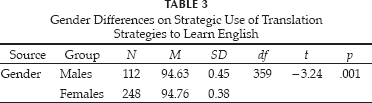
As Table 3 shows, statistically significant differences were found in students' use of strategies involving translation that are attributed to gender. Also, significant differences were found in students' use of strategies in learning English as a foreign language, that are attributed to other variables, with older students, students less proficient in English, and students with lower achievement in English courses, using fewer strategies (Table 4).
Results of One-way ANOVA For the Effect of Background Variables on Strategic Use of Translation Strategies to Learn English in an EFL Context

*p < .05. †p < .01.
Discussion
Arab students most frequently used translation to learn English vocabulary words, to read, and to write. Moreover, they used several resources, such as dictionaries, electronic and online devices, to check reading and listening comprehension. In various situations, they practiced mental translation for their thoughts and to ask questions that helped them better understand English words and phrases in their mother language. Through translation, they attempted to clarify any differences and similarities between Arabic and English. Also, when reading and speaking English, they attempted grasp the meaning of what they read without first thinking of the Arabic equivalent. These findings partially confirmed the results of Liao (2006), Bagheri and Fazel (2011), and Karimian and Talebinejad (2013) studies that considered translation as an effective strategy to improve reading skills in English.
The strategies that Arab students used least were not using translation as a strategy to learn English idioms and phrases or to learn grammar through Arabic explanations of English grammar rules. These findings are somewhat inconsistent with Liao (2006), in which these strategies were found to be frequently used by Taiwanese college students to learn English.
Using translation in EFL classes at Bahrain University depends on the year of study of the student. There is no harm in using translation as a teaching strategy for learning English in an EFL context. Students in early stages of learning the language are certainly exposed to some explanation in their mother tongue especially when explaining difficult grammar rules that the students cannot grasp in English. Thus bilingual method or approach to teaching English has always been welcomed only when a need arises. In upper levels, however, students are expected to understand explanations in English. They should not be encouraged to rely on translation as this will eventually become a habit and they will have less interest in learning the language in its natural native context. At the University level, the whole strategy becomes rather subtle. If a tutor has a rather weak class whose overall level in English language is very poor, he or she may find himself shifting to the translation approach when a need comes up. English major students, and students who are learning all their courses through the medium of English, are exposed in their courses only to English. They are not encouraged by teachers to use Arabic as this certainly conflicts with the college's objectives of learning their degree program.
To sum up, the responses of Bahrain University students to the AITLS items clearly reveal two contradictory tendencies toward the use of translation as a learning strategy: the tendency to demonstrate medium support for the use of translation to learn English vocabulary words, to read, to write, and to check reading and listening comprehension; and the tendency not to use translation into Arabic as mother-tongue language to learn English idioms, phrases, expressions, proverbs, and grammar, to listen to instructional tapes or CDs, and to thus keep the conversation in English going. This is clearly evident among students of higher language proficiency in English.
A possible explanation for the observed discrepancy of thoughts and ideas between undergraduate Arab students is the continuously widening gap between the needs of the students to demonstrate to others the mastery of English on the one hand, and the underdeveloped “linguistic infrastructure” that can assist them in performing these tasks, i.e., without frequently resorting to their native language as the basic tool of communication, on the other hand.
Given that fourth- and fifth-year students constitute the vast majority of the study sample, the findings imply a limited ability to read, write, and speak English without translation, although many English teachers believe that it is necessary for students to use translation only at the initial stages of learning. A possible explanation for this phenomenon is the limited scope of authentic situations in which the student is involved during University study and thus is able to enhance his basic skills in English as a foreign language (Al-Musawi & Al-Ansari, 1999).
The absence of a real English environment in which the Arab student can and should actively communicate with others at a college level without the use of translation is likely to hinder their ability to freely and frequently use English expressions and proverbs without looking up their meanings in dictionaries as well as to learn the different forms and dialects used by English-speaking people from different parts of the world.
When it comes to the use of translation as a strategy to learn a foreign language, the University students employed a wide variety of learning strategies that involved translation to help them strengthen their English skills and ability to solve language problems. As a result, translation can help students verify whether their comprehension of the foreign language proverbs, expressions, and idioms is correct, develop ideas in their mother language, and foster their progress in learning English.
Since students have some conflicting beliefs about the use of translation, teachers may want to “help students raise their level of conscious awareness about the advantages and disadvantages of translating” (Liao, 2006, 210). With this idea in mind, teachers should motivate students to implement translation as an effective strategy for language learning, but to use it with caution, as a heavy dependence on translation may seriously impede the student's progress in learning English.
Given the importance of students' beliefs and opinions about vital aspects of teaching and learning strategies (Al-Musawi, 2003), university teachers should be more attentive to student learning strategies for the use of translation in language learning, because the use of translation prevailed among student English learning in Bahrain, especially in the early years of language teaching. Teachers may not need to prohibit student use of translation altogether and should be more aware of the instances when translation can be beneficial for students as they develop their English language skills and competencies.
With respect to the effect of background variables on the strategic use of translation in learning English in an EFL context, this study found statistically significant relationships between gender, year of study, age, level of English proficiency, and average GPA in English courses, on the one hand, and the frequency of use of translation strategies to learn English, on the other hand. These findings confirm the results of Husain (1995) and Chia and Chia (2001) studies that less proficient English learners more frequently employed or benefited from translation strategies than their counterparts who were more proficient learners of English, but do not corroborate the results of Liao (2006) study that found no significant relationship between these variables.
It appears that girls use more strategies involving translation to learn English in an EFL environment than boys. This can be partially explained by the fact that compared to boys, girls are more dedicated to learning at school and university alike. They are more persistent, more serious, and have more time to spend in learning a foreign language than boys do, given the social and cultural considerations that prevail in an Arab society (Fox, Mourtada-Sabbah, & Al-Mutawa, 2006). While older and more proficient students tend to avoid using mental translation from Arabic and think directly in English as a target language, younger and less proficient learners are keen to translate word-for-word or to write Arabic phrases between the lines of English texts to learn English more quickly, and to reduce their feelings of anxiety stemmed from learning a foreign language.
As the mother tongue acts as the necessary scaffolding to be gradually removed over time, and as long as it does not interfere with conveying the intended meaning, referring to Arabic while learning English in an EFL context should be considered acceptable by teachers and foreign language educators. This is especially true for low-achieving students, who need be constantly and constructively motivated to learn a new language in a climate void of worry and expectation of failure.
Given the structural and cultural hindrances of translation form English into Arabic, teachers are encouraged to use the autonomous learning approach (Darwish, 2011) that helps the low-achieving student master English language skills through independent learning and self-monitoring, while referring to peers and classroom teachers only for error elimination.
Conclusion and Limitations
Arab students most frequently use strategies involving translation to learn English vocabulary words, to read, and to write. Moreover, they used several resources, such as online devices, to check reading and listening comprehension. In various situations, they practice mental translation for their thoughts and to ask questions that helped them better understand English words in their mother language. It appears that girls use more strategies to learn English in an EFL environment than boys. While older and more proficient students tend to avoid using mental translation from Arabic and think directly in English as a target language, younger and less proficient learners are keen to translate word for word or to write Arabic phrases between the lines of English texts to learn English more quickly, and to reduce their feelings of anxiety stemmed from learning a foreign language.
There are some limitations of using questionnaire as a tool for collecting students' opinions on issues of teaching and learning as respondents tend to change or hide their real attitudes to be sociably acceptable. Another limitation derived from finding the relationships between different variables. These relationships, although statistically significant, are not casual, because some interfering factors that were not studied or taken into consideration are likely to be the real reason behind them. Finally, limitation is related to the possibility of generalization of the findings of study, as this can be limited only to populations with similar culture.
Footnotes
2
To view Dr. Liao's permission for translation, please refer to: https://dub106.mail.live.com/mail/#n=239190746&fid=1&mid=8c60febf-2529-11e3-85c1-002264c1c9fa&fv=1.