






Abstract
This study investigated practical thinking in elementary school teachers (known as invisible practice) evoked through the on-line monitoring method of thinking aloud and the off-line monitoring method of report writing, and relationships between practical thinking and teaching experience. Results indicated that during on-line monitoring, participating teachers spoke more frequently about the actions of students and the content of learning, and made more inferences. During off-line monitoring, teachers more frequently reported on the overall lesson structure and their thinking consisted of more impressions. Teaching experience influenced the perspective of participating teachers: novice teachers focused on the lesson as whole, mid-career teachers attended to teacher-student interactions, and long-career teachers focused on actions by both students and the teacher.
There are two unique characteristics of the process of gaining expertise in the teaching profession. First, teachers have a long educational experience as students, and they also undergo an apprenticeship as observers before their employment as teachers (Hammerness, Darling-Hammond, Bransford, Berliner, Cochran-Smith, McDonald, et al., 2005). Second, novice teachers are assigned all teaching responsibilities and have fewer opportunities to learn by observing other teachers because of confined classroom settings (Akita, 1996). Thus, it is important to understand how teachers gain expertise, so that this information can be utilized in teacher education programs, which will in turn influence students' education.
Practical knowledge used by teachers in elementary and junior high schools is dependent on a specific context, implicit, and individual, and different from theoretical knowledge (Sato, Iwakawa, & Akita, 1990; Munby, Russell, & Martin, 2001). This is because lessons are characterized by uncertainty and complexity and teachers have to deal with incidents that occur during lessons by considering situational changes and conflicts of values (Helsing, 2007; Sakamoto & Akita, 2014).
Expert teachers are able to recognize patterns in classroom events and assign meaning to them very quickly. This process is facilitated by the long experience that they have had in the classroom (Berliner, 1986; Tsui, 2005). A number of studies investigating teachers' decision-making have reported that when a lesson deviates from the plan expert teachers do not consider every possible alternative strategy, but simply use the best routine to proceed with the lesson (Shavelson & Stern, 1981). Conversely, novice teachers attend more to maintaining discipline in the classroom than to teaching objectives. Moreover, research has suggested that expert teachers are better able to act automatically and improvise, because they have developed a repertoire of pedagogical routines that they can depend on to deal with a variety of situations (Tsui, 2005).
The question is, how do teachers gain expertise? Obviously, not every teacher can become an expert, despite the extent of his or her experience. There are those who learn and develop as professionals and those who do not. Teachers gradually develop routines that they can utilize automatically, by repetitively engaging in reflection and action. Routines sustain efficiency during teaching and help teachers to proceed with lessons. However, when students cannot adapt to a particular routine, the teacher is confronted with the need to change the routine. Through the processes of efficiency and innovation, teachers learn and develop as professionals (Hammerness, et al., 2005).
Expert teachers utilize practical knowledge in the context of their lessons and are supported by practical thinking that includes reflection. Reflection is especially important for improving teaching ability (Sakamoto, 2007). As a practice becomes more respective and routine, and as knowing-in-practice becomes increasingly tacit and spontaneous, the teacher might miss important opportunities to think about what he or she is doing (Schön, 1983). Reflection is a practical way of thinking that is characterized by reviewing one's viewpoint, framework of ideas, and beliefs. Among different types of reflection, reflection in action is significant (Schön, 1983). It is the process of realizing tacit problems based on the situation and examining problem frameworks while engaging in action.
Recently, the importance of collegiality in the process of learning and education by teachers has been a focus; in particular, in-school training in Japanese schools has been investigated (Kihara, 2004; Akita, 2006). Japan has traditionally developed an autonomous teaching culture with the school at its core. In-school training is conducted to review the lessons of each teacher (Stigler & Hiebert, 1999; Lewis, 2000). This culture has continued to the present day with cycles of stagnation and revitalization in different schools, in different periods (Akita, 2008). In particular, Kenkyuu jugyou and Jugyou kenkyuu is crucial to the process of gaining expertise and the education of teachers (Lewis, 2000). Kenkyuu jugyou [kenkyuu means research or study; jugyou means lesson(s), or instruction, meaning research lessons, or study lessons] refers to the lessons that teachers jointly plan, observe, and discuss. Jugyou kenkyuu means lesson study (or lesson research) and refers to the process of instructional improvement, in which the research lesson is the core.
Stigler and Hiebert (1999) characterized Japanese in-school training by its cooperativeness and indicated that it would be useful for teachers to reflect on their practices and clarify the areas to be improved. On the other hand, it has been suggested that traditional Japanese in-school training limits developing practical thinking in teachers for dealing with situational demands of students and classrooms (Inagaki & Sato, 2014). Traditional training mainly consists of discussions about interpretation of teaching materials and techniques of questioning. Moreover, in traditional training teachers observe lessons given by other teachers and have a discussion afterwards. However, they have no idea about the process of thinking of the teacher who is giving the lesson. It would be indispensable for teachers' learning to cooperate with others to evoke practical thinking, known as invisible practice. Inagaki and Sato (2014) suggested traditional training should be modified into case-study-centered training, in which practical cases are examined.
However, there are few studies on in-school training that have focused on learning and education for improving practical thinking of teachers (Sakamoto, 2007). One reason behind this trend could be that practical thinking, especially reflection, cannot be clearly conceptualized, and it is difficult to link it to student education due to problems of standardization and evaluation (Rodgers, 2002). Furthermore, it is difficult to share practical thinking with others and utilize it for teacher education, because it is implicit and individual (Sakamoto, 2007). Therefore, it is necessary to quantitatively examine the state of the thinking processes when giving lessons, before conducting learning and education aimed at developing practical thinking. Classrooms are powerful contexts for learning (Borko, 2004). The use of video recordings of lessons has been regarded as effective for teachers to learn and gain new insights (Sherin & van Es, 2005). Yet there is insufficient quantitative data on viewing methods and different perspectives of teachers that are based on their experience.
This study examined previous studies that have measured practical knowledge and thinking; these have used various methods (Akita, 1992). The stimulated recall method has been predominant in the study of practical thinking. In this method, a teacher watches a video of his or her recorded lessons and then takes part in an interview to recall and say what he or she was thinking during different classroom situations in the video (Sato, et al., 1990). However, it has been suggested that this method does not reflect practical thinking about choices and decisions that are made in unknown or uncertain situations, because the recall process is based on reflected and summarized conceptions of a teacher; moreover, the recall might be biased due to memory lapses and rationalizations. An additional problem with the stimulated recall method is that it only provides data when a teacher is conscious and aware, and does not account for less-aware decision-making by a teacher.
Therefore, this study examined practical thinking of teachers based on the on-line and off-line monitoring method used by Sato, et al. (1990), Sato, Akita, Iwakawa, and Yoshimura (1991), and Akita, Sato, and Iwakawa (1991). On-line monitoring, or thinking aloud, is a method of keeping records while a teacher watches a video of another teacher's lesson, and freely speaking at any time about what he or she thinks about the lesson. Off-line monitoring, or writing reports, is a method of writing thoughts about a lesson after watching a video. Sato, et al.'s (1990) study compared the monitoring processes of experts and novices and found that expert teachers are characterized by spontaneous thinking, whereas novice teachers substantially varied in their individual thinking styles, based on on-line monitoring. However, quantitative data on whether different monitoring methods lead to different results and what they indicate about practical thinking of teachers have remained unavailable to date.
Another problem is that many studies have attempted to analyze expert teachers as prototypes and then reflect their characteristics in teacher education (Tsui, 2003). This explains why past studies of expertise in teaching mostly took the form of expert-novice comparisons. The process of gaining expertise is assumed to take various developmental courses, unlike understanding or imitating excellent teacher prototypes (Tsui, 2003; Ericsson, 2006). Zhou, Peverly, and Xin (2006) investigated practical knowledge based on Shulman's (1986) study, by comparing four groups of teachers with 1–5, 6–10, 11–20, and more than 21 years of experience. The practical knowledge of most teachers did not differ as a result of the years of experience in teaching. Individualization of teaching may occur along the developmental course (Kihara, 2004). Teaching mannerisms and fixed viewpoints may develop among mid-career teachers with over 10 years of experience (Akita, 1997). Therefore, it is necessary to review and reconsider if there are experience-dependent differences in practical thinking.
This study was designed as a preliminary study on learning and education for developing practical thinking of teachers. The study quantitatively examined practical thinking that was evoked through on- and off-line monitoring using a video of the lessons (known as invisible practice). The goal was to characterize practical thinking elicited through each type of monitoring. This study included mid-career teachers in order to examine the relationships between differences in teaching experiences with each type of monitoring and practical thinking, whereas most previous studies have compared only experienced teachers and novices. Based on the results, the authors discuss the usefulness of case studies using videos of lessons. It is expected that this technique would be effective for developing practical thinking of pre- and in-service teachers.
Method
Participants
This study was conducted at public elementary schools in Osaka, Hyogo, Okayama, Hiroshima, and Kochi areas in Japan. The participants were elementary school teachers (N = 12) working in different schools. The authors were members of several educational research groups that included university, elementary school, and preschool teachers. The participants were mainly recruited from these research groups.
The participants comprised four novice teachers, four mid-career teachers, and four long-career teachers. They were classified on the basis of years of teaching experience, such that the novice teachers had teaching experience of less than 5 years, mid-career teachers had experience of 5 to 15 years, and long-career teachers had experience of over 15 years. Details of the participants in each category are as follows: Novice teacher 1 (woman, 4 years teaching experience), Novice teacher 2 (woman, 2 years teaching experience), Novice teacher 3 (man, 3 years teaching experience), Novice teacher 4 (man, 2 years teaching experience), Mid-career teacher 1 (man, 12 years teaching experience), Mid-career teacher 2 (man, 5 years teaching experience), Mid-career teacher 3 (woman, 5 years teaching experience), Mid-career teacher 4 (man, 14 years teaching experience), Long-career teacher 1 (woman, 15 years teaching experience), Long-career teacher 2 (man, 31 years teaching experience), Long-career teacher 3 (woman, 25 years teaching experience), and Long-career teacher 4 (woman, 30 years teaching experience).
Procedure
Monitored Lesson.—This study used a video recording of a second grade art class run by a female elementary school teacher with 10 years of experience. The class was designed for students to creatively play with wood blocks. It has been suggested in a previous study that experts could easily conduct tasks (Bereiter & Scardamalia, 1993). Therefore, artistic play activities in an art class were selected as the lesson to be monitored, because it was less likely to be influenced by the teacher's experience. The original duration of the class was 90 min., and it was composed of the following three sections: introduction (approximately 10 min.), creative activity (approximately 70 min.), and appreciation education (approximately 10 min.). In order to maintain participants' attention, the video was edited to 63 min., such that it consisted of an introduction (approximately 9 min.), creative activity (approximately 50 min.), and appreciation education (approximately 4 min.).
Unlike in-person observations, information could be lost when viewing the video recording, because the video was replayed on a screen. For this reason, two video cameras were used to record the class in session; the first camera was set to record the entire classroom, whereas the researcher handheld the second camera to record the teacher. A dual-view display was used to show the two different videos on a screen. Similarly, dual audio systems were used to play the audio from the left for the left video and from the right for the right video.
On-Line Monitoring (Thinking Aloud Method).—The research collaborator visited each elementary school and investigated the on-line monitoring. The video image was projected on the screen (50 in. screen size). The participants' speech and behaviors were recorded with a digital video camera. When conducting on-line monitoring, the research corroborator conducting the session was advised not to actively communicate with the participants and to only repeat or nod in response to the participant.
Before proceeding to view the videos of the class, a research collaborator clarified the following five points to the participants: (1) the purpose of this study is to investigate the practical thinking and obtain clues on how teachers view, feel, and think while they are teaching in a classroom setting; (2) the video has been edited to approximately 60 min. from the original 90 min.; (3) the video is to be watched once and should not be stopped in the middle; (4) the participants are encouraged to speak freely about everything that comes to their minds during the video, and the study session would be recorded on video camera to be used only for the purpose of this research; and (5) this study is not intended to evaluate the participants.
Off-Line Monitoring (Report Writing).—In the off-line monitoring condition, the participants were asked to write free descriptive responses to the following questions after watching the video: what did you feel or notice about the lesson, the teacher, and the students?
Analysis
The audio protocol data obtained from the on-line monitoring method was converted to text data. This data, together with the descriptive data from the offline monitoring method were quantitatively analyzed. Representative sentences were used as topics for further analysis following Sato, et al. (1990) and Akita, et al. (1991). Moreover, compound sentences and complex sentences were divided into separate, shorter sentences to increase their coherence. Utterances in the form of interjections such as “hmm” and “well” in the audio data were excluded from the analysis.
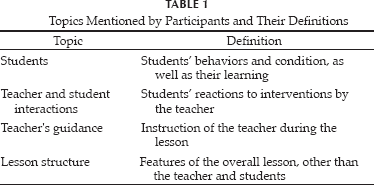
Based on Sato, et al. (1990), in this study practical thinking was defined as the thinking process that begins with participating teachers' involvement and awareness of a problem, followed by framing of the problem, then creating a solution, and finally ending with reflection. Sato, et al. (1990) used the words “instruction” and “learning” as the two major categories of classification. To clearly elucidate the characteristics of the participating teachers' practical thinking during the lesson, topics mentioned by the participants were classified into four categories (Table 1). Moreover, the level of thinking of participants was classified into three categories (Table 2). The procedure and the analysis of the coding were based on Martin and Bateson (1990). Inter-rater reliability between two coders (the first author and a trained coder who was not informed about the hypotheses of this study) was checked for a randomly chosen sample of 10% of the data. Cohen's kappa for each category was .69 to .87.
Topics Mentioned by Participants and Their Definitions
Levels of Thinking Mentioned by Participants and Their Definitions

Results
Relationships Between Topics of Practical Thinking, On- and Off-line Monitoring, and Teaching Experience
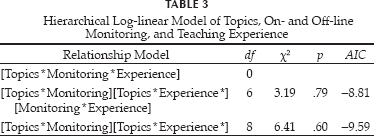
Relationships between topics mentioned by teachers, i.e., participants, on- and off-line monitoring, and teaching experience (novice, mid-career, and long-career) were examined. A hierarchical log-linear model was used to identify relationships among the three categorical variables. The results of the goodness-of-fit tests for each model are shown in Table 3. The most appropriate model was adopted, i.e., experience and monitoring were independently related with the topics. It was quantitatively clarified that the categories of topics mentioned by the teachers were independently related to their teaching experience and the monitoring methods.
Hierarchical Log-linear Model of Topics, On- and Off-line Monitoring, and Teaching Experience
Relationship between each two variables that related in the model was examined in more detail. First, residual analysis was conducted to investigate the relationship between the topics and on- and off-line monitoring methods (Table 4). The results indicated that during on-line monitoring participating teachers spoke about more details of students' actions and the content of learning, whereas they spoke less about the overall lesson structure. On the other hand, during off-line monitoring teachers reported more about the overall lesson structure and less about students' actions and the content of learning.
Relationship Between Topics and On- and Off-line Monitoring

p< .01, two-tailed.
Next, residual analysis was conducted to investigate the relationship between the topics and teaching experience (Table 5). The results indicated that novices mentioned the overall lesson structure, mid-career teachers mentioned teacher-student interactions and the overall lesson structure, and teachers with long careers mainly mentioned student actions and the content of learning and guidance by the teacher.
Relationship Between Topics and Teaching Experience

p < .05.
p < .01, two-tailed.
Relationships Between Teachers' Thinking Levels, On- and Off-line Monitoring, and Teaching Experience
Relationships between teachers' thinking levels, on- and off-line monitoring, and teaching experience were examined. A hierarchical log-linear model was used to identify the relationships among the three categorical variables. The results of the goodness-of-fit tests for each model are shown in Table 6. The most appropriate model was adopted, which indicated that monitoring and experience were independently related to the level of thinking. The results indicated that the thinking levels of teachers were related independently to their teaching experience and the monitoring method.
Hierarchical Log-linear Model of Thinking Levels, On- and Off -line Monitoring, and Teaching Experience

Relationships between each two variables that related in the model were examined in more detail. First, residual analysis was conducted to investigate the relationship between the level of thinking and on- and off-line monitoring methods (Table 7). The results indicated that during on-line monitoring teachers made significantly more inferences and significantly fewer impressions than expected. On the other hand, teachers reported more impressions and fewer inferences during off-line monitoring.
Relationship between Thinking Levels and On- and Off-line Monitoring

p < .01, two-tailed.
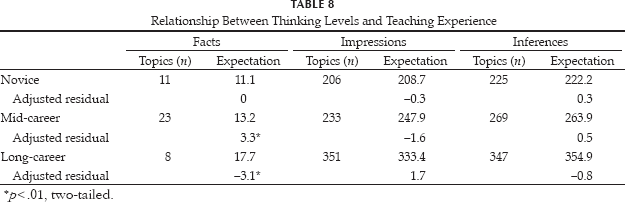
Next, residual analysis was conducted to investigate the relationship between the level of thinking and teaching experience (Table 8). The results indicated that all the teachers showed more impressions and inferences compared to facts. Mid-career teachers mentioned factual thinking significantly more often than the expected value, whereas teachers with long careers mentioned factual thinking less often than was expected.
Relationship Between Thinking Levels and Teaching Experience
p < .01, two-tailed.
Discussion
Relationship Between Practical Thinking and On-Line and Off-line Monitoring
It was considered that the on-line monitoring method (thinking aloud) reflected the impromptu thinking that teachers engage in a classroom setting, whereas the off-line monitoring method (writing a report) represented reflection after a lesson (Sato, et al., 1990). The results indicated that during on-line monitoring the participating teachers spoke more frequently about students' actions and learning content, and less about the overall lesson structure. Moreover, their levels of thinking during on-line monitoring indicated more inferences and fewer impressions. In contrast, during off-line monitoring the participating teachers wrote more frequently about the overall lesson structure and less about students' actions, or the learning content. Their levels of thinking during off-line monitoring indicated more impressions and fewer inferences. Furthermore, the results of each monitoring method were independent of the years of teaching experience of teachers.
These findings suggested that each monitoring method measured different kinds of practical thinking. During on-line monitoring, the participating teachers displayed a practical thinking process that started with attending to students, observing the intentions of students and the teacher for participating in the lesson, framing the problems, developing a solution, and finally ending with reflection. On the contrary, during off-line monitoring the participating teachers frequently wrote about the overall lesson structure, which is a reflective thinking process commonly done after a class. It was initially assumed that the off-line monitoring method, which is a type of reflection after action, would allow the participants to demonstrate reasons for the actions by students and the teacher in the video. However, it was the on-line monitoring method that allowed them to clearly define the reasons for actions. This finding corroborates previous studies (e.g., Schön, 1983; Sato, et al., 1990) that have proposed practical thinking of teachers is context-dependent and characteristically different from theoretical thinking.
In kenkyuu jugyou (research lessons) and jugyou kenkyuu (lesson study) in Japan, discussions generally take place after observing a lesson. Research lessons and lesson study are respectively expected to foster and improve theoretical knowledge and reflection on action. Practical thinking such as reflection in action is not fostered by these school trainings. Each teacher is responsible for learning and improving his or her own practical thinking skills. The development of practical thinking largely depends on the ability and personality of individuals, because it is impossible for other teachers in the school to display their thinking process during classes. In this study, participating teachers freely spoke about what came across their minds without stopping the video. It is suggested that this method is an effective technique for fostering and improving practical thinking of teachers, which is a refinement over methods used in previous studies.
Relationship Between Practical Thinking and Teaching Experience
It was also indicated that the teaching experience influenced the viewpoints of participating teachers. It was clear from their verbalizations that novice participating teachers grasped the lesson as whole, mid-career participating teachers attended to teacher-student interactions, and the long-career participating teachers focused on actions by both students and the teacher. This suggests that teachers gradually change their viewpoints from the broad to the specific as they gain more experience. This finding corroborates previous studies, which have advocated that novice teachers pay attention to lesson plans and classroom discipline, whereas the expert teachers perceive lessons as joint construction and create together with students (Shavelson & Stern, 1981; Akita, 1996). In addition, the finding that mid-career participating teachers focused on teacher-student interactions helped to clarify empirically how mid-career teachers gain experience during the transitional phase between novice and expert teaching.
Years of teaching experience, however, was not related to the teachers' levels of thinking. Most participating teachers equally displayed impressions and inferences more than facts, regardless of their teaching experience, and not many experience-derived differences were observed. This could be because, unlike in previous studies, the novices in this study had at least 2 years of teaching experience. Perhaps as a result of this, they were able to speculate and demonstrate reasons. Moreover, as mentioned above, lesson studies and research lessons have been promoted as in-school and out-of-school training in the teacher education system in Japan, which may also have affected the results of this study.
Training Suggestion to Develop Practical Thinking and Future Perspectives
In Japan, the development of practical thinking has been left to each teacher. However, this study indicated that an on-line monitoring system allows teachers to display their practical thinking. It is suggested that this method can be used for teachers' learning and education. Sharing opinions as a group of teachers and learning what other teachers view, feel, and think, would help teachers to review their own framework of thinking. This technique would be useful for focusing on the unproblematic aspects of teaching that are otherwise overlooked and neglected. Furthermore, when combined with lesson studies, the on-line monitoring method could lead to deliberate practice for teachers and result in creating a positive cycle for teacher education.
The on-line monitoring system is a means of exposing the practical thinking of teachers. In this study, the effect of exposing practical thinking skills on teacher education was not investigated. In the future, it is suggested that longitudinal investigations be conducted to examine the development of practical thinking fostered by this monitoring system. The future challenge for this research is to identify the learning mechanisms and learning processes in order to help teachers to become experts.