






Abstract
This paper introduces a novel approach to teaching instrumental/operant conditioning to students using planarians. Planarians are shaped to move increasingly longer distances along the edge of a petri dish to search for water. The procedure can be done within approximately 30 to 60 min., is easy to replicate, and control animals not trained to seek out water will exhibit non-directional behavior consisting of several starts and stops and turns. In addition to learning about basic operant conditioning principles, students learn such important skills as shaping, patience, observation, consistency, and timing. The majority of students reported that the activity was enjoyable but sometimes frustrating. The exercise is appropriate for a wide range of classes including animal behavior, comparative psychology, experimental psychology, learning, and history of psychology.
One of the more difficult areas to find classroom experiential activities is in the area of instrumental/operant conditioning. There are many inquiry-based demonstrations for habituation and classical conditioning, but instrumental/operant conditioning demonstrations, i.e., behavior controlled by its consequences, are rare (Abramson, Curb, Barber, & Sokolowski, 2011). Even rarer are exercises suitable for comparative investigations (Abramson, Hilker, Becker, Barber, & Miskovsky, 2011). Examples of instrumental/operant conditioning include the well-known rodent Skinner box experiments, the “fish stick” (Miskovsky, Becker, Hilker, & Abramson, 2010) and a labyrinth in which humans negotiate a small metal ball through an obstacle course (Baskin, Cushing, & Abramson, 2013). Planaria have been instrumentally conditioned in previous studies with the use of shock, air puffs, and bright lights as aversive stimuli (Crawford & Skeen, 1967; Abramson, Kirkpatrick, Bollinger, Odde, & Lambert, 1999; Abbott & Wong, 2008), but the use of aversive stimuli can be problematic in the classroom.
The use of invertebrates in the classroom has been described by Abramson and colleagues as an invaluable resource for inquiry-based laboratory experiments in classrooms at all ages (Abramson, 1986, 1990; Abramson, Curb, et al., 2011). Planarians, in particular, have been underutilized in the classroom, although they have much to recommend them. For example, they are easy to acquire and maintain and much literature is available. A recent bibliography, for example, has identified 594 articles on various aspects of planarian natural history, development, physiology, and behavior (Raffa & Rawls, 2008). Moreover, they hold a unique place in the history of psychology as they were among the first animals to be studied from the “simple systems” perspective where they were used to understand the underlying biochemistry of learning and memory (Rilling, 1996).
We introduce a novel approach to teach instrumental/operant conditioning to students in which shaping is used to train planarians. Using successive approximations, animals are trained to move in one direction to seek out water reinforcement. Over the course of several trials, planarians learn to move progressively greater distances before reaching a water droplet. The procedure can be done within a single class time of approximately 30 to 60 min. Moreover, unlike many examples of conditioning in planarians, all students can replicate the basic effect of water-seeking behavior. Control animals not receiving water-seeking training fail to travel the distances necessary to find water. In addition to learning about basic principles of shaping instrumental/operant behavior, students learn such important skills as patience, observation, timing of behavior, and consequence and consistency in the application of reinforcement.
Our approach is based on the early work of Jay B. Best. Best and colleagues developed various types of mazes where removal of water from a “start box” provided the motivation to transverse the maze. Entering the correct well was reinforced with the reinstatement of water (e.g., Best & Rubinstein, 1962; Best, 1965). It was often noticed that after a period of success performance would deteriorate. That such deterioration was not the result of fatigue was shown by the ability of subjects to move normally when returned to the home container. In addition, successful maze performance is highly sensitive to the characteristics of the maze, including the width and shape of alleys, type of water, and smoothness of substrate. As our procedure does not involve the use of a maze, many of the issues affecting maze performance of planaria are not an issue.
Method
Two species of planaria have been successfully used in our experiments: Dugesia dorotocephala and Dugesia tigrina (Planariidae). Both species can be purchased for around $30 for 100 students (Ward's Science, Rochester, NY, Item Numbers 872518 and 872505, respectively). Each order contains instructions for keeping and feeding live planaria. Instructions are also available on Ward's web site. Students or groups of students will also require petri dishes or preferably half petri dishes (the half petri dishes are available from Flinn Scientific, Batavia, IL, Refraction Disk Item Number AP6039). When the petri dishes arrive, a permanent marker (such as a Sharpie) should be used to mark 1 cm distances (Fig. 1). In addition to the petri dishes, each student or group of students should have a stopwatch, data sheet, 1 mL of spring water, and a graduated pipette.

Image of half petri dish apparatus with centimeter demarcations
An individual planarian is placed on the inside of the lip of the dish with a single drop of approximately 0.25 mL of spring water, which can be found at a local grocery or drug store. Transfer a planarian from the stock colony to the petri dish using a small paint brush or pipette. The amount of water that is placed in the petri dish is important because much less than 0.25 mL will create heavy surface tension that immobilizes the water and much more than 0.25 mL will leave droplets that will be used by the planarian. A student and/or instructor can easily administer the proper amount of water by filling the pipette to the appropriate level as indicated on the pipette. We recommend using disposable transfer pipettes. These pipettes are extremely inexpensive with clearly marked graduated subdivisions at each 0.25 mL level (Ward's Science, Rochester, NY, Item Number 2988402).
When the planarian is first placed in the petri dish, a 3-min. acclimation interval is implemented. The purpose of this interval is to adapt the planarian to the apparatus. After this interval, the droplet is then moved approximately 1 cm away from the planarian. It is important to note that when the droplet is moved, only a thin film of water is left behind. When the planarian moves 1 cm in either direction from its starting location, it should be reinforced with water. This methodology is repeated for one additional trial. After the planarian has successfully moved 1 cm for two trials, reinforcement is only offered after the planarian moves 2 cm. After each trial, an intertrial interval should be used in which the animal is allowed to stay in the drop. This intertrial interval should be at least 1 min. Planarians can be trained to travel at least 10 cm to seek out water. A video showing an animal being trained is available on YouTube. 2 The experiments reported in this paper and video were performed by the authors.
If the goal is to train distance, rather than direction, the water droplet does not have to be moved in the same direction each time. Alternatively, if the desired behavior requires directionality the water droplet should be moved in the same direction (Abbott & Wong, 2008). In addition to distance traveled, other dependent variables include speed and latency (as defined from when the droplet is relocated until the first movement of the planarian).
Results
When conducting the demonstration, the primary dependent variable is whether or not the animal can be trained to a specific distance. In our demonstrations, the distance to be shaped was 5cm—all of our animals were successfully trained to reach this distance. Other dependent variables can also be studied such as crawling speed and latency to crawl.
Figure 2 shows average crawling speed data for seven D. dorotocephala and five D. tigrina conditioned to travel 5 cm. In addition, the figure shows the performance of 12 control animals, six D. dorotocephala and six D. tigrina who did not receive shaping. Figure 2 shows that D. tigrina begin at a higher crawling speed than D. dorotocephala and steadily increase in speed as conditioning progresses. On the other hand, D. doratocephala begin to demonstrate learning in the form of increased speed but slow down as trials progress. Whether this decrease in crawling speed is a result of fatigue or early extinction is not known at this time (Best & Rubinstein, 1962). Control animals begin with similar speeds to experimental animals but both species quickly reduce speed and often engage in circling non-directed behavior.
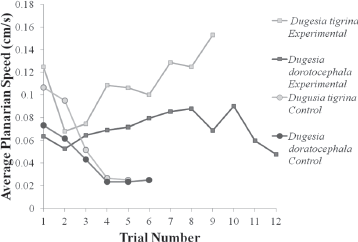
Averaged speed per trial data for two species of planaria (Dugesia dorotocephala and Dugesia tigrina) for conditioned (experimental) and unconditioned (control) organisms.
Our rationale in providing crawling speed data is twofold. First, we wanted to show what other dependent variables can be used in this exercise. We want to stress that the primary dependent variable in this exercise is whether or not they can be trained to some criterion of distance. Historically, the dependent variable in planaria classical conditioning studies is whether or not they contract to a CS that was paired with shock, and in planarian instrumental conditioning studies the primary dependent variable is choice or number of animals congregating in a specific location (Corning & Kelly, 1973). In our example the distance was at least 5 cm, and all animals reached this distance. We believe our study represents one of the few times crawling speed data has been presented for planarians. Latency has been used as a dependent variable in previous studies (Lacy, 1971).
Second, we wanted to provide the instructor with some information that can be used to make a decision on which species of planaria to use in the classroom. Of the two species, our data suggests that D. tigrina will provide the better crawling speed data and may learn faster with minimal fatigue. Although all animals of both species reached the 5 cm distance, D. dorotocephala were slower, and as the number of trials progressed they began to slow down possibly due to fatigue. The slow crawling speeds of D. dorotocephala make training more time-consuming and challenging for students. The faster speeds of D. tigrina are more suitable for situations where the demonstration cannot last for more than 30 min. Personal observation suggests that larger planaria tend to learn faster. Of the several years we have used this exercise, approximately 70 additional animals were successfully shaped to travel at least 5 cm, with many shaped to reach a distance of 10 cm. These data are not included because they were collected in undergraduate classroom experiments.
We also ran 12 control animals (6 D. tigrina and 6 D. dorotocephala). Control animals were placed in the droplet, and 3 min. later the droplet was moved to the 5 cm mark. In order to preserve the health of the control animals, a trial was terminated after 2 min. if the animal failed to reach the 5 cm mark. When the trial was terminated, the droplet was moved to the planarian, and 3 min. later a new trial began. None of the 12 control animals reached the 5 cm mark. Figure 2 shows that control animals would initially crawl when the droplet was relocated, but as the number of trials progressed would eventually stop crawling. As we did not want to stress the planarians, the control experiment was terminated after five trials.
We solicited informal comments from 45 students: 20 from a course on learning, 15 from a comparative psychology course, and 10 from a history of psychology course. Student comments were varied, but consistent across courses and were positive overall. Many of the negative comments focused on a fear of working with animals, and the perceived pressure of producing a positive result. Although many agree that the technique for training planaria can be challenging, students stated that they learned valuable lessons about data collection, patience, and training. Students agreed that the procedure worked, and that the planaria can be trained. We noted with interest that several students mentioned that initially they could not condition their planarian, but when encouraged by the instructor they were subsequently successful. All students commented positively that this exercise taught them the importance of shaping, consistency, and the need for observational skills.
Discussion
We have successfully used this demonstration in a number of venues including classes in learning, comparative psychology, and the history of psychology. We have found the exercise especially useful in stimulating discussions on the philosophical implications associated with the comparison of human and animal “minds” (Muckler, 1963). The exercise also lends itself nicely to a discussion of positive and negative reinforcement. Introductory psychology textbooks often portray positive and negative reinforcement as clearly distinct. Our exercise challenges this simple dichotomy by presenting a situation where there is no clear answer. Are the planarians learning to travel greater and greater distances because they are positively reinforced for finding water or, alternatively, are they traveling such distances because they are escaping possible desiccation? Such a conundrum naturally leads to questions about the importance of classifying learning procedures. As was noted 55 years ago, “classification is not merely a matter of taste” (Bitterman, 1962). Although discussions on the importance of classification in the area of learning are not as prevalent as they once were, instructors can find much source material to share with students (Tulving, 1965; Woods, 1974; Abramson, 1997).
Questions about the importance of taxonomies of learning, issues surrounding the identification of positive and negative reinforcers, and philosophical questions about the “minds” of humans and planarians are only a few of the classroom discussions stimulated by our exercise. Our exercise can also encourage discussion on the differences between instrumental and operant conditioning. In most textbooks, instrumental and operant conditioning are treated interchangeably as behavior controlled by its consequence. However, from a comparative psychological perspective this may not be the case. While most animals across the phylogenetic scale can respond to the consequences of their actions, it might be argued that operant conditioning should be restricted to examples of arbitrary behavior. For example, D. tigrina can be trained to seek out water, and over the course of several trials increase its speed until some asymptote is reached. The question then becomes can the planarian adjust its speed faster or slower based on the contingencies of reinforcement? If so, this would be an example of an operant behavior. One way to conceptualize the difference between instrumental and operant conditioning is that in operant conditioning an organism not only emits a response but can show that they know how to use it (Abramson, 1994).
Another way to address the instrumental-operant distinction is to challenge students to propose other experimental designs. In the exercise proposed here, we used two controls. One control consisted of untrained planarians, and the other consisted of an explicit shaping process. Of the 70 or so planarians that have been used in this exercise over the years, only a handful of untrained planaria have traveled the distances of those that have been explicitly trained. The result of our exercise is supported by the experiments of Best (Best & Rubinstein, 1962; Best, 1965), who also used access to water as reinforcement and found that animals would often make the correct choice when reinforced with water.
We were especially pleased that the students commented positively that the exercise taught them the importance of shaping. Indeed, we believe that one of the strengths of this exercise is that the focus is on getting the student to use successive approximations to create a new behavior. There are few demonstrations available that teach students the importance of shaping. Perhaps the most common is the “shaping game,” where students use rewards to get their fellow students to stand on chairs, turn toward a particular corner of the room, touch a particular item, or turn around several times. The shaping game, while entertaining, is of limited instructional value, in our view.
In addition to shaping, another strength of the exercise is that it is a hands-on, inquiry-based activity. Classroom learning has been shown to improve with the use of inquiry-based activities (Burrowes & Nazario, 2008; Cutica, Iani, & Bucciarelli, 2014). Moreover, our inquiry-based activity fits well within the educational guidelines of the American Psychological Association (2013), which seek to instill in students a variety of experimental design and critical thinking skills.
We would also like to mention that our exercise sharpens students' observational skills. All students commented that their observational skills were improved following this exercise. Our current technology-based culture can reduce individuals' awareness of their surroundings (Neider, McCarley, Crowell, Kaczmarski, & Kramer, 2010). Research has shown that observational skills can be improved with experiential exercises such as the one we propose here (Levine, Gallimore, Weisner, & Turner, 1980; Bardes, Gillers, & Herman, 2001). Moreover, being physically engaged in the activity, as opposed to being an observer, improves learning as well (Burrowes & Nazario, 2008; Cutica, et al., 2014).
Our exercise is also highly versatile. As mentioned earlier, we have used our exercise in several types of classes. We have also used this exercise as part of the “Psych-Mobile” program. This program puts on “Psychology as Science” shows throughout the state of Oklahoma and offers hands-on activities for high school students. As part of our activities, we regularly put on shows at the annual Women in Science program. The Women in Science program focuses on stimulating an interest in natural science to young minority women in Oklahoma, and the planarian experiment is popular.
In addition to flexibility in the number of venues that the exercise can be used in, our exercise is highly versatile in regards to potential experimental manipulations. For example, planarians have been used extensively for the study of regeneration (Brondsted, 1955; Reddien & Alvarado, 2004; Raffa & Rawls, 2008) and for drug studies (Raffa & Rawls, 2008). It would be an interesting class project to determine whether the trained ability to travel longer distances for water is maintained through regeneration and, if so, whether such learning can be enhanced or inhibited by pharmacological agents. Retention of the learned response can also be investigated as an alternative exercise for students. Another interesting variation is to incorporate an avoidance contingency where a signal such as a slight vibration (of change in illumination) of the droplet is presented prior to the movement of the droplet. Will the planarian leave the droplet in anticipation of the droplet moving? Another interesting project is to use a natural selection process to see if crawling speed can be increased over generations of planaria.
Practical Considerations
We have several recommendations for instructors willing to try this exercise. First, the instructor should try the exercise before the students. This will allow the instuctor to anticipate any problems prior to its use. Second, do not use planarians that have been recently fed – feeding reduces activity. We have found satisfactory results two days after a feeding. Third, we have only used the exercise with small (10) to medium (20) class sizes. If large class sizes are used, it may be necessary to have a teaching assistant and/or advanced undergraduate to help. Alternatively, if a large class contains laboratory sections the exercise can be assigned as one of the regular laboratory activities. Fourth, the instructor should provide a context for the experiment. We recommend students receive a copy of the Rilling (1996) paper describing the McConnell studies and the paper by Muckler (1963) discussing the philosophical implications of animal and human comparisons. Depending on the type of class (introductory, history, comparative, learning) additional papers can be assigned. Fifth, when the exercise is over the planarians can be returned to a second container that is not part of the home container. In this way, trained animals are not mixed with untrained animals. However, if the exercise is to be used only once, mixing trained and untrained animals will not be an issue. Sixth, if crawling speed, rather than distance is used as a dependent variable we recommend using Dugesia tigrina. However, this recommendation is tentative as there are no data on crawling speed under controlled laboratory conditions. Sixth, the petri dishes and disposable pipettes can be re-used for future demonstrations. Rinse and flush out the petri dish and pipettes, respectively, with spring water—do not use detergent or soap.
We would like to close by mentioning several potential limitations. Patience, observation, and timing are crucial when conditioning organisms. Some students may succeed easily while others may not yet have the personal skills required to master shaping. This may be of particular concern with large class sizes. A single professor, or a professor and a teaching assistant, may not be able to help all of the students with troubleshooting. Another area of concern is the surface tension of the water droplet. Using 0.25 mL of spring water, the surface tension is generally low enough that the water will move, but the planarian can become encapsulated in the water droplet or water can be left behind that the planarian may use rather than seeking the full water reward. If either occurs, the trial must be ended and restarted after an intertrial interval; this makes successfully training the planarian difficult. If this occurs repeatedly, a new animal should be used. For any instructor or student wishing to use this exercise, we would be glad to offer assistance.