






Abstract
Visitors to an online dating website voluntarily recorded their most recently re-called dream as part of a survey which also collected their relationship status and waking activities. The results showed that individuals who dated on the eve of sleeping and dreaming reported significantly higher frequencies of relationship dream characters than those who did not date beforehand. Furthermore, this difference increased as self-reported interest in entering a relationship decreased. Relationship status, sex, age, and whether participants were attracted to someone also affected the frequency and type of relationship characters in dream reports. These findings are discussed in the context of an extension to the continuity hypothesis of dreaming that describes human needs salient during wakefulness as driving dream content.
The continuity hypothesis of dream meaning describes the dreamer as possessing the same personality, values, and drives during dreaming as during waking, and dream content as being continuous with prior emotionally salient experiences (Hall & Nordby, 1972; Moffitt, Kramer, & Hoffman, 1995; Domhoff, 1996; Strauch & Meier, 1996; Domhoff, 2011). For example, stressful situations and trauma that occur during waking are emotionally important experiences and known to be well-represented in dreams (Witkin & Lewis, 1967; Breger, Hunter, & Lane, 1971; De Koninck & Koulack, 1975; Koulack, 1993), while emotional experiences of limited relevance, such as films that evoke strong emotions, can affect dream tone, but generally result in scant direct incorporation of specific film events and characters (Foulkes & Rechtschaffen, 1964; Cartwright, Bernick, Borowitz, & Kling, 1969; Goodenough, Witkin, Koulack, & Cohen, 1975). This observation motivated an extension to the continuity hypothesis, describing the source of the emotion fueling dream content as conscious waking concerns (Saredi, Baylor, Meier, & Strauch, 1997; Cartwright, Agargun, Kirkby, & Friedman, 2006; Domhoff, Meyer-Gomes, & Schredl, 2006). This extension has been described as broad and vague (Schredl & Hofmann, 2003; Hartmann & Brezler, 2008). At issue is the absence of a comprehensive, quantifiable description of the concerns during waking that are continuous in dreaming.
Coutts (2010) proposed an extension to the continuity hypothesis that fully describes the waking concerns that are continuous in dream content as those pertaining to people's ability to meet human needs. Murray (1938) and Maslow (1943, 1954, 1971) defined comprehensive motivational categories of human needs; these categories can be used to identify the expression of conscious waking concerns in dreams. For example, a concern about an impending divorce could be described as a concern for the potential thwarting of Maslow's need category “belongingness”; concern for a perceived personal failure could be related to a potential thwarting of Maslow's need category “esteem”; a concern for being physically attacked could be related with the need for “safety,” etc. Coutts (2010) tested the needs extension by applying human needs categories to dream content. Judges scored 100 randomly selected dream reports using Maslow's hierarchy of needs. In 92% of the dream reports, the judges agreed on one or more human need expressions (mean agreement was 1.18 expressions per report). Social needs in the dream reports were found to outnumber the physiological, safety, and cognitive needs.
With respect to needs and partner relationships, recently divorced participants were found to dream often of their ongoing social trauma (Cartwright, Lloyd, Knight, & Trenholme, 1984; Cartwright, 2010). Men and women about to be married for the first time were found to be more likely to dream of real or imagined partners than their non-marrying, mostly single counterparts (Westbrook, 1989). Married people were also more likely to dream of their spouses than those who were widowed (Schredl, Schröder, & Löw, 1996). Of particular relevance to the present study, participants in relationships were more likely to dream of an actual partner compared to singles who were more likely to dream of imagined partners (Schredl, 2001).
In regard to the gender of dream characters, Hall and Domhoff (1963), Hall and Van de Castle (1966), and Hall, Domhoff, Blick and Weesner (1982) found that men's dreams contained more men than did women's dreams. Furthermore, Schredl, Loßnitzer, and Vetter (1998) found that the discrepancy of male/female dream characters varied and was proportional to the amount of contact with the opposite gender that occurred during recent waking activity. Paul and Schredl (2012) found that the variation in male/female dream character ratio also depends on relationship status, with women in a heterosexual relationship more likely to dream of men than were single women. Regarding sexual activity in dream reports, Schredl, Desch, Röming, and Spachmann (2009) found that men dreamed more about sex than women. Husband (1936) found that married men dreamed less about sex than single men, while married women dreamed more about sex than their single counterparts.
Partner relationships have the potential to satisfy several human needs, including physiological, safety, belongingness, and esteem. Applying this observation to the proposed extension to the continuity hypothesis, dating activity should significantly affect dream content, resulting in an increase in frequency of relevant dream characters, such as current or former partners (boyfriend, girlfriend, ex-spouse) and attractive non-partners (acquaintances, strangers), which led to the following study hypothesis.
Hypothesis 1. Participants who dated on the eve of their recalled dream will be more likely to report relationship characters in their dreams than those who did not.
The state of being attracted to another person would appear to make salient relevant needs even without dating. Therefore, according to the proposed extension to the continuity hypothesis, these salient needs would affect dream content even without prior dating, which led to the following hypothesis.
Hypothesis 2. Participants who were attracted to someone else whom they are not dating will be more likely to dream of relationship characters than those who were not attracted to another at the time of their dream report.
Variation in relationships would appear to fulfill different human needs. For example, flirtation with an attractive stranger would satisfy different needs than expressed love between spouses. Therefore, the needs extension would predict that these differences would be reflected in dream reports. This prediction led to the following hypothesis.
Hypothesis 3. The types and frequencies of relationship characters in the dreams will reflect relationship status. For example, people in relationships will be more likely to dream of current or former partners than singles who will be more likely to dream of attractive non-partners. In addition, the correlations between the frequency of relationship characters and further self-reported categorization of relationship status will be found. Specifically, singles who describe themselves as not interested in entering a relationship will be less likely to dream of relationship characters than singles who are interested in entering a relationship.
Method
Participants
Visitors to the online dating website Plenty of Fish 2 were recruited to participate in this study via a banner advertisement. This method of online survey has been used successfully to collect dream reports and related data in previous studies (Schredl, Paul, Lahl, & Göritz, 2010; Aumann, Lahl, & Pietrowsky, 2012). Participation was voluntary, anonymous, and unpaid.
Procedure
Clicking on the banner navigated the responder to a brief description of the survey, the intent to publish findings in a peer-reviewed journal, and the study's privacy policy. Participants were then given the option of whether or not to proceed with the survey. Those who did subsequently wrote a report about their most recent dream. On the next page of the survey they were asked whether they were “romantically or sexually attracted to anyone in their dream.” An answer of “yes” was followed by a list of potential characters—current boyfriend/girlfriend, ex-spouse, coworkers, friends, family members, or strangers—from which the participant had to select one. Subsequent questions collected study-relevant activities and emotional states immediately prior to their dream reports, such as whether participants had dated the evening prior to sleeping and dreaming, whether they had romantic feelings toward another in their waking life, their relationship status, and, if single, whether they were interested in entering a relationship. Because reports were retrospective, each question was accompanied with the option “I don't remember” to discourage participants from fabricating responses.
The questions were designed and ordered to limit demand characteristics. All questions required answers before participants could advance to the next page, and participants were blocked from navigating back to prior pages and changing responses. The survey could not be filled out more than once per IP address to reduce the likelihood of multiple responses from one participant. No personal information was exchanged between the author and the online dating service. A large sample set was collected to allow for sufficient sample sizes among several subgroups.
Measure
The main variable in this study was the frequency of relationship characters, primarily relationship partners (current and former), and attractive non-partners, including friends, acquaintances, and strangers, in the participants' dreams.
Analyses
Comparisons were made with Pearson's chi-squared tests for non-parametric variables. Significance level was set at p <.05. Hypothesis 1 was tested by applying this chi-square comparison to the frequency of reported relationship characters in the dream reports of participants who dated prior to sleeping and dreaming to participants who did not date beforehand. Effect sizes were calculated as Cramér's V. Hypothesis 2 was tested by comparing the frequency of relationship characters in the dream reports of participants who reported being attracted to another whom they were not dating at the time of their dream to those who reported not having any strong feelings toward another at the time. Hypothesis 3 was tested by comparing the frequencies of two types of reported relationship characters: (1) current or former partners and (2) attractive non-partners, for three categories of relationship status.
Results
Data Checks
Of the initial 64,024 respondents who entered the survey, 6,732 reported that they could not remember a recent dream and 40,214 said they could but subsequently dropped out (typically when asked to enter a dream report). The remaining 17,078 surveys and their dream reports were reviewed for quality, of which 426 were rejected due to inadequate responses (typically, incomplete dream reports; e.g., “Sorry, I can't remember my last dream,” “asdfasdfasdf,” or descriptions of dreams in general rather than reporting a specific dream). Of the remaining 16,652 participants, 995 could not remember whether they were romantically or sexually attracted to anyone in their dream and were therefore excluded from the analysis, leaving 15,657 responders who completed the survey satisfactorily (66.6% women, 33.4% men; M age = 38.7 yr., SD = 13.1).
Dream Reports
The median lag between the occurrence of the dream and the writing of the dream report was 2 days (range = 1–365, IQR=3). Because dream recall can decay over time (Kemp, Burt, & Sheen, 2003), results for data with report lags of two or more days were compared with report lags of one day. No significant differences were found between the two data sets. The median length of the dream reports was 25 words (maximum=1,621, minimum = 1 word; e.g., “Sex” or “Work”). The following report is representational: “I dreamt that I was asking my ex-boyfriend to return but he refused and told me that he met someone else.”
Frequencies of Relationship Characters in the Dreams
Hypothesis 1, that participants who dated prior to their report were more likely to dream of relationship characters, was supported. Of the 1,504 participants who dated prior to sleeping and dreaming, 60.2% reported dreaming of a relationship character, compared to 44.3% of the 14,153 participants who did not date prior, a difference of 15.9% [χ2(1, n = 15,657) = 137.70, p<.001, V=0.094]. This hypothesis was also supported within each relationship status category. Figure 1 shows frequencies for participants categorized by relationship status. “Partnered” refers to participants who self-reported as being in a relationship or being single but dating someone they would like to enter a relationship with, “Single, seeking a relationship” refers to those who self-reported as being single and seeking either a monogamous or non monogamous relationship, and “Single, not seeking a relationship” refers to participants who self-reported as single but were not currently interested in entering a relationship. Respondents were further categorized under “Date” if they had a date or spent time with a relationship partner on the evening prior to their reported dream, or “No date” otherwise. Participants in every category who dated prior to sleep were more likely to report dreaming about relationship characters than their counterparts who did not date (see Fig. 1 for frequencies and chi square values). Singles who dated prior to their reported dream, but also self-reported as not seeking a relationship, had a larger difference in relationship characters (18.7%) than singles seeking a relationship (14.7%) [χ2(1, n = 11,570) = 153.47, p< .001, V = 0.115]. This may be due to the anomaly of a date for singles who self-reported as not seeking a relationship, as only 3.0% of this group reported dating prior to the dream report, compared to 6.9% of singles who self-reported as seeking a relationship.
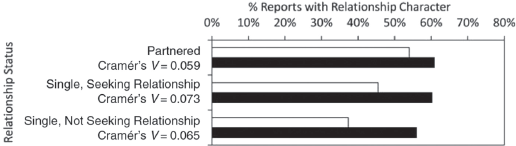
Frequency of relationship characters in dream reports of participants grouped by relationship status and presleep activity (□No date, ▪Date). Partnered: [χ2 (1, n = 4,087) = 14.04, p < .001, Cramér's V = 0.059]; single, seeking relationship: [χ2 (1, n = 6,161) = 32.48, p < .001, Cramér's V = 0.073]; single, not seeking relationship: [χ2 (1, n = 5,409) = 22.89, p < .001, Cramér's V = 0.065].
Hypothesis 2, that participants who reported being attracted to someone in their waking life would be more likely to dream of relationship characters, was supported. Those who reported being attracted to someone had 56.1% likelihood of recording a relationship character in their dream report, compared to 32.7% who were not, a difference of 23.4% [χ2(1, n =13,801)=729.13, p <.001, V = 0.230]. 3 As shown in Fig. 2; the effect of an attraction on the participants' responses was detailed by the target of the attraction; e.g., “a friend or acquaintance” and “someone I never met (e.g., person online, celebrity).” Notably, the frequency of reporting a relationship character among those who reported attraction to someone they had never met (53.4%) was not significantly different from the frequency among those who reported attractions to someone they knew (56.2%) [χ2(1, n = 8,283) = 1.20, p = .27, V=0.012].

Frequency of relationship characters in dream reports of participants grouped by category of attraction to another person and presleep activity (□No date, ▪Date). Current or Former Partner: [χ2(1, n = 4,893) = 23.21, p< .001, Cramér's V = 0.069]; Friend or Acquaintance: [χ2(1, n=2,993) = 7.84, p< .001, Cramér's V=0.051]; No strong feelings for anyone at the time: [χ2(1, n = 5,518) = 54.41, p< .001, Cramér's V=0.097].
Hypothesis 3, that the types and frequencies of relationship characters will reflect relationship status, was supported [χ2(4, n = 15,657) = 660.97, p < .001, V = 0.145]. Figure 3 categorizes the same three relationship status categories as Fig. 1 and further categorizes participants by the type of relationship character found in their dream reports. In other words, participants who described themselves in the dream report as being “romantically or sexually attracted” to a current or former partner are grouped together under the “current or former partner” category. Those who reported being attracted to a non-partner were listed under “attractive non-partner.” The 3.1% of respondents reported being attracted to both a partner and non-partner were grouped with the “current or former partner” category. As can be seen in Fig. 3, participants in partner relationships were more likely to dream of current or former partners (35.0%) than were singles seeking a relationship (17.6%) and less likely to dream of attractive non-partners (20.5% vs. 28.8%). Furthermore, singles seeking a relationship were also more likely to dream of attractive non-partners than singles not seeking a relationship (19.9%). However, they were no more likely to dream of current or former partners (17.6% vs. 18.0%) [χ2(1, n = 11,570) = 0.36, p = 0.55, V = 0.006].

Frequency and types of relationship characters ( Current or former partner,  Attractive non-partner,) in dream reports of single and partnered participants.
Age and Relationship Dreams
Figure 4 shows that age was a predictor of the presence of relationship characters in the dreams for participants who did not date prior to their dream report [χ2(6, n = 14,153) = 159.30, p < .001, V = 0.106] and for those who did [χ2(6, n = 1,504) = 18.54, p = .005, V = 0.111]. However, upon investigation each age subgroup was found to be well-represented among other study groups, such as relationship status and attraction status, and was not found to affect study findings.
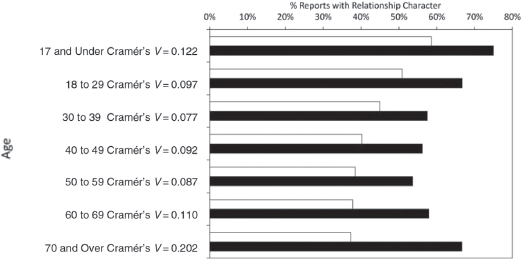
Frequency of relationship characters in dream reports of participants grouped by age and presleep activity (□No date, ▪Date). Age groups: 17 and Under [χ2 (1, n = 103) = 1.53, p < .001, Cramér's V = 0.122]; 18 to 29: [χ2 (1, n = 5,140) = 48.16, p < .001, Cramér's V = 0.097]; 30 to 39: [χ2 (1, n = 3,119) = 18.44, p < .001, Cramér's V = 0.077]; 40 to 49: [χ2 (1, n = 3,779) = 31.69, p < .001, Cramér's V = 0.092]; 50 to 59: [χ2 (1, n = 2,711) = 20.42, p < .001, Cramér's V = 0.087]; 60 to 69: [χ2 (1, n = 737) = 8.90, p < .001, Cramér's V = 0.110]; 70 and Over: [χ2 (1, n = 68) = 2.78, p < .001, Cramér's V = 0.202].
Gender and Relationship Dreams
As depicted in Fig. 5, gender was found to be a predictor of the frequency and types of relationship characters for participants who did not date prior to their dream report [χ2(2, n = 14,153) = 110.94, p<.001, V=0.089] and for those who did [χ2(2, n = 1,504) = 26.49, p < .001, V = 0.133]. For example, men who did not date prior to their dream report were more likely to report dreaming of an attractive non-partner than were women (29.1% vs. 21.3%) [χ2(1, n = 14,153) = 103.88, p< .001, V=0.086]. This comparison also held for men and women who did date beforehand (27.6% vs. 16.3%) [χ2(1, n = 1,504) = 26.27, p< .001, V = 0.132]. However, of those who did not date, men were equally likely to report dreaming of a current or former partner (20.2%) as women (20.5%) [χ2(1, n = 14,153) = 0.12, p = 0.73, V=0.003]. Likewise, there was no significant difference in the men who dated prior to their dream report (37.1%) compared to women who dated (41.6%) [χ2(2, n = 1,504)=2.82, p = .093, V=0.043]; however, this latter finding may be due to a smaller n. Summing these values, men reported more total relationship dream characters than women, both for those who did not date prior to their dream report (49.3% vs. 41.8%) [χ2(1, n = 14,153) = 71.85, p < .001, V = 0.071] and for those who did date (64.7% vs. 58.0%) [χ2(1, n = 1,504)=6.29, p < .001, V=0.065].

Frequency of relationship characters in dream reports of participants grouped by gender and presleep activity ( Current or former partner,  Attractive non-partner).
Discussion
The findings of the present study provide support for the proposed extension to the continuity hypothesis, that the waking experiences that are continuous in dreaming are those relevant to the satisfaction or thwarting of human needs. As mentioned in the introduction, Coutts (2010) found themes associated with social needs more prevalent in dream reports. This led to the present study hypotheses associated with respondents' needs relevant to dating and/or forming partner relationships, as operationalized by categorizing their relational activities the day prior to their reported dream. Singles actively pursuing relational needs were more likely to dream of relevant dream characters than singles who were not pursuing these needs. Singles pursuing relational needs were also more likely to dream of meeting attractive non-partners than participants in relationships whose needs expression was more likely to be dreams of current or former partners. Singles whose waking needs were expressed as an attraction to someone specific were seen to have this need continue in the dreams in the form of elevated frequencies of relationship characters.
The present study is consistent with prior studies that found waking activities and relationship status influence the subsequent frequency of relevant dream characters (Husband, 1936; Schredl, Loßnitzer, & Vetter, 1998; Paul & Schredl, 2012). In addition, the present findings indicate that opportunities to meet relational needs prior to sleep can influence dream content. Partner relationships and associated social needs can provide rich data sets for exploration of the continuity hypothesis. Prior studies that involved singles have often created subgroups of singles by gender. The above findings demonstrate that distinctions in the dream reports of singles can be further grouped, including by the type of relationship they are pursuing, their activities prior to sleeping and dreaming, whether they are currently attracted to anyone, and age.
Limitations and Conclusions
Care should to taken in applying study findings to other populations, as dream recall can be enhanced by prompting (Horton, 2011). While the present study was designed to reduce demand characteristics, the context of the online dating website likely prompted more relationship-related content in dream reports than would a neutral setting. Furthermore, the large sample size led to a very small effect size in a number of comparisons. While this led to confident findings for the parameters compared, there may have been some not collected that affected distributions.
The continuity hypothesis describes the relationship between waking life and dream content, including the currently proposed extension to the continuity hypothesis, but does not attempt to describe why this relationship exists. Several functional theories of dreaming have been proposed as explanations (for review, Pace-Schott, Solms, Blagrove, & Harnad, 2003). Coutts (2010) applied needs categories to describe how such theories, with little outward commonality, could be framed in the context of human need categories and evaluated. For example, the threat simulation hypothesis of dreaming (Revonsuo, 2000) describes dreams as opportunities to practice threat avoidance. This definition can be reframed as addressing the human need for safety and subsequently tested by comparing the quantity of dream reports in which safety needs are either met or thwarted with those of other needs. Winson (1990) described dreams as dress rehearsals that provide dreamers with a chance to revisit and practice past traumatic events as a coping mechanism. This description could be reframed to compare dream reports with needs associated with the traumatic event, and so forth. Likewise, Coutts (2010) described more generally how research findings on dreaming can often be reframed in the context of need categories. For example, the physiological need for sex was found to be as represented in dreaming as in waking life (Hartmann, 1998); the physiological need for hydration was found to be represented in the dream reports of thirsty participants (Bokert, 1968); the belongingness need for companionship were found to be well-represented in the reports of divorced participants (Cartwright, Lloyd, Knight, & Trenholme, 1984); and so forth. Characterizing dream scenarios as meeting or thwarting human needs in this manner can be helpful in the coalescing of the current literature and for the design of future studies. For example, as described in the Introduction, traumatic events during waking (i.e., events that thwart human needs) are well-represented in the dream literature. There is a comparative paucity of examples of waking events in which human needs are met and subsequently incorporated into dreaming. The present study was designed, in part, to demonstrate that the literature may be lopsided toward the thwarting of needs, and to describe a framework for exploring whether salient needs met during waking may be unrepresented in the dream literature.
In general, using needs categories, including whether the need was met or thwarted, would seem to be a useful tool for extending the continuity hypothesis, quantifying and investigating dreaming attributes, evaluating dream theories, and designing future studies of dreaming.
Note that n is smaller for this sample set because it was amended to the survey and therefore presented to a subset of participants.