






Abstract
This study was designed to explore public opinions of suicide bombers' mental health, which is a subject of great popular and scholarly debate. In a random sample of 391 adult residents surveyed by telephone, there did not appear to be significant differences in answers based on respondents' age, sex, or race. However, belief that suicide bombers are mentally ill was inversely related to respondents' level of education. That respondents with less education would be more apt to believe that suicide bombers are mentally ill can be understood through prior research on the fundamental attribution error. In this particular case, however, the least educated respondents' opinions may actually reflect the latest scientific findings on the subject.
For decades, social psychologists have struggled against the fundamental attribution error. This refers to the human tendency to dismiss the importance of social and situational variables, and instead attribute behavior almost exclusively to individual factors, such as personality (Jones & Harris, 1967; Ross, 1977). This error appears particularly common in popular explanations of those who act violently: they are often assumed to be “bad apples” at their very core, with little thought given to the pressures of context or culture that may have greatly shaped their actions (Zimbardo, 2007).
A wealth of research has shown the flaws in this type of thinking. In controlled experiments, people who followed orders to give electric shocks to innocent victims were not inherently evil (Milgram, 1963), and people who were assigned to play “prison guard” and then ended up harassing prisoners were not lifelong sadists (Zimbardo, 1972). More broadly, historical evidence has shown that despite their horrific crimes, the Nazis were not simply a collection of unfeeling psychopaths (Browning, 1998), and before their training and indoctrination, many members of terrorist organizations were essentially ordinary people (Hoffman, 1998; Gunaratna, 2002).
After the September 11, 2011 terrorist attacks on the United States, the fundamental attribution error appeared to run rampant again—at least in some circles. In certain popular and political discourse, the terrorist hijackers were not only lambasted for their murderous actions, but also hastily diagnosed as “monsters,” “evil-doers,” “cowards,” “lunatics,” “crazy,” and “not rational” (Pearson, 2001; Ellis, 2002; Atran, 2003). Those who see their enemies as “monsters” and “evil-doers” may be dehumanizing them, ignoring the relevant social and political factors that contributed to their actions, and thus committing the fundamental attribution error. However, beyond these labels, there is also the scientific question of whether suicide terrorists actually struggle with mental health problems or suicidal tendencies. This remains the subject of heated academic debate (see Lankford, 2014).
On one side are scholars who argue that suicide terrorists are psychologically normal and stable individuals who altruistically sacrifice their lives for an ideological cause (Atran, 2003; Pape, 2005; Brym, 2007; Post, Ali, Henderson, Shanfield, Victoroff, & Weine, 2009). For instance, Atran (2004) concludes this largely based on his interviews of terrorist leaders and families of deceased attackers: “In truth, suicide terrorists on the whole have no appreciable psychopathology.” In turn, Pape (2005) bases his position on his research team's attempt to find information about hundreds of suicide bombers' lives. They uncovered “no documented mental illness, such as depression, psychosis, or past suicide attempts…no evidence of major criminal behavior…[and] not a single report that a suicide attacker was gay, an adulterer, or otherwise living in a way that would bring shame” (pp. 210–211). Both Pape's (2005) methods and findings have been the subject of significant criticism (Ashworth, Clinton, Meirowitz, & Ramsay, 2008), but his conclusion, that “the uncomfortable fact is that suicide terrorists are far more normal than many of us would like to believe” (p. 211), has been echoed by other scholars. From their perspective, suicide terrorists are relatively ordinary people who become fully committed to their cause because of social and situational factors. They argue that those who point to individual factors as a cause of suicide terrorists' behavior may be committing the fundamental attribution error (Atran, 2003; Brym, 2007; Gray & Dickson, 2014; Güss & Tuason, 2014).
On the other side of the debate are scholars whose research reveals signs of personal crises, mental health struggles, and suicidal tendencies in the lives of many suicide terrorists. This perspective does not ignore the influence of social or situational factors on suicide attackers' lives, but suggests that individual factors may be very important as well. For example, Merari's (2010) research team of psychiatrists conducted direct psychological assessments of pre-emptively arrested suicide bombers and two control groups of other terrorists—all of whom had been influenced by similar social and political variables. They found that the suicide attackers had far more suicidal tendencies, depressive tendencies, signs of post-traumatic stress disorder, and previous suicide attempts in their lives (Merari, 2010). In addition, Lester (2011) found perceived burdensomeness among female suicide bombers. Perceived burdensomeness is a well-established risk factor for suicide (Joiner, 2010), and may help explain why these particular women felt like their families would be better off with them dead. Along similar lines, Lankford (2013) documented more than 135 individual suicide terrorists with risk factors for conventional suicide, including many who admitted their suicidal ideation or were believed to be suicidal or depressed by their families. In addition, Lankford (2013) conducted a quantitative analysis of suicide attackers and other perpetrators of mass murder-suicide, such as rampage shooters, that revealed many psychological and behavioral similarities between the various types of killers. More recently, Lankford (2014) offered a number of empirical predictions about the behavior of suicide terrorists and the organizations that recruit and deploy them, which indicate that many suicide attackers are indeed struggling with mental health problems.
On a societal level, however, very little is actually known about public opinions of suicide bombers' mental health. In fact, empirical evidence is almost nonexistent. The high profile quotes about “crazy lunatics” that followed 9/11 may or may not accurately represent popular opinion. It appears there has been only one previous study on the subject: a survey of 68 undergraduate students (20 male, 48 female; M age = 22.1 yr., SD = 5.9) by Lester and Frank (2008). They found that 75% of respondents checked a “yes” box affirming the belief that suicide bombers are “psychiatrically disturbed” (Lester & Frank, 2008). This is an interesting finding, but more information is certainly needed. The present study was designed to collect data from a much larger sample of respondents, and then assess any possible demographic patterns in the age, sex, race, or education level of those who hold various opinions on the subject.
Method
A statewide omnibus telephone survey was administered to an anonymous random sample of 391 adult residents (155 male, 236 female; 72% White, 23% Black, 5% Other race/no answer; M age = 58.2 yr., SD = 15.1). Table 1 provides full descriptive statistics for the sample. Along with demographic questions, the broader survey consisted of questions about problems, issues, and trends of current social interest. For the purposes of the present study, participants were specifically asked, “Do you believe that most suicide bombers are mentally ill?” with the following response options: “Yes,” “No,” or “Don't Know/No Answer.”
Descriptive Statistics (N = 391)

Results
Overall, 191 respondents (48.9%) answered “Yes” that they believed most suicide bombers are mentally ill, 158 (40.4%) answered “No,” and 42 (10.7%) answered “Don't Know/No Answer.” This means that of the 349 individuals who believed they knew or at least provided a Yes/No response, 54.7% answered “Yes.”
Chi-squared and ANOVA tests did not reveal any statistically significant differences in answers according to respondents' age, sex, or race. However, there did appear to be a significant relationship between the highest level of education that respondents completed, and the belief that suicide bombers are mentally ill. These results appear in Table 2. The relationship between education and response type appeared inverse; in other words, those with more education were less likely to answer “Yes” about suicide bombers' mental illness [χ2(12, N = 391) = 26.50, p = .009, φ = 0.18].
Comparison of Respondents with Different Opinions on Suicide Bombers' Mental Health (N = 391)
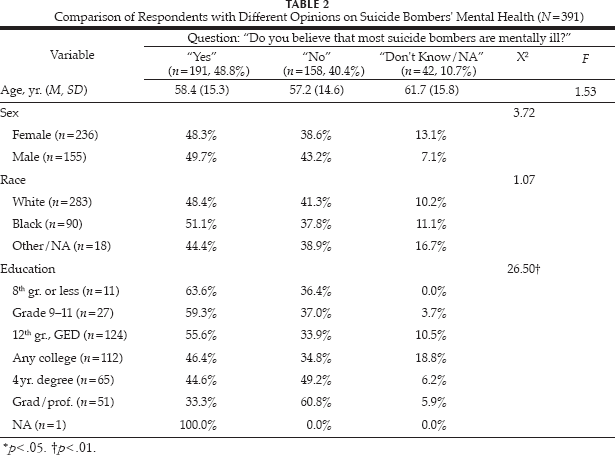
* p < .05. † p < .01.
Discussion
The results of the present study suggest that public opinions of suicide bombers' mental health are not uniform; they are split almost evenly between those who believe that most suicide bombers are mentally ill, and those who believe otherwise. This suggests that past scholars who have generalized that the public on the whole has committed the fundamental attribution error on this subject would seem to have overstated their case (Atran, 2003; Pape, 2005; Brym, 2007). After all, there is not a strong consensus on either side.
Respondents who indicated that most suicide bombers are not mentally ill likely attribute these attackers' behavior to social and situational factors, because the most common alternative explanations are typically that suicide terrorists commit altruistic self-sacrifice for the good of their group or ideological cause (Lankford, 2013). However, the present survey did not explicitly measure the prevalence of this alternative view, so follow-up research that sheds more light on these differing opinions would be of additional value.
Respondents who stated that suicide bombers are mentally ill may have been committing the fundamental attribution error. If these participants were similar to those surveyed by Lester and Frank (2008), it would seem likely. More than 70% of Lester and Frank's (2008) respondents not only characterized suicide bombers as “psychiatrically disturbed,” but also as “irrational” and “evil.” They seemed to assume that anyone who intentionally kills him- or herself in a suicide attack must be an inherently bad person and incapable of rational thought, which is not what the research on either side shows. In fact, it is well established that people who commit suicide, murder-suicide, and suicide terrorism are often lucid, and they commonly make strategic plans about their deaths that require rational calculations of cause and effect (Maris, Berman, & Silverman, 2000).
The finding that respondents' belief that suicide bombers are mentally ill appeared inversely related to their education level also supports the possibility that some were committing the fundamental attribution error. Although educated people may make this error (Bauman & Skitka, 2010), education tends to improve the consideration that students give to the effect of cultural, social, and situational factors on behavior (Riggio & Garcia, 2009). This starts early in grade school and continues throughout the educational process. As Pinker (2011) summarizes, students are increasingly taught the importance of cultural influences: “Today's children have been encouraged to take these cognitive leaps with gentle instructions such as…‘Yes, the things those people do look funny to us. But the things we do look funny to them”’ (p. 311). One would expect respondents with the least amount of education to be most apt to commit the fundamental attribution error, and thus solely attribute suicide terrorists' behavior to individual factors such as mental illness.
Ironically, then, in this study it may actually be many of the least educated respondents whose opinions on the mental illness of suicide bombers most accurately correspond with the latest scientific findings (Merari, 2010; Lester, 2011; Lankford, 2013, 2014). This seems largely attributable to luck; sometimes people are right for the wrong reasons.
A broader concern is whether this overall case illustrates a growing risk for the social sciences and educated society at large. As people become increasingly informed about the dangers of the fundamental attribution error—and adjust their biases to avoid committing it—they may go too far. In their apparent eagerness to avoid attributing everything about suicide terrorists' behavior to their individual psychology, many scholars jumped to the conclusion that “suicide terrorists exhibit no socially dysfunctional attributes” (Atran, 2003, p. 1537). A more accurate middle ground must exist. Ultimately, as Funder (2014) wisely observes in his discussion of the subject, “sometimes people overestimate the importance of dispositional factors, and sometimes they overestimate the importance of situational factors, and the important thing, in a particular case, is to try to get it right” (p. 368).