




Abstract
Humor perception differs across cultures, and this paper examined the cultural differences of humor perception and nomination of humorists in 457 university students from Hong Kong, Hangzhou, and Vancouver. The “big humor/little humor” phenomenon explicates cross-cultural meanings and implications of humor expressions and functions. “Big humor” is a conception that humor is created by professionals, whereas the “little humor” view is that people possess humor as a personality trait. Participants were asked to nominate up to three humorists they know and to specify their reasons for nomination. They also self-evaluated on a scale of 1 to 10, the importance of humor and their own humor. Results showed that students from Vancouver nominated ordinary people more, valued humor more, and considered themselves more humorous than students in Hong Kong and Hangzhou.
Perception of humor differs among people in Eastern and Western cultures (Chen & Martin, 2007; Martin, 2007; Yue, 2010; Cheung & Yue, 2012; Yue & Jiang, 2013). Yue and Jiang (2013) proposed to differentiate the Chinese perception of humor from the Western perception of humor in terms of a dichotomy between a “big humor” view and a “little humor” view. The former viewpoint is common in Eastern cultures: humor is regarded possessed largely by professional humorists (Lin, 1974; Yue, 2010, 2011; Xu, 2011). This is largely attributed to Confucius's time, in which humor was taken as “a form of private, moderate, good-natured, tasteful, and didactically useful mirth” (Xu, 2011, p. 70). Chinese people, for thousands of years, have had a scornful attitude towards humor and preferred a “thoughtful smile” to “hilarious laughter” (Lin, 1974). For example, Jiang, Yue, and Lu (2011) found that the Chinese undergraduates tended to associate humor with unpleasant adjectives and seriousness with pleasant adjectives; the opposite was true for American undergraduates. Liao (1998) reported that loud laughter would make Chinese people feel nervous and uncomfortable.
The “little humor” view, in contrast, regards humor as a desirable disposition for self-actualization and interpersonal relationship as well as a trait possessed by everyone (e.g., Maslow, 1968; Martin, 2007). This is largely attributed to Plato's era; humor was valued as a natural expression of amusement, fun, and delight in social interactions (Grant, 1970). Studies conducted in Western cultures have shown that humor could facilitate coping (e.g., Lefcourt, Davidson, Shepherd, Phillips, Prkachin, & Mills, 1995; Kuiper & Martin, 1998; Moran & Massam, 1999), promote impression management (e.g., Mettee, Hrelec, & Wilkens, 1971), and enhance interpersonal attraction (e.g., Fraley & Aron, 2004). Humor has been taken by Westerners as a core trait of self-actualization as well as of creativity (Guildford, 1950; Maslow, 1968; Mintz, 1983; Mindess, Miller, Turek, Bender, & Corbin, 1985; Sternberg, 1985).
The big-humor and little-humor phenomenon delineates cross-cultural meanings and implications of humor expressions and functions, which can differ greatly: for instance, Chinese children consider humor as “aggression-disruption,” which is not the case for American children (Chen, Rubin, & Sun, 1992). An example of little-humor is, “President Bush would joke about the size of the shoe that was thrown at him as it would demonstrate his wit and charisma over the embarrassing situation” (Yue & Jiang, 2013). An example of big-humor would be, “Even in laughing, Chinese people were advised to laugh gently, Chinese women were even advised to cover their mouths with their hands while laughing” (Lin, 1934; Yue & Jiang, 2013).
Yue and his associates reported that humor was not listed as a core trait of creativity by Chinese undergraduates (Rudowicz & Yue, 2000, 2003; Rudowicz, 2003; Yue, 2011), and that humor was less valued by undergraduates in Mainland China than their counterparts in Hong Kong (Yue, Hao, & Goldman, 2010; Yue, 2011; Yue, Liu, Jiang, & Hiranandani, 2014; Yue, Wong, & Hiranandani, 2014). Likewise, Yue and his associates also studied perception of humorists by undergraduates in Hong Kong and Huhehot and reported that their perception of humorists mostly included comedians, actors, TV hosts/DJs, politicians, etc. (Jiang, Yue, & Lu, 2011; Yue, Hao & Goldman, 2011).
Interesting as these findings are, there are no empirical studies which directly examined how humorists were perceived and valued in China versus Western cultures, only the regional difference between Hong Kong and in Mainland China. Hence, the goal of this study was to examine how humorists are perceived and valued in Hangzhou, Hong Kong, and the West (Vancouver, Canada). The primary goal of this paper is to examine the differences Hangzhou, Hong Kong, and the West (Vancouver, Canada) that relate to humor. The results can provide insight and empirical evidence to contribute to the literature on how humor is perceived and valued in Hangzhou, Hong Kong, and the West (Vancouver, Canada).
Hypothesis 1. Chinese people (Hong Kong and Hangzhou) would perceive humorists as comprising mostly humor-related professions whereas people from Vancouver would perceive humorists as comprising people from other backgrounds (ordinary people).
Hypothesis 2. People in Vancouver, compared with their counterparts in Hong Kong and Hangzhou, would value humor more, and consider themselves to be more humorous.
Method
Participants
A total of 457 university students participated in the present study, including 159 Hong Kong university students (72 men, 87 women; M age = 23.0 yr., SD = 2.2), 178 Hangzhou university students (74 men, 104 women; M age = 19.4 yr., SD = 1.2), and 120 Vancouver university students (59 men, 61 women; M age = 19.9 yr., SD = 2.6). The Hong Kong students were sampled from the City University of Hong Kong, the Hangzhou students were sampled from Hangzhou Normal University, and in Vancouver Canadian students were sampled from the University of British Columbia. The three universities selected were comparable in size and prestige in their respective regions. Finally, all participants were selected from the above-mentioned universities through convenience sampling.
Measures
Participants completed a specifically designed questionnaire for this study which required them to (1) nominate up to three humorists they knew of and specify their reasons for nomination (Yue, 2003, 2004; Yue, Bender, & Cheung, 2011), and (2) rate the importance of humor to them (“How important is humor to you?”) as well as their own level of humor (“Rate your own level of humor”). A 10-point scale was used for both responses, with anchors 1 = lowest and 10 = highest. Questionnaires for Hong Kong participants were printed in traditional Chinese characters, whereas questionnaires for Hangzhou participants were printed in simplified Chinese characters, and questionnaires for Vancouver participants were printed in English. The questionnaire took about 10–15 min. to complete.
Procedure
The questionnaires were administered during lecture or tutorial time. All participants were informed of the purpose of the study and were invited to complete the questionnaire on a voluntary basis. To code all nominated humorists, a three-step procedure was followed (Yue & Rudowicz, 2002; Yue, 2003). In Step 1, a master list of all nominees was compiled. In Step 2, two independent coders (one of them was the first author, the other was a research assistant) would assign a category of recognition for each nominated humorist. The two independent coders were skilled to conduct the coding as they both are psychologists who are familiar with Research Methods in Psychology. If a humorist was active in a number of domains, he or she would be coded by what was best known for to the general public and be mutually agreed on by the two coders; as such, none of the nominees was coded as belonging to more than one category. In Step 3, all coded humorists were grouped into 14 broad occupational categories, which were comedians, actors, singers, talk show/TV hosts/DJs, writers, businessmen, fictional characters, sport stars, directors, teachers, family members and friends, and others. Finally, as the first author has conducted other studies in a similar fashion (Yue, 2004; Yue, et al., 2011), the present procedure was carried out to avoid possible inconsistency in coding.
Results
Table 1 displays percentages and ranking of nominated humorists in the three samples. Comedians were ranked first by Hong Kong and Hangzhou samples (57.6% and 54.1%, respectively) whereas relatives/friends were ranked first by the Vancouver sample (50.8%). Actors were ranked second for Hong Kong students while comedians were ranked second for the Vancouver students. The frequency of nomination of family/friends/others was all less than 10%, except for the Vancouver sample, in which such nomination was 50.8%. The present findings confirm that Hong Kong and Hangzhou samples nominated more celebrities as humorists while Vancouver samples nominated more non-celebrities as humorists, supporting Hypothesis 1.
Categorical Percentages and Rank of Humorists Nominated by Three Samples

Table 2 shows the percentage of nominated humorists by three categories, comedians, celebrities, and non-celebrities. The combined totals of celebrities and non-celebrities nominated were 90.2% and 9.7% for the Hong Kong sample, 90.8% and 9.2% for the Hangzhou sample, and 49.2% and 50.8% for the Vancouver sample, respectively. The students from Hong Kong (32.6%) and Hangzhou (36.7%) nominated significantly more celebrities as humorists than the Vancouver students. The Vancouver sample (50.8%) nominated significantly more non-celebrities as humorists [χ2 (4, n = 457) = 258.97, p < .001, φ = 0.98], supporting Hypothesis 1.
Nomination of Humorists
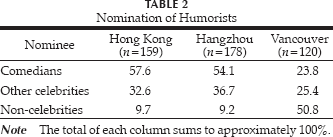
Table 3 displays percentage and ranking of the 10 most frequently nominated humorists for each sample. For all three samples, comedians, and actors dominate the lists. The comedians who topped the list for the three cities were Wong Chi Wah (Dayo) and Stephen Chow (Hong Kong), Charlie Chaplin and Zhao Ben Shan (Hangzhou) and Russell Peters and Jim Carrey (Vancouver). There were several Western comedians in the two Chinese lists, but no Asian comedians in the Canadian list. It is worth noting that many Vancouver students nominated themselves (ranked 7th), but this rarely occurred in the Hong Kong and Hangzhou samples.
Top Ten Most Frequently Nominated Humorists by Sample

Table 4 shows the importance of humor and self-humor across the three samples. The students from Vancouver and Hangzhou rated the importance of humor higher than Hong Kong Chinese (F = 17.42, p < .001, η2 = 0.56). Vancouver students also rated themselves as being significantly more humorous than Hong Kong and Hangzhou (F = 20.81, p = < .001, η2 = 0.44). Taken together, the present results support Hypothesis 2; i.e., Vancouver students did value humor highly and rated themselves as being more humorous than did their Chinese counterparts.
Importance of Humor and Self-humor

‡p < .001.
Discussion
The present findings generally support Hypothesis 1 that Chinese people (Hong Kong and Hangzhou) tended to perceive humorists as comprising mostly humor-related professions whereas Westerners tended to perceive humorists as comprising people from any backgrounds. This can be attributed to the idea that Chinese samples tended to hold the “little humor” view, whereas the Vancouver sample tended to hold the “big humor” view (Yue, 2010, 2011; Yue & Jiang, 2013). That is, Chinese students in either Hong Kong or Hangzhou nominated significantly more comedians than relatives and friends as representatives of humor, and the opposite was observed for the Vancouver students' nomination of humorists. In the Vancouver sample, humor was taken as a positive disposition as well as a common personal trait (Chen & Martin, 2007; Yue, 2011; Yue & Jiang, 2013) whereas for undergraduates in Hangzhou humor was not as much valued or probably practiced (Yue, 2011).
Hypothesis 2 was largely supported in this study as well; i.e., the Vancouver sample, compared with their counterparts in Hong Kong and Hangzhou, associated humor more with ordinary people, valued humor more, and considered themselves as being more humorous. This could be attributed to the influence of collectivism in Chinese culture; i.e., collectivism-based attribution emphasizes hierarchical social structure, respect for authority, and high valuation of social influence (King & Bond, 1985; Bond, 1996; Yue & Rudowicz, 2002; Yue, 2004), while individualism-based attribution emphasizes autonomy and self-expression as well as novelty of thinking and freedom of expression (Amabile, 1996; Mayer, 1999; Sternberg & Lubert, 1999; Ng, 2001; Yue, 2004). In addition, according to Confucianism in the Chinese society, humor was considered to show intellectual shallowness and social informality (Yue, Wong & Hiranandani, 2014). This could explain why the Chinese students would regard humor as being less important and consider themselves as possessing less humor than Westerners (Jiang, et al., 2011).
Limitations and Further Research
Cultural implications of the study emphasized that one's nomination of humorists could help to see how humor is perceived differently across cultures; however, there are several limitations inherent in the present study. First, only university students were sampled in this study; hence, the findings may not be generalized to the diverse populations in Hong Kong, Hangzhou, and Vancouver. Future studies should consider collecting data from people from different professions, classes, ethnic backgrounds, and walks of life to replicate these findings. Second, the present results are preliminary, as they involved only samples from three universities, so future studies ought to involve people from other parts of China and the world. Third, the participants were instructed to use a self-reference to note three humorists but they were not asked to evaluate how humorous these humorists were. Future studies should investigate this. Fourth, the present findings did not find all the hypothesized cultural differences between the Hong Kong and Hangzhou samples.