






Abstract
Throwing techniques represent an important part of Kōdōkan jūdō, aimed at defeating an opponent. Ko-uchi-gari [minor inner reaping throw] is a versatile throw of which the exact origin is unknown. Clear and correct jūdō-specific and didactic terminology are helpful in acquiring the complex motor skills that enable a refined and highly technical jūdō. Ko-uchi-gari relies on the physics principle of a “simple couple,” i.e., an acting pair of two bound opposing forces around the opponent's center of mass with the result, in this case, being perpendicular to those forces, hence producing a torque. Appreciating this may provide an idea about the method this throwing technique is relying on to achieve its success and about its challenges. The purpose of the present paper is to improve the understanding of ko-uchi-gari from a historical, terminological, linguistic, technical, and biomechanical perspective in order to facilitate transferring or acquiring the motor skills necessary to properly master and teach this jūdō throwing technique.
Kōdokan jūdō  1
is a Japanese form of pedagogy, created by Kanō Jigorō
1
is a Japanese form of pedagogy, created by Kanō Jigorō  (1860–1938),
2
based on neoconfucianist values and modern Western principles developed by John Dewey, John Stuart Mill, and Herbert Spencer (De Crée & Jones, 2009). Neoconfucianism is an ethical humanist philosophy and way of life that promotes traditional Confucianist virtues (etiquette, forgiveness, filial piety, honesty, humaneness, integrity, knowledge, loyalty, modesty, respectfulness, and righteousness), while arguing that knowledge is intuitive and not rational. Neoconfucianism formed the philosophic framework of bushidō, the Japanese code of chivalry among the samurai. Dewey, Stuart Mill, and Spencer were influential 19th-century progressive philosophers and political theorists, characterized by a liberal pragmatism, utilitarianism, and empiricism. Furthermore, Dewey is particularly known as a leading American progressive educational reformer.
(1860–1938),
2
based on neoconfucianist values and modern Western principles developed by John Dewey, John Stuart Mill, and Herbert Spencer (De Crée & Jones, 2009). Neoconfucianism is an ethical humanist philosophy and way of life that promotes traditional Confucianist virtues (etiquette, forgiveness, filial piety, honesty, humaneness, integrity, knowledge, loyalty, modesty, respectfulness, and righteousness), while arguing that knowledge is intuitive and not rational. Neoconfucianism formed the philosophic framework of bushidō, the Japanese code of chivalry among the samurai. Dewey, Stuart Mill, and Spencer were influential 19th-century progressive philosophers and political theorists, characterized by a liberal pragmatism, utilitarianism, and empiricism. Furthermore, Dewey is particularly known as a leading American progressive educational reformer.
Jūdō's practical study consists of randori  (free exercises) and 10 different (Kōdōkan) kata
  (predetermined and choreographed physical exercises). The building stones of randori and kata are nage-waza
  (throwing techniques) and katame-waza
  (control techniques; Kanō, 1930a, 1930b, 1930c). In addition to its pedagogical and philosophical foundations, jūdō contains a major physical education component that was derived from several Japanese Medieval unarmed combat schools, known as jūjutsu ryūha
  . In this way, jūdō attempts to realize its triple objective of: shūshin-hō
  (moral training), rentai-hō
  (physical education), and shōbu-hō
  (martial art; Kanō, 1931, 2006; De Crée, 2012).
In jūdō, only selected jūjutsu techniques are used, often refined or modified for safety and modern practicality. Over the last 70 years, the practical physical education component of jūdō has evolved into an Olympic competitive sport. The goals of the sport of jūdō are somewhat different from the more comprehensive goals of jūdō as a pedagogical method. In sports jūdō, the aim is merely to win through scoring points. Points are awarded for a successful throwing technique, for immobilizing and pinning the opponent with both shoulders on the mat for a certain amount of time, or for submitting the opponent through an armbar or choke. The person who performs the throw or technique is often referred to as tori, whereas the person who is being thrown, pinned, armbarred, or choked is often referred to as uke.
The evolution of the sports component of jūdō has caused many techniques to be added to its curriculum, either newly developed or imported from other combat sports, in order to add potential advantages to the competitors' scoring chances. Nevertheless, within its teaching system, the classical techniques developed or approved by Kanō Jigorō represent the majority of practical material that needs to be mastered in order to develop proficiency in the physical application of jūdō. In addition, understanding the principles of those techniques is instrumental to fully capture how mastering practical jūdō is underpinned by its maxims of Sei-ryoku saizen katsuyō  [Optimal use of energy] (usually abbreviated to Sei-ryoku zenyō
  and Jū yoku gō (w)o sei suru
  [Non-resistance overcomes force] (Kanō, 2006). A classical throwing technique within Kōdōkan jūdō that illustrates these principles is ko-uchi-gari
  or “minor inner reaping throw.”
Acquiring the motor skills that enable a refined and highly technical jūdō is a long and hard road. Clear and correct communication in jūdō-specific and didactic terminology is helpful in accomplishing this process. Terminology and categorization of a jūdō throw may provide an idea about the method a technique is relying on to achieve its success and about the challenges it might present to the student. Such terminology and categorization can follow several approaches based on either systematic or personalized didactic views within one's own cultural framework, but also on physics and biomechanics. As our understanding of physics and biomechanics has evolved since the creation of Kōdōkan jūdō in 1882, the question arises whether present day understanding of science has something to offer that may warrant a revision of jūdō terminology or categorization of jūdō throws for pedagogical reasons. The present paper offers an overview of ko-uchi-gari's place and evolution of its categorization among jūdō throws, with an emphasis on its technical and biomechanical properties and challenges. The purpose of this paper is to improve the appreciation and understanding of ko-uchi-gari from a historical, terminological, linguistic, technical, and biomechanical viewpoint in order to facilitate transferring or acquiring the skill necessary to properly master and teach this jūdō throwing technique.
Origin of ko-uchi-gari
The exact origin of ko-uchi-gari is unknown (Daigo, 2005). It does not figure in either of jūdō's two parent schools, Kitō-ryū jūjutsu  and Tenjin shinyōryū jūjutsu
  . Kōdōkan jūdō has adopted several other throwing techniques from Tenjin shinyōryū jūjutsu, such as, notably: ō-soto-gari
  (under the name of mata-futsu
  [thigh sweep]) and ko-so-to-gake
  or ashi-barai
  [leg sweep] (under the name of sukui-ashi
  [leg spoon]; De Crée, 2012). The technique also does not come from the Totsuka-ha Yōshin-ryū
  or from sumō
  , from which different throwing techniques were incorporated into Kōdōkan jūdō (Bennett, 2009, p. 50). However, there exists a technique called uchi kurobushi harai
3
, from which different throwing techniques were incorporated into Kōdōkan jūdō (Bennett, 2009, p. 50). However, there exists a technique called uchi kurobushi harai
3
 [sweeping with the inner side of the ankle] which is part of the curriculum in some koryū
  [traditional martial arts] schools, and which is the likeliest source of Kōdōkan jūdō's ko-uchi-gari.
Ko-uchi-gari is not separately described in the very first jūdō books in Japanese such as those by Uchida Ryōhei and Arima Sumitomo, which date from 1903 and 1904, respectively, and which only describe a few selected techniques. However, it is included in the first jūdō books in Western languages, such as Arima Sumitomo's  1906 book in English, and Sasaki Kichisaburō's
  book in Hungarian (Sasaki, 1907; see Fig. 1). It is also included in Yokoyama Sakujirō
  and Ōshima Eisuke's
  1908 book (in Japanese), as well as in its 1911 French translation by Yves Le Prieur (Yokoyama & Ōshima, 1911). Thus, the technique clearly existed much earlier as it is described being used at the Kōdōkan in a Kōhaku-shiai
  [Red and White promotion tournament] in 1890 by Hirose Takeo
  (1868–1904) (Bennett, 2009, p. 53).
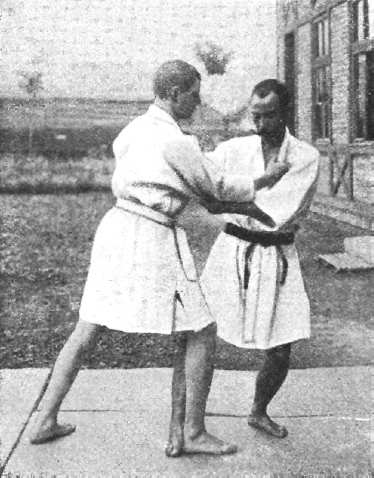
Ko-uchi-gari [minor inner reaping throw] as it appeared in 1907 in the Budapest-published book by Sasaki Kichisaburō (Sasaki, 2007, p. 85).
Definition and description of ko-uchi-gari
Mifune Kyūzō  , Kōdōkan 10th dan (1888–1965), defines the idea behind ko-uchi-gari as follows: “This technique is to reap your opponent's right foot with your right foot or his left foot with your left foot bending like the sickle” (Mifune, 1956, p. 63).
Mifune further describes the technique: “Just when his right foot advances and some weight of his body is set on his foot, you must reap from inside promptly the upper part of his right heel with your right foot bending like the sickle. Simultaneously, make him fall with both hands pushing him instantly towards the right corner” (Mifune, 1956, p. 63).
In the Kōdōkan system, a large number of leg-throws rely on one of three seemingly similar, yet different, ways of making the opponent fall by taking away his leg of support. These three ways are: harau-waza  [sweeping techniques], kari-waza
  [reaping techniques], and kake-waza
  [hooking techniques]. Reaping techniques are distinctively different from sweeping techniques and hooking techniques in so far as the uke (the person being thrown) has more of his body mass leaning on the foot which is attacked, than in a harai movement (where the uke's mass is still mostly on the non-attacked foot), and less than in gake movement (typically uke's full mass is supported by the attacked foot). However, both Mifune and the Kōdōkan waive that distinction when the throw attacks the interior of the leg/foot. Accordingly, Mifune further elaborates on one of the forms of ko-uchi-gari: “Again you can reap the opponent in the right self-defense posture, although somewhat abnormal in this form. In this, you reap the popliteal region of his leg from the inner side with the back of your ankle, and pull him down towards the right back corner” (Mifune, 1956, p. 63).
In performing ko-uchi-gari, the continuation of the lever movement to the back is essential to maintain proper control, even when the reaping foot may already be fully engaged in a rotational motion in the sagittal plane: “This is not different in purport from the case of minor exterior reap, but it is by this technique that you push down the opponent towards the rear corner with relative strength, and you must add carefully and promptly the strength of both your hands to pushdown motion” (Mifune, 1956, p. 64).
In fact, Mifune explicitly warns against failing to maintain this control: “Forgetting to reap and pull the foot sole promptly, you are sometimes apt to sweep it up. In this case, you may be thrown by the opponent's techniques such as Hizaguruma (knee-wheeling), Sasaetsurikomi or Tomoe-nage utilizing your foot believing to have scooped it up” (Mifune, 1956, p. 64).
Kawaishi Mikinosuke  (1899–1969), in his own words, describes ko-uchi-gari in a very similar way (see Fig. 2):

Ko-uchi-gari [minor inner reaping throw] as considered by Kawaishi (1951, p. 36).
Uke stands with his feet spread on one line, or with the right foot forward. Tori quickly steps forward with his left foot; he thus supports his body weight with his left leg. At the same moment, he brings the sole of his right foot as a hook behind uke's right foot and horizontally pursues uke's foot in the direction of his toes. At the same time, he very quickly and forcefully pushes with both arms straight, his fists as a “clothes hanger” slightly lifting uke to avoid letting him regain his balance. Essential, for tori, is to make these movements fast and simultaneously, and to sufficiently have advanced his left leg in order to be able to then pursue uke as far as possible without having to make an extra step.
Note: “Tori's push establishes the imbalance, but tori at the end of the movement [also] can proceed by completing a rotation to the left” (Translated from Kawaishi, 1951, p. 36).
The traditional Kōdōkan jūdō throwing technique classifications
Yokoyama and Ōshima suggest that Kōdōkan jūdō's Nage-waza  [throwing techniques], at one point (pre-1895), initially may have been grouped into three main categories: Taosu koto
  [Throw down techniques], Otosu koto
  [Drop techniques], and Uchi tsukeru
  [Hit and strike techniques] (Yokoyama & Ōshima, 1911, p. 9). The development of throwing techniques in Kōdōkan jūdō is detailed elsewhere (Maruyama, 1939; Kanō-sensei Denki Hensankai, 1984).
The Kōdōkan further classifies jūdō's throws either in one of the three groups of Tachi-waza  or Standing Techniques: 1. Te-waza
  [Hand Techniques], 2. Koshi-waza
  [Hip Techniques], and 3. Ashi-waza
 [Leg Techniques], or in one of the two groups of Sutemi-waza
  or Sacrifice Techniques: 1. Ma-sutemiwaza
  [True (Back) Sacrifice Techniques] and 2. Yoko-sutemi-waza
  [Side Sacrifice Techniques] (Kōdōkan, 1986; Magara, 1992; Kanō, Kawamura, Nakamura, Daigo, Takeuchi, & Satō, 1999). This categorization was largely based on the body part (hand, foot or leg, hip) or body position (standing vs lying down), which was considered most critical to the execution or kake
  phase of the throw. Ko-uchi-gari, accordingly, was ranked as an Ashi-waza type of technique, since it was perceived that it was the leg movement which was dominant for this technique. This classification was already in place by 1889, as is unambiguously evidenced by Kanō-shihan detailing it that year in a lecture held at the Dai Nihon Kyōikukai
  [Greater Japan Society of Education] (Watanabe, 1971).
In 1895, Kōdōkan jūdō's nage-waza became structured in the Gokyō no waza  , consisting of 42 techniques divided over five groups of learning (7 + 7 + 7 + 10 + 11), categorized according to progressive difficulty in executing proper Ukemi
  or breakfalls to safely undergo those techniques (Kanō, 1931; Kōdōkan, 1986). In that original 1895 Gokyō-no-waza classification, ko-uchi-gari was the fourth technique of the fifth and last group (Maruyama, 1939; Oimatsu, 1976; Kōdōkan, 1986; Kanō, et al., 1999). This is rather interesting, knowing that, for example, ura-nage
  , generally considered as one of the more difficult or at least “harder” techniques to fall and throw with, was included in Group 3.
However, in the revised 1920 Gokyō no waza version, which consisted of a total of 40 throws (five groups of eight techniques), this was corrected, and ko-uchi-gari became the second throw of the Dai nikyō  or Second Group (Kōdōkan, 1986; Kanō, et al., 1999). As with many other jūdō throws, the ko-uchi-gari principle knows a number of different expressions or variations (henka
  ). It is interesting to note that one of its effective variations is sometimes also referred to using erroneous terminology and called “ko-uchi-makikomi”
  . No throw under this name has ever existed in Kōdōkan jūdō, and accordingly, was not included in the Gokyō or any of the two appended groups of techniques (the eight Habukareta-no-waza
  [Techniques preserved … from the old 1895 version of the Gokyō …] and 17 Shinmeishō-no-waza
  [newly named techniques]).
Mifune Kyūzō  (1888–1965), in his 1956 Canon of jūdō (Mifune, 1956), and at that time chief instructor at the Kōdōkan, organized jūdō's throws according to five principles that deviated somewhat from Kanō Jigorō's classical Gokyō classification, although each “Principle” equally contained eight throws thus totaling 40 throws, a number which was identical to Kanō's 1920 Gokyō no waza system. In Mifune's system, ko-uchi-gari was included as the first throw of the Second Principle (Mifune, 1956). Most unfortunately, Mifune did not elaborate as to exactly what constitutes the philosophy and pedagogy behind his “Principles.” One can speculate that he was contemplating a third revision of the Gokyō without touching the actual choice of throws made by Kanō, since the 40 throws in Mifune's Five Principles were identical to those included in the 1920 Gokyō, though they are in a different order.
Ko-uchi-gari's appearance in Kōdōkan and non-Kōdōkan-approved jūdōkata
Ko-uchi-gari was not included as a technique in any of the ten Kōdōkan kata. However, it was included in the three Japanese non-Kōdōkan-approved jūdō kata, as follows:
 [Forms of post-initiative response techniques]: Technique No. 6: ko-uchi-gari > < sasae-tsuri-komi-ashi
 [Forms of counters]: Technique No. 3: ko-uchi-gari > < okuri-ashi-barai
 [Forms of reverse throwing techniques]: Series No. 2, Technique No. 2 (= 7th technique) ko-uchi-gari > < hiza-guruma (hidari)
In addition, it was included in several Western-developed non-Kōdōkan-approved jūdō kata:
 [Forms of continuation]: Technique No. 14: yoko-guruma
  + ko-uchi-makikomi
  (≈ ko-uchi-gari)
 [Forms of chain-techniques]: Series No. 2, Technique No. 2: ko-uchi-gake
  (≈ ko-uchi-gari) + rytejime
  & Technique No. 4: ko-uchi-gari + kata-ha-jime
  ; Series No. 3, Technique No. 2: ko-uchi-gari + ashi-gatame
  & Technique No. 3: ko-uchi-barai
  (≈ ko-uchi-gari) + gyakuwaki-gatame
  (Steidele, 1999)
 [Forms of methodology]: Technique No. 5: ko-uchi-gari (Hofmann, 1977)
 [Forms of opportunities of movement]: Series No. 1, Technique No. 2: ko-uchi-gari (Giraldi, 1975)
This implies three appearances in three Japanese non-Kōdōkan-approved kata, and six appearances in four Western non-Kōdōkan-approved jūdō kata. We note that of these nine appearances of ko-uchi-gari in total, eight appearances are as a combination or a counter throw. This is not a coincidence and illustrates ko-uchi-gari's unique suitability for this purpose. Certainly, this is relevant when considering its technical properties or its biomechanical foundation. However, by no means do we suggest that ko-uchi-gari would be less suited as a stand-alone throw.
Non-Kōdōkan historical classifications of jūdō throwing techniques
Probably the most well-known classification of jūdō throws different to that of the Kōdōkan, is the one by Kawaishi Mikinosuke  (1899–1970) in France. Kawaishi's jūdō pedagogical system was influential in France, and in the late 1940s and 1950s also in Belgium, The Netherlands, and Germany. He is probably most known in Europe and other countries for his introduction of the color belt system for kyū
  ranks as an alternative to the Kōdōkan, which only used the colors white and brown to indicate every kyū rank from 6th up to 1st. Kawaishi's seminal book, Ma méthode de judo [My method of jūdō], dates from 1951 and detailed his classification system, which attempted to circumvent potential difficulties for foreign jūdōka unfamiliar with the relatively large vocabulary of Japanese terms used in jūdō; hence, Kawaishi, as an alternative, produced a system based on numbers. The other most noticeable difference with the Kōdōkan system is that Kawaishi's system included an extra category of standing throws, in that he splits the Kōdōkan's Te-waza into two separate categories, namely Shoulder Throws and Hand Throws (Kawaishi, 1951). In his system, ko-uchi-gari is the Sixième lancement de jambe or “6th Leg Throw.” There are 15 numbered leg throws in his classification of jūdō throws. Kawaishi's system also recognizes 15 hip throws, six shoulder throws, nine arm throws, and 15 sacrifice throws which he does not further divide (Kawaishi, 1951).
In Great Britain, Koizumi Gunji  (1885–1965), the founder of the Budōkwai and a founding member of the British Judo Association (BJA), devised his own classification in which he split jūdō throwing techniques into three categories: Kuruma-waza
  [Wheel Techniques], Tenbin-waza
  [Balance Techniques], and Tsumazukase-waza
  [Tripping Techniques] (Koizumi, 1960). He included ko-uchi-gari in the Tsumazukase-waza since he felt the key to the technique was tripping uke's
  [“He who undergoes”] foot and thus preventing him/her from continuing his movement and regaining stability.
However, in 1970 Fujiwara Toyosaburō  (biographical data unknown) introduced three alternative categories to distinguish jūdō throws (Fujiwara, Uchida, & Wilson, 1970). These groups consisted of Ateru-waza
  [Placing Techniques], Karu-waza
  [Reaping Techniques], and Harau-waza
  [Sweeping Techniques] (Sacripanti, 2010). In this system, ko-uchi-gari was listed as a reaping technique. Later classifications, such as that suggested by Tavolucci in 1993, supported classifying ko-uchi-gari as a Kari-waza
  or reaping technique, as Geesink had already done in 1967 (Geesink, 1967, 2000; Sacripanti, 2010).
Recent classification systems of jūdō throws
In 1984, Gleeson attempted to classify jūdō throws according to uke's movement while under tori's  [“the person who is doing the throwing”] control (Gleeson, 1984). The three main groups Gleeson created were “Lifting Techniques,” “Rotating Techniques,” and “Trick Techniques.” Rotating Techniques were then subdivided into “Pure Rotation” and “Transport Techniques.” Ko-uchi-gari, in the Gleeson system, was categorized as a “Rotating (Transport) Technique” in recognition of the forward movement which the uke makes when being thrown prior to rotation (Sacripanti, 2010).
Adams attempted to organize throws based on the contest situation in 1992 (Sacripanti, 2010). He suggested that ko-uchi-gari was most effectively employed as a backward throw inside the uke's arms. Unlike the jūdō throws classification systems introduced by Kawaishi and Koizumi, neither the Gleeson nor the Adams system seem to have been incorporated by many followers among the jūdō population, or other authors for that matter. One might speculate that a major reason is that these alternative systems are not perceived to offer tangible advantages either in the progression of the average jūdō student, or in the competitive success of the elite player. Thus, the principles underpinning the execution of ko-uchi-gari seemed to have reached a degree of consensus in terms of focus and emphasis.
One of the most interesting classifications, though, was proposed by Dr. Ashida Sachio  (1924–2009) in 1995. Ashida, later Kōdōkan 8th dan and United States jūdō Federation (USJF) 9th dan, was a professor of psychology who had emigrated from Japan. He suggested a simple classification of jūdō throws based on the direction of the force vector. His system used just two subdivisions: 1. Lift and thrust, and 2. Lift and wind (Sacripanti, 2010). In the first category, the tori has to significantly overcome his adversary's defense resulting from the combination of body mass and shifting of balance and reactions (e.g., ō-soto-gari
  [major outer reaping throw], ō-uchi-gari
  [major inner reaping throw]). In the second group, Ashida suggests that some techniques (e.g., seoi-nage
  [Back/shoulder carrying throw], uchi-mata
  [inner thigh throw]), however, achieve their effect through partly or chiefly relying on centripetal force and the conservation of angular momentum (Sacripanti, 2010). Ashida's classification, from a biomechanical point of view, was interesting because unlike several of the previous classifications, it mainly relied on an understanding of the throws' biomechanical foundation.
Yiannakis (2011) proposed that jūdō techniques are built from combinations of structural elements and operational principles in a variety of configurations and directions, as well as contextual principles. However, rather than a useful or practical classification to categorize or discriminate between throws and their underlying mechanisms, her terminology represented a more generalized description of a set of pointers, of which some, but oftentimes not all, may play a role in a specific technique, and which an instructor might consider when supervising a particular individual. As far as classification of throwing techniques is concerned, Yiannakis (2011) adopted the Kōdōkan's Gokyō system.
The biomechanical classification of ko-uchi-gari
Attilio Sacripanti (born 1947), an Italian physicist and biomechanics professor, devised the first comprehensive scientific biomechanical classification of jūdō techniques in 1987 (Sacripanti, 1987, 1997, 2010, 2011). Through the utilization of biomechanical principles, he concluded that throws could be classified in two groups. The groups he devised were what he called “Physical Lever” and “Couple of Forces” (Monti & Sacripanti, 1995; Sacripanti, 2010, 2011). Physical Lever techniques were those techniques where a force was applied with the arms against a fulcrum to complete the throw (Sacripanti, 1997, 2010, 2011). Physical Lever techniques were further subdivided into the divisions of Minimum Arm, Medium Arm, Maximum Arm, and Variable Arm. The relative height of the fulcrum created for the throw determines the arm-lever group it should be classified into. The higher the fulcrum on uke's body, the less arm force is required to execute such a throw effectively (Sacripanti, 2010, 2011).
With regard to “Couple of Forces” throws, a “couple” in mechanics is “a set of bound vectors whose resultant is equal to zero” (Kane & Levinson, 1985, p. 94). However, this resultant is equal to zero only if it lies in the same plane as those forces. If, on the other hand, the resultant is perpendicular to the direction of the forces, then the resultant is not zero, but a torque. Furthermore, “a couple consisting of only two vectors is called a ‘simple couple.’ Hence the vectors forming a simple couple necessarily have equal magnitudes and opposite directions.” (Kane & Levinson, 1985, p. 94). The moment of the couple around a point is the torque of the couple, and is unique in a sense that “a couple has the same moment about all points” (Kane & Levinson, 1985, p. 94). Sacripanti uses the term Couple of Forces to indicate such a set of bound vectors that represent the acting pair of two opposing forces around the center of mass, with the resultant force being perpendicular to those forces and thus producing a torque. Thus, in the case of jūdō throws, this grouping was based around techniques where two opposing forces were applied to perform the throw.
“Couple of Forces” techniques were also further subdivided into:
Arms Arm(s) and Leg Trunk and Legs Trunk and Arms Legs
Ko-uchi-gari was classified as a “Couple of Forces, Arm(s) and Leg technique” (Fig. 3). Ko-uchi-gari requires a clear opposing set of forces provided by the Tori's arms driving the Uke to his rear corner and Tori's foot reaping Uke's foot in the opposite direction, thus forwards (Sacripanti, 2010, 2011).

The set of bound vectors about the center of mass, which represents the mechanical “couple” active during ko-uchi-gari, is shown by both arrows pointing in opposite directions their middle point being the center of mass. From Sacripanti, 2010, by permission.
Sacripanti further determined that, for the purpose of teaching, the forces acting in jūdō throws could be described within the body's three biomechanical planes of symmetry: the sagittal, frontal, and transversal plane. In ko-uchi-gari, as such, the forces operate in the transversal plane. The tori, who is applying the “couple of forces,” or more specifically, the “simple couple,” thus moves in the sagittal plane. At the same time, the movement incorporates a rotation around the vertical axis involving the trunk/leg compartment which encompasses the coxo-femoral articulation. These two concomitant actions highlight the flexibility the tori needs in order to perform ko-uchi-gari effectively.
Major points of attention in ko-uchi-gari
From the above technical descriptions by Mifune and Kawaishi, respectively, it is clear that emphasis should be devoted to executing the ko-uchi-gari movement with sufficient speed and promptness, with sufficient control to maintain uke's imbalance, and with attention to reaping in the direction of uke's toes.
Often though, when ko-uchi-gari is taught in jūdō clubs or during clinics, one or two important points may be highlighted, but several others are ignored or not fully understood. While reviewing ko-uchi-gari as part of the first ever international jūdō coaching qualification course, i.e., the first European Jūdō Union [EJU] Level 6 Coaching Award course and the inaugural class of the University of Rome's Master's Degree in Teaching and Coaching Jūdō, students (14 black belts with prior advanced instructor and coach credentials and having been internationally recruited) were asked about important technical points for ko-uchi-gari. The responses and suggestions they gave, placed emphasis mostly on pushing with both arms, but did not fully consider some other crucial points. If the frequent errors (as observed by the authors during both national and international club visits, clinics, seminars, and competition) made by jūdōka when practicing and attempting ko-uchi-gari, and by coaches and instructors while teaching this technique, accurately reflect how this throw is frequently understood, then these responses reflect that its principles and important points are only partly appreciated. Even Mifune's and Kawaishi's descriptions of the technique do not fully tell the story as they largely focus on the kake or execution phase, but not on the preparatory work or what precedes in order to properly perform this technique in agreement with Kanō's maxims of maximal efficiency at minimal effort and overcoming strength with yielding.
The Kōdōkan, as well as most popular books on jūdō, typically teach that a jūdō throw consists of three phases, in the following order: 1. tsukuri  [preparation], 2. kuzushi
  [unbalancing], and 3. kake
  [execution] (Kōdōkan, 1986, pp. 42–44). Thus, at the most, these three objectives are the focus of technical attention by teachers and jūdō books, while a common error in learning jūdō throws often involves one or more of these objectives being ignored or forgotten. Another question is also whether these three objectives, as commonly mentioned within Kōdōkan sources, adequately and comprehensively establish the essence of jūdō throws.
Hirano Tokio  (1922–1993) argued that a jūdō throw, in fact, has four phases, most commonly: 1. kumu
  [gripping], 2. tsukuri
  [preparation], 3. kake
  [execution], and nageru
  [throwing], and No. 1 and No. 2 should be reversed, thus tsukuri preceding kumu (Chen & Chen, 2002). Observations of contest jūdō at the Olympic, world, and continental championship levels over the last two decades show that the majority of jūdōka in modern times strongly adhere to a preferred or personalized grip which they attempt to establish in every fight and which is aimed at controlling the opponent and at representing the starting point of any eventual action. Contemporary competition-oriented textbooks of jūdō and many seminars often favor this approach (Adams, 1992). Hirano, however, offers a diametrically opposed view emphasizing that gripping should not be predetermined and used to start off with or “set up” a technique. Instead, gripping should be the logical consequence (following Kanō's maxims) after tsukuri, with that tsukuri action simply representing what the opponent is doing. Hirano usually does not distinguish a separate kuzushi phase, since the opponent, as a result of his own movements, will always have a relative imbalance somewhere, which the ensuing choice of gripping then will simply reinforce. This also has implications on how to perform ko-uchi-gari, in particular in recognizing when uke completes what is sufficient to reach a suitable position in which ko-uchi-gari is the proper choice (Hirano, 1969).
According to De Crée (2012), while accepting Hirano's reversal of tsukuri preceding kumu, the three stages provided by either the Kōdōkan or Hirano still do not fully capture all essential technical parts of a proper jūdō throw. Consequently, De Crée recognizes seven phases:
Debana Tsukuri Kumu Kuzushi Kake Nageru Zanshin
 [The opportunity and optimal moment to succeed]
 [Preparation]
 [Gripping]
 [Unbalancing]
 [Execution]
 [Throwing]
 [The follow through, literally, the “continuation of the spirit”]
The order of Phases 1 through 4 may change depending on the specific circumstance. These seven phases are jūdō-technical, jūdō-motor skills, and jūdō-philosophy and -pedagogy. They are neither physical nor biomechanical principles. There are clearly different physical principles that apply to the tsukuri/kuzushi (i.e., so-called “action invariants” that build on the Hamilton-Lagrange equation and Hamilton Action Principle) and to the kake (lever techniques vs “couple of forces” techniques) phases (Sacripanti, 2010). Yet, all seven phases detailed above are important in a pedagogical and skills-acquisition sense. For example, even if completely mastering the unbalancing that needs to precede execution of a throwing technique, this will fail to reach the desired result if one does not fully grasp what precisely is and how to discern debana or the proper moment and opportunity to apply that unbalancing. Similarly, if you do not master zanshin, you might be able to throw the opponent, followed up by your opponent choking you out hence effectively securing his win over you. However, in terms of pure physics and biomechanics, it is virtually impossible to distinguish so many different phases as they flow into each other as a single movement, allowing, at the most, three phases in which distinctive physical principles may occur, precisely as described by Sacripanti (Sacripanti, 1997, 2010, 2011). Thus, from a mechanical point of view it would not be helpful to distinguish as many as seven different phases. These reflections on the pedagogical and skills acquisition issues fit well with the analytical understanding that in order to produce a lever action in agreement with the principles of jūdō, it is beneficial to find an ideal opportunity that maximizes unbalance with the least possible effort. However, whether very little or very much effort, the physics and mechanical principles remain generally identical though only the action requiring the least effort truly represents the spirit of jūdō and that which the jūdōka ideally needs to be striving for. It is thus not merely a matter of succeeding in placing a throw, but also how that throw is achieved.
The meaning in Japanese of the word Zanshin, as it is used in budō, technically is a philosophical phase, which follows the execution though it is certainly not a follow-up technique. The term is most apt explained in kyūdō  [archery] and the various arts of the sword (iaijutsu
  , iaidō
  , kenjutsu
  , kendō
  ). However, zanshin manifests itself in continuing control of the uke, after he has hit the mat. “Continuing control,” in this sense, does not imply following up with katame-waza
  [holding techniques], but being in control of one's ki
  [spirit], one's self, and the opponent. The term zanshin is not frequently heard in jūdō, and some, for example in the Kōdōkan, have even argued that zanshin does not exist in Kōdōkan jūdō. That is, however, not quite true. The parent school of jūdō that provides the major philosophical foundation for Kōdōkan jūdō's throwing techniques, is Kitō-ryū jūjutsu
  . Every throw of the Omote-kata
  series of Kitō-ryū's Yoroi kumi-uchi-no-kata
  , nearly integrally exported by Kanō-shihan into jūdō as Koshiki-no-kata
  [The Antique Forms], ends in and emphasizes zanshin, in this case, strongly tied in with the position Kurai-dori
  (the seated safety position in which the tori must have reached great awareness and alertness of his surroundings while maintaining the utmost calm and a dissolution of the Self).
The term zanshin  , when split up in its components, literally means “the remaining mind,” although the compound term is more correctly translated as “the continuation of the spirit.” In the biomechanical explanation of jūdō throws, Sacripanti uses the term as “the follow through,” which is indeed also a correct translation of the Japanese word zanshin, but the term “follow through” in the biomechanical sense is explained in an entirely different way and implies a “follow-up,” that is to say, the necessary control over uke's “body flight” in such a way that if no ippon [one full point] is scored, would allow an ensuing control technique. Thus, from the biomechanical or physical point of view when considering a jūdō throw, the throw (the original technique) at that point has already been carried out, but a second technique may be applied to follow up. However, that is not entirely what zanshin means in Japanese or in its use in budō including jūdō. Zanshin is an integral part of one, thus each and every single throwing technique. Admittedly, there is a shift in level of discourse when zanshin is used to emphasize the purpose (i.e., a higher level of purpose which the technique should express) rather than the actual follow-up technique.
The continuation of control should require more attention in teaching of throws, and thus also with regard to ko-uchi-gari. Furthermore, in achieving proper kuzushi, nageru, and zanshin, correct use of the hara  [belly] and tanden
  (the philosophical focus point below the navel which is considered critical as a center of energy in Japanese and Oriental philosophies and budō) is essential. So, is the proper use of Newton's Third Law (action vs reaction), in order to apply the underlying biomechanical lever principles in such a way that they are realized with minimal effort and while maximally yielding.
To teach or evaluate ko-uchi-gari correctly requires extraordinary jūdō skills and understanding. One person possessing total mastership of this technique and those skills, is Okano Isao  (born 1944), the legendary Tōkyō Olympics 1964 Middle-weight winner, 1965 World Champion, and only middle-weight jūdōka to have won the no-weight class post-World War II All Japan Championships twice (Fig. 4).

Legendary jūdō champion Okano Isao (born 1944), shown here executing a powerful ko-uchi-gari, during the 1964 Tōkyō Olympics on his way to the gold medal. The driving force of the arms and reaping action of the foot are clearly visualized here.
Thus, the illustrative material (Figs. 5–9) presented here is meant to underpin the points raised in the above paragraphs, i.e., the complexities involved in correctly performing ko-uchi-gari. A theoretical comprehension of the different phases of a technique unfortunately does not yet guarantee proper performance. After all, the teacher or coach must be able to understand and discern these mistakes, and the jūdōka must master the motor skills necessary to do all these. This requires time, dedication, skills, and expertise for both the teacher and jūdōka. We believe that biomechanical analysis deserves a proper place in assisting in this process. Through understanding the biomechanics, one may better comprehend the effect of one's technical flaws and the impact of these on the desired outcomes. The Japanese have long understood and applied this. Yamaguchi's academic thesis explored the kinematics and biomechanics of ko-uchi-gari (Yamaguchi, 1992), and the same jūdō throw also has been the focus of an extensive study by Yabune, Tokuda, Nagatani, and Yano (2006), hence we refer to either these works or to Sacripanti's for those wishing to review the biomechanics of ko-uchi-gari in more depth. Furthermore, a few authors have also attempted kinematic or biomechanical studies on a number of other popular jūdō throws [Blais, 2004 (seoi-nage and uchi-mata); Himpe, 1978; Minamitani, Fukushima, & Yamamoto, 1988; Trilles, Lacouture, & Cadiere, 1990; Yabune, Tokuda, Nagatani, & Yano, 2005b (uchi-mata); Imamura, 1996; Imamura, Iteya, & Takeuchi, 2005; Imamura, Hreljac, Escamilla, & Edwards, 2006; Okada, 2008; Yabune, Tokuda, Nagatani, & Yano, 2005a (ō-soto-gari); Yabune, et al., 2006 (ō-uchi-gari); Imamura, et al, 2006; Imamura, Iteya, Hreljac, & Escamilla, 2007; Pucsok, Nelson, & Ng, 2001; Yabune, 1995 (harai-goshi); Harter & Bates, 1985 (harai-goshi and other hip throws); Imamura, et al., 2006; Yabune, Tokuda, Nagatani, & Yano, 2004; Yoshitaka, 1992 (seoi-nage)].

Okano Isao-sensei (born 1944), here during a jūdō seminar, explains the importance of tori's pushing action being initiated and remaining in the sagittal plane. It is crucial that during the preparation phase, uke [“the person being thrown”] is brought on his heels, and kept on his heels with control. To get uke in that position is ideally done by applying Newton's Third Law of action/reaction, and provoke uke by pulling him, so that he reacts by resisting toward the back. Depending on uke's jūdō skills, reactions, way of moving, and relative control, this may not always be possible; in such case, “pushing” uke on his heels offers an alternative, although less elegant, and less in respect of Kanō's maxims. Direction of pushing is as illustrated in Fig. 3. Demonstrating here is Okano Isao-sensei  (born 1944); uke is Okano-sensei's son Okano Tetsuo. Picture taken August 31, 2008.

Equally crucial is to maintain control (pushing action toward the ground behind uke's [“the person being thrown”] right shoulder), and to push the hara [belly] toward the tatami. This is one of the most common mistakes, even by jūdō instructors and well-known champions. Control should not end at the beginning point of the reaping and uke starting to fall, but should be maintained throughout the final point of zanshin  [the “follow through”]. Demonstrating here is Okano Isao-sensei
  (born 1944); uke is Okano-sensei's son Okano Tetsuo. Picture taken August 31, 2008.

Multiple Canadian national champion and Sydney Olympics 100-kg silver medalist jūdō Nicholas Gill demonstrates ko-uchi-gari, in response to Okano-sensei's request. Gill is a very good technician with an impressive competition record. Yet, his ko-uchi-gari, as shown, still has room for improvement. This demonstrates the point raised earlier in this paper, that many, and arguably most, top athletes and champions, including the most skillful among them, still have major errors in their techniques. In this case, the error is two-fold. Figure 7d shows that Gill's left arm (he is performing hidari-ko-uchi-gari, i.e., the left version of the throw, instead of migi-ko-uchi-gari, hence the switch in arms) is pushing only in front of uke's right shoulder instead of behind. In addition, Figure 7e shows that Gill does not maintain proper control with his hara [belly] which is insufficiently involved and is moving sideways to the left as is his reaping foot, instead of being pushed forward downward to the tatami.

Belgian former Olympic champion Robert Van de Walle (born 1954), 8th dan, is demonstrating ko-uchi-gari during a 2010 jūdō guest clinic. While it is reasonable to assume that Van de Walle is “being kind” to his much lighter uke, he does make the same mistake as Nicholas Gill did in Figure 7, failing to properly control with the hara [belly] and continuing to push the hara toward the ground into the moment of zanshin  [the “follow through”]. Moreover, Van de Walle makes an additional mistake when compared to Gill, i.e., that his left arm has insufficient directional control (toward the tatami in order to keep uke's [“the person being thrown”] balance on his heels). Gill in Figure 7 clearly has the better arm control. The fact that he is obviously able to “get his uke on the ground” is not relevant in this context.

Okano Isao-sensei (born 1944) is seen here correcting Gill's error in hara  [belly] control, mentioned in Figure 7, by showing how it needs to be done. The hara thus must be moved forward and pushed forward downward to the tatami. Uke is Okano-sensei's son Okano Tetsuo. Picture taken August 31, 2008
For those seeking guidance in the non-physical and non-biomechanical aspects of ko-uchi-gari, we refer to the books by Kudō (1967), Okano and Satō (1973), and Swain (1994), or the videos or DVDs by Okano (no date) or Mifune (Mifune, 1955). However, nothing replaces a qualified teacher who truly masters kuzushi, debana, and control, as did, for example, Okano Isao, Hirano Tokio, Marcel Clause (Clause, 2003), Mifune Kyūzō, and a handful of others.
Evaluation and conclusion of Sacripanti's biomechanics-based jūdō throws classification system
Sacripanti's work is the result of thorough insight into the physics and biomechanics of motion. As a physicist he was able to access, comprehend, and spearhead un-exploited terrain in the application of physics to jūdō. In this paper we used the technique of ko-uchi-gari to partially evaluate the advantages and disadvantages of applying Sacripanti's approach. One can observe and apply the simple classification of his “Physical Levers” versus “Couple of Forces,” perhaps with the sole caveat that the term “Simple Couple” probably is grammatically less confusing and mechanically less ambiguous. Whilst biomechanical analyses of jūdō throws have been in existence for nearly 60 years (Ikai & Matsumoto, 1958; Ikai, Asami, Kaneko, Sasa, & Matsumoto, 1963), Sacripanti went much further and provided a solid system that does not stop at analyzing standing jūdō throws, but also deals with sutemi-waza, katame-waza, kumi-kata, ukemi, balance, and even jūdō matches and scores.
Although Sacripanti's classification may not replace the Kōdōkan classification of throws, his system has considerable merit without that. We note that neither the Gleeson nor the Adams system has presented a real challenge to the Kōdōkan categorization, and Kawaishi's system, which once was widely spread in Europe, in time was essentially overwhelmed by the Kōdōkan system. There may be merit to jūdō withstanding some “trendy” changes in technique classification, such as in particular terminology stemming from “Brazilian Jiu-Jitsu” (for example, “guard,” “half guard,” “the Kimura,” and “the Ezekiel”) since they do not facilitate better communication and achieving Kanō's educational goals. However, the Kōdōkan also suffers from the other extreme, i.e., a resistance against a modern restructuring of some of its teachings, even if a progressive approach might offer a valuable alternative from a pedagogical point of view.
Sacripanti's biomechanical classification is more extensive and comprehensive than the previous attempts in jūdō by other authors. For example, it is excellently suited for identifying mistakes, or for seeking application in identifying an opportune technical approach for athletes with injuries or those who have to face a particularly difficult opponent. Kōdōkan jūdō is a 19th-century pedagogy for which the philosophical principles may well coexist with the biomechanical expression even if a more scientific analysis can achieve selected objective results more effectively. In fact, we only see a minor temporary challenge in that jūdō teachers, instructors, and coaches will need to be trained in order to improve their understanding of the physics and biomechanics that are illuminated and emphasized by Sacripanti's approach.
Footnotes
1
For absolute rigor, long Japanese vowel sounds have been approximated using macrons (e.g., Kōdōkan) in order to indicate their Japanese pronunciation as closely as possible. However, when referring to or quoting from Western literature, the relevant text or author is cited exactly as per the original source, with macrons used or omitted accordingly.
2
Japanese names in this paper are listed by family name first and given name second, as common in traditional Japanese usage and to maintain consistency with the order of names of Japanese historic figures.
3
Kurobushi is also a medical pressure point that, according to some old jūjutsu schools, is the most painful on the body and even lethal if properly manipulated.
References
 ) [
) [ ),
),  ).
). ) (
) ( ) [
) [ ) (
) ( —)] [The meaning of kata and randori practice: Part 1]
 ) (
) ( )] [The meaning of kata and randori practice: Part 2]
 ) (
) ( )] [The meaning of kata and randori practice: Part 3]
 ) (
) ( ) [
) [ )
)  )
)  )
)  )
)  ), &
), &  ) (Eds.) (
 ).
).  ) [Editorial Committee for the Biography of Kanō-sensei]. (Eds.) (
 )
)  ) (
) ( ) (
) ( ) [Nomenclature of Kōdōkan jūdō techniques]
 ) [Meiji University Collection of Educational Essays Physical Education],
  ) [
) [ ) (
) ( ) [
) [ ). Pp.
  ) (
) ( ) [Mifune 10th dan [complete edition]: The essence of jūdō]. [DVD] Nihon Eiga Shinsha (
 ), 1955.
  )
)  ), &
), &  ) (Eds.) (
 ) [
) [ ). [in Japanese]
 ) (
) ( ) [Revised edition of
  ), Pp.
  ) (
) ( —) [Study of breaking the opponent's balance in ō-sotogari during the Jigorō Kanō Cup 2005]
 ) [
) [ )) (no date)
  ) [Okano Isao's vital judo: My preferred techniques. Vols. 1 & 2]. [VHS Videotapes] Self-published. [in Japanese]
 ) [
) [ ) (
) ( ).
).  ) [Black Dragon Society Publishers]. Pp.
  ) (Ed.) (
 ) [
) [ ). Pp.
  ) (
) ( ) [A study of harai-goshi from the viewpoint of the motion and forces exerted by arms and legs]
 ) [
) [ )
)  )
)  ), &
), &  ) (
) ( ).
).  ). Pp.
  )
)  )
)  ), &
), &  ) (
) ( ).
).  ). Pp.
  )
)  )
)  ), &
), &  ) (
) ( ).
).  ). Pp.
  )
)  )
)  ), &
), &  ) (
) ( ).
).  ); Pp.
  ), &
), &  ) (
) ( ) [
) [ ). [in Japanese]