






Abstract
This research provides an innovative solution for optimizing learning effectiveness and improving postsecondary education through the development of virtual simulators that can be easily used and integrated into existing wind energy curriculum. Two 3D virtual simulators are developed in our laboratory for use in an immersive 3D virtual reality (VR) system or for 3D display on a 2D screen. The goal is to apply these prototypical simulators to train postsecondary students and professionals in wind energy education; and to offer experiential learning opportunities in 3D modeling, simulation, and visualization. The issue of transferring learned concepts to practical applications is a widespread problem in postsecondary education. Related to this issue is a critical demand to educate and train a generation of professionals for the wind energy industry. With initiatives such as the U.S. Department of Energy's “20% Wind Energy by 2030” outlining an exponential increase of wind energy capacity over the coming years, revolutionary educational reform is needed to meet the demand for education in the field of wind energy. The development and implementation of Virtual Simulators and accompanying curriculum will propel national reforms, meeting the needs of the wind energy industrial movement and addressing broader educational issues that affect a number of disciplines.
The issue of transferring learned concepts to solve complex problem-solving tasks is a learning barrier resulting in an inability to perform innovative thinking, which hinders learning performance and work production (Koedinger & Roll, 2012; Yang, Hanneke, & Carbonell, 2013). These educational setbacks are especially being felt in the rapidly growing wind energy industry. There is a shortage of professional experts and scholarly researchers capable of applying relevant concepts to the design and operation of wind turbines and wind farms. This research implemented an innovative solution using Virtual Wind Turbine Simulators for Wind Energy Education that addressed the issue of knowledge transfer, while simultaneously increasing the number and quality of critically needed wind energy professionals. Such a solution would not be limited only to the wind energy industry, but could be expanded or modified to address knowledge transfer across multiple domains (e.g., Richland, Stigler, & Holyoak, 2013).
Two serious educational problems are being raised: (i) limited training for students to transfer learned concepts to practical applications and (ii) lack of educated professionals in wind energy. The issue of knowledge transfer, i.e., transferring learned concepts to practical applications, is a widespread problem experienced in postsecondary education (van Gog, Kester, & Paas, 2011; Day & Goldstone, 2013). This predicament is visible across domains and limits the ability of postsecondary education to prepare students for problems they will face as professionals. Students can often fail to apply knowledge learned in the classroom setting to real world problems. The students retain the classroom knowledge, but do not recognize when it is appropriate to apply in situations outside of school (Kalyuga, Renkl, & Paas, 2010; Meissner & Bogner, 2012).
Despite large monetary investments in wind energy, modern wind farms and individual wind turbines have lower power output and operational uptime than design forecasts, leading to suboptimal economics of wind power (Kusiak, Zheng, & Song, 2009). The workforce does not yet exist to sufficiently optimize current wind energy systems. There are approximately 85,000 professionals working in the United States wind energy industry today (American Wind Energy Association, 2010; Wind Powering America, 2010). These professionals are responsible for the currently installed 35,000 Megawatts of wind energy capacity in the country (U.S. Department of Energy, 2009). A guiding document within the U.S. wind industry is a Department of Energy report that details a number of challenges that must be overcome in order to meet a goal having wind energy account for 20% of the nation's electricity by the year 2030 (U.S. Department of Energy, 2008, 2009). Meeting this goal would require an increase of wind energy capacity from 35,000 Megawatts to 300,000 Megawatts. In addition to constructing enough wind turbines, and developing the necessary power grid infrastructure, a significant increase in number and quality of wind energy professionals is needed to meet current and future demands.
Three-Dimensional (3D) Virtual Wind Turbine Simulator
The 3D Virtual Wind Turbine Simulator is ideally suited for an immersive 3D Virtual Reality (VR) system, but can also be used on standard computer with 3D monitor, regular 2D monitor, or portable device (laptop, tablet, smart phone, or handheld computer). For the non-VR implementations of the simulator, the content can also be delivered online. In this simulator, in the case of VR, students wear 3D glasses and interact with a full-size working model of a wind turbine.
The student can easily walk or navigate through the model, observing the turbine from the ground, climbing up the inner structure of the tower, standing inside the upper nacelle to observe the inner mechanics of the system, or floating in the air outside the turbine. Each part of the wind turbine will be visibly simulated, allowing students access to the working components and allowing them to learn about wind energy in the appropriate context and providing the experience of how the systems really work.
Immersive experience through VR and various computer simulations has been shown to improve learning transfer of complex concepts (Behringer, Christian, Holzinger, & Wilkinson, 2007; Christian, Krieger, Holzinger, & Behringer, 2007; Holzinger, Kickmeier-Rust, Wassertheurer, & Hessinger, 2009). For instance, the use of computer simulation software, Cytotrainer, exposed students to virtual genetics training. Instead of the traditional cytogenetic analysis where students had to manually cut out chromosomes on paper and rearrange them, Cytotrainer provided a visual and proactive approach to examining an assortment of chromosomes. An example of a beneficial feature of the simulator was the virtual microscope which allowed students to zoom in to examine specific chromosomal metaphases that were occurring. Both students and teachers were satisfied and motivated to learn with the Cytotrainer as it provided a more realistic method for students to work with instead of the customary paper cut outs. Overall, the simulator was effective in enhancing the comprehension of more complex details found in cytogenetic analysis by providing a virtual training of the concepts (Holzinger, Emberger, Wassertheurer, & Neal, 2008). It was also important that virtual learning had the ability to take place independent of location, especially today in our knowledge-based e-society. Students should learn from other sources besides a regular PC (Holzinger, Nischelwitzer, Friedl, & Hu, 2010; Larsen, Soerensen, & Grantcharov, 2009; Sanchez, Rodriguez, Gutierrez, Preusche, & Casado, 2012). Hence, the simulator in our research project will be integrated into relevant curriculum and used extensively by students both inside and outside of their classroom (i.e., approximately 10% of in-class activities will utilize the simulator as well as substantial usage outside of class for homework and study).
Wind Energy Training and Education
The 3D virtual simulators for wind energy education are a series of simulators that can be delivered in multiple formats including virtual reality (VR), augmented reality (AR), mixed reality (MR), desktop computer, and mobile devices. The level of virtualization was the key difference between augmented reality and mixed reality (Behringer, et al., 2007). AR was when the real world operated as the main functioning framework with few virtual items included, and in mixed reality the virtual environment was the central framework. Generally, augmented and mixed reality systems were required to track the viewing direction and position of the user. MR technology provided training that did not require an actual patient to be present since it depended more on virtual reality. AR technology was used in teaching motor skills to individuals who had experienced a stroke. Augmented reality allowed for new experiences with learning occurring through the interaction with computers. In the past, learning and training achieved with low-cost augmented reality technology had been utilized in various areas such as mathematics, biology, and aeronautical engineering (e.g., Behringer, et al., 2007; Nischelwitzer, Lenz, Searle, & Holzinger, 2007). Christian, et al. (2007) examined the educational application of augmented technology and virtual reality in training and maintenance in aviation. Training scenarios were set up for a target group in aviation which included the pilot and the maintenance technician who either performed maintenance directly on the aircraft or in the workshop. The augmented reality was beneficial as it allowed for the 3D training material to be viewed in various settings such as at the workplace or workbench. Compared to the traditional face to face method of learning, the e-training in aviation operation and maintenance had great potential as it combined the specific learning concept with augmented and virtual realities.
The simulators examined in this article were not only delivered in VR and desktop computer, but can be modified for various formats and platforms as needed. AR is a type of technology that allows the user to see the real world, with virtual objects superimposed upon or composited into the real world (Milgram & Kishino, 1994; Milgram, Takemura, Utsumi, & Kishino, 1994). AR can be accomplished using various technologies, including mobile devices. There have already been some notable efforts to use MR and AR in the field of wind energy (e.g., Herman, 2012; Ecomagination, 2013). However, many of these earlier trial and error efforts leverage the novelty of the technology for business marketing rather than postsecondary education. Throughout the years, there has been much research on the application of mobile devices to education (Behringer, et al., 2007; Christian, et al., 2007; Holzinger, Kickmeier-Rust, & Albert, 2008; Maag, 2006; Schmitt, Rodriguez, & Clothey, 2009; Holzinger, Koiner, Kosec, Fassold, & Holzinger, 2012).
Combining mobile devices with AR provides a unique ability to deliver context specific information as needed, by overlaying the information on top of the visual image of the real world. In addition to AR, these simulators may also be used with other devices as well including computer with monitor, laptop, tablet, smart phone, or handheld computer.
The purpose of these simulators is to provide training and enhanced interaction when dealing with operations and maintenance of wind energy systems (Fig. 1). Separate simulators are being developed that cover different aspects of wind energy education which will include Aerodynamics, Control Systems, Safety, and Siting as well as a template that will be available for educators and wind professionals to create additional simulators that may be better suited for specific training (Fig. 2). These simulators will be integral to the learning modules, encompassing up to 50% of the students devoted time.

A utility-grade wind turbine simulator allows students to interact either through an avatar, or by flying around freely to explore components and inspect systems critical to wind farm operation.
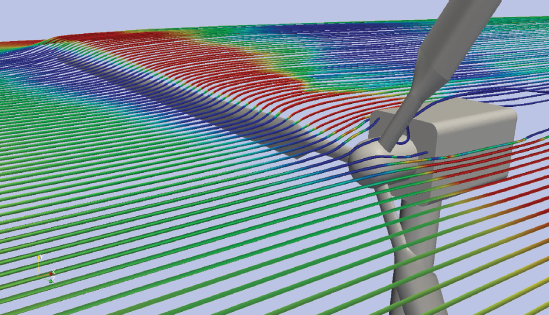
Simulators exploring aerodynamics wind simulations show the effect of wind turbine design on turbine efficiency through changes in air speed velocity and pressure.
Virtual and Augmented Reality Technologies
Virtual and particularly augmented reality technologies have become significantly more accessible in recent years due to the increased capabilities of mobile devices such as smart phones and handheld computers (Srinivasan, Fang, Iyer, Zhang, Espig, Newell, et al., 2009). While a number of early efforts have been made to develop MR learning materials in various fields (Abawi, Dörner, & Haller, 2005; Behringer et al., 2007; Christian et al., 2007; Mujacic, Debevc, Kosec, Bloice, & Holzinger, 2010; Holzinger, et al., 2012), cost and technological limitations have prevented wide-spread adoption. Advances in mobile computing provide great potential to continue these early efforts and develop materials that are easily accessible and distributable on popular consumer-level mobile devices (Holzinger, et al., 2010; Mujacic, et al., 2010; Holzinger, Lehner, Fassold, & Holzinger, 2011a).
In addition to early efforts by others, the authors have successfully implemented virtual simulators and related projects for use in coal power generation, various projects in the steel industry, and other related work (Moreland, Wu, & Zhou, 2010). Of particular note is the development of a 3D Virtual Blast Furnace Simulator that has been developed and is currently being implemented in training materials in the Steel Industry (Wu, Ratko, Ren, Hu, Jin, & Zhou, 2010).
Method
The current research project (1) assesses whether the 3D virtual simulators can be used as learning supplemental tools in a classroom setting and (2) provides usability feedback in the development of mixed reality simulators for wind energy education, by measuring the changes in student perceptions resulting from training using two 3D virtual simulators. The goal is to evaluate the effectiveness of the 3D virtual learning simulators for wind energy education (Christian, et al., 2007; Holzinger, et al., 2008; 2011b; 2012). The preliminary results of this project provide constructive feedback on the efficacy and usability of virtual simulators in educational attainment, as well as implementations for future development of human-computer user interfaces to optimize engineering design effectiveness.
Participants
Purdue University Calumet undergraduate engineering students (N = 30) participated in the current study as a partial fulfillment of the Introductory to Wind Energy course requirement. The sample size was selected by the number of engineering students enrolling in the spring 2011 course. Student participation was voluntary, and participation or nonparticipation did not affect their final grades. All of these engineering students (26 males and 4 females) ranging in ages approximately from 19 to 24 years had normal or corrected-to-normal visual acuity, and were not naïve to the purpose of the current experiment. Students were instructed to provide feedback on the usability of the 3D virtual simulators and the potential effects these simulators might have on their learning. No students had prior experience or coursework related to wind turbines. On the Purdue University Calumet campus, 62% of the engineering students are identified as ethnic minorities [(4%) African American, (1%) American Indian, (51%) Asian American, (5%) Hispanic American, and (1%) others]. An institutional review was performed a priori to adhere to all research ethical conducts set forth by the University Institution Review Board (IRB).
Stimuli, Materials, and Apparatus
Survey.—A 12-question pretest-posttest survey (Appendix C) was used to measure students' change in perception resulting from exposure to a 3D Virtual Wind Turbine simulator and a Wind Turbine Components/Aerodynamics Simulator. The survey was developed by a panel of key researchers involved in the project (i.e., PI, co-PIs, external and internal evaluators). The selection of questionnaires was based on students' feedback and previous research. The survey was measured for its validity and reliability through a series of pilot studies in the laboratory, prior to its assessment in the classroom.
Three Dimensional (3D) Virtual Wind Turbine Simulator.—A 3D Virtual Wind Turbine Simulator and a Wind Turbine Components/Aerodynamics Simulator were developed and implemented in an Introductory to Wind Energy Course in the Fall of 2011. The simulators were implemented at different times during the semester. The 3D Virtual Wind Turbine was presented to students mid-way through the semester, and the Components/Aerodynamics Simulator was used near the end of the semester.
The 3D Virtual Wind Turbine simulator was developed in our laboratory based on a 1.5-Megawatt wind turbine, which was (and still is) the most widely used wind turbine in the United States (Wiser & Bolinger, 2009). The simulator details and interactive components were developed by the authors with learning objectives and usability feedback from College-level wind energy instructors. The software is ideally suited for an immersive 3D Virtual Reality (VR) system, but can also be used on standard computer with 3D monitor, regular 2D monitor, or portable device (e.g., laptop, tablet, smart phone, or handheld computer). The VR implementation was created using VR Juggler and OpenSceneGraph (Bierbaum, Just, Hartling, Meinert, Baker, & Cruiz-Neira, 2001; Osfield & Burns, 2004); and the non-VR implementation used the Unity 3D game engine (Higgins, 2010). For the non-VR implementations of the simulator, the content can also be delivered online through the Unity 3D web plugin. In the case of VR with this simulator, students wear 3D glasses and interact with a full-size working model of a wind turbine.
The student can easily navigate through the 3D environment with a hand-held controller to simulate walking or flying through the model, observing the turbine from the ground, climbing up the inner structure of the tower, standing inside the upper nacelle to observe the inner mechanics of the system, or floating in the air outside the turbine. Each part of the wind turbine will be visibly simulated, allowing students access to the working components and allowing them to learn about wind energy in the appropriate context and providing the experience of how the systems really work in a real life setting.
The 3D Virtual Wind Turbine simulator utilized an immersive projection-based VR system for display and interaction. Students wore 3D glasses, stood within a 12′×8′×8′ space, and navigated through a true-to-scale utility-grade wind turbine. The wind turbine was based on a 1.5 Megawatt design with a 50 meter tower. The class all viewed the 3D Virtual Wind Turbine at the same time, with a member of the simulator development navigating for the group. Students were flown to the top of the wind turbine where the outer-casing of the nacelle was then removed to allow viewing of the inner mechanical and electrical components. Students entering the nacelle viewed component operations while the turbine was spinning, which is not possible in real wind turbines due to safety issues. The course instructor directed navigation through the environment and facilitated discussion about various elements with the students.
Components and Aerodynamics Simulator.—The Components and Aerodynamics Simulator was hosted online and students were provided a link to download and run the simulator on their personal computers locally or remotely. The simulator used standard mouse and / or keyboard for direct interface interaction and 2D monitor for display. The components of the simulator mimicked the 3D Virtual Wind Turbine Simulator from the VR environment, but presented text information and control widgets in lieu of the instructor's discussion (Fig. 3). The software also included a variety of functionality and presented information specific to aerodynamics concepts of blade design, air velocity, pressure, and the angle of the wind relative to the wind turbine (Figs. 4 & 5).

The Components/Aerodynamics simulator uses an interactive window in which the student can zoom, pan, and rotate in three dimensions to inspect wind turbine components from any angle. Additional interface and information are presented on the right based on what the student is currently looking at.

The wind turbine can be changed to present aerodynamics information to the student, allowing them to manipulate various elements to learn about design considerations for creating an optimal wind turbine blade design.
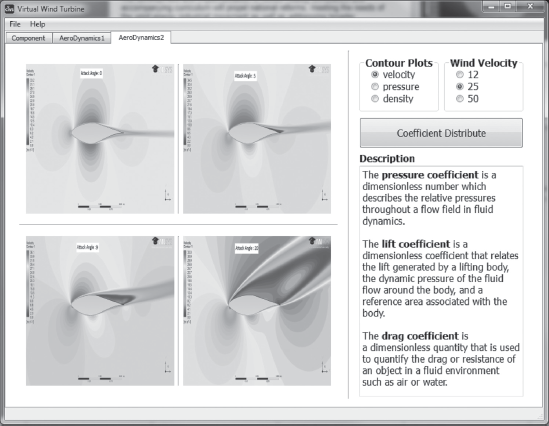
Cross-sectional contours allow students to see the effects of wind velocity and blade shape on the wind turbine's performance.
Procedure
Engineering students in the Introductory to Wind Energy course were given a pretest-posttest survey of 12 questions related to the 3D Wind Turbine Simulation during the first and final week of class, respectively. Students were informed at the beginning of each testing session that their participation or nonparticipation would not affect their grade in the course. Testing was administered during the second half of the class (i.e., after the daily lecture) based on the recommendation of the course instructor. This procedure allowed the students sufficient time to complete the survey or to freely leave the classroom after lecture.
The instructor was asked to leave the classroom for testing to control for participant reactivity and/or researcher's bias. Students were instructed to omit their names and to answer all questions truthfully and accurately to the best of their ability. After collecting all surveys from participants, debriefing was verbally administered. Students were encouraged to contact the researcher(s) with more feedback and / or questions regarding the research project.
Results
The class size and “n” for this survey (30 with 29 data sets available for some items) limited the degree to which quantitative analysis could be utilized. Non-parametric tests were not revealing, leaving examination of descriptive statistics as the only viable quantitative measure that could be employed. However, the post-test descriptive statistics were revealing when viewed through a thematic lens.
When examining means, three distinct groupings can be observed: Items 1–4, 5–9, and 10–12. Analysis of the items demonstrates that these items fall within the categories of motivational, conceptual, and application, respectively.
The motivational items (Items 1–4), such as “Problems posed in the 3D simulator activities increased my interest in the topic of wind energy” appeared to have a relatively high degree of satisfaction with the activities construction (mean range = 4.00–4.27 on a 5 point scale). As motivation is a necessary precursor to substantive inquiry this area was adequately addressed in the project design.
The conceptual items (Items 5–9), including “The 3D simulator activities were structured in such a way as to help me resolve content related questions” appeared to have a moderate degree of satisfaction with the activities construction (mean range = 3.46–3.82 on a 5 point scale). Slight modifications to the activities may be required to help participants more fully synthesize knowledge at the conceptual level. This is especially desirable if critical inquiry and higher order thought applications of the material is required moving forward.
With respect to applied items (Items 10–12), such as “I have developed knowledge of wind turbines that can be applied in practice” participants appeared to have a moderate to high degree of satisfaction with the activities construction (mean range = 3.76–4.13 on a 5 point scale). As application of knowledge, in a practical fashion, is certainly a desirable outcome, some minor modifications to the activities may be desirable.
Discussion
The qualitative survey items suggested student motivation and receptiveness to the inclusion of simulators in the course curriculum. With respect to expertise or novelty (e.g., learning experience or coursework) related to wind turbines, no students had prior experience in these areas. It was revealed that no students had prior exposure to wind turbines before taking the class. Hence, the students' lack of prior exposure may have had an effect on their views and usability ratings of the simulators. Findings represent a positive view of the simulators from students, but do not address actual knowledge acquisition. Additional research is needed to assess the impact of the simulators on content knowledge.
Sixteen students responded when asked what was most beneficial about the wind turbine simulation, but only fifteen of these students stated that the major benefit was related to the visualization of wind turbines and making abstract concepts concrete. However, it was noted in some cases that the simulations could be more thoroughly developed. The timing of implementing the simulators within the course schedule may have had an effect on its usefulness as well. The course instructor suggested that both simulators may have served better by being implemented early in the course to provide a foundation for the turbine components and to provide a tool for the students to refer back to as they learned additional concepts. This was not possible during the pilot implementation due to scheduling.
This finding is in alignment with the moderate to high moderate degree of satisfaction associated with applied items in the quantitative portion of the survey. The remaining student noted that the simulations were related to fluid dynamics but did not elaborate.
Although findings are preliminary, data from the pretest-posttest surveys indicated a moderate to high level of educational outcomes with respect to learning motivation and practical application. Students seemed to enjoy learning about the simulators and how 3D visualizations can directly apply to real life scenarios.
The domain of Virtual encompasses a range of simulated and real environments. A commonly used visual representation of Virtual is depicted in Fig. 6, which places the real world on one end of the spectrum, a completely virtual world on the other end, and a number of hybrid worlds spanning the space in-between. As the various technologies and techniques in this domain have matured, research has been performed exploring the possibilities and potential benefits to education. Many of these studies ground themselves in the educational theory of situated learning, using the technologies to provide a simulated context in which the learning occurs (Holzinger, et al., 2008; Yang, et al., 2013).

Virtual Continuum proposed by Milgram, et al., 1994.
The nature of virtual allows the development of simulators that can be implemented with a variety of technology ranging from fully immersive 3D VR systems, mobile phones and handheld computers, video glasses, web pages, video and interactive content. The simulators to be developed in this project will each have an ideal set of technology on which they can be implemented, but will also be portable such that they will still be able to benefit students with only limited access to technology. In this way, the use of the simulators can be easily replicated and they can be implemented into postsecondary curriculum regardless of available technological resources. In addition, all simulators are to be open-platform, providing the educational and wind energy communities free access to all source materials (e.g., software and learning tutorials). The project will, therefore, encourage educators and industry professionals to help grow and evolve the simulators to be more beneficial for use with current and new wind energy systems.
Conclusions and Future Directions
3D Virtual Simulators provide a method of implementing experiential learning and cost-effective postsecondary educational programs. A 3D Virtual Wind Turbine simulator has been developed along with a Wind Turbine Components and Aerodynamics simulator. These were implemented into an introductory wind energy course and were well received by students, but little could be determined about their contribution to learning outcomes. This may have been due to timing of the implementation, which will be adjusted accordingly for future implementations and assessment.
This research established an open platform to encourage exponential growth and promote fruitful collaborations with educators and industrial leaders in the wind energy professions. By providing the 3D virtual simulator template, additional simulators can be developed by the community, ensuring relevant future impact.
To address wide-scale adoption and sustainability of the project among post-secondary institutions, the educational materials will be made freely available via popular distribution channels. Code and visual assets for the simulators are planned to be released as open source, and efforts are underway to develop a community of users and developers to help address future issues in improving and porting the simulators to other platforms. Mobile AR education and training materials will be available for download from mobile device “App” stores (e.g., the iPhone/iPad App Store or Android Market Place). VR materials for the Virtual Wind Turbine will be available for download in multiple formats that can be used in a wide scale of contexts ranging from fully immersive 3D systems such as CAVE and projector-based VR, head-mounted displays (HMD), 3D TVs, or traditional PC with 2D monitors. 3

