






Abstract
A laboratory investigating and monitoring the effect of exposing a microbe to a virus was added to a Health Psychology class. Students in the Health Psychology class received a class lectures on “Microbiology Laboratory Techniques” and “Concepts in Immunology.” Students then participated in a two-class meeting laboratory procedure to track changes in a microbe exposed to a virus. Student perceptions of their learning satisfaction were increased from pre to post laboratory measures. Learning lessons from the teaching method are presented.
Learning opportunities for students to understand the interconnections of Health Psychology course material to other scientific areas is beneficial to increasing their understanding of the material (Sarafino, 2008). Further, the presentation and simple exposure to other areas of science that are interdependent to the Health Psychology literature are easily accomplished with traditional classroom pedagogy such as literature presentation, concepts and principles coverage in the textbook, and supplemental readings (Sherman, 2003). Additionally, student projects and individual presentations employ methods that direct the student to more comprehensive review of the literature that contain science concepts. Ritchey and Bott (2010) presented findings that identified interdisciplinary connections using a content analysis of introductory course materials and a rating scale. The control group ratings were statistically significant and higher, in this study, for the experimental group as compared to the controls on the outcome “rating influence from other fields on Psychology.”
In the last decade, a 16% increase to a reporting of 33% of Colleges and Universities offering a Health Psychology course has occurred (Brack, Kesitilwe, & Ware, 2010). Given this recognition of the important role of Health Psychology in the Psychology curriculum, seminal articles identifying the manner in which the course could be taught have abounded. Tritt (1993) identified the utility of a laboratory experience in the teaching of Health Psychology. Sumner (2003) reported that an applied assignment using a methodology from literature, such as developing a family health plan, benefits the students' understanding of the course material. Upton and Cooper (2003) advocated the use of online psychology teaching materials. Recently, interactive modules of online Health Psychology materials have been developed for the Health Psychology course or particular modules in other courses (Upton & Cooper, 2006). The most popular topics in Health Psychology include Psychoimmunology (Immunology), Sleep, Patient-Provider communication, AIDS/HIV, the biopsychosocial model, and chronic illness in 80% of undergraduate programs surveyed by Brack, Kesitilwe, and Ware (2010).
Psychoimmunology, a popular topic in Health Psychology courses, provides the student with useful personal information about their health and professional information based on empirical study. The framework of the Psychological influences on immune functioning and the concomitant findings to health is a valuable pedagogical premise. The study of Psychoimmunology provides students in Health Psychology with an enriched understanding of health behavior. A brief literature review in this area revealed thousands of studies in the last 10 years. Sternberg and Gold (1997) have described the mind-body interaction in disease as related to psychoimmunology. With newer studies in this area, this popular topic teaches the student age-related changes that occur in the body as people respond to stress (Kiecolt-Glaser, McGuire, Robles, & Glaser, 2002). Academic stress and other short-term common stressors can provoke changes in immune pathways and are consequential for health (Kiecolt-Glasser, et al., 2002).
With the exception of the earlier Tritt (1993) study, little has been written about the utility of applied experiences and laboratory work to enhance concept formation from lecture material. The Health Psychology division of the American Psychological Association has an extensive webpage with teaching resources of activities, scales, and handouts. This article addresses these issues by providing a description of the inclusion of an Immunology Laboratory within Health Psychology classrooms. The effectiveness of the laboratory was assessed with pre- and post-experimental measures.
Method
Participants
The 30 students in the Health Psychology course were assigned to textbook readings, a research article and general audience reading on the topic of Psychoimmunology (Immunology). They then received three classroom lectures on the topic. The Health Psychology course met two times per week and this topic occurred in week twelve of a 15 wk. semester at a small Liberal Arts College in the Midwest.
Procedure
Health Psychology students were assigned readings in their textbooks and two science magazine articles on the topic of immunology. They then received a lecture on the topic of Psychoimmunology in their Health Psychology course (by first author). Prior to conducting the laboratory 2 exercise, students received a lecture on microbiology techniques and immunology from the second author. During this lecture students learned about non-specific immunity (fever, pH, temperature change, interferon, etc.), specific immunity which is imparted by production of B cells or T cells, viral structure, implications of viruses in disease, and applications for immunology. Students then proceeded to the laboratory to complete the immunology exercise.
Students worked in teams of six, where at least one member was familiar with the necessary laboratory procedures. Each participant was assigned a particular condition to be evaluated in the exercise. The conditions tested included controls of E. coli or phage without other additions, and variable conditions of E. coli and phage with antibody added after 2, 4, or 8 min. of virus exposure (Fig. 1). For each condition, 1 milliliter of the solution was plated onto a tryptic soy agar plate using a pour plate technique and incubated at 37°C for 48 hr. Following the incubation participants counted the number of clearing (plaques) in the E. coli growth, which represented loss of bacterial cells due to viral infection. Using the simple formula of: Plaque forming units/ml = #plaque forming units/Amount plated × Dilution factor, students were able to calculate how many viruses remained in each condition of the experiment.
Learning Activities
Assigned readings in the textbook, empirical article reading and general audience readings addressed many components of the topic of Psychoimmunology. These components are listed in Table 1. To enhance and expand the students' learning of Psychoimmunology, a laboratory exercise that focused on the investigation of the change in a microbe as a result of varying levels of exposure of phage virus was conducted using Carolina Biological Kit 20–2150. This exercise modeled human immune function by exposing a simple bacterium (E. coli) to a bacterial virus, or bacteriophage. Some cells were exposed to virus alone, while other bacteria were amended with antibody to mitigate the lethal effects of the virus, simulating the actions of the human immune system, which synthesizes antibody to eliminate foreign materials from the body.
Lecture Concepts
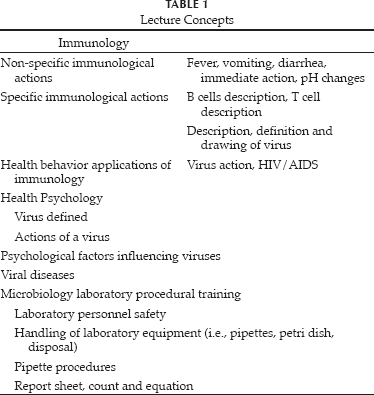
Before beginning the laboratory, which followed the classroom lecture time, students completed a pretest of their knowledge of Psychoimmunology (Immunology) topics, their knowledge of laboratory procedures, their understanding of the relationship between immune system functioning and health behavior, and phage behavior when exposed to an antibody. Table 2 lists the laboratory orientation steps and key concepts presented in the Biology Professor's lecture. Following the two laboratory classes, students completed the post-experiment measure, which was composed of the same questions. An additional measure of Health Knowledge was administered at the beginning and end of the semester. This 30-item true/false scored measure required the students' true or false responses. Two of the 30 items were selected as relating to the elements of Psychoimmunology concepts.
Familiarity with Microbiology Laboratory Procedures

The results of the exercise demonstrate that fewer E. coli cells are destroyed by bacteriophage when antibody is present, and the sooner antibody is present the less damaging the virus is to the bacterial cell (Figure). This demonstrates a critical point in human immunology – the time required for the immune system to recognize and respond to foreign material. Many students were surprised to learn that 14 days are required to achieve a peak immune response in humans' immune system without prior exposure or 7 days after prior exposure (e.g., vaccination).
Results
Overall, the student ratings (n = 30) indicated greater agreement following the Psychoimmunology Laboratory. The greatest areas of change were in terms of antigen-antibody relationship, phage exposure and laboratory procedures. These findings are presented in Table 2. Twenty-five of the 30 Health Psychology students completed the Health Knowledge Quiz at beginning and end of the semester. The average score for this aggregated group was 19 (63%) correctly identified statements of the 30 items overall. The two items related to Health Psychology Immunology yielded large differences from pre- and post-semester measurements. The question that asked about certainty of the relationship between stress and disease was correctly endorsed more frequently at the post-semester measurement. The question about stress, immune system function, and disease was correctly answered by more students at the pre-semester than at the post-semester measurement (Table 3); the wording of this question should be checked because it may have been confusing. The student course evaluations indicated positive (65%), negative (23%), and neutral (12%) responses to the Laboratory experience.
Health Knowledge Quiz Findings

Source: Health Knowledge Quiz can be found on the Division 38 Health Psychology, American Psychological Association webpage.
Course Evaluation Comments About Immunology Experiment (N = 18)

In summary, familiarity with Immunology Laboratory procedures and findings was related to better understanding at post-semester of Immunology concepts. The familiarity with and interest in Laboratory procedures was slightly higher following the experiment as well. Students' Health Knowledge scores increased in terms of awareness of the stress and disease relationship and declined with regard to specific effects of stress on the immune system. In general, the students were positive about the Laboratory.
Discussion
Overall the exercise was effective in helping participants to visually observe immunology in action. Students observed that longer exposures of E. coli cells to antibody resulted in a much greater survival of the bacteria. Lecture material delivered prior to the exercise should have allowed students to predict this very outcome. However, it may have been helpful to spend additional time after completion of the exercise discussing the results and extrapolating those results to the human system.
The laboratory procedures necessary to conduct the exercise were foreign to many student participants. Future inclusion of this exercise would benefit from incorporating a “dry run” day where students could practice pipetting solutions, plating bacteria, and aseptic technique. This would allow students to feel comfortable with the procedure once timing of steps became critical. Furthermore, this addition would address the negative comments on the course evaluation for this exercise, especially those that felt the exercise was rushed or not successful.
While increases in learning and student satisfaction were obtained, these gains could have been enhanced by additional discussion and a quiz over the lecture and readings to strengthen student learning outcomes.
Furthermore, this straightforward method is best obtained by the team teaching of the topic. However, in a setting where cross-discipline collaboration is not possible, several educational DVDs in the area of Psychoimmunology (Immunology) and Microbiology laboratory techniques could be used with a Biology professor consultation.
Footnotes
2
Prior to the lecture and laboratory experience, the second author provided an ice-breaker exercise to the class. The purpose of this exercise was to introduce basic general concepts about viruses. To introduce the concept of immunology, students participated in a simulated epidemic classroom exercise, whereby students received a numbered vial with either water or sodium hydroxide. Students then poured a portion of their fluid into another student's vial to simulate spread of the disease. After conducting this exchange twice, student vials were amended with phenolphthalein. Vials that turned color were indicative of the presence of disease. Students then attempted to identify which student was responsible for beginning the epidemic.