






Abstract
A 2013 paper by Adel, Hossain, and Johnson presented findings that seem to support a tenet of astrology: the relationship between birth sign and celebrity. However, their finding was simply an artifact of assigning an arbitrary starting point to the zodiac signs and, consequently, the data do not support the validity of astrology.
A 2013 paper by Adel, Hossain, and Johnson presented findings that seem to support a tenet of astrology: the relationship between birth sign and celebrity. Verification of this result would be surprising, first, because previous research has not supported sun sign astrology (e.g., Jackson & Fiebert, 1980); and second, because the sun signs of popular astrology no longer coincide with the actual position of the sun against the Zodiac (Culever & Ianna, 1988). Even some astrologers dismiss or downplay sun sign astrology (e.g., Kochunas, 2008).
Adel, et al. (2013) looked at three samples of celebrity birth dates. The sample sizes were 100, 200, and 300, respectively. In each case, a significant correlation between birth sun sign and number of celebrity births was reported. The reported Pearson's correlation coefficients were large for the three samples (r = .47, r = .48, and r = .59, respectively) with the sun sign Aquarius showing the largest number of celebrity births for all three samples. However, the study was methodologically flawed. In this paper I will explain the fundamental error made by the authors and re-analyze the data.
In their analysis, Adel, et al. (2013) regressed the number of celebrities' births against the sun signs arranged in order from Aries to Pisces. Aries is given the value of 1, Taurus 2, and so on. The authors freely admit that this ordering is arbitrary, but claim “even if Aries is not marked by ‘1’ by another data analyzer, neither the result nor the academic value changes as long as the consistency is maintained in all cases of assigning the numbers to the zodiacs” (p. 172). The central purpose of this paper is to demonstrate that this claim is false.
Method
In this re-analysis I have used only the data from the largest sample of 300 celebrities. I have calculated the correlations between number of celebrity births and sun sign. However, I have run the analysis 12 times. In each case, I have used a different sun sign as the starting point and assigned it the value of 1, and then from that point, counted off the remaining signs in order. All calculations were made in R.
Results
The results are shown in Table 1.
Correlations Between Sun Sign and Celebrity Births: Same Data Set with Different Initial Sun Signs
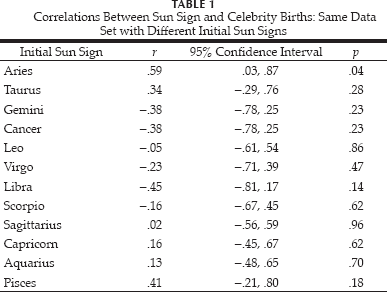
Some correlations are small and statistically nonsignificant (r = .02, p = .96), while others are large and statistically significant (r = .59, p = .04); indeed, some correlations are large and negative (r = −.45, p = .14). The results reported by Adel, et al. (2013) are an artifact of their ordering of the zodiac signs, a choice that they concede is arbitrary.
Discussion
Since there is no real zero point in the zodiac, the choice of Aries was arbitrary. While there has been a long tradition of listing Aries as the first sign, this custom has not been universally embraced. For example, it is believed that the earliest Greek astrologers used Cancer as the first sign (Mure, 1832). Indeed, it should be remembered that the constellations themselves are categories created by humans and do not reflect any natural or necessary order. This is significant for any kind of regression analysis: altering the starting point changes the relative distribution of the data points and affects the strength of the correlations.
A more appropriate test would be to compare the number of celebrity births for each sign with the number of births in the general population. Care would have to be taken here, since births are not distributed uniformly over the year (Pasamanick, Dinitz, & Knobloch, 1959). This will cause some signs to have an excess of births just from the natural variation in births over the year and could be mistaken as evidence for astrology. In addition, sun signs are not of uniform duration. For example, there are 31.5 days for the sign Cancer and 29.5 days for Capricorn (Dean, 1977). This fact alone will cause variation in the number of births per sign.
Thus, a goodness of fit test, such as the chi-squared test, comparing the expected number births with the observed number of births, would be an appropriate statistical analysis. However, since birth frequency varies across time and cultures and the Adel, et al. (2013) data were collected from online sources without controls for time or place, it is unclear how to calculate the expected values. In addition, even if reasonable expected values were calculated and an appropriate method of analysis used, a statistically significant finding may not be robust support for astrology.
There are other phenomena that might be mistaken for astrology, such as relative age effects. Relative age effects occur when the annual dates that define an educational or athletic cohort create a developmentally unequal group. Baker, Schorer, and Cobley (2010) give this example: “educational systems that use a date of September 1st (e.g., UK) to group pupils result in those with a birthday immediately after this selection date (e.g., September 3rd) being almost 12 mo. older that a cohort member with a birthday on August 29” (p. 26). Thus, in an annual cohort, some individuals will have a maturational advantage over others and that advantage would be correlated with birthdate. Relative age effects have been observed in a number of sports and school subjects (Baker, et al., 2010). Yet these effects are caused by social conventions, and cannot be used as support for astrology.
In addition, a test of astrology would need to control for season-of-birth effects. Although still controversial, there is evidence of relationships between some psychological conditions, such as schizophrenia, and season of birth (e.g., Davies, Welham, Chant, Torrey, & McGrath, 2003). Sun sign could simply be a proxy for season of birth; thus, any observed association between sun sign and an outcome variable may have a more parsimonious explanation than some astrological influence now unknown to science (Natale, Adan, & Chotai, 2002).
The paper is flawed in two other ways. First, it makes no reference to the many other studies of astrology. For example, McGrew and McFall (1990) investigated the ability of six astrologers to match case files on 23 individuals with their respective horoscopes. The study is noteworthy because the astrologers themselves indicated what information should be included in the case files, allowing them to match files to horoscope. Even though the astrologers had high confidence in their ratings, they failed to perform above chance.
Second, the paper failed to mention that because of the procession of the zodiac, caused by the earth's wobble on its axis, the sun signs used in popular astrology and by Adel, et al. (2013) no longer match the actual position of the sun against the constellations (Culever & Ianna, 1988). Explanation for this discrepancy would seem a minimum requirement for claims of astrological influence.