






Abstract
In past research, the best treatments of anger management training, jobs, and mentors have been shown to divert 25% to 37% of at-risk youth from court. Within Midwestern urban high schools located in crime-ridden areas, youth were given these treatments after first being identified as at-risk using a predictive regression equation comprising carefully chosen and relevant demographics, behaviors, and test scores. This regression of data from the perpetrators of 500 shootings replicated previous results from 4 other samples (Ns = 71, 30, 26, and 127) of those who had used firearms in homicides with matched control groups. Youth (who were expelled, academically failing, maladaptive, low in SES, previously arrested, suspended, truant, or underachieving) included 250 students in 6 high schools during 2009; 1,700 pupils in 38 high schools during 2010; 1,700 more in 38 high schools during 2011; and 1,200 others in 32 high schools during 2012. After treatment, homicides decreased by 32%, shootings by 46%, and assaults by 77%. This saved approximately 104 lives and $492 million dollars, with a Return on Investment (ROI) = 6.42.
Every community struggles with how to deal with violence. Researchers and scientists have conflicting, confusing, and contradictory explanations of violence, how to find it, prevent it, and what it costs. However, there are three promising approaches for prediction, prevention, and cost reduction: (a) using empirically developed regression equations to identify those prone to violence; (b) building programs comprising treatments shown to be effective by meta-analyses of intervention research; and (c) applying and assessing cost-benefit analyses of the interventions used to divert those at risk for violent behavior. The goal of this paper is to review these three approaches, and then describe a partial application in an urban high school system with post hoc analysis of cost-benefit to show whether the approaches, used together, can lower violence and reduce costs.
From a developmental/sociological theory of homicide and violence, high school is the final key environment in the development of violent tendencies among youth (Zagar, Busch, Grove, & Hughes, 2009a; Zagar, Zagar, Bartikowski, & Busch, 2009; Zagar, Zagar, Bartikowski, Busch, & Stark, 2009). Intercepting violence in the high schools is expected to lower homicide rates effectively, save lives, and reduce social and governmental costs (Zagar, Isbell, Busch, & Hughes, 2009; Zagar, Zagar, Bartikowski, & Busch, 2009).
Organization of This Report
The organization of this report begins with a description of the identification of violence-prone persons with actuarial measures, then the development of an empirically derived, predictive regression equation. The second part includes a review of the meta-analyses of interventions shown to divert youth from criminal behavior, particularly violence. The third section comprises cost-benefit analyses to assess the return on investment (ROI) of these interventions. Finally, a real-world application is described in which these three approaches could be used to address wider problems in prisons and communities.
Identification of Violence-prone Persons
Since the pioneering work of Burgess (1928), investigators have studied actuarial and/or statistical prediction of delinquent and later criminal behavior. The criterion was “return to court” (a subsequent offense) or “dangerousness.” Eighty-two risks were found consistently. These risks were categorized as adult court contact; community, family, and home risks; individual medical status; employment; juvenile court contact; peer relationships; and academics. These demographic characteristics have been valuable in saving the costs avoided by detecting, apprehending, convicting, imprisoning, and not paroling dangerous offenders. More recently the assessments for violence have been used in clinics, workplaces, and universities to assess the risk of criminal offending.
There are two ways to find persons with tendencies toward violence: (a) using a predictive regression equation; or (b) employing a case study approach with statistical (actuarial) testing. In the first method, one can use information such as demographics, life history, academic records, and standardized test scores to create a valid predictive regression equation. This method will be discussed. The second method, the case study approach with statistical (actuarial) testing, has been discussed in Zagar, Kovach, Basile, Hughes, Grove, Busch, et al., 2013, (in review) and will not be further mentioned here. The regression equation to identify risk-prone teens has a proven track record of predicting which youths may become violent, compared with those less likely to commit offenses against persons.
Since early in the 20th century, recidivism or “return to court” has been predicted by tracking criminals over time and comparing those who “returned to court” versus those who did not. Male and female adolescent and adult offenders on 3 continents, (5 countries; 17 states or provinces) were tracked for up to 10 years in these studies. Using meta-analyses to compare the effect sizes of predictors or risks, Lipsey and Derzon (1998) examined the predictors of violent behavior. These predictors varied as a function of age of the sample. For very young offenders, Farrington (1997) reported that a serious first offense was the best predictor. For the younger offender, past behavior was the best predictor of future violence (Lipsey & Derzon, 1998). For the older offender, lack of social ties, having antisocial peers, or gang membership were the best predictors of violence (Lipsey & Derzon 1998). Bonta, Hanson, and Law (1998) found that the best predictor of adult violent behavior was past criminal offenses. Other risks included early antisocial behavior, convicted parents and family, poverty, school failure, unemployment, and drug use. In predicting homicide (Busch, Zagar, Hughes, Arbit, & Bussell, 1990; Zagar, Arbit, Sylvies, Busch, & Hughes, 1990), criminally violent family and relatives, physical abuse, gang membership, and alcohol and substance abuse were the statistically significant risks. Zagar, Isbell, Busch, and Hughes (2009) showed that prior court contact, lower executive function (poorer decision making), infant illnesses, frequent home and school moves, and alcohol and substance abuse were the best predictors of homicide from infancy to adulthood.
Zagar and Grove (2010) improved the accuracy of predicting homicide from records of up to 12 years of early childhood and youth risks in a sample of 1,127 youths to an Area under the Curve (AUC) = .91 (Fig. 1). Using a similar procedure, among 1,595 adults, with Shao's bootstrapped logistic regression procedure (Shao, 1996), the AUC was .99. The predictive equations in a combined adult and youth sample of 2,722 had an AUC of .96. The accuracy of these results is noteworthy because most literature attempting to predict recidivism or violence has AUCs in the region from .69 to .76 (Moosman, 2013). For example, Quinsey, Harris, Rice, and Cormier (1998, 2006) tested non-randomly selected violent offenders without a control group, resulting in a Receiver Operating Characteristic 3 (ROC) of .76. Among 200 non-randomly selected sex offenders without a control group, these same researchers obtained ROC =.70. Thus, the bootstrapped logistic regression represents a considerable improvement in predictive accuracy (Zagar, Busch, Grove, & Hughes, 2009b; Zagar & Grove, 2010), providing a sound empirical basis for risks that consistently and reliably predict future violent criminal activity. These risks include poor executive functioning (decision making and related abilities), lower social maturity, weapons possession conviction, violent family, gang membership or participation, male gender, academic under achievement, serious illnesses, prior court contact or arrest, low socioeconomic status, substance abuse, previous neurological disorder, alcohol abuse, head injury, and truancy/suspension or expulsion (Table 1) (Busch, et al., 1990; Zagar, Arbit, Sylvies, Busch, & Hughes, 1990; Zagar, Arbit, Busch, Hughes, Schiliro, Sylvies, et al., 1992; Zagar, Arbit, Busch, Hughes, & Sylvies, 1998; Zagar, Busch, Grove, & Hughes, 2009b; Zagar, Busch, Grove, Hughes, & Arbit, 2009; Zagar & Grove, 2010). When Chandler, Levitt, and List (2011) examined 12,989 higher-risk students among whom there were 500 perpetrators who committed shootings, the significant personal characteristics predicting shooting were consistent with this prior research: male gender, academic underachievement, prior court contact or arrest, low in socioeconomic status (SES), truancy, suspension, and expulsion.

Regression-weighted scores yield sensitive and specific discrimination of 1,127 violent (▪) from matched non-violent youth (Infants ; Children and Teens  ). AUC = .91.S.
Effect Sizes For Regressions of Four Groups of Homicidal Youth With Controls and One School Shooting Sample
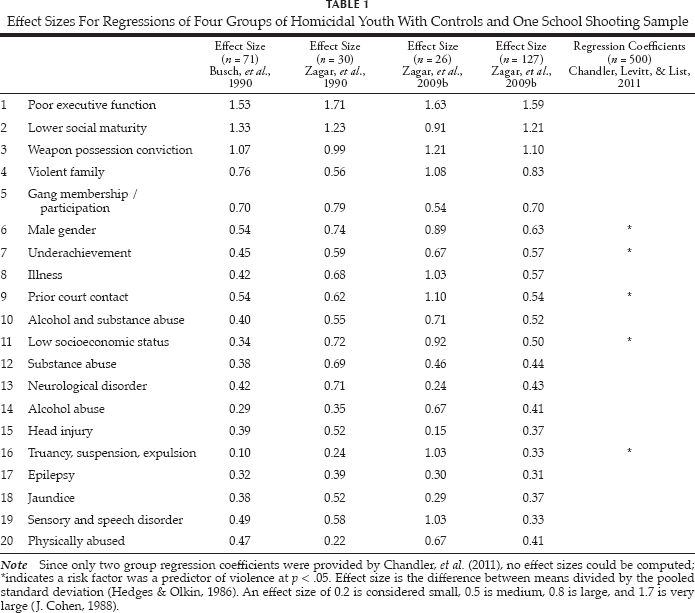
Note Since only two group regression coefficients were provided by Chandler, et al. (2011), no effect sizes could be computed; *indicates a risk factor was a predictor of violence at p < .05. Effect size is the difference between means divided by the pooled standard deviation (Hedges & Olkin, 1986). An effect size of 0.2 is considered small, 0.5 is medium, 0.8 is large, and 1.7 is very large (J. Cohen, 1988).
Effectiveness and Cost-benefit of Interventions
In his meta-analyses, Lipsey evaluated the effects of empirical treatments in diverting youth from court. Lipsey (1992, 1995, 1999, 2006a, 2006b, 2009) reviewed 500 treatment studies from 1950–1995. As seen in Fig. 2, over 50 years, in several meta-analyses the most effective treatments have been identified. The best interventions for youth were: (1) jobs, resulting in a 37% rate of diversion from court; (2) behavioral therapy or anger management training, with a 25% diversion rate; and (3) multi-modal therapy or personal mentoring, with a 25% diversion rate (Lipsey, 1999). Personal characteristics of offenders, treatment and program variables, and outcome effect sizes in terms of behavioral changes for serious offenders have been clearly delineated. Lipsey's (1999) meta-analysis was consistent with ad hoc treatments selected by the therapist being less effective.

School-based program effects on behaviors: weighted mean effects. Data for Social skills through Performance adapted from Wilson and Lipsey (2007); multimodal therapy (mentor), behavior change (anger management) and jobs comprised treatment in the U.S. DOJ funded Culture of Calm, and were adapted from Lipsey (1999).
In Fig. 2, Wilson and Lipsey (2007) demonstrated the relative treatment effect size needed to improve behavior, i.e., how successive increases in treatment dose were associated with decreases in re-offending. Multimodal, carefully monitored, and closely supervised therapies were the best interventions. The most effective programs focused on social skills, activity levels, and problem behaviors. Treating aggression was considerably less effective. However, it could be that this approach misses the most crucial element of treatment: targeted, timely application of treatments over the age-specific course of the most risky behaviors.
In the third column of Table 3 is the Washington State Policy Institute's (2006) list of evidence-based treatments. Application of these treatments may reduce future prison construction, criminal justice costs, and crime rates. For prevention programs, the best Return on Investment (ROI) was pre-kindergarten interventions for low-income 3- to 4-year-olds, with $20.57 in savings expected for every dollar spent. For juvenile offenders, the best ROI was inter-agency coordination programs, with $25.03 in savings for every dollar spent. For adult offenders, the best ROI was cognitive behavior therapy, with $98.09 in savings expected for every dollar spent. Knowledge of the various interventions and their relative ROIs are important to decision makers. With a quick glance at Table 2, one can see that adult cognitive behavior therapy, inter-agency coordination, job, juvenile diversion program, pre-kindergarten education, adult community drug treatment, nurse family partnership for children training, anger/ aggression replacement training, juvenile functional family therapy, vocational education, multidimensional treatment, high school graduation equivalency, teen courts, restorative justice, and multi-systematic therapy all have ROIs above $10 for every $1 dollar spent.
Estimate of Injury, Lives, and Costs Saved by the Culture of Calm Program (ROI) = 6.421 1

Note aValues are in millions of dollars. 12012 U.S. dollar costs based on U.S. Department of Agriculture (1994), Cohen and Miller (1994), Cohen, Miller, and Rossman (1994), Cohen (1995, 1998), Cohen and Piquero (2007), Lino (2007), Zagar, Zagar, Bartikowski, and Busch (2009), and the Consumer Price Index (2012) in the U.S. Bureau of Labor Statistics (2013). The national rate of youth homicide is 9.8% (Federal Bureau of Investigation, 2012) but the Chicago youth homicide rate is 19.6% (Harris, 2009; Ahmed-Ullah, 2011; Ritram, 2011; Vevea, 2011; Dardick, 2012; Byrne & Dardick, 2013).
Checklist of Risks and Treatments to Reduce Violence

Note Effect sizes are from regressions predicting violence in Zagar and colleagues' five groups. ROI = return on investment. Effect size is the difference between means divided by the pooled standard deviation (Hedges & Olkin, 1985); 0.2 is considered small, 0.5 is medium, 0.8 is large, and 1.7 is very large (J. Cohen, 1988). ROIs are from Washington State Policy Institute (1999).
The Culture of Calm: an Intervention to Prevent Violence
In 2009, the U.S. Department of Justice (U.S. DOJ) funded a trial intervention called the “Culture of Calm” in a Midwestern, urban high school setting within crime-ridden areas (Saulny, 2009; Shelton & Banchero, 2009). The grant provided funding for: (a) development of an empirical, predictive, regression equation to identify at-risk youth; (b) evidence-based interventions (Lipsey, 1999) to reduce court contact, comprising anger management training, jobs, and mentors; and (c) analysis of the cost savings achieved applying these interventions to lower violence. An age-specific model that focused on particular risks for homicide was presented to the decision makers (Mayor and staff) with specific predictive factors for infants, children, teens, and adults. The model was based on evidence that the statistical predictions were accurate in identifying individuals who were at-risk for violent behavior from 1989 to 2009 in Chicago and Cook County (Zagar, Busch, Grove, & Hughes, 2009b). Four distinct, cross-validated samples of 127 homicidal teens and two larger samples of youth (N = 1,127) and adults (N = 1,595) were used to model risk factors and interventions. Anger management training, jobs, and mentoring were emphasized as the best interventions for potentially homicidal youth. The suggestion was to apply one or more of the above-mentioned, empirically supported interventions among the at-risk in urban high schools, due to the high number of homicides and shootings. The grant's development of a predictive regression equation using community data imitated the technique already successful in identifying at-risk youth.
The schools' CEO and staff used police data from 500 shooting incidents to identify the demographic characteristics of these most at-risk youths. The logistic regression findings from these community data (Harris, 2009; Saulny, 2009, Shelton & Banchero, 2009; Ahmed, 2010; Chicago Board of Education, 2010; Rossi, 2010; Chandler, et al., 2011) were consistent with previous reports (Busch, et al., 1990; Zagar, Arbit, Sylvies, Busch, & Hughes, 1990; Zagar, Busch, Grove, Hughes, & Arbit, 2009; Zagar & Grove, 2010). The reliable predictors used to target the interventions were: male gender; the number of serious misconduct behaviors per day; below average academic performance or failing a grade; percent days suspended; percent days absent; juvenile jail; adult jail; Illinois State Achievement Test (ISAT) reading score; ISAT mathematics score; free lunch status; and times shot previously.
The intervention began in six high schools in crime-ridden areas of Chicago. These locations were identified by police as having high violence rates, using crime statistics. Based on the above-mentioned regression developed from 500 perpetrators of shooting incidents among 12,989 higher-risk students, the 250 most at-risk students across the initial six schools were chosen for receipt of jobs (Schochet, Burghardt, & Glazerman, 2001), behavior therapy or anger management training (Alexander, Sexton, & Robbins, 2000; Larson, 2005), and multimodal therapy or adult mentoring (Henggeler, Schoenwald, Borduin, Rowland, & Cunningham, 1998). These interventions were applied in the six high schools during 2009 to 250 students; in 38 schools during 2010 to 1,700 students; in 38 high schools during 2011 to 1,700 students; and in 32 schools during 2012 to 1,200 students.
The Culture of Calm program resulted collectively in an estimated savings of 104 lives and $491 million in resources. Specifically, there were 32% fewer homicides, 46% fewer shootings, and 77% fewer assaults (Harris, 2009; Ahmed Ullah, 2011; Ritram, 2011; Vevea, 2011). The total Return on Investment (ROI) was 6.42 (Ahmed, 2010; Rossi, 2010) as indicated in Table 2. Data included (a) the youth homicide rate (Federal Bureau of Investigation, 2012; U.S. Bureau of Justice Statistics, 2006); (b) the 19.6% Chicago rate of youth homicides (like Chicago, many large U.S. cities' homicide rates are far above the national rate); (c) the youth homicide rate during the Culture of Calm; (d) the total students treated in the Culture of Calm; (e) the number of high schools in the program; (f) the youth murder reduction during the Culture of Calm (the number of students enrolled times the 32% fewer shootings converted to homicides with an equation developed by O'Flaherty & Sethi, 2010). These data were used to estimate the lifetime cost saved by reduced youth murders: $4,660,986 per homicide (from Zagar, Zagar, Bartikowski, & Busch, 2009, with the regional Consumer Price Index in 2012 added, times a 32% decline in killings based on the 46% decrease in shootings); with these estimates, the total savings over the four years of the Culture of Calm were $456,776,628. In addition to the savings from homicides prevented, it was possible to estimate costs saved from reductions in assaults. Using the rate of youth high school assaults with injury, the reduction of youth high school assaults in Culture of Calm (77%), and the cost of youth assault with injury of $29,872 per incident (Zagar, Zagar, Bartikowski, & Busch, 2009; the 2012 regional Consumer Price Index was added times the number of assaults in participating schools); the savings over four years was $111,571,920. The outcome in terms of ROI was calculated from the homicide rate plus the reduced assault cost under the Culture of Calm, and the U.S. DOJ funds spent over four academic years on the Culture of Calm ($76,600,000).
Yet another way of looking at the outcome is to consider that, if the cost of program was $76,600,000 and 104 lives were saved, the cost of saving each life was $730,769. Based on the 2012 dollar value of the loss of a life at $4,660,986, the ROI for this program was $4,660,986/$730,769 = 6.38. A summary of this complex outcome might be, “Help at-risk youth be productively busy so they don't have time to murder.” In short, violence was reduced and resources saved.
Extending Cost-effective Targeting
Statistical prediction supported with effective interventions form a strategy that may be difficult to improve. The first increase in effectiveness is gained by identifying those in the at-risk population most likely to commit a homicide. Data from shootings in the local police files are easily available. The next step was applying one or more empirically supported treatments. The treatment with the greatest effect on violence rates was jobs. In the Chicago Culture of Calm U.S. DOJ grant, anger management training, jobs, and mentoring were applied together. Examining Fig. 2 and Tables 2–3, it is clear the Chicago Culture of Calm program could be extended to at-risk infants and children by providing pre-kindergarten education to the very young, nurses to train mothers in child-rearing, encouraging interagency cooperation, and applying cognitive behavior therapy and functional family therapy for children in middle school, along with the jobs, mentors, and anger management for the most at-risk teens in the high schools. It has been projected that such an age-specific targeting of cost-beneficial, cost-effective interventions could lower homicide rates by 89% in a city like Chicago (see Table 3 of Zagar, Busch, & Hughes, 2009).
There are other ways to extend the use of targeting and treatment of at-risk and violent youth and adults. Benefits, costs, and efficiency drive all such decisions. Approximate lifetime costs, including mental disorders or prison, associated with various at-risk behaviors are shown in Fig. 3. Obviously there is ample economic reason to address such problems for at-risk individuals. Given that approximately 1% of the population is psychotic and another 1% has depressive or mood disorders, means that in the U.S. there are 6 million mentally ill. One percent are pedophiles or sex offenders and 1% are addicted/alcoholic. Among these 12 million at-risk individuals, some could potentially be homicidal or violent, so employing scientific approaches to assist those most at-risk to lead a higher quality of life will also safeguard the community. Using either regression equations or actuarial (statistical) tests and then targeting treatments to these at-risk youth and adults is important to lower the lifetime costs and the chance that a small portion of these non-offender, at-risk individuals will perpetrate a homicide or become a chronic delinquent or criminal.

At-risk students' lifetime costs in millions of 2012 dollars. Based on the 1990–1992 National Crime Victim Survey, updated to 2012 U.S. Dollars with the regional Consumer Price Index (2012) and adapted from Cohen and Miller (1994) and Cohen (1995).
Prisoners with mental disorders (mainly psychoses) could be more effectively treated in hospitals; these comprise some 15% of imprisoned adults and youth. In Cook County, annual expenses are $225,000 per delinquent compared to medical and the psychiatric hospitals at $150,000 per year, which was why since 1955 most state psychiatric facilities were closed, moving those with psychiatric disorders into the community and thence many into prisons (Primeau, Bowers, Harrison, & Xu, 2013). Using either regression or actuarial (statistical) tests to find the at-risk, which is more sensitive and specific than clinical judgment, is important from a cost-beneficial point of view but also for the safety of the community, given that some offenders are homicidal. The relative annual cost estimates of several possible interventions based on computerized testing, medication, and case management are presented in Fig. 4.

Low (), middle ( ) and high (
 ) estimated annual costs of treatment and electronic monitoring, jail, and hospitalization in U.S. 2012 dollars, based on U.S. Department of Agriculture (1994), Cohen (1995), Zagar, Zagar, Bartikowski, and Busch (2009), National Institute of Corrections (2012), and the Consumer Price Index (2012) in the U.S. Bureau of Labor Statistics (2013).
Many severely mentally ill in the community are not monitored and choose not to take medication; a minority who become violent cause terrible loss of life, including mass murders like that at Sandy Hook, Connecticut, in 2012 (Federal Bureau of Investigation, 2012; National Institute of Corrections, 2012). Clearly, despite the high costs of hospitals, the most dangerous of these individuals should be identified for treatment to protect the community, saving the extreme costs of large-scale violence. It is clear that any identification system cannot depend on subjective assessment by psychiatrists or psychologists: in meta-analyses, Grove, Zald, Lebow, Snitz, and Nelson (2000) reported that in 130 of 136 studies, the statistical (actuarial) predictions were at least 10% better than a professional's subjective judgment.
Among offenders, the lifetime costs are higher for the homicidal and the career offender, as seen in Fig. 3. Specifically, adult prison costs average approximately $30,000 per inmate and juvenile jail $70,000 per inmate. Electronic monitoring costs approximately $2,500 per year to supervise parolees, probationers, and prisoners in their homes, as an inexpensive alternative to prison for the non-violent. Given the costs of homicide, it is well identifying those at risk for violence. Computer testing (about $350 U.S.) via the internet is the least expensive option and represents a savings of about 90% less than full neuropsychiatric evaluation. A brief paper test costs about $700, a long test $1,000, a psycho-educational assessment $1,200, a full case study in the schools $1,600, and a neuropsychological evaluation $2,000. With price dictating utility, a clear option is for agencies to use the 24/7 internet availability of a computer test battery based on an accurate predictive regression equation to identify the at-risk, and then to employ prevention strategies or lowest-cost treatments. The other issue that professors who teach statistical (actuarial) testing acknowledge is that clinicians do not employ tests in dealing with mentally ill patients, despite the data showing that judgment is fallible. From both a lifetime cost and community safety perspective, accurate regression or statistical (actuarial) testing and targeting treatment makes economic and practical sense.
Limitations
Researchers debate the accuracy of actuarial decisionmaking tests for risk of violence. Typically they cite issues of false negatives and positives and their associated costs. Due to the stakes of over- and under-identification, precision is central to any debate of risk appraisal. Given the improved accuracy from regression modeling, concern about over- and under-identification is reduced. The validity of the set of unique risk factors identified using bootstrapped regression techniques in five samples challenges objections to risk appraisal. The prediction of violence and homicide is practical, reliable, valid, and generalizable. Analyses comparing the five samples with the demographics of the E.U. and U.S. populations suggest that the cross-validated and replicated risks for homicide are generalizable to those broad areas.
There were, of course, limitations and threats to validity. There may be issues with the experiment of nearly 5,000 high school students in that there was not true random sampling; in any such study, there are validity threats due to history, selection, and expectancy bias. Official records may not accurately represent the amount of abuse, delinquency, crime, or other risks. There may be some bias in refusal or enlistment into the Culture of Calm. The samples were the largest on homicidally violent youth available, yet still small. Perhaps other risks may be observed in larger samples, although the literature review of 80 years of risk patterns was consistent with the risks identified and cross-validated in the five samples. There was heterogeneity of variance on some measures or risks, although for most risks the assumptions of normality and homogeneity of variance were met. With over 60 years of successful empirical treatments, some with 27% to 35% diversion rates, it seems reasonable to accept any threats to validity and reliability of actuarial testing, since demonstrably lives and costs were saved.
It is not acceptable to identify homicide-prone behavior proactively and intervene in a manner that limits individuals' constitutional freedoms. But one can predict and prevent violence by applying empirical treatments and interventions to youths through the public schools or through employee assistance and other health interventions for adults. Confidence in the legality and practical utility of this approach should be high now that actuarial identification combined with empirical treatments has been applied with federal funding in a large urban center (Saulny, 2009; Shelton & Banchero, 2009). Providing decision makers with actuarial data about individuals at entry to high school, university, or workplace and applying age-appropriate empirical treatments can not only divert individuals from a career of delinquency and crime, but also lower violence. Information sharing and the universal use of mathematical modeling, testing, and targeting treatments does save lives and costs and could save much more if widely applied.
Conclusions
The approach of targeting limited resources to violence-preventive interventions is demonstrably the most cost-effective way to reduce murder and assault. Keeping youths out of courts predictably occurs in 25% to 37% of targeted and treated individuals, but the rate could be higher if treatments were combined. Without actuarial testing, there will be over- or under-identification of those prone to violent crime, resulting in fatalities, violations of civil rights, and other negative outcomes. The use of treatments with less than 25% diversion rates and “threat assessment” without empirical evidence should be avoided.
Footnotes
3
The Receiver Operating Characteristic is roughly equal to the Area under the Curve. The Area under the Curve has a range of zero to 1.0, with .5 being 50% accurate and 1.0 being 100% sensitive and specific.