






Abstract
In the current study, an eye tracker was used to examine the gaze of teachers while they watched a video of a lesson. We found no difference in teaching experience between teachers who were aware and those who were unaware of students' misbehavior. In addition, teachers who noticed students' misbehavior fixated on target students more frequently and longer than teachers who did not notice the misbehavior. However, we found no difference in the duration of each fixation, and thus, frequent fixations seemed to make fixation length longer. Moreover, we found no difference in the time to the first fixation on target students between groups. These results suggest that there is no relationship between teaching experience and the ability to notice students' negative behavior and that aware teachers make frequent fixations on students' misbehavior. Our study shows that eye tracking is a novel technique that reveals perceptual characteristics of teachers.
Teachers are able to obtain information about students' learning by observing students' behaviors in the classroom. Teachers can then make a variety of instructional decisions based on this information. Therefore, teachers have to be skillful in how they interpret students' behaviors. Previous studies have examined how teachers perceive student behavior (Emmer & Stough, 2001). For example, Kagan and Tippins (1991) described students' verbal and nonverbal behaviors as “student cues.” The authors presented experienced and student teachers with a video of a teaching demonstration in order to examine how the experienced and novice teachers evaluated students' behaviors. Results showed that experienced teachers used student cues as a way to adjust and evaluate the teachers' own instructions (Kagan & Tippins, 1991). Ainley and Luntley (2007) interviewed experienced teachers and reported that such teachers mentioned attentional skills that allowed them to notice student cues displayed in the classroom.
Lobman (2006) observed a series of teacher-child interactions and found that teachers who were able to extend and enhance children's activities were more responsive to children's cues. Westerman (1991) compared expert and novice teachers' thinking styles and decision making while teaching, using stimulated recall interviews. Although novice teachers usually ignored students' misbehaviors when such behaviors first occurred, expert teachers were more rapidly aware of these behavioral cues; this enabled the expert teachers to modify their teaching style (Westerman, 1991). Furthermore, a recent study showed a negative relationship between teachers' recognition of students' characteristics and needs and disciplinary behaviors (Kayıkçı, 2009). Taken together, these findings suggest that an ability to notice and adjust to student behaviors is a key component to developing teaching expertise. Regardless of the classroom, there are likely to be children who will follow a teacher's instruction and those who will not. Nevertheless, teachers must be sensitive to student (mis)behaviors and adapt accordingly.
How can teachers notice student cues? Some methods include observing students, listening to students' talk, and examining students' written work (Kohler, Henning, & Usma-Wilches, 2008). Kohler, et al. (2008) reported that student teachers use observation and listening most frequently when assessing students' learning. Peterson and Clark (1978) suggested that a teacher's cognitive state while teaching is characterized by a sequence of observations of student reactions. Hence, teachers process visual information of student behaviors and conduct their lessons based on these visual cues.
Carter, Cushing, Sabers, Stein, and Berliner (1988) examined differences between expert and novice teachers' visual information processing. The authors provided the teachers with a sequence of classroom slides and compared how expert and novice teachers perceived and processed visual information in the classroom. Their results suggest that experts reported richer interpretations of students' nonverbal behavior as compared to the novice teachers. Consequently, expert teachers may be slightly more aware of subtle behavioral cues than their novice counterparts are. However, this study did not directly assess how expert teachers direct their visual attention to student behavior. In other words, little is known about the relationship between teachers' awareness of student behavior and teachers' allocation of visual attention toward those behaviors. Thus, it would be meaningful to better understand how teachers allocate their visual attention toward students' behavioral cues.
In the present study, teachers' eye gaze was a direct indicator of the allocation of visual attention. It is generally believed that eye movements reflect the allocation of visual attention (Rayner, 1998). Eye tracking data can provide precise information on the near real time distribution of visual attention (Scheiter & Van Gog, 2009). Gaze behavior indicates the areas in which an observer is seeking detailed information in a visual scene (Boraston & Blakemore, 2007). Eye tracking methods have undergone considerable improvement. This improvement has led to easier calibration procedures that are free of physical restraints for participants. Therefore, studies assessing eye movements as a measure of visual attention have increased in recent years (Carrasco, 2011; Kowler, 2011). In particular, eye-tracking methodology has provided significant insight into the differences of visual information processing between experts and novices (Gegenfurtner, Lehtinen, & Säljö, 2011). For example, Kundel, Nodine, Conant, and Weinstein (2007) revealed that experienced mammographers fixated their gaze toward abnormalities more rapidly than less-experienced observers did. This result suggests that the time it takes the eyes to first fixate the abnormality can help discriminate between experts and novices in radiology (Donovan & Litchfield, 2012). Haider and Frensch (1999) tested their information-reduction hypothesis by using an eye tracker. They observed that fixations toward task-redundant information decreased as expertise on the task increased (Haider & Frensch, 1999). This result suggests that experts allocate their visual attention selectively toward relevant information. With regard to experts' selective information processing, Jarodzka, Scheiter, Gerjets, and Van Gog (2010) reported similar results, using dynamic stimuli. Results from these aforementioned studies lend credibility to the use of eye tracking methods for assessing the allocation of visual attention in a variety of domains.
Carter, et al. (1988) observed that expert teachers notice student behaviors better than do novices. Tan (1996) also reported that experienced teachers are more aware of a greater number of student behaviors than are inexperienced teachers during a physical education lesson; Housner and Griffey (1985) reported similar results. Hence, we would expect that expert teachers are more skilled at noticing student behaviors than are novices. Teachers' awareness of student behavior is indicated by selective visual attention toward certain behaviors, and this selective attention can be directly measured with eye tracking. In the current study, the relationship between teachers' awareness of students' misbehavior and teachers' eye gaze was examined. Teachers viewed a video of elementary school students' behavior in a classroom. Teachers' gaze while watching the video was recorded using an eye tracker. The main goal of the current study was to compare gaze allocation of teachers who were and were not aware of students' misbehaviors.
First, the relationship between teachers' awareness of students' misbehavior and teaching experience was investigated. It was predicted that teachers who were able to notice students' misbehavior would have more teaching experience than teachers who were less able to detect this behavior. Second, we compared differences in gaze allocation between teachers who did or did not notice the students' misbehavior. The duration and location of fixations reflect to what aspects of a visual scene a person attends (Hutton & Nolte, 2011). According to the information-reduction hypothesis (Haider & Frensch, 1999), experts fixate more toward relevant information (Gegenfurtner, et al., 2011). Therefore, it was hypothesized that teachers who were aware of students' misbehavior would fixate more frequently toward the students than would teachers lacking this awareness.
Method
Participants
Participants were 43 Japanese elementary school teachers (enrolled as master's students at a graduate school) participating in an in-service teacher training (22 men, 21 women; M age = 39.8 yr., SD = 9.2; M teaching experience 15.7 yr., SD = 8.7). Of the participants, 13 teachers had less than 9 years of teaching experience, 16 had from 10 to 19 years, nine had from 20 to 29 years, and five had more than 30 years of teaching experience. No monetary compensation was provided for participation. Institutional approval for the study was obtained.
Materials and apparatus
Participants viewed a video of a first-grade class in a Japanese elementary school for one minute. Students portrayed in the video were all Japanese elementary school students. This video was recorded by a static camera set in front of the classroom. Two students in the video did not follow the teacher's instructions to close their textbook (target students). Their textbook remained open until the end of the video.
Participants' gaze was recorded using a Tobii T60 and T120 (both sampled at 60 Hz) eye tracker (Tobii Technology, Stockholm, Sweden). This screen-based eye tracker was used to record participants' gaze free from physical restraint, which provided for a more seamless calibration. Participants' gaze was recorded individually.
Procedure
At commencement of the experiment, each participant was seated approximately 60 cm from the eye-tracking screen. The experimenter sat beside them to control the computer but did not interfere with behavior. The eye tracker was calibrated for each participant using a 5-point calibration of each eye, wherein each participant followed the location of a red dot shown on the screen. After calibration, the participant was instructed to watch the students' behavior carefully, and the video started. At the beginning of the video, an image (+) was presented on the center of the screen for three sec. to fixate the participant's gaze.
After watching the video, participants were asked the following question: “There were some students who did not follow the teacher's instructions. Do you know who they were?” This question was administered to assess whether participants noticed students' misbehavior. For participants who replied “yes,” a photo of the whole classroom was presented on the screen and asked, “Which ones?” This was done to examine the accuracy of participants' awareness.
Gaze analysis
Areas of interest (AOI) were designated to regions of each of the two target students (AOI1 and AOI2; see Fig. 1). Each AOI was defined using the Tobii Studio AOI tool to draw an outline of the target student. The duration and the number of fixations on each AOI were analyzed. The fixation radius was defined as 35 pixels.

Areas of Interest (AOI). AOI1 and AOI2 indicate each target student.
Results
Awareness of target students
Responses to the question after the video indicated that 15 participants (9 men, 6 women) were aware of target students and 28 participants (13 men, 15 women) were unaware. We compared the teaching experience of the two groups and found no difference between those who were aware (M = 14.9 yr., SD = 9.4) and those who were unaware (M = 16.0 yr., SD = 8.5) (t41 = 0.39, p = .70, d = 0.13). This result showed that there was no relationship between awareness of target students and years of teaching experience.
Teachers' gaze on students
Fig. 2 shows an example of a gaze path for the 30 sec. following the teacher's instruction to close the textbook. Eye movement, that is, movement of the fixation point, is shown as a line, and the fixation points are indicated as circles. The longer the duration of fixation is, the larger the circle is.
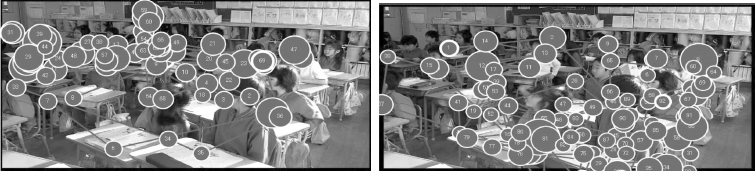
Examples of gaze paths for 30 sec. of two participants who were aware (left) and unaware (right) of target students, respectively.
The fixation count was examined as the sum of the number of fixations on AOI1 and AOI2 during 30 sec., the total number of fixations during 30 sec., the fixation length (sum of the durations of all fixations on AOI1 and AOI2), the mean fixation duration on AOI1 and AOI2, the time to first fixation on each of AOIs, the number of fixations on other regions before fixation on each of the AOIs, and the duration of first fixation on each of the AOIs.
Number of fixations on AOI.—The sum of the number of fixations on AOI1 and AOI2 were compared for aware teachers and unaware teachers (Table 1). Aware teachers made significantly more fixations on target students than unaware teachers (t17.78 = 2.50, p = .02, d = 0.97). This result suggests that aware teachers fixated on target students more frequently than unaware teachers. In contrast, there was no difference between groups in the total number of fixations for 30 sec., as aware teachers made 63.33 fixations compared to 60.68 fixations for unaware teachers (t41 = 0.59, p = .56, d = 0.19).
Number of fixations by aware and unaware teachers on both AOIs and the video

Fixation length on AOI.—The total fixation duration on AOI1 and AOI2 was compared for aware teachers and unaware teachers and showed a significant difference between groups (t14.18 = 2.66, p = .02, d = 1.05). That is, aware teachers fixated longer on target students than unaware teachers (Table 2). However, in the mean fixation duration on AOI1 and AOI2, there was no difference between aware and unaware teachers (t41 =0.37, p = .71, d =0.12).
Total fixation time and mean fixation duration on both AOIs and duration of first fixation on each of the AOIs of aware and unaware teachers (sec.)

The duration of the first fixation on each of the AOIs was compared between aware and unaware teachers. There was no difference between teacher groups for either AOI1 or AOI2 (t41 = 0.83, p = .41, d = 0.27; t41 = 1.19, p = .24, d =0.38, respectively).
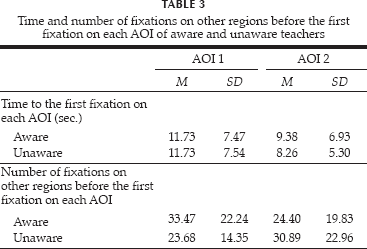
Time and number of fixations on other regions before the first fixation on each of the AOIs.—The time to the first fixation on each of the AOIs was compared for aware and unaware teachers. There was no difference between teacher groups for either AOI1 and AOI2 (t38 = 0.001, p = 1.0, d = 0.00; t31 = 0.52, p = .60, d = 0.19, respectively). In other words, both aware and unaware teachers first fixated on target students at about the same time (Table 3). The number of fixations on other regions before the first fixation on each AOI was compared between aware and unaware teachers. There was no difference between groups for either AOI1 or AOI2 (t20.41=1.54, p = .14, d = 0.56; t41 = 0.93, p = .36, d = 0.30, respectively).
Time and number of fixations on other regions before the first fixation on each AOI of aware and unaware teachers
Discussion
Awareness of target students
In the present study, there was no difference in teaching experience between aware and unaware teachers. This result indicates that teaching experience did not influence the ability to notice students' misbehavior. There are two ways to account for this finding.
One is that a number of studies have been conducted comparing the skills and decision making of expert and novice teachers during teaching. Differences between expert and novice teachers are interpreted as experts' richer and more elaborate schemata (e.g., Borko & Livingston, 1989; Colton & Sparks-Langer, 1993). It has also been reported that experienced teachers utilized more student cues for instructional actions than did novices (Fogarty, Wang, & Creek, 1983). The difference described in these studies is in the utilization of student cues for teaching. Nevertheless, in the current study examining the ability to notice student cues, that there was no difference in teaching experience between groups. Applying this finding to a social information-processing model (Crick & Dodge, 1994), utilizing student cues corresponds to the phase of “interpretation of cues,” whereas noticing student cues corresponds to “encoding of cues.” The results suggest that encoding of student cues is unrelated to teaching experience but interpretation of student cues is likely related to teachers' information processing during teaching.
Novice teachers did notice students' misbehavior. This indicated that negative student cues were equally important to novice and experienced teachers; but positive cues are reported to be noticed more frequently by experienced teachers than by novices (Clark & Peterson, 1986). The student behavior focused upon in this study was negative (not following the teacher's instructions). Hence, similar to Clark and Peterson's findings, novice teachers were able to notice students' misbehavior. The current result suggests that in settings in which teachers observe lessons being conducted rather than conducting lessons themselves, the ability to effectively observe students is not related to teaching experience.
Teachers' gaze on students
Eye movements relate to cognitive processes (Rayner, 1998; Kostons, Van Gog, & Paas, 2009). Studies in several fields have reported perceptual differences between experts and novices using eye-tracking data (e.g., Shank & Haywood, 1987; Helsen & Starkes, 1999; Charness, Reingold, Pomplun, & Stampe, 2001). Nevertheless, eye-tracking research has never been conducted to examine the behaviors of teachers. Verbal-protocol data, for example, interview and observation, has been mainly used to investigate teachers' cognitive processes; however, it has been reported that eye-movement data produces more detailed information on the allocation of attention than verbal-protocol data (Van Gog, Paas, & Van Merriënboer, 2005). Thus, eye tracking is a novel technique for revealing teachers' perceptual characteristics.
Teachers who noticed target students fixated on them more frequently than those who did not (Table 1). Loftus (1972) investigated the relationship between eye movements and recognition memory for pictures and found that higher-valued pictures both received more fixations and were remembered better than low-valued pictures were. Moreover, in recognizing facial affect, normal adults fixated more frequently on the eyes and mouth, which are the regions with high information value, than did schizophrenic patients (Shimizu, Shimizu, Yamashita, Iwase, Kajimoto, & Kawasaki, 2000). These findings suggest that the number of fixations represents the information value of a target. Hence, in the present study, teachers who noticed the target students regarded misbehavior in the class as high-value information. Additionally, there was no difference between teacher groups in the total number of fixations when watching the video. This result shows that teachers who noticed target students had a higher proportion of fixations on target students—they fixated on target students repeatedly. Teachers who noticed target students considered the misbehavior of not following a teacher's instructions in the class as a high-value cue, probably for instructional decision making.
Furthermore, we found that aware teachers made longer fixations on target students than unaware teachers (Table 2). A relationship between gaze duration and reading comprehension (Just & Carpenter, 1980) has been reported; readers interpreted a word during fixation and continued to fixate on it until they had finished processing it. A longer fixation on a particular word showed that more time was being taken to translate and understand it (Uzzaman & Joordens, 2011). In addition, fixation duration is affected by the discrimination task of analyzing fixated targets (Hooge & Erkelens, 1999). An eye-tracking study on print advertisements revealed that attracted attention and curiosity for further information led to longer fixations (Hutton & Nolte, 2011). These findings suggest that the duration of fixations represents the time to process information about a target. However, there was no difference in the duration of each fixation between groups. Hence, the number of fixations by aware teachers led to longer fixation length. The results demonstrate that teachers process instructional information not by long fixations but by frequent fixations, in order to continually attend to the whole classroom.
No difference between aware and unaware teachers was found in the time to the first fixation (Table 3), the fixations before fixating on an AOI (Table 3), and the first fixation duration (Table 2), so there was no difference in the time required to notice target students. Previous studies showed that the velocity of eye movements and both timing and accuracy of gaze shift were affected by the observer's expectation or prediction (Kowler, Martins, & Pavel, 1984; Kowler, 1989; Wang & Stern, 2001). In the present study, participants watched unfamiliar students in the video, and thus, they had no prior knowledge about target students. There may have been no difference between teacher groups in the time to notice target students because participants could not predict students' behavior from previous experience with the students.
Two key findings have emerged from the present study. First, when observing another's teaching, there was no relationship between the ability to notice students' misbehavior and teaching experience. Second, fixations of teachers who noticed students' misbehavior were more frequent. These findings suggest that inexperienced teachers can acquire the ability to notice students' cues by effective visual search.
Limitations and future directions
The present study has two limitations of note. First, we examined teachers' gaze while watching a video, which is not the same as monitoring teachers' visual attention while they are actually teaching. For example, teachers are required to be more acutely aware of their surroundings during real-life teaching situations than when watching a teaching video. This difference might affect teachers' gaze toward students' misbehavior. Although we recorded an actual lesson from the perspective of a teacher (i.e., the camera was set up in a location where a teacher would normally stand in front of a classroom), further investigation of teachers' gaze in a setting that more closely matches a real teaching scenario is needed. Second, culture plays a significant role in terms of the expression of classroom behaviors. Stigler, Lee, and Stevenson (1987) observed that American children spend more time displaying “off-task” behaviors than do Japanese students. In the present study, we only presented participants with a video of students “on-task,” where students should be following the teacher's instruction. However, regardless of culture, students likely show similar “on-task” behaviors. Since the present study used a video of a Japanese classroom, we did not investigate whether similar results would be obtained if assessing a classroom from a different culture (i.e., North America or Europe). Nevertheless, we focused on teachers' gaze when teachers watched familiar classroom behavior that was reflective of the teachers' own culture. Therefore, the findings may be generalized to reflect how a teacher would allocate visual attention in his/her familiar classroom environment.
Japanese classrooms tend to have more students that classrooms in the United States (Stigler, et al., 1987). Thus, it is meaningful to analyze the gaze behavior of Japanese teachers. Novices might utilize the recordings of experts' gaze as a model for learning effective allocation of attention (Van Gog, Jarodzka, Scheiter, Gerjets, & Paas, 2009), just as eye gaze of expert surgeons is currently being used to train novice surgeons (Khan, Tien, Atkins, Zheng, Panton, & Meneghetti, 2012). Thus, novice teachers might be able to learn effective strategies for allocating attention by modeling the eye gaze of expert teachers.