






Abstract
Online social network sites are often used for personal purposes during working hours. Whether or not such use interferes with and impairs work performance is obviously of organizational and economical interest. This impairment hypothesis was empirically tested by the current study. A total of 11,018 (5,656 male) employees participated in a web-based cross-sectional survey distributed in the online edition of several Norwegian newspapers. To investigate the relationship between the use of online social network sites for personal purposes during working hours and self-reported work performance, these measures were included with additional questions about demography (age, sex, education, relationship status, professional position) and personality (Mini-IPIP; Extroversion, Neuroticism, Agreeableness, Conscientiousness, Intellect/Imagination). The data was analyzed by hierarchical regression analyses, where absolute (usual performance) and relative (usual performance compared to one's judgment of the usual performance of most workers in similar a job) self-reported work performance comprised the dependent variables. Demographic variables were entered in block one, personality variables in block two, and use of online social network sites for personal purposes during work hours was entered in the third and final block. This variable was significantly and negatively related to both absolute and relative self-reported work performance, and explained 1.1% and 1.2% of the variance in these variables, respectively. The findings suggest that the use of online social network sites for personal purposes during working hours has a negative effect on self-reported work performance, although the effects were very slight. The results might have been influenced by self-report bias.
The use of the Internet for personal purposes during working hours has to an increasing extent become an issue of concern (Griffiths, 2003; Andreassen & Pallesen, 2014). Such use is often denoted as “cyberslacking” or “cyberloafing.” Cyberslacking has been defined as behaviors that include online gambling, stock trading, online romance, chat, or visiting pornographic websites during working hours (Johnson & Indvik, 2004). Lim (2002) defined cyberloafing more specifically as “any voluntary act of employees using their companies' Internet access during office hours to surf non job-related websites for personal purposes and to check (including receiving and sending) personal email” (p. 677).
Employers typically fear that cyberloafing may reduce productivity and, as such, may cause economic loss (Greengard, 2000; Block, 2001; Milss, 2001). Some recent studies support this fear, reporting that personal e-mail activities (i.e., minor cyberloafing) have a negative effect on employees' work and on academic performance (Lim & Chen, 2012; Zoghbi-Manrique-de-Lara, 2012). As a result, employers have tried to limit such use of the Internet by the implementation of specific policies at the workplace (Case & Young, 2002; Young & Case, 2004; Lara, Tacoronte, & Ding, 2006; Henle, Kohut, & Booth, 2009). On the other hand, it has been suggested that the use of the Internet for personal purposes during working hours may also have some beneficial effects, such as counteracting stress and boredom, and increasing job satisfaction and creativity (Lim, 2002; Oravec, 2002; Eastin, Glynn, & Griffiths, 2007; Pelling & White, 2009; Reinecke, 2009).
One type of popular Internet use is online social network sites (Pelling & White, 2009; Andreassen, Torsheim, Brunborg, & Pallesen, 2012; Andreassen & Pallesen, 2014). Such sites are defined as web-based services that allow individuals to: construct a public or semi-public profile within a bounded system, articulate a list of other users with whom they share a connection, and view and use their list of connections and those made by others within the system (Boyd & Ellison, 2007). Studies have shown that such sites are often used for personal purposes during working hours (Turner, 2010). With their billion active users worldwide, this comes as no surprise.
Recent research findings also imply that attitudes toward the use and actual use of online social network sites for personal purposes during working hours are related to demographic (male sex, younger adults, single status, higher education), personality (high extraversion and neuroticism, low conscientiousness), and work-related factors (fewer challenges and demands) (Andreassen, Torsheim, & Pallesen, 2014). Furthermore, accessibility of and policies prohibiting the personal use of such sites at the workplace seemingly serve their purposes (Andreassen, et al., 2014). But does the personal use of online social network sites during working hours impair work performance? Surprisingly, as far as we are aware, no studies of this relationship have been conducted thus far.
Employees who perform well are of crucial importance for organizations. Because of this, a large body of studies has been conducted on individual work performance over the years (Koopmans, Bernaards, Hildebrandt, Schaufeli, de Vet, & van der Beek, 2011). Although several definitions of individual work performance exist, it is often referred to as “actions and behaviors that are under control of the individual that contribute to the goals of the organization” (Rotundo & Sackett, 2002, p. 66). Work performance and productivity is often used interchangeably in the literature, although the latter represents a narrower concept (Koopmans, et al., 2011). In their conceptual models, scholars use various dimensions to describe the work performance phenomenon, generically in terms of task performance (e.g., being skilled), contextual performance (e.g., taking initiative), adaptive performance (e.g., being innovative), and voluntary counterproductive work behavior that negatively influences the well-being of the organization (e.g., engaging in off-task behavior), among others (Rotundo & Sackett, 2002; Koopmans, et al., 2011). Occupational health psychologists have sometimes divided counterproductive work behavior into absenteeism (not attending work) and presenteeism (attending work while ill) (Smith, 1970; Allen, 2008; Escorpizo, 2008; John, 2010).
Presenteeism typically refers to attending work while ill, but has also been defined as decreased productivity at work due to health issues or other matters that sidetrack one from optimal productivity (Hummer, Sherman, & Quinn, 2002), thus making it relevant when investigating the personal use of online social network sites at work, as research shows that such sites may serve as a distraction from work-related duties (Andreassen, et al., 2012, 2014; Andreassen & Pallesen, 2014). Overall, this type of distraction may thus potentially harm the well-being of organizations.
Other factors that may influence work performance should be mentioned. In terms of age, a meta-analysis showed that older workers score higher than do younger workers in terms of positive noncore job performance (e.g., citizenship and safety behavior) and lower on negative noncore job performance (e.g., aggression, substance use, and voluntary absence), whereas age overall seemed to be unrelated to core task performance (Ng & Feldman, 2008). Concerning sex, a meta-analysis showed that women were on average rated as performing somewhat better in operational field settings than were men (Roth, Purvis, & Bobko, 2010). Educational level seems, according to another meta-analysis, to be positively related to core task performance and citizenship, and negatively related to counterproductive work behavior (Ng & Feldman, 2009). Although little research has been conducted on the relationship between marital status and work performance, research does indicate that married men perform better than do unmarried men (Mehay & Bowman, 2005). When it comes to the specific performance of leaders, this is assumed in general to be superior compared to that of subordinates (Stogdill, 1974).
The relation of main personality dimensions outlined in the five-factor model (McCrae & Costa, 1987) of personality (conscientiousness, neuroticism, agreeableness, extraversion, openness to experience/intellect) to work performance has been widely studied. The overall conclusion from these studies is that Conscientiousness is positively related and Neuroticism is negatively related to work performance, whereas no overall clear-cut relationship seems to have been established for the three other dimensions (Hurtz & Donovan, 2000).
Prior research has traditionally focused on job characteristics (e.g., job security, workload, and demand), leadership (e.g., leadership styles), and dispositional characteristics (e.g., personality) as antecedents of presenteeism and other work performance behaviors, suggesting that such factors affect performance to varying degrees (Borman, 2004; Kahya, 2007; Tse & Chiu, 2014). Whether or not the use of online social network sites for personal purposes at work serves as an counterproductive behavior and as such actually impairs performance, e.g., in terms of reduced effort and productivity, or is beneficial as a means by which to reduce stress and boost creativity, is a question open to debate (Anadarajan, Simmens, & D'Ovidio, 2011) and empirical study.
As many organizations and behavioral professionals assess work performance among their employees on a regular basis (Whitehouse, 2005), more knowledge about the personal use of online social network sites at work may help them pinpoint areas for improvement. For the time being, they cannot lean on research conducted on cyberloafing, as research thus far has examined the relationship between online social network sites and work performance to a very limited extent. Therefore, specific research on this topic is important for organizations and their employees. This seems highly relevant, as such use may include possible benefits as well as risks, and since such sites involve more than a billion active users worldwide. Also, scholars have addressed the need to focus on specific use of the Internet (e.g., online social network sites) in line with a content-specific approach (Young, 2009). Online social network sites are different than other Internet sites, and involve many people. As an illustration, if Facebook were a country it would be the second largest in the world. However, we are currently unaware of any study that has specifically investigated cyberslacking related to online social network sites in a large sample of employees.
Against this backdrop, the goal was to conduct a survey that specifically assesses the use of online social network sites for personal purposes during working hours, and examined whether such use is related to absolute (rating of own usual performance) and relative (rating of own usual performance compared to one's judgment of the usual performance of most workers in similar a job) self-reported work performance, controlling for basic demographic, personality, and work-related variables.
Specifically, it was hypothesized that use of online social network sites would be negatively related to self-reported work performance, when the relationship tested using stepwise hierarchical regression. If the use of online social network sites interferes with self-reported work performance, then reported amount of online social network site use should correspond to significant variance in the measures of work performance. In addition, age would be unrelated to self-reported work performance, women would report higher performance than would men, educational level would be positively related to self-reported performance, and respondents in a relationship were hypothesized to report better self-reported performance compared to those not in a relationship. Leaders were expected to report better performance than were subordinates, and in terms of personality Conscientiousness would be positively related and Neuroticism negatively related to self-reported work performance. Other personality variables were expected to be unrelated to self-reported work performance.
Method
Sample
The sample consisted of 11,018 employed respondents, 5,656 men and 5,362 women; 7,082 were currently in a relationship whereas 3,936 were not. In all, 555 had completed only compulsory school, 1,349 had completed high school, 2,713 had completed vocational school/technical college, 3,904 had a bachelor's degree, 2,283 had Master's degrees, and 217 had Ph.Ds. Eight hundred eleven were top-level managers, 1,821 were mid-level managers, 2,764 performed other managerial functions, and 5,622 had no managerial duties. The mean age of the sample was 35.4 yr. (SD = 10.1).
Procedure
Respondents were recruited to participate in a web-based cross-sectional survey concerning the use of online social network sites at their workplace by clicking a link available in articles about Facebook addiction published in the Internet edition of seven Norwegian newspapers. After clicking the link, potential responders were given access to a web-based survey administered by SurveyXact (www.surveyxact.no). Responses were stored on a server administered by SurveyXact. Approximately 1 mo. following publication of the link, SurveyXact retrieved and sent all data to the research team. The Regional Committee for Medical and Health Research Ethics in Western Norway did not consider informed consent to be a requirement for the study, since no intervention was conducted and all data would be collected anonymously.
Measures
Demographics.—Questions asked concerned age, sex, level of education, relationship status, and managerial responsibilities.
Mini International Personality Item Pool.—Five-Factor Model measure (Mini-IPIP).—Mini-IPIP was used as a measure of the five-factor model of personality. The Mini-IPIP is comprised of a total of 20 items, four reflecting each of the following five dimensions: Extraversion (e.g., being outgoing, talkative), Agreeableness (e.g., being sympathetic and warm), Conscientiousness (e.g., being organized and structured), Neuroticism (e.g., being nervous and moody), and Intellect/Imagination (e.g., being creative and intellectual). Each item is answered on a five-point adjective scale (1 = very inaccurate, 2 = moderately inaccurate, 3 = neither inaccurate nor accurate, 4 = moderately accurate, and 5 = very accurate) (Donnellan, Oswald, Baird, & Lucas, 2006). The Cronbach's α for the five subscales of the Mini-IPIP in this study were 0.78, 0.75, 0.66, 0.66, and 0.67, respectively. Previous studies with the Norwegian version of the Mini-IPIP have shown similar psychometric properties (Andreassen, Griffiths, Hetland, Kravina, Jensen, & Pallesen, 2014; Hanss, Mentzoni, Blaszczynski, Molde, Torsheim, & Pallesen, in press).
Use of online social network sites at the workplace.—Seven items were created to assess personal use of online social network sites at the workplace. All items were answered using a five-point Likert scale (1 = strongly disagree, 2 = disagree, 3 = neither agree nor disagree, 4 = agree, and 5 = strongly agree). According to the instructions, the items pertained to the use of Facebook/Twitter or other social network sites for personal (non-job related) purposes during working hours. The seven items were:
“I visit Facebook/Twitter almost daily during working hours,”
“If nobody could discover it, I would spend more time on Facebook/Twitter during working hours,”
“If I have the opportunity, I like to visit Facebook/Twitter during working hours,”
“I am often so curious about what's happened on Facebook/Twitter or other social network sites that I can't resist visiting these sites during working hours,”
“I monitor what's happening with my friends via Facebook/Twitter or other social network sites during working hours,”
“I often read or post on Facebook/Twitter or other social network sites during working hours,” and
“I often chat on Facebook/Twitter or other social network sites during working hours.” Cronbach's α for this scale was 0.88 in the study. We have previously shown that the scale has good factor structure and that items concerning attitudes towards use of social network sites at the workplace load on a different factor than the behavioral/use items used in the present study (see Andreassen, et al., 2014).
Self-reported work performance.—Self-reported work performance was assessed by three items (from the Presenteeism subscale) of the World Health Organization Health and Work Performance Questionnaire (HPQ). Absolute self-reported work performance was assessed by asking the respondents to rate their usual work performance over the last year or two on a scale from 0 (“worst performance”) to 10 (“best performance”). The scores were multiplied by 10. Relative self-reported work performance was calculated as the ratio between the respondents' own work performance on the 0 to 10 scale, divided by their judgment of the usual performance of most workers in a similar job. The distribution of the relative self-reported work performance scores is restricted to a range of 0.25 to 2.00 (Kessler, Barber, Beck, Berglund, Cleary, McKenas, et al., 2003; Kessler, Ames, Hymel, Loeppke, McKenas, Richling, et al., 2004). The measure of absolute self-reported work performance and the measure of relative self-reported work performance correlated positively (r = 0.56, p < .01), thus providing some evidence of convergent validity.
Analysis
Table 1 shows an overview of the distribution of the nominal variables in the study, and the mean scores and their standard deviations of the interval/ratio variables. In order to investigate how demographic and personality variables and the use of online social network sites for personal purposes during working hours relate to self-reported work performance, two hierarchical regression analyses were performed. The absolute self-reported and the relative self-reported work performance scores comprised the dependent variables. Basic demographic variables in terms of age, sex, relationship status, educational level, and management position were entered in the first step of the regression analyses. Since the educational level and management position variables were both nominal, these were dummy coded before being entered into the regression analyses. In the second step the personality variables were entered, in terms of the scores on the five subscales (Extraversion, Agreeableness, Conscientiousness, Neuroticism, and Intellect/Imagination) of the Mini-IPIP. At the third and last step, the scores of the Personal use of online social network sites at the workplace scale were entered. Preliminary analyses were conducted to ensure no violation of the assumptions of normality, linearity, multicollinearity, and homoscedasticity. Outliers, defined by a z-score above or below 3.3, were excluded from the analyses.
The Study Variables

Results
Table 2 shows the results for the regression analysis where absolute self-reported work performance comprised the dependent variable. The demographic variables age, sex, relationship status, educational level, and professional position were entered at step 1, and explained a total of 2.5% of the variance (F11,10902 = 25.4, p < .01). At step 2, the five personality dimensions (Extraversion, Agreeableness, Conscientiousness, Neuroticism, and Intellect/Imagination) of the five-factor model of personality were entered. These five variables explained an additional 7.1% of the variance (ΔF5,10897 = 171.6, p < .01). Finally, the use of online social network sites for personal purposes during working hours was entered at step 3. This variable explained an additional 1.1% of the variance (ΔF1,10896 = 129.2 p < .01). The model as a whole explained 10.7% of the variance (F17,10896 = 76.6, p < .01). In relation to significant associations with absolute self-reported work performance in the final step, sex (male = 1, female = 2) was positively related; relationship status (in a relationship = 1, not in a relationship = 2) was positively related; bachelor's, master's, and Ph.D. degrees were all negatively related (vocational school/technical college comprised the contrast group); all management positions (some management functions, mid-level and top-level management positions) were positively related (no managerial functions comprised the contrast variable); Extroversion was positively related; Agreeableness was positively related; Conscientiousness was positively related; Neuroticism was negatively related; Intellect/Imagination was positively related; and finally, use of online social network sites for personal purposes was negatively related.
Hierarchical Multiple Regression Analyses Examining Effects of Demographic Variables, Personality, and Use of Online Social Network Sites for Personal Purposes at Work on Absolute Self-reported Work Performance (N = 10,913)

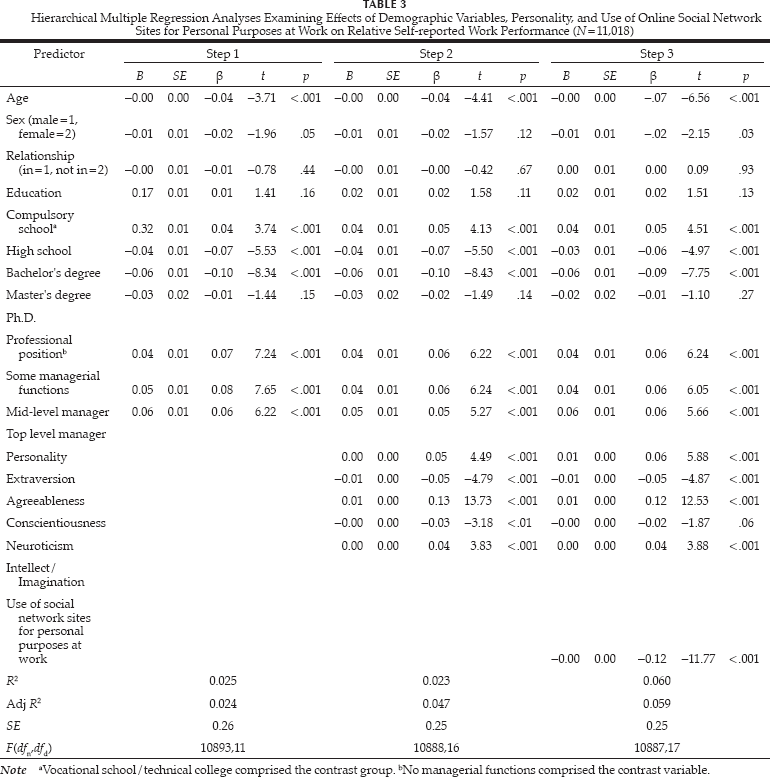
Table 3 depicts the results for the regression analysis where the relative self-reported work performance was the dependent variable. The demographic variables age, sex, relationship status, educational level, and professional position were entered at step 1, and explained 2.5% of the variance (F11,10893 = 25.3, p < .01). The five dimensions (Extraversion, Agreeableness, Conscientiousness, Neuroticism, and Intellect/Imagination) of the five-factor model of personality were entered at step 2. These variables explained an additional 2.3% of the variance (ΔF5,10888 = 53.6, p < .01). At the final and third step, the use of online social network sites for personal purposes during working hours was entered. This variable explained an additional 1.2% of the variance (ΔF1,10887 = 138.5, p < .01). The model as a whole explained 6.0% of the variance (F17,10887 = 41.1, p < .01). Concerning significant associations with relative self-reported work performance in the final step, age was negatively related; sex (male = 1, female = 2) was negatively related; a high school diploma, bachelor's, and master's degrees were all negatively related (vocational school/technical college comprised the contrast group); all management positions (some management functions, mid-level, and top-level management positions) were positively related (no managerial functions comprised the contrast variable); Extroversion was positively related; Agreeableness was negatively related; Conscientiousness was positively related; Intellect/Imagination was positively related; and the use of online social network sites for personal purposes was negatively related.
Hierarchical Multiple Regression Analyses Examining Effects of Demographic Variables, Personality, and Use of Online Social Network Sites for Personal Purposes at Work on Relative Self-reported Work Performance (N = 11,018)
Discussion
The overall goal of this study was to investigate whether or not use of online social network sites for personal purposes during working hours impairs self-reported work performance, when controlled for basic demographic and personality variables. Self-reported work performance was assessed by two variables, one pertaining to absolute self-reported work performance and one pertaining to relative self-reported work performance (Kessler, Barber, Beck, Berglund, Cleary, McKenas, et al., 2003). The discussion pertaining to how each independent variable relates to self-reported work performance will be based on the results from the third and final step of the regression analyses.
In the final step of the regression analysis, age was unrelated to absolute self-reported work performance, but negatively related to relative self-reported work performance. The former finding supports the hypothesis, although the latter runs counter to the hypothesis and to one study in which age was positively related to absolute self-reported work performance (presenteeism) (Terry & Xi, 2010).
Women had higher absolute self-reported work performance than did men, but lower relative self-reported work performance. The finding regarding absolute work performance is in line with the hypothesis and a former meta-analysis on sex and job performance (Roth, et al., 2010). However, the latter finding concerning relative work performance runs counter to the hypothesis. This finding might reflect the fact that women experience or perceive stricter performance standards than do men (Gorman & Kmec, 2007).
Relationship status was unrelated to absolute self-reported work performance, but respondents not currently in a relationship had higher scores on relative self-reported work performance compared to those in a relationship. This finding runs counter to the hypothesis and a former study of men (Mehay & Bowemn, 2005). Still, the finding is in line with findings from a previous study on self-reported work performance (presenteeism; Terry & Xi, 2010), and may reflect that a single status frees time and effort for work performance.
Generally, educational level was inversely related to both absolute and relative self-reported work performance. This was surprising, and supported neither the hypothesis nor a former meta-analysis on this topic (Ng & Feldman, 2009). Although speculation, this may reflect that career aspirations and standards of performance increase with educational level, and that people with high education therefore have lower self-report ratings of their work performance than do people with a lower level of education. Future studies should address follow-up on this topic.
Managerial position was on the other hand positively associated with both absolute and relative self-reported work performance. This was in line with our hypothesis. As managerial responsibilities are often compensated by relatively high salaries, these findings are in line with studies showing that income is positively associated with self-reported work performance (Kuvaas, 2006; Terry & Xi, 2010) and with “great man” leadership theories (Stogdill, 1974).
All the personality traits were related to self-reported work performance. Extraversion, Conscientiousness, and Intellect/Imagination were positively related to both absolute and relative self-reported work performance, whereas Neuroticism was negatively related. The findings regarding Conscientiousness and Neuroticism were in line with the hypothesis and a relevant meta-analysis (Hurtz & Donovan, 2000). The expectation concerning no relationship with self-reported work performance for Extraversion and Intellect/Imagination was thus not supported by the study. Still, the finding concerning Extraversion and Intellect/Imagination is overall in line with a previous meta-analysis on the relationship between the five-factor model of personality and work performance (Salgado, 1997). We expected Agreeableness to be unrelated to self-reported work performance. However, the results showed that this trait was positively related to absolute self-reported work performance but negatively related to relative self-reported work performance. One explanation for this might be that people who are good natured and sympathetic (McCrae & Costa, 1987) try overall to do a good job, but are at the same time reluctant to portray themselves as better than others.
The main question asked in this study concerned whether or not the use of online social network sites for personal purposes at work actually impairs self-reported performance when controlling for demographic and personality variables. In line with our hypothesis, the results indicated that self-reported work performance, both absolute and relative, was negatively associated with the use of online social network sites for personal purposes during working hours. Hence, the potential negative perspectives of such use seem to be supported (Polito, 1997; Greengard, 2000; Block, 2001; Milss, 2001; Griffiths, 2003). However, the significance of this effect is a matter of discussion. It will be of interest to use an objective measure of work performance in future studies to assess the true effect size. Experiments where use and availability of social network sites for personal purposes are manipulated and where work performance, job satisfaction, and other relevant work parameters constitute the dependent variables are clearly warranted.
The last block of the regression analyses, containing the online social network use variable, explained only 1.1% and 1.2% of the variance, respectively. As the overall explained variance is very low, the effects on self-reported performance may be regarded as slight enough to be irrelevant, with no practical importance. That is, a 1% change outcome variable may not be perceived as very interesting, considering all of the other explanations for performance that are available. Employers' fear of financial loss due to employees' cyberloafing (Greenberg, 2000; Block, 2001; Milss, 2001) could be disproved by these results. Our data show that, at least as far as self-reported worker's productivity goes, these fears are incorrect. However, we argue that it is too soon to conclude that these effects are negligible, given the interests of the various stakeholders in an organization. Whether or not the 1% explained variance might amount to significant accumulated economic loss over time, and across many employees, is thus a question open for further empirical study. Whether the true performance cost is represented by these self-reports is also not known.
Furthermore, it cannot be ruled out that use of online social network sites for personal purposes actually stimulates creativity and inspires some workers (Lim, 2002; Oravec, 2002; Eastin, et al., 2007; Pelling & White, 2009; Reinecke, 2009). Thus, future studies should investigate the effect of use of online social network sites for personal purposes on various subgroups of workers and job contexts. It cannot be ruled out that online social network site use aids performance, particularly if workers are interacting with their coworkers though these sites. However, this study explicitly focused on the use of online social network sites for personal purposes at work; use involving communication with coworkers was therefore excluded as a study focus.
It should be noted that the study is based on a cross-sectional design. Conclusions concerning cause-and-effect relationships cannot be drawn. In line with this, an alternative explanation for the findings is that those who use online social network sites for personal purposes during working hours simply have too little to do at work, and that one natural consequence of this is to spend time on these sites during working hours. If this is the case, one way to counteract this would be to assign more work-related tasks (Henle & Blanchard, 2008). Previously, we have shown that policies prohibiting use of online social network sites for personal purposes at work, positive work challenges, and quantitative work demands are inversely related to the use of online social network sites at the workplace (Andreassen, et al., 2014).
As mentioned above, this is the very first study, to our knowledge, that examines the relationship between use of online social network sites for personal purposes during working hours and self-reported work performance. A high number of respondents provided strong statistical input for the analyses. It may be regarded as a weakness that we exclusively focused on one type of personal Internet usage during working hours. However, the relatively specific focus is in line with perspectives concerning problematic Internet use, which argue for a content-specific approach (Young, 2009).
Limitations
The study had several limitations. Overall, the predictors explained only approximately 11% and 6% of the variance, leaving vast proportions unexplained. This variance may be explained by other individual, job, and contextual characteristics not covered in this study, such as stress and mental ability (Zhong, Yano, Lan, Wang, Wang, & Wang, 2006), learning style (Furnham, Jackson, & Miller, 1999), health (Ford, Cerasoli, Higgins, & Decesare, 2011), leadership (Humborstad, Nerstad, & Dysvik, 2014), and time of day (Folkard & Tucker, 2003), in addition to variables such as impression management (Rosse, Stecher, Miller, & Levin, 1998). Although one could speculate about underlying motives (e.g., to counteract stress and boredom) for the personal use of online social network sites at work, these were not specifically measured. Neither did we measure how excessive use of online social network sites indirectly effects performance at work (e.g., by distracting attention).
As for a vast majority of workplace research conduced, this study also chose a quantitative self-report approach to allow access to a wide sample addressing the research questions. Another obvious limitation of the study is that the data is exclusively based on self-reports; thus, the results may be influenced by the common method bias (Podsakoff, MacKenzie, Lee, & Podsakoff, 2003). Also, due to the highly subjective nature of the data, the assessment of work performance may be very biased. We emphasize this by referring to “self-reported work performance” throughout the paper. Still, studies have shown positive, albeit slight to moderate, associations between self-reported and other-rated work performance, especially for relative work performance (Heidemeier & Moser, 2009). It should also be noted that estimates of work performance vary significantly according to the instrument used (Turpin, Ozminkowski, Sharda, Collins, Berger, Billotti, et al., 2004; Mattke, Balakrishnan, Bergamo, & Newberry, 2007; Zhang, Bansback, & Anis, 2011). Objective performance reports from peers or subordinates would undoubtedly be an asset.
As the study was based on a convenience sample, with no knowledge of non-respondents, we are precluded from estimating specific population parameters. The data should therefore not be generalized to other populations without caution. In line with this, it should be noted that the study participants responded to a call in online newspaper articles about Facebook addiction. This recruitment methodology may imply self-selection bias (e.g., attract certain groups such as younger people and excessive users of social media), making the sample biased and different from other people who use online social network sites at work, and thus limiting the external validity of the results (Klovning, Sandvik, & Hundskaar, 2009). This study design makes it therefore difficult to estimate population parameters due to lack of representativeness.
Still, the full range of scores was obtained for all variables in the data set (results not shown), thus any potential bias seems unrelated to a narrow of restricted range of scores. It should be noted that previous research concludes that offline versions of inventories and online versions are comparable (Cronck & West, 2002; Pettit, 2002; Gosling, Vazire, Strivastava, & John, 2004; Buchan, DeAngelis, & Levinson, 2005), and that many nationally representative studies on other topics (such as gambling addiction and workaholism in Norway and elsewhere) have used both online and offline versions to collect data (Andreassen, Griffiths, et al., 2014; Hanss, et al., in press). We therefore believe that web-based data is applicable given there is little empirically evidence demonstrating that such results would be any way skewed. We also compared our study data with data from nationally representative samples concerning overlapping instruments, such as the Mini-IPIP, and found similar results (data not shown) (Andreassen, Griffiths, et al., 2014; Hanss, et al., in press). Still, the sample is arguably suitable for estimations of the relationship between parameters (Cozby, 2005). Some of the alpha values for the personality subscales were somewhat low, suggesting low internal consistency. This may have influenced the results by reducing the magnitude of associations between the study variables. However, some of these subscales consisted of only four items, which naturally lowers the Cronbach's α values (Steiner & Norman, 2008), with similar values obtained in other representative Norwegian samples (Andreassen, Griffiths, et al., 2014; Hanss, et al., in press).
Conclusion
Self-reported work performance seems to be negatively associated with the use of social network sites at work for personal purposes. The effect is small, however, and the current findings should be corroborated by studies employing objective measures of work performance as well as through well-designed experiments.