






Abstract
This study aimed to examine the relationships among perceived likeability of principal, school identity, and teacher motivation. Differences between elementary school and secondary school teachers were also compared on perceived likeability of principal, school identity, and teacher motivation. Data were collected from 360 teachers from different elementary and secondary schools. The findings indicate that elementary school teachers reported higher perceived likeability of principal, school identity, and teacher motivation than secondary school teachers. There were strong correlations among perceived likeability of principal, school identity, and teacher motivation. Perceived likeability of principal was the best predictor of school identity, and the only significant predictor of teacher motivation was school identity.
A leader has a potent influence on organizational improvement and performance. Researchers have long been interested in how leaders can motivate employees in the workplace (Landy & Becker, 1987; Klein, 1989; Carmeli, Ben-Hador, Waldman, & Rupp, 2009). One of the keys to continuous school improvement is that a principal must demonstrate effective leadership. Leadership is embedded in a social context, and the idea of social intelligence as a required leadership trait is a powerful one (House & Aditya, 1997). Some researchers have suggested that attention should be directed to study the importance of relational leadership in cultivating positive relational interaction through which greater motivation, among other outcomes, is fostered (Fletcher, 2007). Shirom (2007) indicated that high-quality relationships are a key to invigorating people at work. Likeability is considered an important trait of a relational leader. A school leader or principal who is likeable tends to have positive relationships with teachers. Thus, it is important to understand how a school leader can cultivate better relationships in an organization, especially in a school, and thereby improve school identity and work motivation among teachers.
Likeability
Likeability is an accumulation of several characteristics that other people quickly perceive and judge in a positive way (Cottringer, 2003). Likeability has been labeled a persuasion tactic and a model of self-presentation (Kenrick, Neuberg, & Cialdini, 2002). Aspects that appear to increase likeability include physical attractiveness, similarity to the perceiver, compliments, and association (Kenrick, et al., 2002). In a series of studies, participants rated physically attractive sources as more talented, kind, honest, and intelligent (Eagly, Ashmore, Makhijani, & Longo, 1991). Cottringer (2003) confirmed eight simple ways to communicate likeability and improve chances for success as a leader. They are to laugh, listen more, learn empathy, appear attractive, act smart, be honest, be positive, and be humble. Reysen (2006) also showed evidence for a link between laughter and likeability. According to Sanders (2005), four elements, including friendliness, relevance, empathy, and realness, are necessary to improve one's likeability and are effective in both professional and personal environments. Chaiken and Eagly (1983) used a list of 12 bipolar adjectives to measure likeability. Two factors were found when a factor analysis was conducted. The attractiveness factor included likable, friendly, approachable, pleasing, modest, warm, and unbiased adjectives, whereas the expertise factor included the adjectives knowledgeable, intelligent, and competent. The Reysen (2005) Likeability Scale incorporates both the attractiveness and expertise factors described by Chaiken and Eagly.
School identity
Social identity theory has been very influential in social psychology (Tajfel, 1982; Hogg, & Abrams, 1988). Social psychologists have translated ideas of the social identity approach into organizational contexts (Tyler, 1999; Hogg & Terry, 2000; Tyler & Blader, 2000; Haslam, 2001). School identity is an organizational phenomenon that has lately received increasing empirical attention. In several empirical studies, relationships between different dimensions of identification and work-related attitudes have been observed (van Knippenberg, 2000; van Dick & Wagner, 2002; van Dick, Wagner, Stellmacher, & Christ, 2004). An increase in social identity was associated with improvement in those aspects of work motivation, work satisfaction, and other behaviors of group members that are in accordance with in-group norms. An understanding of teachers' school identity may play a key role in teachers' self-efficacy, motivation, commitment, job satisfaction, and effectiveness, so investigation of this factor is essential for professional practice. Tajfel (1982) defined social identity as that part of an individual's self-concept which derives from knowledge about his membership in a social group together with the value and emotional significance attached to that membership. Ellemers, de Gilder, and Haslam (2004) stressed social identity as the person's emotional involvement with the particular group. Van Dick, et al. (2004) provided three dimensions of social identity, including cognitive, affective, and evaluative components. In addition to these, Jackson (2002) proposed a fourth dimension: common fate or behavioral identity. Thus, in this study, school identity was measured by cognitive, affective, evaluative, and behavioral components.
Principal's likeability and teacher's school identity
In a study by Chaiken and Eagly (1983), communicators who were rated as likeable were more effective in achieving attitude change among listeners than were unlikeable communicators. Success as a school leader depends on the perceived likeability. The ability of the principals to motivate their teachers is decided by their ability to show superior individual qualities, such as intelligence, fairness, or likeability. Moreover, the secret of successful leadership lies in the capacity of the leader to induce followers to perceive him as the embodiment of a positive social identity which they have in common with that leader and that distinguishes them from others (Ellemers, et al., 2004). Therefore, it is an important issue to examine the relationship between the perceived likeability of a school leader and school identity of teachers.
Teacher motivation
The review of literature shows that teacher identity is a key influencing factor on teachers' sense of purpose, self-efficacy, motivation, commitment, job satisfaction, and effectiveness (Day, Kington, Stobart, & Sammons, 2006). It is widely accepted and believed that the central factor energizing a school's effectiveness is the teachers' commitment (Nir, 2002). The most important psychological factor affecting efficiency of work performance is motivation (Bedney & Karwowksi, 2006). Teachers' motivation is considered an essential factor for classroom effectiveness and school improvement (Ofoegbu, 2004). Teacher motivation has to do with teachers' desire to participate in the education process as well as in the school environment. Teacher motivation naturally has to do with teachers' attitudes toward work.
Teachers have both intrinsic and extrinsic needs (Ofoegbu, 2004). Intrinsic work motivation, the extent to which a professional is motivated to perform well in their job according to specific content, task characteristics, perceived significance of the work, and autonomy, are important in predicting intention to stay in a profession (Houkes, Janssen, de Jonge, & Nijhuis, 2001). A teacher who is intrinsically motivated may be observed to undertake a task for its own sake, for the satisfaction it provides, or for the feeling of accomplishment and self-actualization. On the other hand, an extrinsically motivated teacher may perform the activity or duty in order to obtain some reward, such as salary. Hence, the aim of the organization should be to build on and enhance intrinsic motivation for teachers to teach effectively and at the same time, to supply some extrinsic motivation for improvement (O'Neil, 1995). In the study of Sanchez-Perkins (2002), the Minnesota Satisfaction Questionnaire is used to measure intrinsic, extrinsic, and general satisfaction dimensions to measure teacher motivation, which includes intrinsic and extrinsic dimensions.
Relationships among variables
Leaders and managers should help staff feel empowered, motivated and energized (McAleese & Hargie, 2004). Evans (1999) observed that the largest influences on teacher motivation are school leadership and management. Pihie and Elias (2004) indicated the reasons given by teachers for not favoring the teaching profession can be categorized as external factors such as work load, low salary, students' discipline problems, unsatisfactory leadership, and work pressure. Many teachers would sacrifice higher pay if they could work in schools with well-behaved students, motivated colleagues, and supportive administrators (Langdon, 1999). Quinn (1978) suggested that the principal and a motivated staff are the most important and critical ingredients in a successful school. Quinn also found that principals are responsible for motivating teachers. Frase (1992) found that teachers' satisfaction and motivation are higher when principals exhibit a collaborative or relationship-oriented leadership style. If the school leader, the principal, is likeable, supportive, and satisfied, teachers may have more enthusiasm and motivation to participate in their work.
According to Wegge, van Dick, Fisher, Wecking, and Moltzen (2006), highly organizationally identified employees report higher work motivation and more well-being. van Knippenberg (2000) studied the relationship of organizational identification with motivation and performance. Results showed that identification was positively related to work motivation, task performance, and contextual performance. Accordingly, teachers' motivational orientation could be influenced by school identity.
Elementary and secondary school teachers
Since elementary and secondary schools have more curricular changes than other educational systems, the principals and teachers in those schools encounter more pressure and varied challenges. Both the roles of the principal and the teacher have important influence on school improvement in elementary and secondary schools. As yet there are no studies of the relationships among principal's likeability, school identity, and teacher motivation in the context of elementary and secondary schools. There were two goals: (1) to compare elementary school and secondary school teachers on perceived likeability of principal, school identity, and teacher motivation, and (2) to examine the relationships among perceived likeability of principal, school identity of teacher, and teacher motivation.
Method
Participants
The participants were 360 teachers, 180 elementary school and 180 secondary school teachers. The samples for the pilot study were excluded from the main research. They were recruited from different elementary and secondary schools located in three main regions of Taiwan, including the northern, middle, and southern areas of Taiwan. Nine elementary schools and nine secondary schools were sampled. The 138 men and 222 women ranged in age from 26 to 55 years (M = 42.0). All volunteered to respond to the scales. The response rate was 85.7%; 420 scales were distributed to 18 schools.
Measures
In this study, three instruments were utilized to gather the data from elementary and secondary school teachers. The Likeability Scale was developed to measure perceived likeability of a principal. The others are School Identity Scale and Teacher Motivation Scale, which were developed to measure school identity and motivation among elementary school and secondary school teachers. All the distributions were checked for compliance with assumptions of exploratory factor analysis.
Likeability Scale
The present study developed a measure of likeability, the Likeability Scale, based on literature review and the study of Chaiken and Eagly (1983), the Reysen (2005) Likeability Scale, and Sanders' (2005) book entitled The Likeability Factor. The scale was identified as consisting of two components of attractiveness and expertise. The likeability of a school principal was evaluated by the teachers and so is called the perceived likeability of the principal.
The expressions of a few items were rewritten after evaluation by two experts of education and psychological mesurement. Then, a pilot study was executed with 240 teachers, including 120 elementary teachers and 120 secondary school teachers. An exploratory factor analysis of the 15 items using the maximum likelihood method was conducted. Results showed that 12 items loading on two factors, accounting for 77.9% of the total variance. Three items were discarded from the Attractiveness factor due to loadings below .40. Therefore, a 12-item scale comprising seven items on attractiveness (e.g., “My principal is friendly”) and five items on expertise (e.g., “My principal is knowledgeable”) was used. The items are rated on 5-point scales, anchored by 1: Strongly disagree and 5: Strongly agree. Higher ratings indicate teachers perceiving greater likeability of principals. Cronbach's alpha of these two subscales were .94 and .95, respectively, and .96 for the total scale.
School Identity Scale
A new measure of school identity was developed based on literature review and the studies of van Dick, et al. (2004) and Jackson (2002). School identity is composed of cognitive, affective, evaluative, and behavioral components. All item responses were scored on a 5-point scale, anchored by 1: Strongly disagree to 5: Strongly agree. Higher values indicate greater school identity.
A few items were revised after evaluation by two experts of education and psychological measurement. Then, a pilot study was run with 240 teachers. An exploratory factor analysis of the 20 items was conducted. Only 17 items loaded on three factors with eigenvalues greater than 1.0, accounting for 68.3% of the total variance. Three items were deleted because of loadings below .40. Therefore, a 17-item scale comprising six items on affective (e.g., “I like to work for my school”), five items on evaluative (e.g., “My school is positively judged by others”), and six items on behavioral identity (e.g., “I try my best to work for my school”). Cronbach's alpha reliability coefficients for the three factors were .89, .86, and .90, respectively, and .94 for the total scale.
Teacher Motivation Scale
The Teacher Motivation Scale was developed based on a literature review and prior studies such as Sanchez-Perkin (2002) and Ofoegbu (2004). Teacher motivation included intrinsic and extrinsic dimensions. All item responses were scored on a 5-point scale anchored by 1: Strongly disagree to 5: Strongly agree. Higher values indicated greater teacher motivation. Once the scale was developed, two reviewers were also invited to revise some of the items. Then, a pilot study was executed with 240 teachers. After an exploratory factor analysis of the 10 items, results showed that nine items loading on two factors accounted for 65.6% of the total variance. One item was deleted from extrinsic motivation because of a loading below .40. The resulting 9-item scale comprised five items on intrinsic motivation (e.g., “Teaching increases my self-esteem”) and four items on extrinsic motivation, (e.g., “I want to be respected by school”). Cronbach's alpha of these two subscales were .87 and .80, respectively, and .88 for the total scale.
Design and analyses
Three questionnaires were developed and implemented to measure perceived likeability of principal, school identity of teacher, and teacher motivation among the main sample of 360 teachers. Cronbach's α coefficients were utilized to test the internal consistency reliability of the scales and principal component analyses were used to examine the factor loadings of the scales. Elementary school and secondary school teachers were compared on perceived likeability of principal, school identity, and teacher motivation using a multivariate analysis of variance (MANOVA). Finally, relationships among perceived likeability of principal, school identity of teacher, and teacher motivation were assessed. Intercorrelation matrices among all the variables were computed. Hierarchical regression analyses were used to explore whether the perceived likeability of principal was an indicator of school identity and whether the perceived likeability of principal and school identity of teacher were significant predictors of teacher motivation.
Results
Differences between school types
A MANOVA compared the mean scores of school type (elementary and secondary schools) on the scores of the perceived likeability of principal, school identity of teacher, and teacher motivation. There was a main effect of school type (Wilks' λ = .83, F = 10.23, p < .0001; η2 = .17). Univariate F tests were further performed to investigate which variables contributed to the overall multivariate significance. Descriptive statistics and univariate F tests for the subscales and the total scales of likeability, school identity, and teacher motivation are presented in Table 1. Elementary school and secondary school teachers differed significantly on attractiveness, expertise, total scores on likeability, evaluative identity, extrinsic motivation, and the total scale of teacher motivation. Based on means, elementary school teachers scored higher than secondary school teachers (Table 1).
Means, standard deviations, and univariate f tests on likeability, school identity, and teacher motivation (n = 360) by school type

Correlations among principal's likeability, school identity, and teacher motivation
Correlational and hierarchical regression analyses were utilized to analyze the relationships among principal's likeability, school identity, and teacher motivation. Table 2 represents the intercorrelations among those variables. Results showed that there were statistically significant positive relations among all of them. Therefore, perceived likeability of principal was highly associated with school identity of teacher. Also, both perceived likeability of principal and school identity of teacher were significantly correlated with teacher motivation (Table 2).
Intercorrelations among likeability, school identity, and teacher motivation

Hierarchical regression analyses were run to assess whether perceived likeability of principal could predict school identity of teacher and whether both likeability of principal and school identity of teacher could predict teacher motivation. The results of the analyses for predicting school identity of teacher are summarized in Table 3. The predictors were two dimensions of likeability and the criterion variables were three dimensions of school identity. Results showed that two dimensions of likeability, attractiveness, and expertise were the significant predictors of affective and behavioral identity, whereas expertise was the only significant predictor of evaluative identity. The perceived likeability of principal was positively correlated with school identity as shown in Table 2. Hence, teachers who have more perceived likeability of principal tended to report higher school identity (Table 3).
Summary of hierarchical regression for likeability predicting school identity

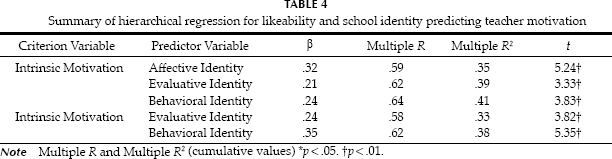
The other results of hierarchical regression analyses for predicting teacher motivation are summarized in Table 4. Results showed that three dimensions of school identity, affective, evaluative, and behavioral identity, combined to predict intrinsic motivation. Both evaluative identity and behavioral identity were the significant predictors of the extrinsic motivation. As shown in Table 2, school identity was strongly related to teacher motivation. A high school identity corresponded with high teacher motivation. It might be tempting to conclude that school identity of teacher is more important than likeability of principal in explaining teacher motivation (Table 4).
Summary of hierarchical regression for likeability and school identity predicting teacher motivation
Discussion
Of primary importance is the fact that elementary school teachers reported higher perceived likeability of principal, school identity, and motivation than secondary school teachers. There were statistically significant correlations among perceived likeability of principal, school identity, and teacher motivation. Perceived likeability of principal was statistically significantly associated with school identity of teacher; both perceived likeability of principal and school identity of teacher were statistically significantly related with teacher motivation. Finally, perceived likeability of principal was the strongest predictor of school identity, whereas school identity was the only statistically significant predictor of teacher motivation.
It is a common research finding that teachers report lower motivation and higher stress than other professional groups (Lens & Jesus, 1999; Pithers & Fogarty, 1995). Prior studies (Langdon, 1999; Pihie & Elias, 2004) indicated that the reasons given by teachers for not favoring the teaching profession are work load, pressure, and unsatisfactory leadership. In contrast, elementary school teachers feel less work stress, which may be associated with higher perceived likeability of principal and stronger school identity as well as higher teacher motivation.
More perceived likeability of principal tended to be associated with higher school identity of teachers (Ellemers, et al., 2004). Both perceived likeability of principal and school identity of teacher were statistically significantly related to teacher motivation, but the only statistically significant indicator of teacher motivation was school identity, in support of the prior studies (Van Knippenberg, 2000; Wegge, et al., 2006). Although the subjects of this study were 360 teachers in Taiwan, future studies may extend the sample to provide greater external validity. Future research should examine reliabilities and validities of the questionnaires. Moreover, future studies may identify more factors associated with likeability.
Footnotes
Appendix
Likeability Scale
Attractiveness
My principal is likeable. My principal is friendly. My principal is approachable. My principal is warm. My principal is genuine. My principal is smiling. My principal is modest.
Expertise
8. My principal is knowledgeable. 9. My principal is intelligent. 10. My principal is competent. 11. My principal is talented. 12. My principal is expert.
School Identity Scale
Affective Identity
I identify my school. Being a member of school reflects a significant meaning on me. I am loyal to my school. I have a strong sense of belonging to my school. I place importance on future development of my school. I like to work in my school.
Evaluative Identity
7. I have an agreement with school rules. 8. My school has a good reputation. 9. I am proud of being a member of my school. 10. My school students are positively judged by others. 11. My school has a good vision towards future development. 12. My school teachers are respected by others.
Behavioral Identity
13. I do my best for maintaining school reputation. 14. I work hard for school. 15. I can fully develop my ability in this school. 16. I expect to contribute to school. 17. I will help my school to create a good atmosphere.
Teacher Motivation Scale
Intrinsic Motivation
Teaching increases my self-esteem. Teaching contributes to my personal development. I enjoy teaching. I like to work hard. Teaching makes me feel accomplished.
Extrinsic Motivation
6. I expect to be recognized by my school. 7. I expect to be respected by my community. 8. I expect my performance to be rewarded by school. 9. I care about school evaluation of me.