






Abstract
The purpose of this quasi experimental study was to examine the effect of a fine motor intervention program on the graphomotor skills of 64 kindergarten and early elementary school Greek students (33 boys, 31 girls). The participants were assigned to experimental (EG) and control groups (CG). Graphomotor skills were assessed with the visual motor control items of Bruininks-Oseretsky Test of Motor Proficiency – Long Form (BOTMP-LF). The intervention program lasted two months, twice per week. Analysis indicated significant multivariate and univariate interaction effects for each graphomotor skill. Early elementary educators and kindergarten teachers should consider fine motor intervention programs to improve the graphomotor skills of all students.
According to dynamic systems theory development is non linear and not necessarily smooth. The dynamic model “implies that systems within the task, the individual, and the environment not only interact but also have the potential for modifying and being modified by each other as one strives to gain motor control and movement competence” (Gallahue & Ozmun, 1998, pp. 31). According to Gallahue and Ozmun (1998), the developmental process is highly influenced by the demands of the task itself. Therefore, over reliance on gross and fine motor milestones is of limited importance “when working with individuals from a developmental perspective” (pp. 31).
Fine motor skills are characterized by small muscle movements: those that usually occur in the fingers (Gallahue & Ozmun, 1998; Zervas, 2006) which never act alone, as more proximal parts (wrist, forearm, upper arm, shoulder, and spine) are almost always involved to provide the stability needed for the fingers to function with skill (Erhardt & Meade, 2005). The fine motor skills incorporate, among others the graphomotor skills (GS) which, in turn, involve the strength and control of the finger muscles (Levine, 1987; Kent, 1998), and incorporate important daily skills such as writing and drawing, necessary for the academic achievement of all students (Gallahue & Ozmun, 1998; Zervas, 2006).
Early childhood (2–6 years old) is the time period when children develop and refine a wide variety of movement skills that have been developed from birth. These skills are practised mainly through play, which occupies most of students' waking hours and may literally be viewed as the child's equivalent of work. Play, therefore, is an important facilitator of cognitive and affective growth as well as an important means for the development of fine and gross motor skills (Gallahue & Ozmun, 1998). The transition from kindergarten to elementary school is an important period for developing the fine motor skills and graphomotor skills. Children learn during their first years at school to develop their fine motor skills and become competent hand writers (Feder, Majnemer, Bourbonnais, Plat, Blayney, & Synnes, 2005).
According to the Greek Ministry of Education (2005), the curriculum educational programs for kindergarten and early elementary school children focus, among others, on the development of motor skills, both fine and gross, perceptual-motor development, coordination, spatial orientation, etc. Through the implementation of the curriculum, the teachers are able to monitor the academic progress of their students and detect those who may need support to fulfil the requirements of their academic life (e.g., children with learning disabilities, attention deficit hyperactivity disorder, developmental coordination disorder, etc.).
A literature search revealed few studies examining intervention strategies to facilitate the development of fine motor and graphomotor skills of children and infants with (Gelfer, 1988; Quah, 1998; Aparicio & Balana, 2009) and without disabilities (Smits-Engelsman, Niemeijer, & van Galen, 2001; Kambas, Amoutzas, Makri, Gourgoulis, & Antoniou, 2002; Erhardt & Meade, 2005; Ratzon, Efraim, & Bart, 2007; Spanaki, 2008; Spanaki, Nikolopoulos, Skordilis & Koutsouki, 2008; Kambas, Fatouros, Christoforidis, Venetsanou, Papageorgiou, Giannakidou, et al., 2010; Kaiser, Albaret, & Doudin, 2011). Gelfer (1989) presented a therapeutic-educational program for parents and children at risk for developmental delays. The program was individualized and incorporated observations of gross and fine motor skills, providing therefore input for parents seeking early intervention for their children (Gelfer, 1988). Quah (1998) conducted an intervention program for preschoolers with mild disabilities. The program incorporated daily living skills, was individualized and included assessment of gross and fine motor skills, language, and social abilities. After the 9-month intervention period, the children, parents, and teachers were positively affected (Quah, 1998). Aparicio and Balana (2009) examined the effect of a fine motor intervention program in the motor development of infants with Down syndrome. The researchers found that early treatment improved fine motor skills and overall motor development.
With respect to children without disabilities, Ratzon, Efraim, and Bart (2007) studied the effect of a short-term occupational treatment on the fine-motor and graphomotor skills of 52, Grade 1 students, both Arab and Jewish. The participants made significant gains both in the graphomotor test and the fine-motor items of the Bruininks-Oseretsky Test of Motor Proficiency – Long Form (BOTMP- LF) (Bruininks, 1978) compared to a control group, which exhibited no significant gains. Erhardt and Meade (2005) reported that a dynamic intervention between occupational and physiotherapy approaches meets the educational needs of adolescents with handwriting difficulties. The researchers provided principles for the design of successful intervention programs, such as sequencing, adaptation of activities and equipment, integration of treatment into daily activities, and establishment of a positive channel of communication among the participating families and professionals (Erhardt & Meade, 2005).
Kaiser, et al. (2011) examined the effect of a handwriting program in 23 first grade primary school students. The objectives of the six-week program, with a frequency of twice per week, were to develop digital dexterity and to develop handwriting learning strategies. A second group of 19 children participated in their usual handwriting program. At the termination of the intervention program, the first group displayed better performance on quality and speed of handwriting, used ‘fewer ambiguous letters’ and ‘incorrect relative heights’ compared to the control group (Kaiser, et al., 2011).
In Greece, Kambas, et al. (2002) examined the effect of a psychomotor programme, emphasizing time and space, in 35 children, 4 to 5 years old. The participants' graphomotor skills were assessed through the following items of the BOTMP-LF: copying circle, triangle, rhombus, and overlapping pencils. Kambas, et al. (2002) found significant differences between the experimental and control groups after the intervention. These differences were attributed to the improvement of the experimental group while the control group did not improve on the four examined variables. Kambas, et al. (2010) examined the effect of a psychomotor intervention program on 84 preschool children's improvement of spatiotemporal awareness on visual motor control. After the program, the intervention group improved significantly both their total visual motor control scores and their scores in the half of tested items, while the control group did not improve significantly pre- and post-intervention on these scores nor the total visual motor control.
In addition, Spanaki, et al. (2008) studied the effect of a motor development intervention upon gross, fine and graphomotor skills in a sample of 148 children from ‘general’ kindergartens and primary schools in Athens, Greece. At the end of the program, improvements were significant for gross, fine, and graphomotor skills for all students, regardless of their motor proficiency.
So far, the effect of the different intervention strategies presented above, upon the graphomotor skills of children, have been examined. However, the effect of an intervention approach based exclusively on fine motor skills and its effect upon the graphomotor skills has not been examined yet. For that reason, the present study was designed to examine the effect of an intervention program emphasizing fine motor activities on the graphomotor skills of kindergarten and early elementary school children. Based on the previous research findings:
Hypothesis. The fine motor intervention program will improve the student's graphomotor skills.
Method
Participants
The participants were 64 kindergarten and Grade 1 elementary school students, between 4.5 and 7 years old (M = 5.3, SD = 0.8). Two kindergarten classes and two Grade 1 elementary school classes were used to recruit the sample. The participants were classified in 33 boys and 31 girls, in Greek ‘general’ schools from Heraklion, Crete. The city of Heraklion, where the sample was recruited from, is representative of the general urban Greek population (Greek Census, 2001). Inclusion criteria were Greek citizenship and no disability mentioned in the school records. The participants were free to withdraw from the study at any time and their data were strictly confidential. All the students met the inclusion criteria.
Procedure
The study design was quasi experimental (Pedhazur & Pedhazur-Schmelkin, 1991). Initially, a purposive sampling selection was used to recruit the sample of this study (Thomas & Nelson, 2003). The four classes (2 kindergarten, 2 Grade 1) were purposively selected and then randomly assigned to the experimental and control groups. The primary researcher visited the schools, had a communication with the Headmasters and the teachers, informed them about the purposes of the study and its details and asked for their permission.
An informed consent form was distributed to all students, requesting their parents' approval to participate in the study. Furthermore, parents reported their children were not participating in extracurricular activities that may have affected graphomotor skills (e.g., drawing classes). Parents were instructed to avoid the children's involvement in such activities during the two-month intervention.
The students in the experimental condition were unaware of the condition in which they participated. The students in the control group received their ordinary educational training, according to the curriculum educational programs of the Greek Ministry of Education (2005).
The initial examination of children's graphomotor skills occurred during October and was followed by the intervention program, based on the respective educational needs of the students. The second examination was held at the end of the intervention program, approximately two months later. The pre- and post-assessments and the intervention program were held throughout the daily school schedule, within the classrooms by the primary researcher in the presence of the respective kindergarten and elementary school teachers. The activities were individualized using the Bruininks-Oseretsky Test of Motor Proficiency (see below) and children participated either in groups or in pairs into the classroom.
Measure
The Bruininks-Oseretsky Test of Motor Proficiency incorporates a Long and Short Form and was developed to evaluate motor proficiency of children 4.5 to 14.5 years old. The BOTMP-LF comprises 46 items classified under eight subtests, generally concerning motor skills, determination of direct educational goals, and evaluation of movement and developmental disorders. The 7th subtest (Visual-Motor Control) measures the ability to integrate visual with fine motor responses and it has been used, either in its completed form (Spanaki, et al., 2008; Kambas, et al., 2010) or partially (Kambas, et al., 2002), in studies examining preschooler's and school-aged children's graphomotor skills. According to Bruininks (1978), the BOTMP-LF may provide clinicians, practitioners, and researchers with information concerning motor skills, direct educational goals, and movement and developmental disorders. It is one of the most commonly used batteries, since it measures important skills of motor development (Miles, Nierengarten, & Nearing, 1988; Burton & Miller, 1998; Wilson, Kaplan, Crawford, & Dewey, 2000; Hassan, 2001; Goodway, Crowe, & Ward, 2003). Lam (2011) supported the construct validity of the BOTMP in a sample of 333 Hong Kong preschool children, as described by the five subtests (Running Speed and Agility, Balance, Bilateral Coordination, Strength, and Upper Limb Coordination) of the overall construct of motor proficiency. Finally, Flegel and Kolobe (2002) found a high intercorrelation between Problem-Oriented Perinatal Risk Assessment System (POPRAS) and BOTMP, suggesting that the two tests may be used together for assessing children and provide practitioners with suggestions on early intervention programs.
The validity and reliability of the BOTMP-SF and BOTMP-LF have been examined in Greece (Kambas, Aggelousis, Proviadaki, Mavromatis, & Taxildaris, 2004; Kambas & Aggeloussis, 2006; Venetsanou, Kambas, Aggelousis, & Fatouros, 2006). Venetsanou, et al. (2006) assessed the detection of children with motor problems using the BOTMP-SF and BOTMP-LF, reporting that 72.2% of students with motor problems were identified by both instruments. They concluded that these instruments could be used for clinical and research purposes in Greece, provided that the scoring system was suitably modified.
The children's graphomotor skills were tested through the following items of the 7th BOTMP subtest (Visual-Motor-Control): cutting out a circle with preferred hand, drawing a line through a crooked path with preferred hand, drawing a line through a straight path with preferred hand, drawing a line through a curved path with preferred hand, copying a circle with preferred hand, copying a triangle with preferred hand, copying a horizontal diamond with preferred hand, and copying overlapping pencils with preferred hand. The sum of the eight graphomotor skills tests was used to evaluate the total graphomotor score and as the estimate of the fine motor skills of the children examined (Bruininks, 1978). The item raw scores are converted into numerical point scores which are summed to give a total subtest point score and a standardized score.
Evidence for the technical adequacy of the aforementioned 7th subtest of BOTMP was provided in a pilot study (Kambas, et al., 2010), with good 3-mo. test-retest reliability in a sample of 25 preschool children (r = 0.82). In the same study, the internal consistency of the total graphmotor score (Cronbach's α) ranged from 0.79 to 0.87 (Kambas, et al., 2010). Finally, Proviadaki (2004) confirmed the accuracy and reliability of BOTMP and provided the translated datasheets and the using guidelines in Greek.
Intervention Program
The intervention program lasted two months and was held twice per week, for about 35 to 45 min. The goals of the program were based on both the respective curriculum of the Greek Ministry of Education (2005) and Gallahue and Ozmun (1998), who indicated that the developmental characteristics of early childhood are incorporated in several activities that require object handling and eye-hand coordination. Gallahue and Ozmun (1998) stated that the integration of academic concepts with fine and gross movements provide an effective way of reinforcing critical thinking skills.
The intervention incorporated a variety of activities for the participants, including tasks such as the following: they tore sheets of newspapers into pieces using their fingers, then teams used sheets from magazines to create already traced images (Fig. 1); they were given different pictures (snail, butterfly) and tried to stick wool and beans on them (Fig. 2); they used scissors to cut pages from magazines into pieces (Fig. 3); they were shown drawings (e.g., houses, clouds, flowers, trees, fish, etc.) and they were asked to copy them; they sewed on a button using thread (Fig. 4); they put laces through macaroni (Fig. 5). Finally, in a specific time period, children were asked to do some handwriting exercises starting from the left side of the paper to the right, etc. (Fig. 6). The activities were carefully selected so as not to repeat the eight graphomotor skills of the BOTMP-LF and, therefore, avoid a learning effect (Thomas & Nelson, 2003). The goal was to promote the individualized educational needs of all students. The respective needs were assessed using (a) each student's baseline BOTMP-LF graphomotor scores, (b) examination of the respective norms provided by Bruininks (1978), and (c) consultation among the primary researcher and the teachers.

Using sheets from magazines cut in small pieces to cover images.
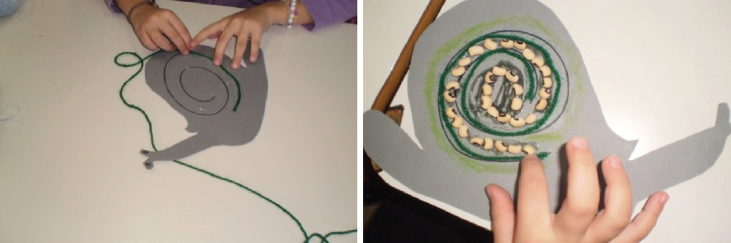
Sticking wool and beans on an image of a snail.

Using scissors to cut pages from magazines into pieces.

Sewing through a button using thread.

Pulling wool through macaroni.

Writing exercises starting from the left side of the paper, with a time limit.
The intervention programme was developed in accordance to the initial assessment with the 7th subtest of BOTMP and the unique educational needs of the students involved. For example, the test revealed that most children had difficulty cutting out a circle with preferred hand. Consequently, the program included several activities to support the improvement of finger movement, to prepare adequately for cutting (e.g., making small marbles of paper with the fingers (Fig. 7) or putting the wool through the macaroni, Fig. 5). Moreover, copying overlapping lines with preferred hand was another inability of the participants that was revealed by the test. The teachers noticed that the children did not know from which point they had to begin. So, the intervention program incorporated activities which taught children how to start, writing from left to right and from above to below. In addition, the teachers and the researcher observed that there was insufficient speed in the execution of some activities so there were some writing activities that had to be performed in a specific time more than once (Fig. 6).
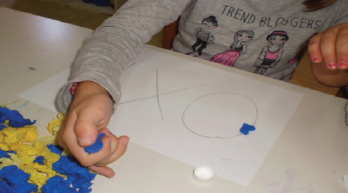
Making small «marbles» of paper and sticking them over a circle or two overlapping lines.
The teachers, in turn, were responsible for the implementation of the program and provided ongoing feedback to the primary researcher throughout the two month period.
Statistical Analyses
The Statistical Package for the Social Sciences was used for statistical analyses (SPSS: Norusis, 1993). Specifically, 2 × 2 analyses of variance (ANOVA) were used to examine the effect of the fine motor intervention program upon the total graphomotor score and the eight graphomotor skills of the children (Tabachnick & Fidell, 2001). Post hoc t tests with Bonferroni adjustment (0.05/8) were used to identify the significant interaction effects. The two independent variables were group (experimental group, control group) and time, a repeated measures factor with two levels (baseline, post-test at two months). All tests were two-sided and statistical significance was set at p < .05. Eta squared (η2) values were also used for data interpretation, following the criteria of Cohen (Cohen, 1988).
Baseline comparison was also used to examine whether the two groups differed significantly on the total graphomotor score. A 2 (group) × 5 (age level) chi-squared analysis was used afterwards to examine whether there was a significant difference in age distribution between the groups, with age classified according to the respective norms (4.5–5, 5–5.5, 5.5–6, 6–6.5, 6.5–7 years old). Intraclass coefficients were assessed reliability of measures.
Results
The children were assessed on the eight graphomotor skills of the BOTMP-LF. The graphomotor assessments concerning the experimental and control groups, both at the beginning (baseline) and at the end (post-test) of the two-month intervention program are presented in Table 1. The intraclass reliability was estimated afterwards and the coefficient for the total score was 0.80, while the coefficients for the graphomotor skills ranged from 0.73 to 0.82.
Graphomotor Skills Scores in Experimental and Control Groups

Baseline comparisons between the experimental and control groups were conducted to confirm that the two groups exhibited no significant differences at the beginning of the program. On the total graphomotor score, the independent groups t test indicated no significant difference between the two groups (t = −0.32, ns). For the eight separate graphomotor skills, the MANOVA was not significant (λ = 0.90, F = 0.76, ns) indicating that the groups exhibited no significant differences in scores at the beginning of the intervention program. The participants were classified according to the age norms of Bruininks (1978) for the 2 × 5 chi-squared analysis, which revealed no significant differences [χ2 (4) = 7.58, ns] in the number of participants in the experimental and control groups classified into the five different age groups. The data were considered appropriate for further statistical analysis.
The 2 (group) × 2 (time) ANOVA with respect to the total graphomotor score was significant (F1,62 = 133.50, p < .001, η2 = 0.68). The post hoc t test revealed no significant differences at baseline (t = −0.25, ns) but significant differences at the end of the program between the two groups (t = 6.23, p < .001). Specifically, the experimental group had significantly higher total graphomotor score at the end of the intervention program, compared to the control group. The overall findings are presented in Fig. 1.
The 2 (group) × 2 (time) ANOVAs for the eight separate graphomotor skills were statistically significant for the separate graphomotor skills (Table 2). The post hoc t tests with Bonferroni adjustment (0.05/8) revealed that the Experimental group had a significantly higher mean score compared to the Control group at the end of the intervention program, while no significant differences were evident at the beginning.
Multivariate Analysis of Variance: Univariate Results for the BOTMP Visual Motor Control Items

Discussion
The fine motor intervention program improved the graphomotor skills of kindergarten and early elementary school children. According to Cohen's (1988) criteria, the effect was high for the eight separate items and the total score. These findings are in agreement with Drakos and Binias (2009) and Zervas (2006) who supported that the fine motor programs strengthen perceptual-motor development and improve graphomotor and writing skills. They are also in further agreement with other studies examining the effect of different intervention strategies to facilitate the development of graphomotor skills for both preschoolers and school-age children. For instance, Smits-Engelsman, et al. (2001) found that physical therapy improved the proficiency and handwriting skills of children with handwriting problems. Kambas, et al. (2002) stated that the psychomotor program that they implemented had a significant positive effect on the graphomotor skills of the experimental group. In addition, Spanaki (2008), examining the effect of a motor development program in primary students' motor skills, concluded that the effect was significant for gross, fine, and graphomotor skills for all students in the experimental compared to the control group. The above research suggests that a motor program could improve the children' graphomotor skills. The present findings are in line with the above research since there was a significant interaction effect with respect to the fine motor skills examined.
During the preschool and early elementary years, there are rapid changes leading to an improvement in children's motor proficiency due to growth and maturation (Gallahue & Ozmun, 1998). As a consequence, the children in the groups both improved their performances across the two repeated measurements. However, examination of respective effect sizes revealed that the children in the Experimental group had more improvement, compared to the Control group. On the other hand, the Control group participated only in movement activities that were included in the kindergarten and the Grade 1 elementary school curriculum, while neither group participated in any other organized fine movement activities (painting, sculpture, etc.), during their free time.
The improvement of the children in the experimental group may be due to the instruction provided during the intervention period, according to the dynamic systems approach. This instruction was based on the students' deficiencies identified in consultation with teachers and from the BOTMP-SF baseline assessment. The participants in the experimental group were exposed to a wide number of visual–motor activities, under the assumption that development is individualized, non-linear, and discontinuous (Gallahue & Ozmun, 1998). According to Gallahue and Ozmun (1998) “the control of movement is the end result of several systems working dynamically together in a cooperative manner” (p. 30). The systems, self-organized and derived from characteristics of the individual, the task, and the environment (teaching), operate and subsequently determine the rate and extent of development (Gallahue & Ozmun, 1998). In this study, the teachers who implemented the program manipulated the tasks and instructions in an attempt to improve the fine motor skills and subsequently the graphomotor skills of their individual students. Further, the teachers who implemented the program manipulated the tasks and instructions in an attempt to improve the fine motor skills and subsequently the graphomotor skills of their students.
The present findings are subject to certain limitations and may not be generalized without caution. Firstly, the research team was not aware of any children diagnosed with developmental disabilities such as attention deficit hyperactivity disorder (ADHD), developmental coordination disorders (DCD), learning disabilities (LD), or other comorbid conditions. Secondly, teachers were not blind to the group assignments, since they actively communicated with the primary researcher and participated throughout the two-month period. Finally, no follow-up assessment was conducted to evaluate the long-term effect of the intervention program.
Overall, handwriting is a significant functional activity in academic and real-life settings (Marr, Windsor, & Cermak, 2001). Based on previous research findings, children's handwriting legibility gradually improves as standard instruction is presented both in kindergarten and Grade 1 curriculum (Vreeland, 1999). Educators must assist the students by developing new strategies in case they discern lack of improvement in students' facility or when they perceive that a student does not show the same progress the other students in the class perform.
There have been various programs dealing with handwriting problems, including visual perception, visual-motor and letter-formation training (Oliver, 1990; McHale & Cermak, 1992; Lockhart & Law, 1994; Peterson, 1999). According to Woodward and Swinth (2002), handwriting remediational practices vary within the school environment and there is no consensus among experts with respect to the most effective activities and modalities used to stimulate the handwriting skills of kindergarten and early elementary school students. Therefore, it is essential for early elementary school and kindergarten educators to understand the factors underlying handwriting skills, assess their students and develop individualized strategies to improve those who may be at need (Woodward & Swinth, 2002).
Gallahue and Ozmun (1998) stated that during the preschool and early elementary school period, fine motor skills are being developed. Based on Gallahue and Ozmun and the present findings, future researchers and teachers may need to focus upon the individualized fine motor skills of their kindergarten and elementary school children. The individualized needs can be assessed through baseline assessments, upon entrance into the kindergarten and elementary school, as the basis for the implementation of intervention programs to enhance graphomotor skills (Erhardt & Meade, 2005; Pernalete, Edwards, Gottipati, Tipple, & Kolipakam, 2005). Moreover, the effect of fine motor intervention strategies upon academic achievement, concentration, etc., in different age groups, and examination of a retention period, may be useful in future studies. Finally, the effect of a similar fine motor intervention program upon the graphomotor skills of children with learning disabilities (LD), developmental disabilities (eg. DCD, ADHD), intellectual disabilities, etc., constitutes a key issue requiring more research.
The present intervention program has not incorporated certain skills that may be used nowadays by children at the respective age band of 4.5 to 7 years old. These skills, such as the use of computer keyboards, joysticks, electronic pencils on touch screens and their daily practice may contribute to the development of the fine motor skills and subsequently to the graphomotor skills (Venetsanou & Kambas, 2010). This is also an avenue for further research.
In conclusion, the fine motor intervention program had a positive effect upon the graphomotor skills of kindergarten and early elementary school children. Similar intervention strategies could be recorded in a review study, in order to evaluate their respective effectiveness. The future goal for researchers and practitioners is to establish intervention guidelines for the successful improvement of all students' graphomotor skills.