






Abstract
This article presents a series of exercises using consumer products to teach students and children basics of the scientific method. Ants and honey bees are used to test the effectiveness of popular magnetic field insect repellents, domestic house cats are used to determine preferences for litter and litter box sizes, and earthworms are used to determine the significance and effect of soil additives and compression. Suggestions on possible variations in experimental designs are included. Ethical questions raised by the use of animals in product development and environmental effects are discussed, as are issues related to critical awareness of how consumer products are marketed.
Students notoriously ask the question, “How will I ever use this (knowledge) in real life?” The fact is, most students will not grow up to be scientists, but, by teaching them to solve problems and answer questions using the scientific method, we can implement the National Science Education Standards in a meaningful and practical way and meet the National Research Council's primary goal of creating a scientifically literate society (National Research Council [NRC], 1996). The purpose of this paper is to help students learn the scientific process by testing consumer products used with animals, observe variations in animal behavior with regard to human influences on environmental conditions, and to guide students in understanding experimentation with regard to product marketing.
Over the past 23 yr, the Laboratory of Comparative Psychology and Behavioral Biology at Oklahoma State University has developed a number of science-based activities. These include Project Petscope, which turns pet stores into animal behavior centers (Abramson, Huss, Wallisch, & Payne, 1999), and the use of invertebrates such as honey bees, planarians, and earthworms to demonstrate principles of learning (Abramson, Onstott, Edwards, & Bowe, 1996; Abramson, Mixson, Cakmak, & Wells, 2007). Exercises have also been developed to create science trading cards modeled after the popular baseball trading cards, calendars highlighting contributions in science, a library research exercise, a letter writing exercise, and games such as Jeopardy!, Cranium, and Pictionary (Abramson & Hershey, 1999; Abramson, French, & Locy, 1999; Abramson, Kirkpatrick, Bollinger, Odde, & Lambert, 1999; Lord, Martin, & Abramson, 2007; Abramson, Burke-Bergmann, Nolf, & Swift, 2009).
In developing these activities we were struck by how little attention is given to teaching students the relationship between consumer products and animal testing. Such activities are valuable on several levels, including encouraging students to discuss ethics in research and promoting better understanding of animal behavior in the design of commercial products. We also believe that activities related to teaching the scientific method using consumer products increase awareness of the role of science in daily life and promote the critical evaluation and analysis of consumer products and the claims made to sell those products.
During the time children are in Grades 5–8 their intellectual skills are developing rapidly, and teachers may notice a significant change in their critical thinking and problem-solving abilities over a relatively short time. Even very young children are attracted to more complex patterns, develop curiosity through experience with their surroundings, and often engage in complex reasoning about the world (Jirout & Klahr, 2012; NRC, 2012). As children develop through elementary and middle school, exposure to more formal instruction helps promote curiosity, complex analytical thought, and problem solving (Zimmerman, 2000, 2007).
The NRC (2012) recommends that learning progress over the course of a child's education and not just focus on knowledge, but also the practice of knowledge through experimentation. As a result, elementary and middle school years are the ideal developmental time to teach scientific experimentation skills, not only for the sake of pure science but for the sake of pure thought. The NRC advocates the teaching of science through the practice of experimental learning, using not just one scientific method but a wide range of practices, activities, and experiments in order to help students develop theories and exploratory thinking (NRC, 2012).
A focus of the NRC emphasizes the application of science for the purpose of understanding existing engineering and technology practices and their role in product design (NRC, 2012). In support of the NRC's goals, studies suggest that children who are given more opportunities to conduct experiments and use reasoning tend to improve with experience and age (Kuhn, 2009; Kuhn, Pease, & Wirkala, 2009).
In order to facilitate experimentation and critical thinking skills in elementary and middle school students, teachers can use a variety of readily available products to help students understand the fundamentals of the scientific method. For decades, teachers have used classic consumer products like ant farms to teach the principles of animal behavior with regard to environmental changes, but teachers can also use available natural resources to encourage learning and incorporate better understanding of human practices that may affect the environment and subsequent animal behavior. In this paper, we suggest classroom experiments that involve modest equipment so that children of all ages can easily observe changes in animal behavior that result from exposure to consumer products.
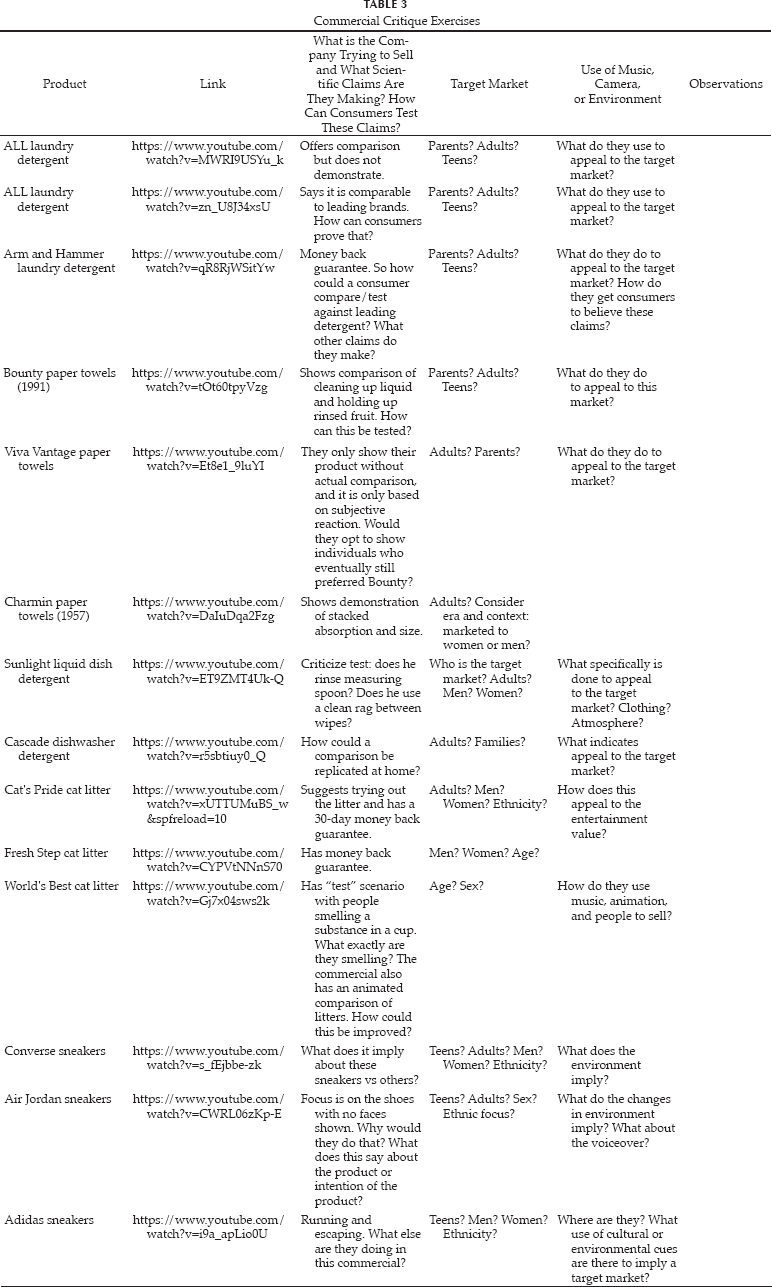
This article contains several different types of activities. In addition to classroom experiments, we also include at-home experiments using household pets. A unique feature is that we also include Internet links to various consumer products listed in Table 3 whose claims and marketing strategy can be analyzed by students. The purpose of this exercise was to use knowledge of experimentation to critically evaluate claims made in marketing. The exercise also allows students to analyze the marketing strategies of products depending on the focus of the advertiser and to think critically about everyday advertising of consumer products.
Behavioral Experiments

Product Testing Experiments

Commercial Critique Exercises
Example 1: Insect Deterrents
Hypothesis
The purpose of this study was to examine the effects and efficacy of two commercial electronic pest repellents that claim to deter insects. Depending on the repellents used, students may develop their own hypotheses as to whether one, both, or neither product will be effective at repelling or, at the very least, changing insect behavior.
Materials
Ant farm(s) and/or access to ants outside.—We used Uncle Milton's Fascinating Ant Farm measuring approximately 10” × 6” × 1,” purchased online for approximately $15.00. 2 We also used a 3-D Gel Ant Habitat measuring 6.5” × 5.5” × 1.25,” also purchased online for approximately $25.00. 3 If outdoor ants gather near the classroom, you may choose to include them as well, so long as an electrical outlet is nearby.
Ants.—Ants can be ordered online for approximately $10.00 per vial (one vial is more than enough ants to populate one ant farm) or they can be collected from outside colonies, so long as care is taken not to mix colonies and to handle them carefully. 4
Most ant farms will come with coupons for ordering ants, though these ants are not free and may take weeks to arrive. We found it simpler to order the ants at the same time as the farms, but children in a school setting may enjoy collecting ants from outside. We used western harvester ants from Insectkits.com.
Honey bees.—Honey bee colonies were obtained from a local supplier. An artificial feeder was established containing 15% sucrose. The 15% sucrose ensured a steady supply of bees at the feeder, along with ants, wasps, and other assorted insects. If a local supplier is not available, wild honey bees can be used by locating wildflowers on which bees are foraging. If such bees can be found, a feeder can be established which will be found by the honey bees. This will give students access to a wild colony.
Ultrasonic Pest Repeller(s).—We used Bell Howell Dual Technology Electromagnetic and Ultrasonic Pest Repeller, purchased online for approximately $10.00, 5 and the Sunbeam Ultrasonic Pest Repeller, also purchased online for approximately $9.00. 6
Electrical or Battery Power.—Whatever ultrasonic devices you choose, be sure you have access to power. For example, if you choose to study the ants congregating by the dumpster outside the cafeteria, make sure you have a place to plug in your device or an option to power it with batteries. For safety reasons, the use of extension cords is not recommended.
Time and Space Requirements.—These of course will depend on the size of your classroom and your specific experimental design. The ant farms we used took up less than one bookshelf. You may choose to use much larger ant farms, you may choose to work with an outdoor colony, or you may include both outdoor ants and indoor ant farms, as we did in the experiment reported here. The amount of time required for the experiment could be as little as 1 wk., depending on the number of devices tested. We used two devices, and so we ran our experiment for 2 wk.
Procedure
Independent Variables:
Type of ant farm
Pest repeller model
Position and location of pest repeller
Time repeller is turned on or off
Type and species of ant
Dependent Variables:
Ant behavior/behavioral changes
Number of ants moving during a given time period
Relative speed
Change in rate of movement
Mortality
Set up the ant farm(s) as per the manufacturer's instructions. If you have ordered live ants, they will most likely come in a vial or small container. It is important to get them into their habitat as quickly as possible. Placing the vial of ants in the refrigerator, not freezer, for 15 min. will slow the ants down considerably so it is much easier to relocate them from the vial to their new environment. However, they recover quickly, so if you allow students to do this part of the project have them work in groups of two or three, if possible, and expect to lose a few ants in the process. Please make sure to identify students who may be allergic to insect venom. They should not handle the ants.
We tested two ultrasonic devices on two different types of ant farms, one sand and one gel, as well as on ants outdoors. A control group can be added by setting up an additional ant farm in a neighboring classroom or principal's office, since the ultrasonic waves do not penetrate dense walls and have a limited reach. Alternatively, each ant farm can be used as its own control group by placing the ant farm in its final location and observing ant behavior prior to using any repelling device. The control can also be set up as a within-subjects design where only the teacher knows if the repeller is turned on. In this scenario, the students continue to make observations of ant or bee behavior and are only later told under what conditions the repeller was operating. In either case, make sure that all variables in the controlled environment are recorded to determine any differences between groups that might affect the observed outcomes to ensure that independent variables are accounted for. Dependent variables such as changes in ant behavior are due to changes in independent variables, as opposed to unknown environmental or classroom conditions.
Teachers should explain the difference between independent and dependent variables to the students to facilitate the understanding of experimentation. Independent variables (e.g., ant species, ant number, location of ant farm) are the variables in the experiment that the researcher controls, whereas dependent variables (e.g., ant movement, foraging behavior) are the variables that may change as a result of manipulation of the independent variables.
The ant farms were set up and the ants given two days to acclimate to their new environments. During this time, students can observe ant behavior (location in farm, overall activity level and speed, number of ants moving, etc.) and can use this as a control. The ants in the traditional sand farm were fed and watered every other day per the manufacturer's instructions. The first device, the Bell & Howell, was activated on a Monday morning and deactivated on a Friday afternoon, simulating a school week. The ants were allowed to rest with no ultrasonic interference over the weekend. The second device, the Sunbeam, was activated the following Monday morning and deactivated the following Friday on the same timetable.
Honey Bees
Independent Variables
Subspecies of honey bee (Apis mellifera)
Wild or domestic colony
Colony size
Location of habitat
Location of repeller
Type of repeller
Type of repeller is turned on or off
Dependent Variables
Changes in observed bee behavior
Number of ants moving during a given time period
Relative speed
Change in rate of movement
Mortality
When the artificial feeder was established, we placed the device next to it and tested the devices, as was done for the ants.
Findings
The devices yielded no change in the ants' or honey bees' behavior. Neither the bees nor the ants showed any difference in foraging behavior. Behavior recordings at this level may simply be a function of general number of animals moving, how they move compared to when the device is not on (control), or where they choose to go within their environment and if this differs from the control.
Experimental Variations
Although the results were not significant (the insects continued to visit the feeder or survive in the ant farm), there are many variations of the basic design that students can explore. As we mentioned earlier, the project can accommodate several independent and dependent variables including type of device, location of the device (relative to distance from the ant farm and left/right top/bottom orientation), type of ant farm, subspecies of ant or honey bee, reward concentration, number of ants, and type of environment (ant farm or natural conditions). In addition, more than one device can be tried simultaneously. Several dependent variables can also be studied, and include the number of surviving ants per day, activity of the ants, where the ants spend the majority of their time (near the device, away from the device), health of the ants, and, if honey bees are used, number of bees visiting the feeder.
Experimental Design Questions
Related to questions of what to experimentally manipulate are those inquiries related to experimental design. Students can be asked to consider the nature of environmental variables (weather, lighting conditions, and day/night cycle) and subject variables (ant species, sex, caste structure, and size). Control variables such as proper lighting, noise, and vibration conditions can also be discussed. Discussions of these variables lead naturally to discussions of the relationship between independent and dependent variables. How are dependent variables measured, and should more than one be used? How are independent variables manipulated, and should more than one be used? What differences are expected using a laboratory-based situation (the ant farm) when compared to a field situation (studying ants outdoors)? What are the relative advantages and disadvantages of laboratory based vs. field based research?
In addition to discussions of environmental, subject, and independent and dependent variables are questions related to how to best conduct the experiment. For example, should a within-subjects design or between-subjects design be used? To incorporate a between-groups design, students will run two groups, one exposed to the device and one not. Alternatively, students can decide to use a within-subjects design where a group is exposed to three conditions: the device is not turned on, the device is turned on, or the device is turned off after a period of operation. Such considerations lead naturally to discussions of the relative merits of within- and between-groups designs and whether both should be employed in an experiment.
Example 2: Domestic Cats and Litter Box Preference
Hypothesis
This experiment is designed to test feline preferences for litter or, alternatively, for litter box size/style. Students can develop their own hypothesis as to what litter the cat will prefer/use more, or what box size/style the cat will use more. This works best for students who already live with indoor felines and have access to adult supervision who can help manage feline litter and waste removal. Similar experiments can be done with feline or canine preference testing for treats, scratching posts, sleeping beds/boxes, etc. Litter was chosen since it is very inexpensive relative to other pet products.
Materials
This experiment requires access to domestic felines and multiple litter boxes. This experiment works best if there are multiple felines occupying the same residence or if multiple residences are used that duplicate the type and style of litter and litter boxes used. However, this experiment can be done in a household with a single cat in order to demonstrate and practice scientific principles and procedures in the home. A similar test of 74 domestic cats was performed in 43 households in which each household used two litter boxes of different sizes: one standard size and one larger (86 cm in length; Guy, Hopson, & Vanderstichel, 2014). In experiments testing preferences for litter box size, both litter boxes should be filled with equal amounts of the same litter. For experiments testing litter type preferences, identical litter boxes (small litter boxes are available at local stores for under $10) should be filled with equal amounts of different litter. Appropriate litter and litter boxes can be purchased at local pet supply stores.
Procedure
Independent Variable
Cat
Litter or litter box
Location of litter boxes
Amount of litter in each box
Dependent Variables
Amount of time spent in litter box
Amount of feces in litter box
Amount of urine in litter box
Amount of time spent in room before and after using litter box
In experiments testing for litter box size/style preference, place both litter boxes in different locations in the same room. Observe and record daily feline behavior and collect and record elimination material for each box over the course of 2 wk. Feline behavior may include time spent in the room, time spent in the litter box, time taken to choose a box, and if the cat chose to linger outside the box after elimination. Observation may be direct or indirect via use of a camera or web cam. Note: depending on the age and circumstances of the student, adult supervision and assistance may be required. At the end of the 2 weeks, switch locations of the boxes and continue to record behavioral observations and elimination material in each box, continuing to clean boxes daily.
Experimental Variations
As an alternative to testing litter box preference, individuals can adjust the above experiment by using multiple identical litter boxes and varying the type or texture of litter instead. This changes the independent variable from litter box to litter so that the student would be testing litter preference instead of litter box preference. Additional variations of independent variables include moving litter boxes to separate rooms or within the same room to test room or special preferences, changing lighting conditions or, if using a covered box, changing the direction of the door. Additional dependent variables can be studied, including changes in time to choose a litter box, duration within the litter box, and (especially if choosing to test litter varieties) number of scratches the feline makes after using the litter box.
Experimental Design Questions
Design questions for this experiment closely resemble those for the ant and honey bee experiments in terms of questioning the environmental variables (season, temperature, and lighting) and subject variables (number of cats, sex, and age), all of which can be discussed in terms of which variables can be controlled and which ones cannot. Again, this can lead to discussions of independent vs. dependent variables and which variables can and should be manipulated vs. those that are studied through observation.
Applicability of Experiment
Litter box type, location, cleanliness, and litter variety have been shown to influence feline elimination behavior (Horwitz, 1997; Neilson, 2004a, b; Ellis, 2009; Herron, 2010; Guy, et al., 2014), which can account for up to 63.4% of feline elimination problems associated with behavioral disorders (Amat, de la Torre, Fatjo, Mariotti, Wijk, & Manteca, 2009). In order to understand the influence of owner's choices on cat behavior and welfare, consumers need to understand how even simple choices of cat litter box size, type, location, and cat litter can influence feline behavior.
Example 3: Impact of Soil Density and Composition on Earthworms
Hypothesis
In this experiment, students are testing the effect of changes in soil density/compaction and composition on earthworm colonies through the observation of the changes in number and size of earthworms in the test container when compared to the control. Students can form their own hypotheses as to how earthworm colonies may behave through direct observation (observations of activity and movement) as well through indirect behavioral observations (size and number can reflect reproductive and feeding behaviors). The default hypothesis is that increases in soil compaction and/or increases in chemical composition adversely affect earthworm size and number when compared to control groups.
Materials
For this experiment, two identical containers (we suggest 2-gallon buckets with small drainage holes), equal amounts of soil (enough to fill each bucket), and worms are required. Buckets can be acquired or purchased and holes can be drilled into the bottom using an electric drill bit. Native soil should be rinsed and cleaned of any existing worms and placed in the buckets prior to testing. Worms can be acquired online through sites such as Amazon. The Blooms ‘n Buds 200 red wiggler worms are affordable and easy to use. 7
Procedure
Independent Variables
Worm species
Bucket type
Soil type / composition
Soil compaction/density
Temperature/location
Dependent Variables
Number of worms
Worm movement/observable activity
Worm size
Fill each bucket with clean soil (bought or obtained from native soil and cleaned of organisms). In one bucket, compact the soil using hands, feet, or a flat heavy object until the soil is compacted as much as possible. Count out worms and add equal amounts of worms to each bucket. The number of worms will vary depending on the size of the container. For 2-gallon (7.57-L) buckets, use 20 worms each. Add 1 cup of water to each bucket twice a week to maintain equal moisture. Observe and record worm behavior and soil changes over 2 mo. Worm behavior can include movement, number of worms seen above soil, length/size of worms, and relative movement (number of worms moving or speed) with relation to the control. Soil should not be disturbed during the observation process. After 2 mo., empty buckets and count worms to determine population. Resulting population densities, worm sizes, and movement should be observed and recorded.
Experimental Variations
Using the basic procedures outlined above, variations in soil type (sandy, loam, silt, and clay), organic matter (percentage compost and degree of breakdown in organic matter), soil temperature, and added particles or chemicals (rocks, soap, and cotton) can be added to change the independent variables in the test bucket.
Independent variables include bucket, soil type, soil compaction differences, initial worm populations, moisture content, and season. Dependent variables include worm behavior and worm populations. Changes in independent variables can include changes in lighting or temperature, organic matter, and worm type.
Experimental Design Questions
Design questions for this experiment closely resemble those for the cat litter and ant and honey bee experiments in terms of questioning the environmental variables (season, temperature, and lighting) and subject variables (number of worms and species). These can be discussed in terms of independent and dependent variables and different ways to manipulate independent variables and how that might change the nature and purpose of the experiment.
Applicability of Experiment
Commercial products and chemicals can influence animals and natural systems, but it is also important to consider the mechanical and physical changes that are imposed on environments through human actions, how these changes affect animal behavior, and how those changes in animal behavior might then influence societies and cultures. Such considerations, like those discussed in the earthworm study, can influence and impact microenvironments, which in turn can affect larger environments. Students partaking in earthworm studies can discuss how soil compaction can influence home environments as well as agricultural environments.
Earthworm populations have long been used to determine the health of soil (Capowiez, Cadoux, Bouchand, Roger-Estrade, Richard, & Boizard, 2009; Groffman, Fahey, Fisk, Yavitt, Sherman, Bohlen, et al., 2015), and previous research in earthworms suggested that soil quality and earthworm populations vary depending on land use (Capowiez, Cadoux, Bouchant, Ruy, Roger-Estrade, Richard, et al., 2009; Guéi & Tondoh, 2012; Bartz, Pasini, & Brown, 2013), which suggests that human activities (especially agriculture and development) impact soil ecosystems. Severe soil compaction of densities greater than 1.7g/cm3 has severe impacts on soil ecosystems, including earthworm populations (Beylich, Oberholzer, Schrader, Höper, & Wilke, 2010) that prefer non-compacted soil and take much longer to colonize compact soil (Capowiez, Cadoux, Bouchand, Roger-Estrade, et al., 2009; Capowiez, Cadoux, Bouchant, Ruy, et al., 2009).
However, some studies show that earthworms are able to rehabilitate compacted soil after a period of years by improving porosity and water drainage (Barré, McKenzie, & Hallett, 2009) Yvan, Stéphane, Stéphane, Pierre, Guy, & Hubert, 2012; Hedde, Bureau, Delporte, Cécillon, & Decaëns, 2013; Groffman, et al., 2015). Since plants also prefer non-compacted soil (Whalley, Dumitru, & Dexter, 1995), earthworms help to regenerate the soil and make it useful for both future agriculture and native growth. Therefore, human effect on soil can influence worm populations, which can then greatly change future soil ecology and use by both human and native flora and fauna.
Ethical Questions
In addition to questions about experimental design, we believe the strength of these exercises lies in the ethical questions students are encouraged to discuss. Many teachers around the age of 50 yr. will remember studies in which cosmetics were tested by applying them to the eyes of rabbits. While we do not advocate the abolition of animal testing, students should be made aware that alternatives are available and should be used whenever possible. Possible ethical questions that students can consider include: Under what conditions is it appropriate to test consumer products on animals? Is it right to kill another species because they cause us some inconvenience? Do the possible unintended consequences of animal testing (i.e., affecting non-target animals) outweigh potential benefits? How do consumer products affect animals? In regard to the latter question, Abramson, Aquino, Azeredo, Filho, and Price (1997) studied the attraction of Africanized honey bees (the so called “killer bee”) to soft drinks and perfumes. Such a study becomes important for those who are afraid of insects and/or allergic to insect venom.
Optional Experiments
Tables 1 and 2 provide additional variations to behavioral and product tests, respectively. Table 1 describes basic behavioral experiments with pets and domestic species as well as options for experiments with wild and non-domestic species. The experiments outlined in this table involve environmental modifications and behavioral observations. Table 2 suggests materials and methods for home and personal product testing and provides options for documenting and analyzing results. Part of developing objective approaches to products is practicing critical evaluations of marketing and advertising. Table 3 provides examples and links to commercials and questions and considerations for developing critical evaluations toward marketing.
Discussion
Over the past several years, we have used the ant and bee exercises as part of our “Psych Mobile” program. One of the goals of the program is to teach students at the elementary and high school levels how to use the scientific method and explore options in experimental design. We have found that applying these principles to the study of consumer products is an effective and enjoyable experience for both students and teachers. We have also used this exercise at the college level and have found these exercises to be stimulating from both a research design and ethical perspective. These exercises are easy to perform yet address some fundamental questions in behavioral science, product testing, and ethics.
The suggested experiments involving animal behavior provide opportunities to observe behavioral changes in domestic and non-domestic species following environmental modifications. Such experiments with domestic species give students and children the opportunity to objectively observe animal behavior within the home and discuss how human choices and products under domestic conditions can influence the behavior of pets. These discussions can then lead to dialogues on how pet and animal behavior can lead to a better understanding of environmental conditions with potential implications for animal welfare.
Behavioral experiments with non-domestic species can further this dialogue through observing changes in behavioral patterns resulting from basic and small changes in environmental conditions. Such changes may occur naturally or as a result of human actions (compaction of soil), whereas others may be a direct result of human interference (electronic insect repellent). By observing behavioral changes in non-domestic species that result from direct and conscious environmental changes, students can discuss how humans change environmental conditions in nature and how those changes might influence the behavior and welfare of wildlife.
Additional experiments with products at home provide children with opportunities to develop critical thinking skills and practice experimental design. Children evaluate product claims and test the validity of product marketing through basic scientific experiments, creating an opportunity to discuss differences between advertising and tested results. This critical analysis can continue with the questions and considerations put forth in the exercises involving advertisements and analyzing target markets and differences in sales techniques for common products.
Easy experiments that are capable of being performed at home or school create options for children to observe and discuss behavior; e.g., how humans influence behavior in animals, and how those influences can impact animal welfare both at home and in the wild. Combined with product testing exercises and advertisement critiques, these experiments allow children to experience and practice experimental design, observational skills, and analytical thinking regarding ethics and media.
Ants can be purchased on Amazon from the following link: http://smile.amazon.com/Live-Ant-Farm-Ants-Shipped/dp/B00GVHEQV0/ref=sr_1_1?ie=UTF8&qid=1444352548&sr=8-1&keywords=ants or from insectkits.com: http://www.insectkits.com/contents/en-us/d47_Live_ants.html.
The Bell Howell Repeller is available at http://smile.amazon.com/DuDu-Ultrasonic-Repellent-Electronic-Cockroach/dp/B014LXK-3PI/ref=sr_1_fkmr0_1?ie=UTF8&qid=1444352764&sr=8-1-fkmr0&keywords=used+Bell+Howell+Dual+Technology+Electromagnetic+and+Ultrasonic+Pest+Repeller.
The Sunbeam Pest Repeller is available at http://smile.amazon.com/Sunbea-Ultrasonic-Pest-Repeliers-Set/dp/B0006ZD1WS/ref=sr_1_5?ie=UTF8&qid=1444352863&sr=8-5&keywords=sunbeam+pest+repeller.