






Abstract
This study investigated whether the supervisor-nurse relationship influences the nurses' intention to help colleagues and whether supervisor mood sharing mediates such an influence. The sample comprised 46 supervisors and 138 nurses. Results indicated that the supervisor-nurse relationship is positively related to supervisors' mood sharing behavior, which is positively related to nurses' intention to help colleagues. Supervisor mood sharing fully mediated the extent to which the supervisor-nurse relationship affected nurses' intention to help colleagues.
As a cost-effective means of on-the-job training, peer assistance facilitates knowledge distribution, nurtures collegiality within an organization, and advances the knowledge of both the receiver and the helper (Pressley, Wood, Woloshyn, Martin, King, & Menke, 1992). Additionally, collegiality and peer support help to overcome workplace obstacles (Antonucci & Akiyama, 1987). Most modern health care practices are delivered by teams of healthcare professionals (e.g., nurses), and teamwork is essential to care outcomes (Sammer, Lykens, Singh, Mains, & Lackan, 2010), thus highlighting the vital role of nurses' intention to help colleagues.
Intention to help colleagues can be defined as the willingness to assist coworkers (nurses in this study). Previous studies have identified antecedents of intention to help colleagues, including group membership and previous relationships (Constant, Sproull, & Kiesler, 1996). These studies have established the importance of relationships in increasing the intention to help. However, such studies have not investigated whether and how the supervisor-subordinate relationship affects the subordinate's intention to help colleagues. This represents a gap in current literature.
Sharing moods improves others' understanding of one's particular circumstances (Harden, Schafenacker, Northouse, Mood, Smith, Pienta, et al., 2002). Previous theories have indicated that mood sharing is essential in social interactions (Denham, 1986) owing to its symbolism of friendliness (Keltner & Kring, 1998), regardless of whether the shared mood is positive or negative. Supervisors' mood sharing (i.e., informing of work-related thoughts and associated affections) with subordinates likely influences the subordinates' behavior.
A sense of community is critical to the nursing practice (Freeney & Tiernan, 2009). Weinstein and Ryan (2010) found that volunteering for pro-social activities benefits the receiver and the helper. While assuming that helping colleagues is a pro-social activity, this study examined the role of the supervisor-nurse relationship as a novel antecedent to pro-social activities. This study significantly contributes to the literature by investigating how the behavior of a third party (i.e., the supervisor) may increase autonomous pro-social behavior (i.e., helping colleagues).
Hypotheses
Supervisors are responsible for employees' performance of their work tasks, and are thus prone to heavy work stress and associated negative moods. Individuals prone to negative moods are likely to share them with others in order to relieve their emotions. In the workplace, the supervisor's mood can affect the moods, perceptions, thoughts, and actions of subordinates (George, 2000; Sy, Côté, & Saavedra, 2005). Supervisors must thus carefully choose with whom to share their moods. At the same time, supervisors' thoughts may affect subordinates' behavior and performance. Thus, supervisors tend to identify which subordinates are trustworthy and are less likely to disclose personal information to other subordinates. Trust has been used interchangeably with relationship quality in management theory (Crosby, Evans, & Cowles, 1990), because subordinates with good relationships with their supervisors can understand (sympathize with) supervisors' moods.
(Hypotheis 1) Strength of the supervisor-nurse relationship is positively related to the frequency of mood sharing of the supervisors.
A supervisor's mood can affect the perceptions, thoughts, and actions of subordinates (George, 2000). Supervisors' moods can function as social stimuli for subordinates, regardless of whether the shared mood is positive or negative. The act of sharing moods with subordinates signals the supervisor's trust and friendliness, as well as fueling positive emotions among subordinates. Positive mood increases the likelihood of altruism (Capra, 2004), so subordinates who are trusted may be more willing to help others (Haigh, 2010). Hence:
(Hypotheis 2) Frequency of supervisor mood sharing is positively related to nurses' intention to help colleagues.
A supervisor-nurse relationship is intuitively unrelated to a nurse's intention to help another nurse, even if the supervisor does not share his or her moods with anyone. Thus, this study assumed that supervisors' mood sharing would be a full mediator in such a relation. Restated, this study assumed that the supervisor-nurse relationship and nurses' intention to help colleagues were not related directly.
(Hypotheis 3) Supervisors' mood sharing will fully mediate the relation between the supervisor-nurse relationship and nurses' intentions to help colleagues.
Method
Sample and procedure
A cross-sectional design was adopted. The study was conducted in a medical center in northern Taiwan. The institutional review board and the nursing department of the medical center approved the study. Nurses and their supervisors were oriented about the study's objectives. All participants gave informed written consent before their participation.
There were two inclusion criteria: (1) participants were working full time and (2) participants were not nurse practitioners or students. A supervisor and three nurses comprised one set, ensuring an equal influence of each ward unit, thus, multiple nurses were included from a given unit. The nurse participants of a unit were randomly sampled. The researchers distributed 53 sets of questionnaires and gathered 46 complete sets of supervisors and nurses responses, subsequently creating the sample used for analyses. Table 1 lists the demographic characteristics of the nurse participants and supervisor participants.
Description of nurses and supervisors

Trained research assistants informed the nursing supervisors the day before data collection. Research assistants then approached the supervisors and the selected nurses in the ward units. When a nurse refused to participate in this study, another one in the same ward unit was randomly selected as a replacement. Research assistants issued the questionnaires and allowed supervisors and nurses to take questionnaires home for up to two days to complete them. Research assistants collected the completed questionnaires from the participants.
Measures
Data were collected using questionnaires. Nurses were requested to provide information on their demographics, perceived supervisor mood-sharing behavior, and intentions to help colleagues. Supervisors were then instructed to provide information on their demographics and relationships with each of the three selected nurse participants, respectively. That is, the value of the relationship between the supervisor-nurse can be different among the three nurses, although they were rated by the same supervisor.
Items were selected and created to measure relationship, mood sharing, and intentions to help. Three items assessing the supervisor-nurse relationship were revised from the supervisor-subordinate relationship scale of Chen and Tjosvold (2006). Supervisor's mood sharing was assessed with one item: “My supervisor frequently shares her mood regarding her work.” Four items assessed nurses' intentions to help colleagues. The items were based on the items of Dougherty and Larson (2010), which were used to assess the willingness of nurses to collaborate with each other. The items assessing nurses' intentions to help colleagues required careful examination with respect to reliability and validity. All items were rated on a 7-point scale with anchors 1: Very disagreeable and 7: Very agreeable.
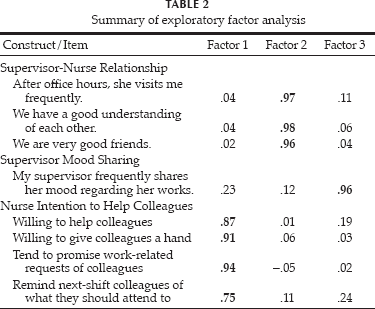
The eight items had Cronbach's α > .90. Since the items used in this study had not been tested previously, exploratory factor analysis (EFA) was conducted with the varimax rotation procedure. Three factors explaining 87.2% of the overall variance were selected using a scree plot. Table 2 summarizes the EFA results.
Summary of exploratory factor analysis
Data analyses
Respondents' demographics and correlations among the measures were summarized using SPSS Version 12, while structural equation modeling (SEM) analyses were performed using LISREL 8.53. As stated in the above hypotheses, intention to help colleagues was the dependent variable and supervisor-nurse relationship was the independent variable. Mood sharing of supervisors was assumed to be a mediator. The study hypotheses were tested using path coefficients. The significance level was set at .05. Data from the 46 supervisors were matched to those of the 138 nurses (46 × 3) to form 138 supervisor-nurse pairs of responses for analyses.
Results
Hypothesis testing
Table 3 lists the means, standard deviations, and correlations among the study constructs. The measures showed low correlations (≤ .35), implying an adequate discriminant validity. Furthermore, this study utilized multiple data sources (i.e. supervisors and nurses), reducing the effects of common method variance.
Means, standard deviations, and correlations among study constructs

Note.—Max denotes maximum possible value, and Min denotes minimum possible value. *p < .05.
The coefficient for the path from supervisor-nurse relationship to supervisors' mood-sharing was .19 (t = 2.29, p < .05), thus supporting Hypothesis 1. The coefficient for the path from supervisors' mood-sharing to nurses' intention to help colleagues was .34 (t = 4.09, p < .01), thus supporting Hypothesis 2. The structural model acceptably fit the data (χ2 = 64.14, df = 19, p = p < .001, CFI = .95, GFI = .90, IFI = .95, NFI = .93, SRMR = .05).
After the direct effect of the independent variable on the dependent variable was added, the path coefficient was –.03 (t = −0.37, p > .05). The χ2 value of the competing model was 63.82 (df = 18). The χ2 difference test (Bentler & Bonett, 1980) showed that χ2 difference 0.32 = (64.14–63.82) is below the crucial value [χ2(df = 1, α = .05) = 3.84]. That is, the competing model did not fit the data significantly better than the study model did, yet contained a non-significant path, thus supporting the adequacy of the study model. Restated, supervisor mood sharing fully mediated the relation between supervisor-nurse relationship and nurses' intention to help colleagues, thus supporting Hypothesis 3.
Addition of control variables
Potential biases caused by omitted variables were tested by adding control variables to the study model. Supervisor-nurse age similarity, years of experience in nursing, average number of patients, and nurse agreeableness were the control variables. The first three variables were assessed using single-item measures. Self-categorization theory (Turner, 1987) posits that people tend to like demographically similar individuals. Such a similarity may fuel a good relationship, indicating that a supervisor-nurse age similarity should be considered as a control variable in the analyses. Teng, Chang, and Hsu (2009) identified working experience as a predictor for care outcomes. Hence, analyses considered the number of years of nursing experience as a control variable. The number of patients cared for may reduce the nursing time allocated to each patient. The number of patients cared for may increase the time-related pressure on nurses, likely reducing the quality of care (Buerhaus, Donelan, Ulrich, Norman, Williams, & Dittus, 2005). Nurses caring for many patients are likely to focus on completing their own tasks, rather than on helping colleagues. Therefore, the analyses included the number of patients cared for as a control variable. Agreeableness refers to a tendency to be kind and empathetic (McCrae & John, 1992). Highly agreeable nurses are kind and empathetic towards their colleagues, increasing their intention to help colleagues. Thus, nurses' agreeableness was included as a control variable.
Following the addition of control variables, the data still supported the hypotheses. Fig. 1 summarizes the analytical results. The path from the supervisor-nurse relationship to the supervisor mood-sharing was .19 and did not change when the control variables were added. Moreover, the path from supervisor mood-sharing to nurses' intention to help colleagues was .33, a minimal change (.01). Added control variables did not significantly change the findings.

Analytical results with control variables. Squares under the dotted line are control variables. *p < .05.
The path coefficient from age similarity to the supervisor-nurse relationship equaled –.20 (t = −2.33, p < .05). The coefficient for the path from number of years of experience in nursing to nurses' intention to help colleagues was .03. The coefficient for the path from the average number of patients cared for to nurses' intention to help colleagues was .03; this result was positive but non-significant. Finally, the path from nurse agreeableness to intention to help colleagues was .43 (t = 5.44, p < .05). This model fit the data tolerably (χ2 = 117.94, df = 47, CFI = .92, GFI = .87, IFI = .92, NFI = .88, SRMR = .05). R2 values for the three variables were .04, .04, and .30, respectively.
Discussion
The supervisor-nurse relationship was positively related to the supervisors' mood-sharing behavior, which was positively related to nurses' intention to help colleagues. Age similarity was negatively related to the supervisor-nurse relationship. Nurses' agreeableness was positively related to nurses' intentions to help colleagues.
Implications
This study indicated that the mood-sharing behavior of supervisors fully mediates the effect of the supervisor-nurse relationship on nurses' intentions to help colleagues. The supervisor-nurse relationship was positively related to the mood-sharing behavior of supervisors. Since supervisor-subordinate relationships can be cultivated by collaboration (Chen & Tjosvold, 2006), friendship, and off-work interactions (Jeffrey & Putman, 1994), healthcare managers should facilitate collaboration, supervisor-nurse friendship, and support their off-work interactions.
Mood-sharing behavior of supervisors was positively related to nurses' intentions to help colleagues. This study thus recommends that healthcare managers encourage supervisors to share their moods with nurses. Through mood-sharing activities, nurses can more fully sympathize with the circumstances supervisors frequently encounter, thus increasing nurses' intentions to help colleagues.
Research limitations and future research directions
This study adopted a cross-sectional design that minimized the confounding effects of time-related factors (e.g., nursing rotations). However, cross-sectional designs are limited by their capacity for directly examining causality. Future studies could thus adopt a longitudinal design to confirm the study findings.
Further studies should examine the potential mediating role of emotional intelligence, which is associated with resilience to negative events (Armstrong, Galligan, & Critchley, 2011). Shared mental model and team leadership (as discussed in Kalisch & Lee, 2011) are also potential mediators that warrant further study. Moreover, the tested model did not elucidate how supervisor mood-sharing affects nurses' intention to help colleagues. Nurses willing to participate in this study may have tended to help others more than those who were unwilling to participate. Such a sample may incur some sampling biases that raise the overall level of intention to help.
Because nurses' intention to help colleagues is only one aspect of nurses' collaborations, future studies should utilize a measure of nurse-nurse collaborations (as in Dougherty & Larson, 2010) to investigate whether and how the supervisor-nurse relationship facilitates nurse-nurse collaboration. Moreover, this study investigated intention to help rather than measuring actual helping behavior. Practitioners should be aware that intention to help does not always lead to helping behavior.
This study explored agreeableness and its relation to nurses' intentions to help colleagues. Additionally, extraversion (tendency to be energetic, talkative, and gregarious) may be related to nurses' intentions to help colleagues, because energetic individuals have adequate physical resources, while talkative and gregarious individuals frequently interact with colleagues and thus know their needs. Future studies should explore the role of extraversion in forming intention to help colleagues.