






Abstract
This study attempted to obtain empirical evidence on education students' attitudes towards the teaching profession in Qatar using the Attitude Scale Towards Teaching Profession. 334 students (M age = 21.3 yr.) majoring in education were surveyed. Internal consistency reliability of scores was acceptable (Cronbach's alpha = .94). The results indicated that the participants tended to hold a fairly positive attitude towards teaching as a profession. Results also suggested that education students' attitudes towards the teaching profession affected their undergraduate academic achievement. Some recommendations to enhance these attitudes were made.
School is considered fundamental to society and is the basis for professional activity. Training of professional teachers is essential to provide proper education for students. Unfortunately, many teachers leave their jobs only a few years after beginning professional practice. This is the case in Qatar, in spite of efforts made to reform and improve the educational system.
In 2001, the government of Qatar became alarmed that the educational system was not developing high quality students and that the overall system was outdated and resistant to change (Brewer, Augustine, Zellman, Ryan, Goldman, Stasz, et al., 2007). In response, the Qatari government approached RAND, a nonprofit research organization, and asked to have Qatar's K-12 education system critically examined. RAND was assigned the task of examining the existing educational system and providing recommendations and suggestions to develop a top educational system that would meet Qatar's future needs (Brewer, et al., 2007).
In recent years, the schools in Qatar have been suffering from a high turnover of Qatari teachers that is thought to be due to a loss of interest in the teaching profession and to the attraction of other forms of employment. Attrition of teachers can also be caused by disrespect from the administration, students' lack of discipline, and low salaries (Gonzalez, Brown, & Slate, 2008). Examining prospective teachers' attitudes towards the teaching profession could contribute to the development of more positive attitudes towards the profession. It also could provide useful information for teacher education programs.
There is a need in Qatar to examine teacher attrition as the educational system undergoes major changes and improvements. However, studies investigating education students' attitudes towards the teaching profession are limited, based on searching different Education E-Resources. Teachers' attitudes toward their pedagogical practices are important to classroom performance and success (Shaw, Stratil, & Reynolds, 1973, cited in Tok, 2011). In addition, it is important to study students' attitudes towards teaching, to assess factors in the turnover rate of teachers.
The focus of the present study was attitudes towards the teaching profession by education students enrolled in an elementary education program. This study aims (a) to collect empirical evidence about the attitudes of College of Education students majoring in education in Qatar towards the teaching profession, and (b) to assess the relationship between students' attitudes towards teaching profession and undergraduate achievement. The scale used was from Turkey (Ustuner, 2006; Tezci & Terzi, 2010), so a validity study was necessary to ensure the factor structure and internal consistency reliability of the scale.
Research Question 1: What were education students' attitudes towards the teaching profession?
Research Question 2: To what extent did education students' undergraduate achievement depend on attitudes towards the teaching profession?
Method
Participants
Data were collected from 334 undergraduate students majoring in education, all enrolled in the College of Education in Qatar. Of these, 256 (76.6%) of them were Qatari nationals and the rest were from 10 different Arab nationalities, mainly Palestinians, Yemenis, Syrians, and Egyptians. The majority (295; 88.3%) of participants were women, since primary education is traditionally a female-dominated profession. All students had chosen a major in education and were enrolled in education courses, some of which included a field component. Their ages ranged from 18 to 36 years (M = 21.3 yr., SD = 3.23). Of the participants, 142 (42.5%) were freshmen and 48 (14.4%) were seniors.
Measure
Quantitative research methodology was implemented in this study. A survey was used to gather data on students' attitudes towards teaching. Descriptive statistics were performed to find the overall attitudes toward the teaching profession. The unidimensional, 34-item Attitude Scale Towards Teaching Profession (Ustuner, 2006; Tezci & Terzi, 2010) was used. The items are rated on a 5-point scale, with labels 5: Strongly agree, 4: Agree, 3: Undecided, 2: Disagree, and 1: Strongly disagree. Data collection in this research also included a short Demographic Data Sheet survey which requested demographic information about the participants, including: nationality, age, gender, major, GPA, and year in the university. The scale was translated from Turkish; although a formal back translation was not performed, several native speakers of Arabic agreed that the translation was adequate.
Cronbach's alpha reliability coefficient of the entire scale was calculated as .94, indicating adequate internal consistency reliability. The two-month test-retest assessment of temporal reliability was .83, using a subgroup of 43 participants.
The validity and reliability of the scale was studied by Ustuner (2006) and Terzi and Tezci (2007). The internal consistency coefficient for the entire scale was .93 in Ustuner (2006) and .97 in Tezci and Terzi (2010). The intercorrelation matrix was analyzed by principal components factor analysis. Based on Kaiser's criterion, a minimum eigenvalue greater than 1.00 was used to identify the initial number of factors to be retained for rotation. Four factors had eigenvalues (15.9,1.7,1.5, and 1.1) greater than 1.0. They successively accounted for 46.7%, 5.0%, 4.4%, and 3.1% of the total variance of the scale. An inspection of the coefficients of the first component, as well as an examination of the scree (Cattell, 1966) test for eigenvalues plotted against factors (Fig. 1), suggested a one-factor solution accounting for 46.7% of the total variance. Given Cattell's suggestion (1978) that the eigenvalue > 1 criterion overestimates the number of factors in analyses with a relatively large number of variables, the one-factor solution was retained. The single factor was interpreted to represent attitudes towards the teaching profession (Tezci & Terzi, 2010). These results permitted the use of summed ratings as a valid measure of attitudes towards the teaching profession.

Scree plot showing eigenvalues of the components.
Procedure
The study was conducted in the only public university offering a teacher education program, Qatar University. The College of Education consists of four-year undergraduate teacher education degree programs, two-year diploma graduate programs, and two Master's degree programs.
The sample comprises the students attending the Primary Education program. The primary education program has four tracks: Arabic Studies (Arabic language, Islamic Studies, and Social Studies), Math and Science, English, and Early Childhood. Participants were asked to volunteer to complete the Attitude Scale Towards Teaching Profession questionnaire. Descriptive and regression analyses were conducted on the composite score of attitudes towards teaching profession.
Results and Discussion
Descriptive statistics are presented in Table 1. The items of the Attitude Scale Towards Teaching Profession are listed. Mean scores indicated that education students' attitudes towards the teaching profession were positive on average. This favorable attitude towards teaching was to be expected, since the teacher education program's objective is to develop skills and favorable attitudes towards teaching (Jain, 2007). As the major religion of Qatar, Islam stresses the importance of reading and education. The working definition of the term “attitude” refers to an individual who is passionate about teaching and views the teaching profession as an honorable and respected job (Tok, 2011). According to Richardson (2003), consciousness of one's attitudes is an emerging concept in teacher education.
Descriptive Statistics For Student Responses to Scale (N = 334)
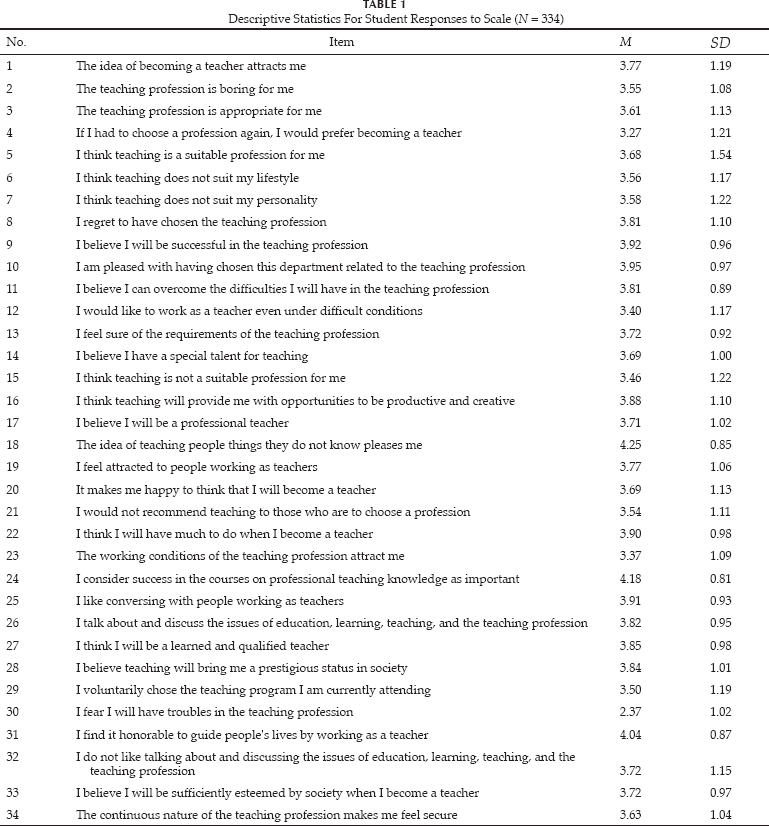
The mean rating was M = 125.5, indicating that primary teachers selected teaching as a profession due to an interest in children. This result is congruent with the findings in Obanya (1978) indicating that teachers chose teaching because they enjoyed working with children. These results support previous research conducted by Senel, Demir, Sertelin, Kilicarslan, and Koksal (2004), Alim and Bekdemir (2006), Terzi and Tezci (2007), and Tezci and Terzi (2010) in Turkey. Interestingly, 53 (15.7%) of students had negative attitudes, 4 (1.2%) were neutral, and 277 (82.9%) had positive attitudes towards the teaching profession. The unfavorable attitudes reported by some students might be improved by an enthusiastic teacher who could improve their interest in the program. Findings in Tok's (2011) study obtained through interview data showed that changes in pre-service teachers' attitudes towards the profession related to practice and cooperation occurring throughout their formal education.
The participants' GPAs (scale of 1 = poor to 4 = excellent) ranged from 1.70 to 3.95, with an average GPA of 2.94. Two hundred sixteen (64.7%) of the participants indicated their GPAs were 3.00 or higher and 17 (5.1%) reported their GPAs were 2.00 or lower.
Regression results indicated that the Attitude Scale Towards Teaching Profession explained 38% of the variance in achievement (GPA) (F1,332 = 7.36, p < .001, R2 = .38). In the present sample, regression results indicated that education students' attitudes towards the teaching profession affected their undergraduate achievement. Oskamp and Schultz (2005) argued that teaching and instruction were one of the many determiners of attitudes. The difference of attitude scores among students in the current study may be the result of negative learning experiences of these students in their teacher education process or because students in the early years of the program have not practiced teaching yet. Sisman and Acat (2003) found that practice teaching supports student teachers' perceptions of the teaching profession.
“Attitude” consists of affective, cognitive, and behavioral elements (Kreitner & Kinicki, 2007), including all kinds of feelings of the individual towards the outside world (Sears, Freedman, & Peplau, 1985). Numerous studies illustrate the importance of attitudes and that they are not inherited but behavior-related and learned (Shrigley, Koballa, & Simpson, 1988); therefore, teacher education courses must have a strong role in the development of attitudes (Ginns & Watters, 1999) and provide advance information about the profession (Kagitcibasi, 1985). Attitudes towards teaching are learned later in life (Can, 1987), so positive attitudes toward the teaching profession will have important effects not only on students' success at college but also during their professional careers as teachers.
The major difficulty encountered in this study was the unavailability of published research studies in the national literature regarding education students' attitudes towards the teaching profession. Therefore, the findings were discussed in comparison with the results of previous studies in the international literature. The participants were 334 students recruited from one university. Therefore, generalization to prospective teachers elsewhere should be approached with caution. To obtain a better understanding of the development of education students' attitudes towards teaching, additional studies should be conducted with pre-service and in-service teachers.
These students had chosen the teaching profession. The College of Education follows a new program in which great effort is made to prepare students for their professions. It should be noted here that 14.4% of the sample students were in their senior year, so they have strong attitudes towards their profession and know that teaching does suit them, since they have finished their practicum at this point. Evaluating education students' attitudes towards the teaching profession provides insight into how teachers express desire, capability, and motivation in the classrooom.