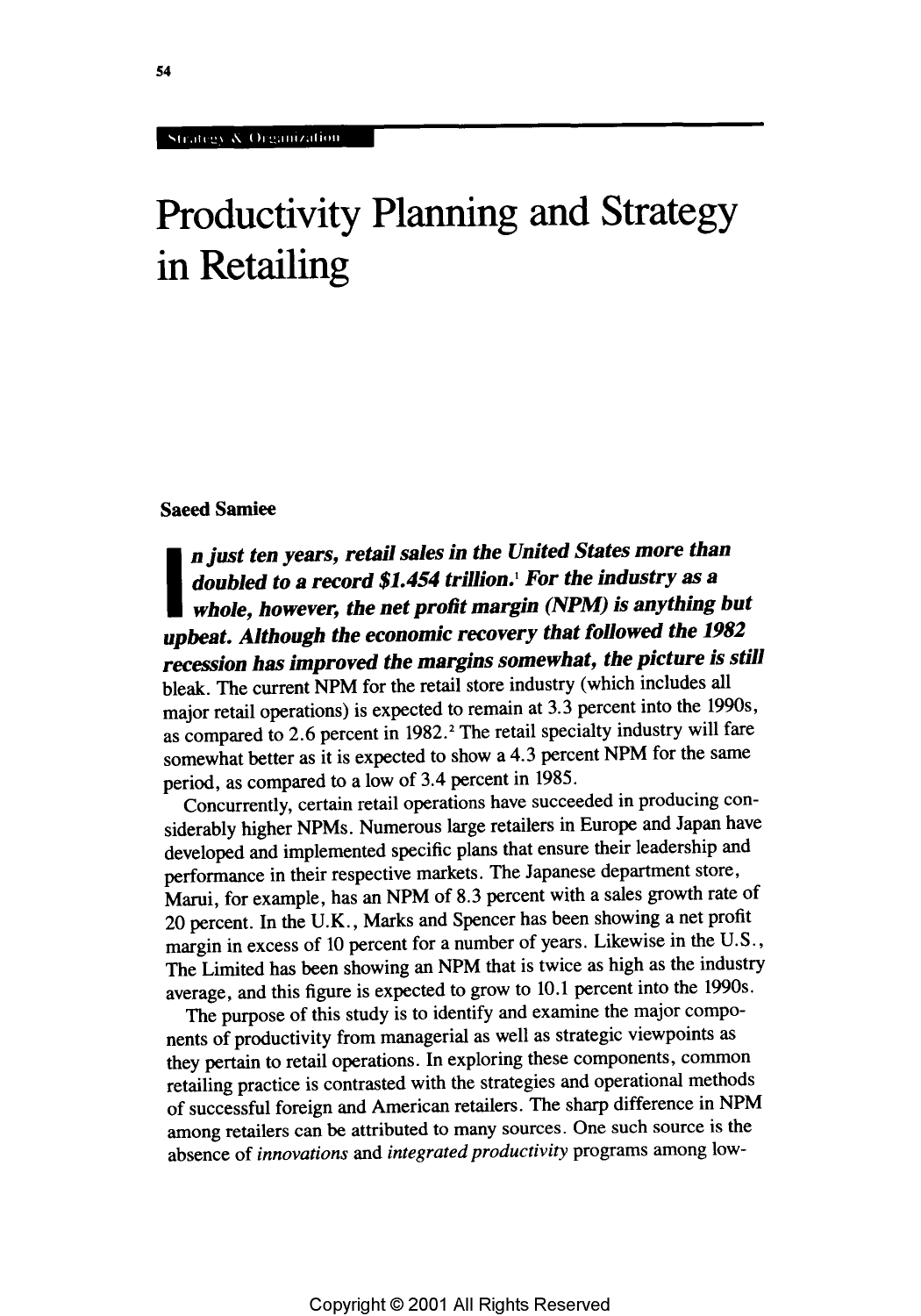
Retail Industry Report, 1986; Retail Industry Report, 1987 (New York, NY: Value Line, Inc.)
3.
CortStanton G., Productivity In General Merchandise Retailing (New York, NY: National Retail Merchants Association, 1980).
4.
ChaseRichard B., “Where Does the Customer Fit in a Service Operation,”Harvard Business Review (November/December 1978), pp. 137–142.
5.
BucklinLouis P., Productivity in Marketing (Chicago, IL: American Marketing Association, 1978).
6.
DavidsonWilliam R.SweenyDaniel J.StampflRonald W., Retailing Management (New York, NY: John Wiley & Sons, Inc., 1984).
7.
Cort, op. cit.
8.
A section on productivity improvement in MasonJ. BarryMayerMorris L., Modern Retailing: Theory and Practice (Plano, TX: BPI, 1987), pp. 139–143, is representative of this definition.
9.
See, for example, “Discounters and Specialists Win Merchandise Battle,”Chain Store Age Executive (November 1988), pp. 64–71.
10.
Strictly speaking, productivity is measured in terms of output for a given set of resources used. However, such a measure is of little assistance in identifying critical elements of productivity.
11.
See, for example, RatchfordBrian T.StoopsGlenn T., “A Model and Measurement Approach for Studying Retail Productivity,”Journal of Retailing (Fall 1988), pp. 241–263; IngeneCharles A., “Labor Productivity in Retailing,”Journal of Marketing (Fall 1982), pp. 75–90; and IngeneCharles A.LuschRobert F., “Estimation of a Department Store Production Function,”International Journal of Physical Distribution and Materials Management, 9/6 (1979): 272–284.
12.
These proportions are not representative of the population due to the nature and size of the sample.
13.
“Formal Planning Program Boosts Productivity,”Discount Store News, July 13, 1981, p. 2.
14.
See MintzbergHenry, “Patterns in Strategy Formulation,”Management Science (May 1978), pp. 934–948.
15.
For further information regarding the study of planning process see MinzbergHenryRaisinghaniDuruThéorôtAndré, “The Structure of Unstructured Decision Processes,”Administrative Science Quarterly (June 1976), pp. 246–275.
16.
See, for example, LeontiadesMilton, “A Diagnostic Framework For Planning,”Strategic Management Journal, 4 (1983): 11–26.
17.
It is noteworthy that in service businesses, capital spending on new technologies per worker is estimated to be twice as productive as the industrial sector and is expected to grow four-times as much by 1990. See AnaniaLawrence, “Services: Low Productivity/High Costs,”Review of Business (Summer 1987), pp. 21–22.
18.
Personal checks that are accepted by 4.5 million retailers in Europe and can be written in any one of the major currencies.
19.
WeinerSteve, “Many Stores, Abandon Service With A Smile, Relying on Signs, Displays,”The Wall Street Journal, March 16, 1981, p. 1.
20.
BlumenthalKaren, “A Few Big Retailers Rebuff Middlemen,”The Wall Street Journal, October 21, 1986, p. 6.
21.
WatsonThomasJr., A Business And Its Beliefs (New York, NY: McGraw-Hill, 1963).
22.
A study of 200 Canadian retail establishments, for example, shows sharp differences between management and employees on many critical factors such as job satisfaction, compensation, working condition, communication, and motivation. See PeachDavid A.OliverR. Dale, “Employees and Managers—Seeing Things Differently,”Business Quarterly (Fall 1985), pp. 39–43.
23.
In addition, the study by Peach and Oliver (ibid.) reveals that retail managers' views of fairness (reflecting the cost of living and changes in the CPI) and competitiveness (as compared to other employers) of retail wages are inaccurate and in sharp contrast to employees' perception.
24.
BarmashIsadore, “Selling: Retailing's Lost Art,”The New York Times, March 15, 1983; Weiner, op. cit.
25.
There are a number of independent firms, such as Shop'n Check, that track in-store personnel performance and assist retailers with upgrading of customer service. See, for example, “Who Was That Masked Customer?”Chain Store Age Executive (November 1988), pp. 80–81.
26.
QC benefits 4 times greater than its costs have been reported by GyrnaJ., Quality Circles: A Team Approach to Problem Solving (New York, NY: American Management Association, 1981).
27.
See DoneganPriscilla, “Productivity Power to the People,”Progressive Grocer (January 1982); “At J.C. Penney: How Quality Circles Work,”Stores (March 1982).
28.
SamieeSaeed, “How Auto Workers Look at Productivity Measures: Lessons From Overseas,”Business Horizons (March 1982), pp. 85–91.
29.
In response to demographic changes, Publix and Zales Corporation, for example, have opened day-care centers. See “Publix To Open Day-Care Center,”Supermarket News, February 4, 1985; “Working mothers and Day-care: A Need For Retailers,”Stores (January 1982).
30.
TseK.K., Marks and Spencer: The Anatomy of Britain's Most Efficiently Managed Company (Oxford: Pergamon Press, 1985).
31.
SinkD. Scott, Productivity Management: Planning, Measurement and Evaluation, Control and Improvement (New York, NY: John Wiley, 1985).
32.
Anania, op. cit.
33.
ReibsteinLarry, “A Finger On The Pulse: Companies Expand Use of Employee Surveys,”The Wall Street Journal, October 27, 1986, p. 33.
34.
See, MintzbergHenry, “Patterns in Strategy Formulation”Management Science (May 1978), pp.934–948.
35.
See TichyN.M.FombrunC.J.DevannaM.A., “Strategic Human Resource Management,”Sloan Management Review (Winter 1982), pp.47–61. In particular, the authors note that Corning Glass Works monitors its top 100 executives for such qualities as entrepreneurial flair. General Electric, on the other hand, attempts to match the personality of managers with the strategic position of units for which they will be responsible.
36.
PIMS data indicate that retailers with 8–14 percent market share showed a mean ROI of 20 percent as compared to 8.4 percent for retailers with market shares below 8 percent. See BuzzellRobertDewMarci, “Strategic Management Helps Retailers Plan For The Future,”Marketing News, March 7, 1980.
37.
SamieeSaeed, op. cit.
38.
TakeuchiH.BucklinL., “Productivity in Retailing: Retail Structure and Public Policy,”Journal of Retailing (Spring 1977), pp. 35–46.