DrtinaR. E.LundstedtS. B., “Cooperative Assessment Procedures under the National Environmental Policy Act,”Toxic Substances Journal (Fall 1980), pp. 150–160.
2.
U.S. Steel received its federal permit from the U.S. Army Corps of Engineers for effluent discharge into Lake Erie. Other state and local permits are pending. In the meantime, top-level U.S. Steel management has been changed, and plans for constructing the plant have been indefinitely postponed.
3.
See, for example, U.S. Department of Commerce, Office of Environmental Affairs, Early Corporate Environmental Assessment: Selected Papers (February 1980); School of Natural Resources, The University of Michigan, The Value of Time in Environmental Decision Processes: Concepts and Issues (November 1979).
4.
Consider two separate cases: Case A, inflation is 10 percent and discount rate is 10 percent; Case B, inflation is 10 percent and discount rate is 15 percent. Further, assume construction costs under cooperation occur as $10,000 at the end of years 1 and 2, while costs under adversity occur at the end of years 3 and 4 due to delay in approval. As the discount rate increases beyond the rate of inflation, the discounted cost of construction is less when delayed. Consequently, adversity appears favorable.
5.
Note that the 10 percent inflation level is for convenience only. In practice, one has to forecast the various flows which may be increasing in price faster or slower than the rate of general inflation.
6.
For a more complete treatment, see BiermanH.Jr.SmidtS., The Capital Budgeting Decision, fourth edition (New York: Macmillan, 1975), part 1.





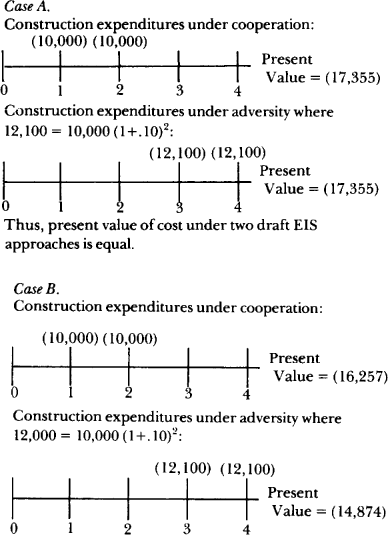 As the discount rate increases beyond the rate of inflation, the discounted cost of construction is less when delayed. Consequently, adversity appears favorable.