





Abstract
This article reviews the literature on the use of antidepressants for symptoms associated with perimenopause. In some perimenopausal women, mood instability, insomnia and vasomotor symptoms cause significant distress. Studies of antidepressants for perimenopausal symptoms are summarized, with a focus on perimenopausal depression and vasomotor symptoms. Antidepressants should be considered as an alternative to hormone therapy for perimenopausal depression and hot flashes, especially when hormone therapy is contraindicated, or as an augmentation strategy for women who are only partially responsive to hormone therapy.
Keywords
The menopausal transition can be associated with distressing mood and somatic symptoms. Prior to the publication of the Women's Health Initiative (WHI) data [1], these symptoms were typically treated with hormone replacement therapy (HRT). While the WHI data may or may not be applicable to perimenopausal women using HRT for short durations for symptom relief [2] and the absolute increased risk of adverse events was small, HRT is being used less often, as evidenced by a decrease in recent HRT prescriptions [3]. As a result, there are likely many peri- and postmenopausal women who suffer but do not pursue or are not offered adequate treatment for their symptoms.
Perimenopause is a time of fluctuating hormones and active estrogen withdrawal, making it distinct from the postmenopausal period. For example, in some studies perimenopausal women have a different response rate to HRT for menopausal symptoms, particularly depression, compared with postmenopausal women [4,5]. It is important to study the treatment of perimenopausal symptoms separately from postmenopausal symptoms.
Symptoms of perimenopause include emotional symptoms, vasomotor symptoms (e.g., hot flashes and night sweats), sleep disturbances, as well as urogenital dryness and atrophy (Figure 1). This article addresses the use of antidepressants for perimenopausal symptoms. The main topics covered include the use of antidepressants for perimenopausal depression, anxiety, hot flashes, insomnia and sexual dysfunction. In addition, common side effects of antidepressants will be reviewed. Recommendations will be made regarding the use of antidepressants for perimenopausal emotional and vasomotor symptoms.
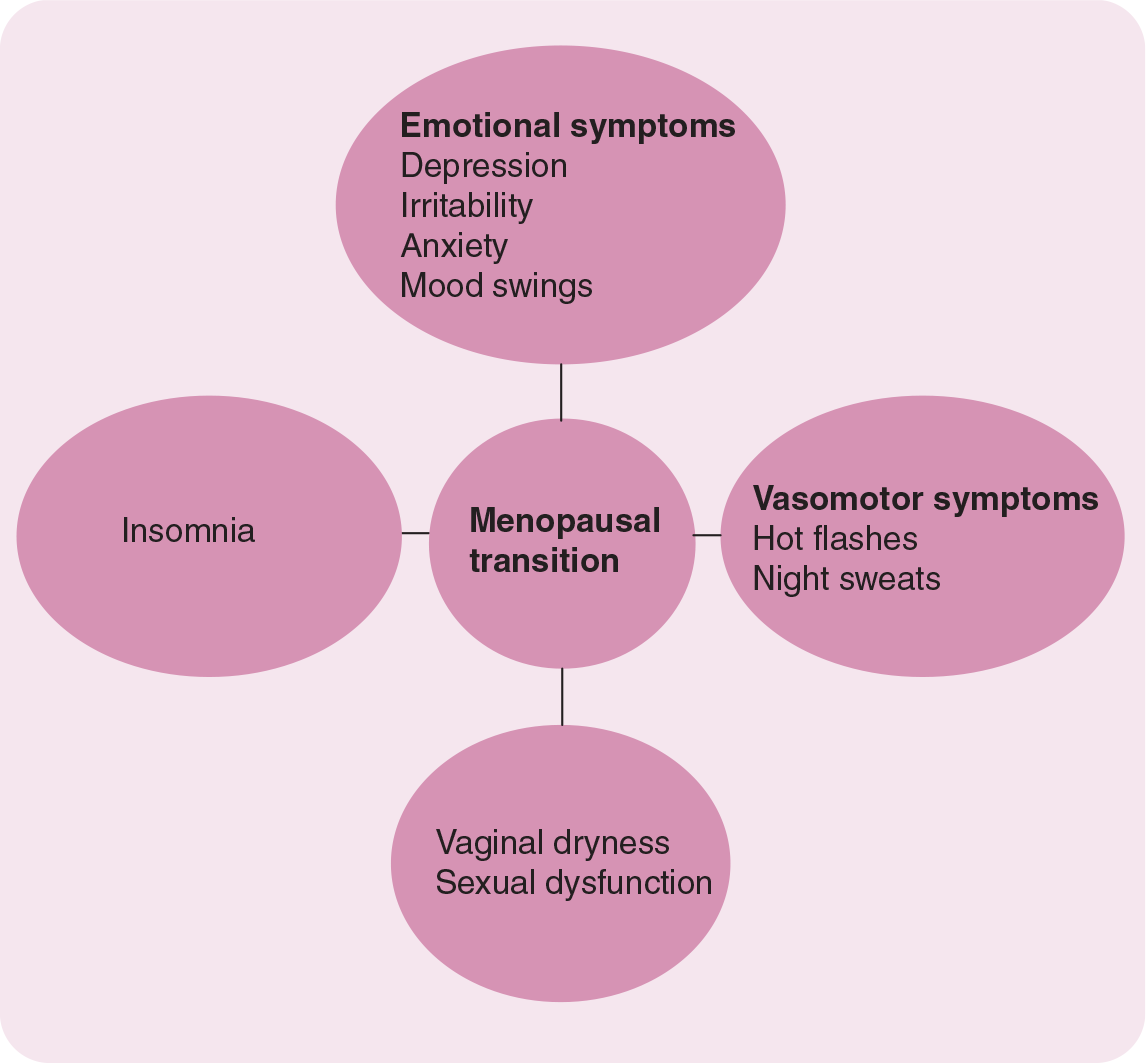
Common symptoms associated with the menopausal transition.
Definition of peri- & postmenopause
Perimenopause is the time leading up to menopause when a woman's menstrual cycle becomes irregular. This menopausal transition typically lasts for 2–8 years with a median age of onset of 47 years. There are two stages of perimenopause, early and late, as defined by the Stages of Reproductive Aging Workshop (STRAW) clinical criteria [6]. The early perimenopause occurs when menstrual cycle length varies more than 7 days from a woman's usual cycle. The late stage occurs when two or more menstrual cycles have been skipped. A woman is considered postmenopausal with the cessation of the menstrual cycle for 12 months or longer. The mean age of onset of menopause is 51 years.
Hormonal fluctuations characterize the perimenopause. Following a decrease in inhibin, follicle-stimulating hormone (FSH) levels increase [7]. FSH is secreted by the pituitary gland in an attempt to stimulate increasingly resistant ovarian follicles. Other hormonal changes include a decrease in estrogen leading to an eventual increase in lutenizing hormone (LH) levels. An elevated FSH level is useful in determining perimenopausal status, especially in unclear clinical situations. However, since hormone levels vary widely, menstrual irregularity is generally agreed upon as the most helpful marker to establish perimenopausal status.
Emotional symptoms & perimenopause
Perimenopausal emotional symptoms include depression, anxiety, irritability and mood lability. In a large epidemiological study, perimenopausal emotional symptoms were reported by 14–18% of women [8].
Most of the data have focused solely on perimenopausal depression. An estimated 10–40% of women report depressive symptoms during the perimenopause [9]. While controversial, the weight of the evidence suggests that the risk of developing depression increases during the perimenopause and decreases once postmenopause is reached [10–12]. The primary risk factor for depression during perimenopause is a history of depression [10]. Other risk factors identified for developing depression include increased length of menopausal transition, hot flashes and interpersonal stressors. However, not all of these have been reliably replicated in later studies [13,14].
Studies of antidepressants for perimenopausal depression
Given the efficacy of antidepressants in general depressed patients, it is natural to examine their use in the perimenopausal population. Antidepressants have been studied for the treatment of perimenopausal depression as monotherapy and as adjuncts to HRT (Table 1). There are many different types of antidepressants (Table 2), and only those with serotonergic activity have been studied for perimenopausal depression.
Studies of antidepressants for perimenopausal depression.
Antidepressant dose unless specified.
CGI: Clinical Global Improvement; DB: Double blind; FSH: Follicle-stimulating hormone; HDRS: Hamilton Depression Rating Scale; HRT: Hormone replacement therapy; MADRS: Montgomery-Asberg Depression
Rating Scale; MDD: Major depressive disorder; MINI: Mini International Neuropsychiatric Interview; OL: Open-label; PC: Placebo-controlled; SCID-IV: Structured Clinical Interview for DSM-IV.
Antidepressants: class and use in perimenopause.
CR: Controlled release; ER: Extended release; HRT: Hormone replacement therapy; SR: Sustained release.
Monotherapy
Three open-label studies have examined the efficacy of antidepressant monotherapy specifically for the treatment of perimenopausal depression [15–17]. The antidepressants studied were citalopram, escitalopram and venlafaxine. All studies showed improvement in perimenopausal depressive symptoms with antidepressant monotherapy. The depression definitions were similar with all studies including women with major or minor depression or dysthymia. However, perimenopause was defined differently in each study. The citalopram and escitalopram studies used mixed peri- and postmenopausal samples, while the venlafaxine study included only perimenopausal women. In the only study using a placebo comparison group, depression remitted in 75% of the subjects receiving escitalopram compared with 25% of the women treated with estrogen plus progesterone [15]. These results are suggestive that antidepressants are a promising treatment of perimenopausal depression and their efficacy should be confirmed with larger, randomized, placebo-controlled trials.
With hormone therapy
Estrogen is important in serotonin modulation. Some have hypothesized that estrogen therapy in postmenopausal women enhances response to antidepressants [18], but data supporting this theory are limited. There are two types of augmentation data. HRT can be added to an antidepressant or vice versa.
There are two studies examining the addition of HRT to an antidepressant [9,19]. In a double-blind, placebo-controlled trial of estrogen augmentation for perimenopausal depression, women who had a partial response to an antidepressant showed a significant response to HRT augmentation compared with placebo augmentation. In an open-label study, women only partially responsive to fluoxetine were given estrogen augmentation. A significant decrease in depression was shown as early as the end of week 1, with five patients responding partially and one patient achieving remission. Differing definitions of perimenopause were used in these studies. These preliminary studies suggest that adding estrogen to an antidepressant may be beneficial when there is at least a partial response to antidepressant monotherapy.
There are two open-label studies of an antidepressant being added to estrogen therapy for perimenopausal depression [15,20]. In the first study, women with depression unresponsive to estrogen alone were given citalopram adjunctively. In the second study, women with major depressive disorder receiving stable doses of estrogen were given mirtazapine. Both studies included a group of mixed peri- and postmenopausal women who showed significant improvement in depressive symptoms. Although both are open-label studies, these data suggest that serotonergic antidepressants may be useful in perimenopausal women who continue to have depressive symptoms while receiving HRT.
Studies of antidepressants in perimenopausal anxiety & irritability
Although not extensively studied, anxiety, irritability and mood swings may increase during perimenopause. In fact, anxiety and irritability may be even more common during perimenopause than depression [8]. These symptoms may affect a woman's quality of life (QoL) and may also be a target for antidepressant treatments.
No studies have specifically evaluated the efficacy of antidepressants for perimenopausal anxiety. However, a decrease in anxiety symptoms was observed in two open-label studies of women treated with citalopram [15] and venlafaxine [17] for perimenopausal depression. It is unknown whether antidepressant treatment would be effective for perimenopausal women who have anxiety or irritability as their primary mood symptoms.
Studies of antidepressants for perimenopausal somatic symptoms
Perimenopausal somatic symptoms such as hot flashes, insomnia and sexual dysfunction are bothersome to many women and can cause significant distress requiring intervention. Therefore, finding safe and efficacious treatment for menopausal symptoms is imperative.
Hot flashes
Vasomotor symptoms (hot flashes and night sweats) occur in most women at some point during the menopausal transition [21]. The most common complaint is hot flashes and many women will experience severe symptoms [22]. Approximately 75–90% of women will experience hot flashes during the menopausal transition [10,22]. Table 3 reviews the randomized, placebo-controlled trials of antidepressants for the treatment of hot flashes. In some randomized, placebo-controlled studies [23–25], but not all [26], serotonin reuptake inhibitor antidepressants have been shown to be efficacious for the treatment of hot flashes. Venlafaxine, a combined serotonin–norepinephrine reuptake inhibitor, reduced hot flash severity and frequency in one randomized, placebo-controlled trial [27] and reduced the subjective effects of hot flashes in another [28]. Mirtazapine, a noradrenergic and specific serotonergic antidepressant, has also been shown to reduce hot flashes in open-label trials [29,30]. In postmenopausal women, the North American Menopause Society (NAMS) recommends low-dose venlafaxine, paroxetine and fluoxetine to reduce hot flashes [31]. In these studies the subjects were either breast cancer survivors in whom HRT is contraindicated (regardless of menopausal status) or nondepressed postmenopausal women. It is unclear whether these data can be generalized to perimenopausal women experiencing hot flashes.
Comparison of randomized, placebo-controlled antidepressant trials for hot flashes.
CR: Controlled release; HFCS: Hot flash composite score (severity and frequency); HRT: Hormone replacement therapy; QoL: Quality of life; RPCT: Randomized, placebo-controlled trial.
No studies have been published that were designed with the primary aim of evaluating antidepressants for the treatment of hot flashes during the perimenopause. The only data in women experiencing perimenopausal hot flashes are in studies evaluating their use for perimenopausal depression. There is one study showing a positive response and two negative studies. In a study of escitalopram versus HRT in a mixed peri- and postmenopausal depressed sample, 56.2% of women receiving escitalopram reported remission of vasomotor symptoms [16]. In an open-label study of venlafaxine monotherapy for perimenopausal depression, there was no significant reduction in vasomotor symptoms [17]. Likewise, in an open-label study of citalopram for perimenopausal and postmenopausal depression, there was no significant decrease in hot flashes in either the citalopram monotherapy or adjunctive group [15]. None of these studies required hot flashes for study eligibility.
Insomnia
Sleep disturbance is a common complaint associated with depression. In addition, women often report decreased sleep during the menopausal transition. Difficulty sleeping is reported by up to 38% of women during the menopausal transition [32]. Perimenopausal sleep disturbance is often described as frequent awakenings associated with nocturnal vasomotor symptoms as well as difficulty initiating sleep. However, objective polysomnography does not always correlate with a woman's subjective perception of sleep difficulties [33]. It has been hypothesized that perimenopausal sleep disturbance may be due to awakenings caused by vasomotor symptoms such as night sweats and that estrogen can alleviate sleep disturbance [34]. However, not all studies have found a correlation between hot flashes and night-time arousals [35]. It might be expected that if antidepressant treatment for perimenopausal depression or hot flashes is efficacious, then a secondary improvement in sleep might occur. In a study using citalopram to treat hot flashes in nondepressed women, citalopram was found to improve insomnia despite not significantly improving hot flashes [26]. This raises the question of whether antidepressants could independently, aside from their impact on vasomotor symptoms or depression, improve either objective or subjective sleep difficulties in this population. While hypnotics have been shown to be effective for perimenopausal insomnia [36], no studies examining antidepressants in perimenopausal women have been published.
Sexual dysfunction
Sexual dysfunction is common during perimenopause and vaginal dryness effects up to 39% of perimenopausal women [37]. Vaginal dryness is a common peri- and postmenopausal symptom that is often treated with systemic HRT or topical vaginal creams. The effect of antidepressants on sexual functioning in the peri- and postmenopausal population has not been established. One study did not find a worsening of sexual functioning with serotonergic antidepressants in a postmenopausal sample [23]. The authors suggest that since menopause itself is associated with a decreased libido, antidepressants may not add to this effect. Antidepressants themselves can cause sexual dysfunction, such as decreased libido, decreased arousal or anorgasmia. However, it is unknown whether antidepressants in a perimenopausal population could improve sexual functioning by decreasing depression or vasomotor symptoms.
Antidepressant side effects
Common side effects from the serotonergic antidepressants include gastrointestinal upset, insomnia, sedation, headaches and sexual dysfunction. More than 50% of women receiving serotonergic antidepressants will report sexual dysfunction, including decreased libido, anorgasmia and decreased arousal [38]. Sexual function is an important QoL issue. Women should be directly questioned by clinicians regarding this side effect as, in the authors' experience, patients are sometimes reluctant to discuss these issues. Another common side effect of many antidepressants is insomnia, therefore clinicians should monitor for antidepressant-induced sleep disturbance. At therapeutic doses, many antidepressants can induce sweating, which may be confused for continued vasomotor symptoms in some patients. The authors' experience suggests that antidepressant-induced sweating can usually be clinically distinguished from vasomotor symptoms by virtue of the distribution of sweating. Antidepressant-induced sweating typically occurs throughout the whole body, while menopausal hot flashes are mostly experienced in the upper body. Occasionally, antidepressants can cause an initial increase in anxiety and should therefore be started at low doses in a patient prone to anxiety. Mirtazapine can cause sedation and weight gain.
Antidepressants should be used carefully in women with a history of bipolar disorder due to the risk of inducing mania. Therefore, all depressed women should be screened for a history of hypomania or mania. They should not be used in concert with monoamine oxidase inhibitors (MAOIs) or medications that have MAOI activity due to the risk of serotonin syndrome. Serotonin syndrome is a serious and potentially fatal hyperserotonergic state. While it is generally seen when serotonergic agents are combined, it has been reported with the use of single serotonergic agents. Common symptoms include changes in mental status, autonomic instability, hyper-reflexia, diaphoresis, shivering, tremor and myoclonus. Bleeding may be of concern in patients receiving other medications that can affect coagulation.
Recent US FDA warnings have suggested that antidepressants in children and adolescents may be associated with an increase in suicidal ideation and behavior, so all patients should be monitored closely when first started on an antidepressant. Practitioners should be careful to use therapeutic doses and not to call a medication ineffective until an 8–12-week trial has been completed. Often, intolerable side effects or inefficacy of an antidepressant can be solved by switching to a different antidepressant.
Conclusion
Depression, insomnia, and sexual and vasomotor symptoms are common and can lead to a poor QoL in many women during the menopausal transition. This article discusses the use of antidepressants for the treatment of these symptoms during the perimenopause. The available data are mostly from open-label trials with small sample sizes and varying definitions of perimenopause. Perimenopausal depression is not currently a separate diagnostic entity from major depressive disorder. However, it has received separate study given that perimenopausal women are unique due to their intermittent and declining ovarian function. The resulting hormonal fluctuations differentiate perimenopausal women from both pre- and postmenopausal women. It cannot be assumed that peri- and postmenopausal women will respond identically to treatment for depression. This is highlighted by the observation that perimenopausal women may respond better to HRT for depression than postmenopausal women [4].
Preliminary data from several small, open-label trials support the use of serotonergic antidepressants for perimenopausal depression. Preliminary data suggest that monotherapy with some serotonin reuptake inhibitors (e.g., citalopram and escitalopram) and a combined serotonin–norepinephrine reuptake inhibitor (venlafaxine) is a useful alternative to HRT for perimenopausal depression. This is not surprising given that these medications are effective for depression in general. The data for the use of antidepressants for perimenopausal depression should be considered preliminary due to small sample sizes and their open-label design. Larger randomized, placebo-controlled trials are needed to confirm the efficacy of antidepressants for perimenopausal depression. Based on the data, only serotonergic antidepressants are recommended as a first-line treatment for perimenopausal depression.
In perimenopausal women whose depression is only partially responsive to antidepressant treatment, estrogen augmentation may be an option, although the data are preliminary and the risks of HRT therapy must be considered. In addition, women already receiving HRT who continue to be depressed may benefit from the addition of an antidepressant. It is unknown if it would be possible to stop the HRT and just use an antidepressant in this population. The use of HRT has come under scrutiny in some populations. The WHI was a study of long-term combined estrogen and progesterone use in over 16,000 postmenopausal women. The study was stopped after 5 years due to increases in several adverse events. As was widely reported, long-term HRT in postmenopausal women resulted in an increased risk of cardiovascular events, ovarian cancer, breast cancer, thromboembolic events, stroke and dementia. Women reported improvement in vasomotor symptoms but no overall benefit on QoL. The patient and clinician have to weigh the risks and benefits of HRT augmentation for perimenopausal depression and it certainly should be avoided in certain groups such as women with breast cancer.
Preliminary data from two open-label studies measuring anxiety in women with perimenopausal depression show an improvement in anxiety. Serotonergic antidepressants are a reasonable choice for perimenopausal anxiety and should be started at a low dose and titrated up slowly. There are no data on the use of antidepressants for perimenopausal irritability or mood swings. Further studies designed to examine antidepressant effects on perimenopausal mood symptoms other than perimenopausal depression are needed.
Most of the data support the use of antidepressants for hot flashes in breast cancer survivors and postmenopausal women. The response to antidepressant treatment is swift, with hot flash symptoms often partially decreasing within a week. There is a high placebo response rate, which has led to some negative studies. Frequently the antidepressant doses used to treat hot flashes are much lower than those used to treat depression. There are no studies directly studying the use of antidepressants for hot flashes in perimenopausal women. However, of the three studies that address this issue, only one found an improvement in hot flashes using an antidepressant. Unlike studies of postmenopausal hot flashes, the studies that examine the usefulness of antidepressants for perimenopausal hot flashes have all been in depressed cohorts. Depression symptoms may remit despite the continuation of hot flashes [15,17]. Studies in perimenopausal women are necessary to evaluate the efficacy of antidepressants for perimenopausal hot flashes.
All of the antidepressants shown to be effective for reducing hot flashes have the effect of increasing serotonin. Hot flashes are thought to result from a change in the thermoregulatory set-point located in the anterior hypothalamus [39]. Decreased estrogen may lead to a decrease in serotonin and increased sensitivity of the serotonin (5-hydroxytrypamine [5-HT])2A receptor [40]. It has been hypothesized that the serotonergic antidepressants may exert their effect on hot flashes through inhibiting action at the 5-HT2A receptor [41]. It is unknown whether nonserotonergic antidepressants would also decrease hot flashes.
There are no published studies designed to evaluate perimenopausal insomnia or sexual dysfunction. A recent placebo-controlled, 9-month trial, designed to evaluate postmenopausal hot flashes, found that citalopram decreased insomnia [26]. However, in the same trial fluoxetine did not have a significant effect on sleep. Perimenopausal sleep disturbance may be more subjective than objective. The association between hot flashes and perimenopausal sleep disturbance has become questionable. In addition, while it is possible a more sedating antidepressant may have a bigger impact on reports of insomnia than a more activating antidepressant, this has not been investigated.
When evaluating the studies it is important to note that the menopause transition is defined differently in the reviewed studies. Menstrual irregularity was a necessary criterion in some [15,16,19,20], but not all studies [9,17]. Since hormones fluctuate throughout the menopausal transition, menstrual cycle irregularity between 6 and 12 months is a good and easily replicated definition in women who previously had regular menstrual cycles.
The importance of treating depression during this time in a woman's life cycle should not be underestimated. Since the menopausal transition is a time-limited phenomenon, one might take a ‘wait and see’ attitude. However, not only can perimenopausal depression negatively impact QoL and relationships; it may also have other long-term physiological effects. For example, perimenopausal depression is a risk factor for decreased bone density [41]. While it is unknown whether treatment reverses this risk, it is prudent to consider perimenopausal depression as a potentially serious illness. Every woman will experience menopause, making the public health impact of treating perimenopausal symptoms extraordinarily significant.
Since the menopausal transition is characterized by wide fluctuations in hormones, there have been attempts to link symptoms to these fluctuations. However, the etiology of vasomotor symptoms and perimenopausal depression, has not been definitively determined. In women with and without perimenopausal depression there is no known difference in reproductive function [42]. Changes in FSH have been linked to depression [43] and the therapeutic benefit of estrogen in the treatment of perimenopausal depression [4,43] suggest estrogen withdrawal as the etiology of perimenopausal depression. Hot flashes are related to perturbation of the thermoregulatory system but the pathophysiology is poorly understood. Estrogen modulates many neurotransmitters, in particular serotonin, which has been implicated in mood disorders. Therefore, perimenopausal symptoms may in part be due to a ‘serotonin deficiency’ as a result of decreasing estrogen levels [44]. This makes the serotonergic antidepressants a reasonable treatment alternative to HRT for perimenopausal depression. However, in women without affective perimenopausal symptoms, HRT is still the gold standard for the treatment of somatic symptoms. If a woman declines HRT, then a serotonergic antidepressant should be tried.
Executive summary
Early perimenopause is characterized by menstrual cycle length variations over 7 days from a woman's usual cycle.
Late perimenopause is characterized by two or more skipped menstrual cycles.
Postmenopause occurs when a woman has no menstrual cycle for longer than 12 months.
Symptoms of perimenopause include emotional symptoms, sleep disturbance, vasomotor symptoms (hot flashes and night sweats), vaginal dryness and sexual dysfunction.
A total of 10–40#x0025; of women will experience depression during perimenopause.
Antidepressants have been studied for the treatment of perimenopausal depression as monotherapy and as adjuncts to hormone replacement therapy (HRT).
Venlafaxine, citalopram and escitalopram have been found to be effective in preliminary, open-label trials for perimenopausal depression. Randomized, placebo-controlled trials are needed.
Serotonergic antidepressants may be effective when added to HRT, and HRT may improve depression in women with a partial response to antidepressants. More data are needed.
Anxiety and irritability may be even more common than depression during perimenopause.
A decrease in anxiety symptoms was observed in two open-label studies of women treated with citalopram and venlafaxine for perimenopausal depression.
A total of 75–90#x0025; of women experience hot flashes during the menopausal transition.
Most data support the use of antidepressants for the treatment of hot flashes in women with breast cancer or postmenopausal women. No data exist to support their use for hot flashes during the perimenopause.
However, in women declining HRT, serotonergic antidepressants are a reasonable alternative to try.
No studies specifically examining antidepressants for perimenopausal insomnia or sexual dysfunction exist.
Common side effects of the serotonergic antidepressants include gastrointestinal upset, insomnia, sedation, headaches and sexual dysfunction.
They should be used cautiously in women receiving other serotonergic agents or with bipolar disorder.
Overall, there is a low risk and a high potential benefit for using antidepressants to treat perimenopausal depression.
Serotonergic antidepressants are recommended as a first-line treatment for perimenopausal depression.
There are too few data to recommend serotonergic antidepressants as first-line treatments for perimenopausal symptoms other than depression.
Overall, there is a low risk and a high potential benefit for using antidepressants to treat perimenopausal depression. Few contraindications exist for the use of antidepressants. Therefore, they should be considered as a first-line treatment for perimenopausal depression. Further data are needed before antidepressants can be fully recommended for other symptoms associated with perimenopause. However, they should be considered in patients when HRT is either contraindicated or declined due to patient preference.
Future perspective
It is likely that antidepressants will become a more accepted treatment for symptoms associated with the menopausal transition, such as depression and vasomotor symptoms, as further studies are conducted. Further studies need to operationalize the definition of the menopausal transition and double-blind, placebo-controlled trials are necessary to confirm the efficacy of antidepressants in this population. In addition, other common mood symptoms such as anxiety, irritability and mood lability need to be addressed in these studies. Studies specifically targeted towards vasomotor symptoms in depressed and nondepressed perimenopausal women are currently lacking and need attention. In addition, studies examining antidepressants for the treatment of menopausal insomnia and sexual dysfunction are needed. It can be expected that women with menopausal symptoms will initially go to their primary care providers for treatment. Psychiatrists are unlikely to be a primary source for menopausal women who have not previously sought mental-health care. These providers must educate themselves regarding nonhormonal treatment alternatives so that antidepressants can be safely prescribed when necessary. Antidepressants should be considered when HRT is contraindicated or in women who are only partially responsive to HRT.