





Abstract
Estrogen deficiency has a negative impact on the quality of life of postmenopausal women and is associated with vasomotor symptoms, insomnia and emotional lability. Other manifestations of estrogen deficiency include dry skin, dry vagina and dyspareunia, in addition to bone loss. Estrogen replacement effectively reverses these changes. The only indication for the administration of a progestogen is to protect the postmenopausal uterus against the potential development of endometrial hyperplasia and carcinoma.
Different progestogens have been used and different adverse effects were documented according to type, dose and duration. Trimegestone is a novel norpregnane progestin, which has potent progesterone receptor (PR) and very low androgen receptor affinities but no detectable affinity for the estrogen receptor. Trimegestone has been developed for use in conjunction with estrogen for postmenopausal hormone replacement therapy (HRT).
Trimegestone administered sequentially with estrogen results in a dose-dependent modulation of the bleeding pattern. Women receiving the higher trimegestone dose of 0.5 mg had a predictable day of onset of withdrawal bleeding with minimal incidence of breakthrough bleeding compared with the bleeding pattern observed with lower doses. However, there is no dose-dependent increase in adverse effects, particularly weight gain and, equally importantly, trimegestone does not negate the beneficial effect of estrogen on lipids and bone.
Trimegestone has a beneficial effect on alipoprotein (Apo)-A1 and high-density lipoprotein (HDL), which, when compared with epidemiological data, may be associated with a reduction in the risk of fatal myocardial infarction (MI).
Trimegestone is an effective and well-tolerated new progestin that adds a safe option in the management of postmenopausal women.
Management of the menopause: current views
The menopause transition is a natural progression in women and is a reflection of the precipitous decline in oocyte population [1]. This decline in oocyte recruitment and development results in estrogen deficiency and, consequently, approximately two-thirds of women will suffer in varying degrees from vasomotor symptoms, insomnia and emotional lability [2,3]. Indeed, many women will continue to experience these symptoms in later years. In addition, genitourinary symptoms, and loss of collagen in skin and bone may progress acutely during the early postmenopausal years and more slowly afterward.
It is irrefutable that estrogen supplementation is the first-line treatment to cure symptoms of the menopause and improve quality of life (QoL), which declines as a result of this transition. A number of metabolic processes, adversely affected by the menopause, are effectively reversed by estrogen replacement. For example, cholesterol handling is improved [4], fasting insulin levels are depressed [5] and antioxidative effects in endothelial cells are promoted [6]. Venous thrombosis has been cited as an adverse effect of estrogen supplementation, but this has not been documented with nonoral estrogen [7]. Estrogen supplementation can induce endometrial hyperplasia and carcinoma in women with an intact uterus if given unopposed, in other words, without a progestogen. The other and most feared adverse effect is the assumed increased risk of breast cancer.
The Women's Health Initiative (WHI) trial of estrogen (conjugated equine estrogens [CEE]) plus progestogen (medroxyprogesterone acetate [MPA]) for postmenopausal women aged 50–79 years was halted in 2002 after a mean follow-up of 5.2 years (range 3.5–8.5 years) in view of increased risks compared with benefits. Coronary heart disease (CHD), stroke, thromboembolic disease and breast cancer all increased, while the incidence of fractures and colon cancer were reduced [8]. Despite the fact that the adjudicated results, subsequently published, showed no significant increase in the risk of coronary artery disease overall, these data have not attracted equivalent publicity [9].
The estrogen-only arm of the WHI trial was allowed to continue, but was terminated later in 2004 in view of the increased risk of stroke. The mean duration of follow-up was 6.8 years (range 5.7–10.7 years) [10]. Curiously, the heightened risk of stroke was similar to that observed in the CEE/MPA arm of the study, yet it was not taken as a reason to stop those arms of the WHI. Estrogen-only therapy showed no significant effect on the incidence of CHD or overall mortality, and the extent of the reduction in the risk of hip fracture was maintained. Estrogen-only therapy showed a reduction, albeit not statistically significant, in the incidence of breast cancer. This reduction was unanticipated in view of the prescribed doctrine that estrogen treatment is a cause of increased breast cancer incidence, and that the CCE/MPA combination therapy arm of the WHI showed an increase of 24%.
Therefore, the results of the WHI suggested that estrogen-replacement therapy has an advantage over estrogen plus progestogen for the treatment of postmenopausal women. However, this advantage cannot generally be entertained by postmenopausal woman with an intact uterus.
Adding progestogen
The only indication for the administration of a progestogen in postmenopausal women with an intact uterus is to protect the endometrium against the potential development of endometrial hyperplasia and carcinoma. Given sequentially for 10–14 days in every 28–30-day treatment cycle of continuous estrogen treatment, progestogens will induce withdrawal bleeding, which may be irregular and heavy in 50% of users [11,12]. Increasing the dose of progestogens can ameliorate the problem of unscheduled bleeding, but this maneuver may increase the incidence of androgenic adverse effects and may also induce symptoms of fluid retention, bloatedness and mastalgia. Furthermore, the administration of progestogens in this cyclic manner may offset some of the beneficial effects of estrogen [13]. Vasomotor symptoms may sometimes recur and the metabolic effects of estrogen on lipids may be reversed [14,15]. Two alternative strategies may be deployed. First, to reduce the dose of estrogen with a sequential progestogen regimen, but this may leave residual symptoms and may not be effective in protecting bone mass, despite the claims that ultralow doses of estrogen may suffice to suppress bone loss [16]. The second strategy is to administer the progestogen in a continuous manner along with estrogen. This is supposed to induce amenorrhea [17], making it more popular among women who could tolerate the continuous dosing of progestogens, but the metabolic impact of such an approach, particularly on the risk of cardiovascular disease and mammary carcinogenesis, remains to be quantified.
Different progestogens: are they different?
Different progestogens have been synthesized to exert secretory changes in the endometrium and they have different effects according to their type, dose and duration [18]. One of the reasons for the different biological effects of synthetic progestogens currently available for clinical use is their varying degree of binding ability to steroid nuclear receptors other than PRs. Hence, adverse effects may be noted as a result of activation of the androgen, glucocorticoid and mineralocorticoid receptors. Conversely, compounds such as dydrogesterone, with binding affinities similar to natural progesterone, are associated with minor or no androgenic adverse effects on the metabolic processes compared with other progestogens, but are associated with a high incidence of inadequate cycle control compared with MPA, norethisterone acetate (NETA) and levonorgestrel [19]. Similarly, MPA is used in postmenopausal women in preference to NETA due to its lower incidence of androgenic adverse effects, although it has less favorable bleeding patterns compared with NETA and levonorgestrel [20]. A new progestogen, drospirinone, has been developed as a continuous combined HRT preparation with estradiol, which is claimed to have antimineralocorticoid activity [21,22]. Independent data on this progestogen are limited. What is clinically required of a new progestogen is to maintain a full progestogenic effect on the endometrium while not interfering with the effects of estrogen, or other steroids, elsewhere.
Understanding laboratory in vitro and in vivo data of these progestogens may lead clinicians to develop tests for in-depth evaluation of these progestogens in clinical practice. In vitro studies indicated that the development of thrombosis with MPA when added to vascular smooth muscle cells was more pronounced compared with NETA and levonorgestrel [23]. Such procoagulant activity may be useful in exploring auxiliary pathways in the clotting process that may assume relevance in clinical settings. Primates treated with a combination of estradiol and MPA had greater coronary artery constriction responses compared with those treated with estradiol and progesterone [24]. Similar data on the attenuation effects of MPA on the protective actions of estrogens on the coronary artery in ovariectomized monkeys have been published [25–30]. These findings may point to the potential vascular mechanisms that underlie coronary events when similar treatment is administered to a susceptible population of women, as has been noted in the CEE/MPA arm of the WHI report. The majority of the coronary events were observed in women at more than 20 years postmenopause.
Trimegestone
Trimegestone is a novel norpregnane progestin, which in receptor binding studies with human recombinant receptors showed a sixfold stronger relative binding affinity (RBA) for the PR than progesterone. Trimegestone had a 40-times lower RBA than testosterone for the androgen receptor, eight-times lower than dexamethasone for the glucocorticoid receptor and a 2.5-times lower RBA than aldosterone for the mineralocorticoid receptor [31]. Trimegestone is devoid of any affinity for estrogen receptors. These data suggest that trimegestone has a high specificity for the PR, with no significant affinity for other steroid receptors. Trimegestone is rapidly absorbed after oral administration, with the maximum plasma concentration (Cmax) being reached after 30 min, and has a relatively long half-life of 17 h (range 7–37 h) [32]. These properties make trimegestone suitable for combination with estrogen in HRT regimens.
Induction of uterine transformation
Animal studies have demonstrated that orally administered trimegestone is approximately 25–60-times more active than MPA and NETA, respectively, in inducing uterine transformation. The transdermal administration of trimegestone appeared to be six-times more active than MPA and 1000-times more active than NETA, respectively, in inducing uterine transformation, according to the McPhail scale [31,33].
The number of receptor binding sites is similar for both trimegestone and progesterone and the dissociation rate of trimegestone is approximately ten-times slower than that of progesterone, which may contribute to the potent progestogenic action of trimegestone [34,35].
Endometrial histology
Approximately 96% of the endometrial biopsies (total number of biopsies: 195) taken on day 24 of the sixth treatment cycle in women receiving cyclical sequential trimegestone in the dose-ranging study showed secretory changes [36]. One sample showed simple hyperplasia with secretory features in the trimegestone 0.5 mg group, which was below the incidence of 2% observed in an untreated population of postmenopausal women [37]. There were three proliferative endometria, which were obtained from one patient in each of the other dose groups (0.05, 0.1 and 0.25 mg). Other comparative studies showed a similar protective effect of trimegestone, with a low incidence of endometrial hyperplasia [38]. However, in another study of 361 women, none of the biopsies obtained on day 24 of the 13th treatment cycle of sequential combined 17β-estradiol and two doses of trimegestone 0.25 and 0.5 mg showed endometrial hyperplasia [39].
Clinical profile of trimegestone
Climacteric symptoms
Women receiving continuous estrogen combined with sequential or continuous trimegestone had greater improvement in vasomotor symptoms compared with placebo [38], results that are not dissimilar to those of other estrogens and progestogens similarly administered.
Dose-ranging study
Trimegestone was given orally to 266 postmenopausal women (aged 45–65 years) in a double-blind, randomized, dose-ranging study [36]. Each treatment cycle consisted of oral micronized estradiol 2 mg/day for 28 days and oral trimegestone in one of four doses (0.05, 0.1, 0.25 or 0.5 mg) from day 15–28 for 6 months.
There were significant improvements in anxiety, depression, somatic, vasomotor and sexual components of the Greene Climacteric Scale in all treatment groups (p < 0.01) after 3 months of treatment, which was maintained at the end of the study. There was no statistically significant difference in symptom control between the different dose groups [36], further suggesting that trimegestone does not interfere with the action of estrogen in the CNS.
Trimegestone compared with norethisterone
In another study, 387 women were given one of the following orally administered combinations: estradiol 2 mg daily and cyclical trimegestone (days 15–28) at either 0.25 or 0.5 mg/day, or estradiol 2 mg on days 1–22, cyclical NETA on days 13–22 and estradiol 1 mg on days 23–28 for 12 months [39]. Trimegestone was as good as NETA in not interfering with estradiol in relieving vasomotor symptoms. The incidence of women who had complete relief from hot flushes remained constant at approximately 60–70% for cycles 3, 6 and 12 in all treatment groups, and no significant differences in the incidence were observed between the treatment groups.
Quality of life
One of the important goals of HRT in postmenopausal women is improvement in QoL. It is widely accepted that vasomotor symptoms have a major negative impact on QoL in postmenopausal women [40]. Using the Kupperman index (heavily weighted towards vasomotor symptoms), the continuous combined trimegestone (0.125 mg) with 17β-estradiol 1 mg demonstrated a significantly better profile compared with NETA 0.5 mg plus 17β-estradiol 1 mg (p < 0.002). Similar improvements were noted when the results of the WHI were compared between the two preparations [38,40]. Combined trimegestone 0.5 mg with estradiol demonstrated a lower number of days with sleep disorder in all cycles, which was statistically significant (p < 0.05) in 5 out of 13 cycles in comparison with combined estradiol and NETA [38].
Bleeding pattern
Estrogen & sequentially
combined trimegestone
The addition of progestogen sequentially to continuous estradiol is required to protect the endometrium against hyperplasia and carcinoma. This leads to the development of withdrawal bleeding. The re-establishment of monthly bleeding may dissuade women from continuing HRT, particularly if the bleeding is irregular or heavy [11]. Indeed, up to 50% of women discontinue HRT due to bleeding problems [41]. Therefore, it became necessary to explore in detail the effects of trimegestone on withdrawal bleeding and compare the new agent with other progestogens.
Dose-ranging study of trimegestone
Analysis of the menstrual diaries completed by women who participated in the dose-ranging study of trimegestone demonstrated a dose-dependent modulation of bleeding episodes. Women receiving higher doses of the drug had a later mean day of onset of progestogen-associated bleeding (PAB), as they bled at or after the end of the course of trimegestone (p = 0.0001) and the variability of the cycle was reduced (Figure 1). Their bleeding episodes were lighter (p < 0.0001) and of shorter duration (p < 0.0001) compared with those observed with the lower doses. Women receiving the lower doses experienced an earlier mean day of onset of PAB, and the bleeding episodes were heavy and prolonged [36].

Mean and range of day of onset of bleeding by trimegestone dose.
Similarly, there was a more favorable bleeding pattern in women treated with sequential trimegestone (0.5 mg) compared with NETA (1 mg) (Figure 2) [39]. When compared with norgestrel (0.5 mg), sequentially administered trimegestone (0.5 mg) combined with continuous estradiol (2 mg) resulted in a lower mean number of bleeding days per cycle [42].

Mean and range of day of onset of PAB.
Continuous combined estrogen & trimegestone
The amenorrhea rate in women receiving CEE 0.625 mg and trimegestone 0.1 mg was approximately 85% by the 13th cycle. This compares favorably with 76% in women receiving continuous combined CCE 0.625 mg and MPA 2.5 mg [38,43]. Similarly, women receiving continuous combined 17β-estradiol 1 mg with trimegestone 0.125 mg had a higher amenorrhea rate (>85%) compared with women who received continuous combined 17β-estradiol 1 mg with NETA in two doses (0.5 and 1 mg) [44].
Effect of endometrial
structural abnormalities
In the dose-ranging study of trimegestone, 70% of women underwent diagnostic hysteroscopy at screening in an attempt to define the predictive value of hysteroscopically identified endometrial structural abnormalities in the bleeding pattern associated with this new progestogen. The presence of submucous fibroids was associated with heavy, prolonged PAB and a higher incidence of intermenstrual bleeding. This association was statistically significant but the effect of the dose of trimegestone was still the dominant determinant of the severity and duration of bleeding [45], indicating the profound progestogenic properties of trimegestone on endometrial stability. It is universally accepted that the endometrium overlying submucous fibroids is less responsive to progesterone in the natural cycle and shows retarded secretory changes compared with adjacent endometrium. It is suggested, albeit unproven, that the higher dose of trimegestone may be more effective in controlling factors involved in tissue breakdown, such as the activation of metalloproteinases that operate in the endometrium overlying these submucous fibroids, to result in the heavy menstrual loss associated with HRT [46].
Adverse effects
The majority of progestogens in use are associated with fluid retention, bloatedness, mastalgia and a variety of psychological changes, mainly irritability and depression. These symptoms are dose-related, although some women are more sensitive than others.
In the dose-ranging study of trimegestone, there were no statistically significant differences between women from each trimegestone dose group for the development of adverse events, severe adverse events and the number in whom study medication was discontinued as a result of adverse events [36]. In the comparative study, the adverse events induced by trimegestone (0.25 and 0.5 mg) were similar to those induced by NETA [39]. The number of women who withdrew due to adverse events was 27, 29 and 32 in the trimegestone 0.25, 0.5 mg and NETA arms, respectively. There was one case of cerebral ischemia in the trimegestone 0.25 mg group, two cases of deep vein thrombosis in the trimegestone 0.5 mg group and two cases in the NETA group. One case of breast cancer occurred in the trimegestone 0.25 mg group and three cases in the trimegestone 0.5 mg group. One of the cases of breast carcinoma was detected after only 6 months of treatment and may have been present before the start of the study. For the three other cases, the pretreatment mammograms were reviewed again by another expert radiologist and the breast carcinoma was present in one case [39].
Effect of addition of trimegestone on body weight
Weight gain is a major concern for women who choose to receive hormonal treatment. Mean bodyweight was neutral with a greater than 0.4 kg change from baseline to cycle 13 in women treated with trimegestone, continuously or sequentially combined with estrogen, compared with MPA or NETA therapy. This is most likely due to the lack of mineralocorticoid activity of trimegestone [38].
Metabolic effects of trimegestone
Lipid profile
Most studies demonstrate that estrogen replacement therapy reverses the menopause-associated adverse changes in lipoproteins; in particular, it increases HDL cholesterol [47–49], while progestogens, as well as natural progesterone, attenuate the effect of estrogen [15,50–53]. However, a 2-year study of oral progestone (0.5 mg/day given for 21 days out of every 28-day cycle without added estrogen) did not change the lipoprotein profile [54], thus illustrating the heterogeneity of the metabolic impact of progestogens. Just as the size of the beneficial lipid changes varies with the type of progestogen, so one might expect that any due to trimegestone lacking androgenic adverse events may also vary with the regimen.
In the dose-ranging study of sequentially added trimegestone to continuous estradiol, fasting blood samples were collected at baseline, 3 and 6 months after starting treatment [36]. Data on lipid metabolism were available from 250 postmenopausal women who completed the study [55]. There was a mean decrease in total cholesterol, low-density lipoprotein (LDL)-cholesterol and Apo-B. This change was observed after 3 months of treatment in all dose groups and was sustained at 6 months. There was a mean increase in triglycerides (TGs), HDL-cholesterol, HDL2-cholesterol, HDL3-cholesterol and Apo-AI. There was a statistically significant change in all measured lipoprotein and apolipoprotein parameters in each dose group at 6 months compared with baseline (ANalysis Of VAriance between groups [ANOVA]; p < 0.0001). No significant change in Apo-A2 was noted.
Analysis of variance of each of the above parameters of lipoprotein and apolipoprotein values showed no significant difference between the dose groups for the changes from baseline to 6 months. Although there was no demonstrable dose–response effect, cyclically administered trimegestone did not negate the estrogen effect on lipoprotein profile. Trimegestone in combination with estradiol was associated with a more favorable lipid profile than norgestrel combined with estradiol valerate. This may be actions [56].
Apolipoproteins AI & B predict the risk of coronary heart disease
It is widely acknowledged that lowering high cholesterol levels reduces morbidity and mortality from CHD [57,58] and levels of LDL- and HDL-cholesterol, as well as their ratio, are used to predict the occurrence of CHD [59]. However, the absolute levels of various lipoprotein components are influenced by age and many other factors, thus limiting the power of prediction of CHD risk of these lipids levels [60–63]. Furthermore, several recent studies have demonstrated that normal HDL is anti-inflammatory, but HDL from patients with cardiovascular disease, or from patients with cardiovascular disease equivalents such as diabetes, may actually be proinflammatory [64,65], thereby further limiting its predictive value.
The biological significance of sustaining a higher serum level of functional Apo-AI in the prevention of atherosclerosis has been documented in a number of experimental models [66–70]. Indeed, in vitro estradiol stimulates, while MPA, natural progesterone, norgestrel and norethisterone (listed in order of potency) inhibit the process of HDL formation due to the suppression of intracellular cholesterol release to the HDL assembly point [71]. Therefore, it is necessary to understand the implication of the magnitude of the change in Apo-AI levels in association with different progestogen regimens in order to treat patients without compromizing the protective effects of estrogen.
Apo-B-containing lipoproteins are generally regarded as atherogenic and the level of serum total Apo-B is a more accurate estimation of the atherogenic risks compared with total cholesterol and LDL-cholesterol [72]. Since the measurement of Apo-B as well as of Apo-AI can be carried out with high precision and accuracy [73–76] and is easily automated [77,78], numerous publications have called for the inclusion of Apo-AI and -B into standard clinical investigations [72,79–83].
The Apolipoprotein-related MOrtality RISk (AMORIS) study results showed Apo-B and -AI and the Apo-B: Apo-AI ratio to be highly significant predictors of fatal MI at any given level of total cholesterol and TGs, regardless of sex or age, and that Apo-B and -AI are better predictors than the closely related direct measurements of LDL-and HDL-cholesterol [84].
Estimation of the risk of myocardial infarction: results of HRT trials compared with the epidemiological evidence
A randomized, controlled trial of continuous oral estrogen and sequentially added trimegestone (two doses) or NETA supplied information on the changes in lipid profile produced by these different progestogens [85]. Notwithstanding the fact that progestogens may also influence the risk of fatal MI through nonlipid pathways, such as clotting and direct vascular mechanisms, an attempt was made to estimate the effect obtained via the changes in lipid profile, since these are the most commonly used tools in clinical studies [86]. In this study, the difference in Apo-AI levels was 13–15% higher in the estradiol/trimegestone regimens than in the estradiol/NETA treatment. When the changes in Apo-AI and -B were modeled along those deployed in the AMORIS study, only the two trimegestone-based regimens had beneficial effects on Apo-AI (and HDL), but they had a similar effect to that of NETA on Apo-B (and LDL). Models that included both apolipoproteins suggested that the addition of sequential trimegestone to continuous estrogen potentially reduced the risk of fatal CHD by 7% (95% confidence interval [CI]: 5–10), whereas the sequential addition of NETA had little or no effect on the risk. Furthermore, the estimated potential reduction in the risk of CHD through the use of trimegestone was underestimated, since there was an adverse profile of changes in lipids among those who discontinued the NETA arm of the study [86].
Other effects
The mechanism underlying the pathogenesis of thromboembolism in postmenopausal HRT is not very clear. In a randomized, placebo-controlled trial, unopposed estradiol, estradiol combined sequentially with trimegestone 0.5 mg, or dydrogesterone 10 mg were given to postmenopausal women over a 12-week period. There was an unfavorably large increase in resistance in activated protein C activity (p < 0.001) and an increase in platelet activation (p < 0.04), and there was no difference between the three treatment groups [87,88].
The menopause is associated with an increased concentration of homocysteine. Homocysteine is a cardiovascular risk factor due to its effect on coagulation systems. It is an independent risk factor for occlusive arterial disease and deep venous thrombosis. Van Baal and colleagues demonstrated that sequential combined trimegestone 0.5 mg or dydrogesterone 10 mg with 17β-estradiol 2 mg resulted in a significant reduction in fasting homocysteine levels. The largest reductions were in women with the highest levels at baseline (p < 0.01) [89].
Asymmetric dimethylarginine inhibits nitric oxide, which has a vasodilating effect. Hence, it is a risk factor for acute coronary events. Sequential combined trimegestone 0.5 mg with 17β-estradiol 2 mg resulted in a significantly higher reduction in asymmetric dimethylarginine compared with sequential combined dydrogesterone 10 mg with 17β-estradiol 2 mg (p < 0.001) [90].
Conclusion
Trimegestone is a well-tolerated progestogen compared with the other types currently available for clinical use. It is associated with a more acceptable bleeding pattern and favorable lipoprotein profile. It is devoid of mineralocorticoid activity, hence there is no observed weight gain in clinical studies. Further data are required to establish its relative safety in mammary carcinogenesis and coronary vascular reactivity in comparison with other progestogens. The introduction of trimegestone adds a new tool in establishing endometrial safety without interfering with the actions of estrogen.
Future perspective
The development of trimegestone introduces a new and very interesting progestogen that may contribute to the safe administration of HRT in postmenopausal women. In particular, its use in a sequential combined fashion with continuous estrogen is of interest, since the continuous administration of progestogens still raises concerns regarding the associated long-term adverse effects.
A nonantagonizing profile to estrogen actions on bone protection [91], lipid metabolism [86] and microvascular endometrial morphology [92] combined with dose-dependent regulation of withdrawal bleeding in the absence of dose-dependent adverse effects [36], illustrate the fundamental safety of this new progestogen.
Following initial marketing of sequential combined oral trimegestone with continuous oral estradiol, there has been little research and development with this preparation. It has been available in a number of European and Latin American countries for the last 5 years but its use has been limited due the adverse publicity associated with the first WHI publication. The aftermath of the WHI study report dissuaded many pharmaceutical companies from pursuing any development in postmenopausal women's health. New progestogens and better delivery systems are required to further help the individualization of hormonal treatment. Indeed, the development of the transdermal delivery system of trimegestone had been successful but was halted in view of limited commercial interest in this field.
The future of HRT treatment for postmenopausal estrogen deficiency states, be it a short- or long-term treatment, will rely predominantly on the education of women to make informed health choices. In particular, it is important to publicize the numerous shortcomings of the WHI study regarding continuous CEE/MPA preparations, both in design and the analysis of data [93], and expand the notion that the WHI CEE-only arm failed to confirm the hypothesis that estrogen increases the risk of breast cancer. Indeed, it has been shown to lower the risk of breast cancer [94].
Similar approaches should be made to the drug regulatory authorities and the respective healthcare agencies who have found a refuge behind these uncorroborated data to limit spending in this area of preventive medicine. Improvement in the QoL of postmenopausal women by reversing the effects of estrogen deficiency states will have far-reaching advantages for women, workplace and society.
Executive summary
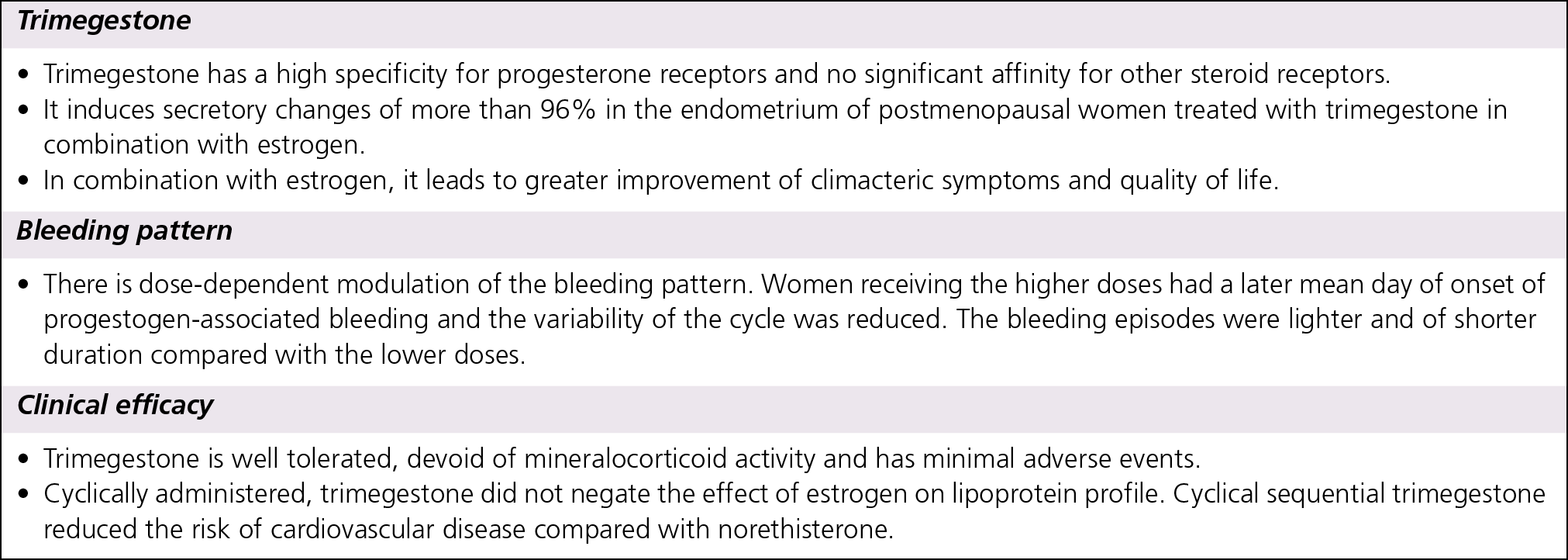
Trimegestone has a high specificity for progesterone receptors and no significant affinity for other steroid receptors.
It induces secretory changes of more than 96% in the endometrium of postmenopausal women treated with trimegestone in combination with estrogen.
In combination with estrogen, it leads to greater improvement of climacteric symptoms and quality of life.
There is dose-dependent modulation of the bleeding pattern. Women receiving the higher doses had a later mean day of onset of progestogen-associated bleeding and the variability of the cycle was reduced. The bleeding episodes were lighter and of shorter duration compared with the lower doses.
Trimegestone is well tolerated, devoid of mineralocorticoid activity and has minimal adverse events.
Cyclically administered, trimegestone did not negate the effect of estrogen on lipoprotein profile. Cyclical sequential trimegestone reduced the risk of cardiovascular disease compared with norethisterone.