






Abstract
The purpose of the present study was to explore the possibility of establishing cancer radiotherapy protocols that could promote treatment efficacy at a reduced radiation dose. Mouse models of melanoma (B16) and Lewis lung carcinoma (LLC) were used in the experiments. Conventional local radiotherapy was combined with low dose whole-body irradiation (LDWBI) in the presence or absence of gene therapy by intratumor injection of a recombinant plasmid Egr-mIL-18-B7.1 (E18B). After a number of trials with different combinations it was found that a protocol of 2-week treatment with 2 × (E18B + 2 Gy + 0.075 Gy × 2) was found to be able to promote treatment efficacy at a reduced radiation dose. In this protocol local irradiation with 2Gy was administered 24h after intratumor injection of 10 μg of the plasmid E18B followed by LDWBI with 0.075 Gy every other day for 2 sessions in 1 week, and the procedure was repeated for another week. When this combined treatment was compared with conventional radiotherapy, i.e., 2Gy every other day 3 times in one week repeated for 2 weeks, the treatment efficacy was improved, as judged by increased average survival rate, reduced mean tumor weight, reduced pulmonary metastasis and suppressed intratumor capillary growth with a 2/3 reduction of radiation dose. Immunologic studies showed stimulated natural killer (NK) and cytotoxic T lymphocyte (CTL) activity as well as increased interferon-γ (IFN-γ) secretion in this combined treatment group as compared with the group receiving local treatment alone. It is suggested that up-regulation of host anticancer immunity by LDWBI and the initiation of expression of immune genes by both the local large dose and LDWBI are important factors in the realization of improved cancer control.
I INTRODUCTION
Radiotherapy is the most commonly used local treatment of cancer. However, the large dose needed for local control often limits its successful use. In some cases of more advanced disease, such as nonresectable lung cancer, radiotherapy in combination with chemotherapy may improve the treatment result to some extent, but the toxicity is not easily tolerated. Therefore, exploration of more effective and safer treatment modalities is needed. In view of the stimulatory effect of low dose radiation (LDR) on anticancer immunity (Liu 2003) an experimental study of the effect of low dose whole-body irradiation (LDWBI) on the outcome of conventional local radiotherapy of cancer was designed with an aim at reducing the total dose and at the same time promoting treatment efficacy. Since radiation doses as low as 0.05∼0.1 Gy could stimulate the expression of genes downstream of Egr-1 promoter (Yang et al 2004; Jin et al. 2005) and gene therapy with Egr-IL-18-B7.1 in combination with local X-rays showed better control of mouse melanoma than local radiotherapy alone (Jin et al. 2005), it was desirable to study the effect of a combined protocol with conventional radiotherapy plus LDWBI and gene therapy by introducing this plasmid in cancer models. Here we report on the effect of LDWBI combined with conventional radiotherapy in the presence or absence of gene therapy on improvement of cancer control with a reduction of total radiation dose in melanoma and Lewis lung cancer models. Preliminary data on possible mechanisms are included.
II MATERIALS AND METHODS
1 Animal models
C57BL/6J mice were used in all the experiments. Cancer cell implantation was given subcutaneously in the hind leg with 106 cells in 50 μl saline using either B16 melanoma (B16) or Lewis lung cancer (LLC) cells. The treatment was started on day 10 after implantation when the tumor size reached 100∼150 mm3 with X-irradiation, the details of which are given in the following sections.
2 Treatment protocols
Local radiotherapy was performed with a deep X-ray machine at the dose rate of 0.287 Gy/min with dose fractions of 2 or 5 Gy. LDWBI was administered at the dose-rate of 12.5 mGy/min with doses of 0.075 or 0.1 Gy in each session. Combined gene therapy was instituted in certain groups by intratumor injection of 10 μg recombinant plasmid pEgr-mIL-18-B7.1 (E18B) using 50 μl polyethylenimine (PEI) for transfection with the control receiving intratumor injection of 50 μl 0.9% saline. Tumor volume was measured every 2 days after termination of treatment.
3 B16 Melanoma modal
A 1-week treatment protocol was first tried in a pilot study with the B16 model. Four groups were set up: 1) Control: no treatment; 2) E18B: injection of plasmid pEgr-mIL18-B7.1; 3) E18B + 5 Gy × 3 and 4) E18B + 5 Gy × 1 + 0.1 Gy WBI × 2. Radiotherapy was started 24 h after plasmid injection and repeated every other day. Observation was continued for 19 days after treatment.
4 Lewis lung cancer modal
Two protocols were set up for the treatment of LLC-bearing mice. The first consists of 5 groups treated for 2 weeks and observed for one month: 1) Control: no treatment; 2) 2 × (5 Gy × 3); 3) 2 × (5 Gy × 1 + 0.075 Gy WBI × 2); 4) 2 × (E18B + 5 Gy × 3); 5) 2 × (E18B + 5 Gy × 1 + 0.075 Gy WBI × 2). The second protocol consists of 5 groups using the same schedule as in the first protocol but using a local dose of 2 Gy instead of 5 Gy.
5 Mechanistic studies
Separate groups of mice were used for studies on the possible immunologic mechanisms of the therapeutic effects. Mice were treated as in the different protocols and sacrificed on days 1, 3 and 5 after termination of treatment. The spleen was taken to prepare cell suspensions for the examination of NK (natural killer) activity against Yac-1 cells and CTL (cytotoxic T lymphocyte) activity against B16 or LLC cells as targets as well as secretion of interferon-gamma (IFN-γ) and tumor necrosis factor-alpha (TNF-α) using methods reported previously (Liu and Yang 1991). The expression of Lamp-1 (CD107a) was assayed using immunofluorescence with flow cytometry (FACScan, B-D) (Marcenaro et al. 2006). Four to five animals were used in each group. Mean survival time was calculated from groups (8 in each) of mice in the second protocol of LLC model. Average tumor weight, pulmonary metastasis (by counting macroscopic pulmonary nodules) and intratumor capillary density (using immunochemistry on 4 μm sections from tumors stained with CD31 monoclonal antibody) were also recorded from each group of 5 animals of the second protocol of LLC model on the 18th day of treatment.
III RESULTS AND DISCUSSION
1 B16 model with one week treatment
In the B16 melanoma model gene radiotherapy with transfection of the plasmid pEgr-mIL-18-B7.1 followed by local X-irradiation with 5 Gy every other day for 3 sessions (total dose 15 Gy) resulted in marked retardation of tumor growth in comparison with both the control (no treatment) and the gene only (E18B) groups. Substitution of the second and third local doses of 5 Gy each with 0.1 Gy WBI showed a similar effect as demonstrated in the lower two curves in the left panel of Figure 1. It is known that IL-18 exerts its anticancer effect through inducing the secretion of IFN-γ (Osaki et al. 1999) and B7.1 (CD80) expression increases the immunogenecity of cancer cells (Gilligan et al. 1998). The plasmid pEgr-mIL-18-B7.1 was used in the present study since it has previously been proven that radiation doses from 0.05 to 5 Gy could stimulate the expression of the genes downstream of Egr-1 promoter (Yang et al. 2004; Jin et al. 2005). Injection of E18B not followed by radiation had only an insignificant effect on cancer growth (second curve in the left panel of Figure 1).

Combined treatment of B16-bearing mice with 1-week protocol. Left panel: Tumor growth curves of gene radiotherapy with or without 0.1 Gy WBI; Right panel: Changes in immunologic parameters of the spleen 1 day after termination of treatment.
Mechanistic studies illustrated that the NK and CTL activities of the splenic cells were up-regulated to the same extent in the treatment groups with 5 Gy × 3 and 5 Gy + 0.1 Gy WBI × 2, and the examination of secretion of cytokines including IFN-γ and TNF-α showed less significant stimulation (right panel of Figure 1). The observation of the beginning of departure between the two lower growth curves in the left panel on d17 and d19 (though not statistically significant) prompted us to prolong the treatment schedule in the next experiment. Since B16 melanoma grew much faster usually reaching a volume of more than 4000 mm3 and leading to death of all untreated B16-bearing mice within 20 days (Jin et al. 2005), LLC models were used for longer periods of observation in the following experiments.
2 LLC model treated with 5 Gy × 6
In the LLC model the protocol of gene radiotherapy was compared to local radiotherapy with or without LDWBI. As seen in Figure 2, substitution of 4 local doses of 5 Gy with 4 doses of WBI of 0.075 Gy produced the same effect of retardation of tumor growth. Since the survival rate of tumor-bearing mice in the control group (receiving no treatment) dropped to 1/8 to 2/8 beginning from d20 after treatment, no statistical analysis between the treated groups and the control could be made beyond d18. Among the 4 treated groups there was no statistical difference in the tumor volume in the whole course of observation. That is to say, substitution of 4 local doses of 5 Gy with 4 doses of WBI of 0.075 Gy produced the same effect of tumor control in the presence or absence of gene therapy. That is to say, about 1/3 of the total dose produced the same therapeutic effect.
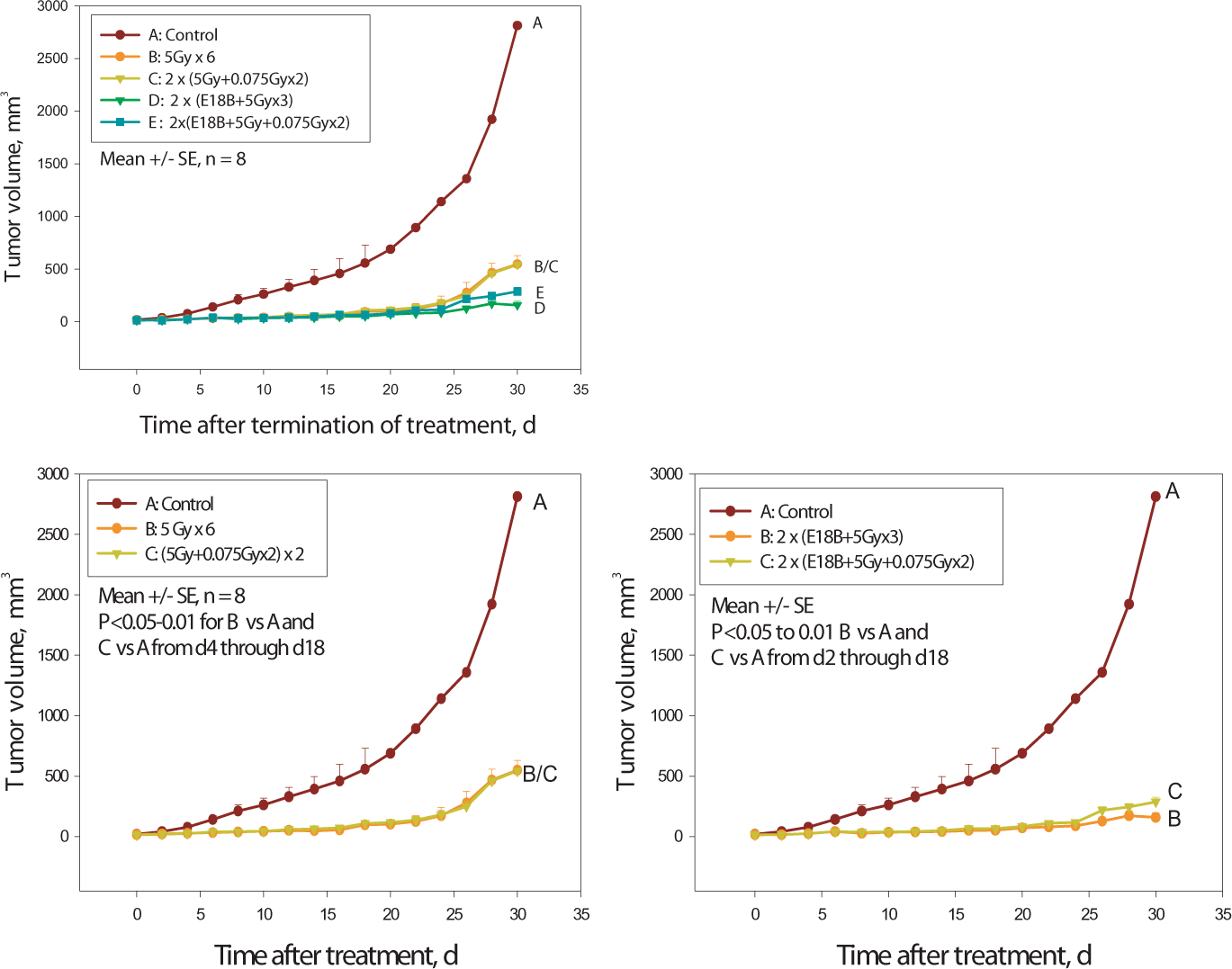
Tumor growth curves of Lewis lung cancer treated with a 2-week regimen of 5 Gy sessions. LLC model was used in the trial of a protocol with 2-week treatment and observation of tumor growth for one month after treatment as shown in the left upper panel. In order to discern the effect of combination of local high dose irradiation and LDWBI with or without the introduction of gene therapy with E18B plasmid, the left and right lower panels are shown with statistical analysis which illustrated that in the presence or absence of gene introduction, substitution of 4 local doses of 5 Gy with 4 doses of WBI of 0.075 Gy exerted the same efficacy of tumor control.
3 LLC model treated with 2 Gy × 6
The same protocol as that in section 2 above was followed in another experiment except that the local doses of 5 Gy were changed to 2 Gy in each treatment session. The results are shown in Figure 3. As seen in the left upper panel of this Figure, 2 Gy × 6 given to the tumor mass in 2 weeks caused significant retardation of tumor growth after treatment, and substitution of the second, third, fifth and sixth doses of 2 Gy with WBI of 0.075 Gy increased the efficacy of tumor control with the tumor volume on the 30th day after treatment being only 40.6% of that in the 2 Gy × 6 group. The right upper panel shows the result of the same radiation treatment protocol as that in the left upper panel, but with introduction of the plasmid pEr-mIL-18-B7.1 before irradiation. In this case there was a further increase in cancer control, with the tumor volume being 61.4%, 53.5%, 56.5% and 60.5% of that in the 2 Gy × 6 group on d10, d12, d14 and d16, respectively (p<0.05). At the end of observations 30 days after treatment, the tumor volume was only 39.1% of that in the 2 × (E18B+2 Gy × 3) group. For more accurate assessment of tumor growth, separate groups of mice receiving treatment of this protocol were sacrificed on d18 after treatment to record the tumor weight (see Table 1). In the left and right lower panels of Figure 3 the treatment result of the protocols with and without introduction of gene therapy was compared. In the presence of pEgr-mIL-18-B7.1 the tumor control was as a whole better than that in the corresponding protocol without the plasmid, especially on d16 through d24 for the 2 × (E18B+2 Gy × 3) group, and on d12 and d14 for the 2 × (E18B+2 Gy+0.075 Gy × 2) group.
Comparison of the main parameters of cancer growth and progression in the protocol of 2Gyx6

A=tumor-bearing mice without treatment; B=tumor-bearing mice with local radiotherapy 2Gy × 6; C=tumor-bearing mice with 2 × (2Gy + 0.075Gy × 2); D: tumor-bearing mice with 2 × (E18B + 2Gy × 3); E: tumor-bearing mice with 2 × (E18B + 2Gy + 0.075Gy × 2); n=8 for survival rate calculation and n=5 for other parameters; mean ± SD;
P<0.05 vs A
P<0.05 vs B
P<0.05 vs C
P<0.05 vs D.

Tumor growth curves of Lewis lung cancer treated with a 2-week regimen of 2 Gy sessions with or without gene therapy and LDWBI (explanation in text).
Figure 4 shows the immunological changes in the spleen of different groups of the 2 Gy protocol from d1 to d5 after termination of treatment. The NK activity on d1 after termination of treatment is shown in the left upper panel of this figure and CTL activity on d3 is shown in the right upper panel of the figure (no significant changes were observed on other days). It seems that NK activity was stimulated promptly and briefly after treatment, with the group receiving 2 × (E18B+2 Gy+0.075 Gy × 2) demonstrating the most prominent activation, and CTL activity only became markedly enhanced on d5 after treatment, also with the group receiving 2 × (E18B+2 Gy+0.075 Gy × 2) showing more marked changes. As shown in the left lower panel IFN-γ secretion was up-regulated with time in the tumor control and all the treated groups, and the magnitude of the changes showed the following relationship: 2 × (E18B+2 Gy+0.075 Gy × 2) group > 2 × (E18B+2 Gy × 3) group > 2 × (2 Gy+0.075 Gy × 2) group > 2 × (2 Gy × 3) group. This may indicate that low dose WBI as well as the plasmid could stimulate host immunity in the cancer cells resulting in significant immune up-regulation. Lamp-1 (lysosomal-associated membrane protein-1) in the NK cells and CD8+ T cells are related to the enzymes perforin and granzyme that are important in cancer killing by these immune cells (Alter et al. 2004; Peters et al. 1991). As shown in the right lower panel the expression of Lamp-1 was stimulated in response to tumor implantation (column B) and there was no further up-regulation in all treatment groups (columns C, D, E, F). This is probably due to the fact that the granules are further mobilized when the immune cells are in contact with the targets and in the present study no target cells were added in the assay preparations. However, the group with introduction of E18B and substitution of 4 doses of 2 Gy with 0.075 Gy WBI (F) showed the most prominent changes on d5.

Immunological changes in the spleen of LLC-bearing mice after termination of radiotherapy and gene radiotherapy with or without LDWBI. Left upper panel: NK activity on d1; Right upper panel: CTL activity on d5; Left lower panel: IFN-γ secretion on d1, d3 and d5; Right lower panel: Lamp-1 expression on splenic lymphocytes on d1, d3, d5. For all panels: A=normal mice; B=tumor-bearing mice without treatment; C=tumor-bearing mice with local radiotherapy 2 Gy × 6; D=tumor-bearing mice with 2 × (2 Gy + 0.075 Gy × 2); E: tumor-bearing mice with 2 × (E18B + 2 Gy × 3); F: tumor-bearing mice with 2 × (E18B + 2Gy + 0.075 Gy × 2)
The mean survival time, average tumor weight, pulmonary metastasis and intratumor angiogenesis were further compared in the different experimental groups of the second protocol of LLC model. It can be seen from the values in Table 1 that in this protocol the comparative treatment efficacy shows a clear relative relation of E>D>C>B. That is to say, conventional local radiotherapy plus LDWBI and gene therapy with E18B showed the most significant promotion of treatment efficacy in this LLC model. It should be emphasized that conventional local radiotherapy with 2Gy × 6 (group B) did not significantly increase the average survival rate (p>0.05 compared to the untreated group A). As compared with local radiotherapy alone (group B) this combined treatment (group E) increased the mean survival time by 60.2%, decreased the average tumor weight by 70.8%, lessened the pulmonary metastasis by 66.9% and suppressed the intratumor capillary growth by 64.8% (all with P<0.05). And such effects were realized on the basis of a reduction of the total radiation dose by 64.2%. As the treatment efficacy judged by the above 4 parameters is an increase by 65.7% in average, it can be simply stated that an increase in treatment efficacy by 2/3 is realized by a reduction of total radiation dose by 2/3.
From these experimental studies it is evident that LDWBI could be used in the planning of cancer treatment, and other measures such as up-regulating host anticancer immune responses by gene therapy could be added to further promote the efficacy of cancer radiotherapy.
IV CONCLUSIONS
From the data presented in the above sections a few tentative conclusions may be drawn as follows:
Whole-body X-irradiation with low doses (0.075 to 0.1 Gy) substituting 2 doses of 5 Gy in the 5 Gy × 3 protocol (melanoma) or substituting 4 doses of 5 Gy in the 5 Gy × 6 protocol (Lewis lung cancer) could produce the same anticancer effect as the original 15 Gy or 30 Gy protocols, as shown by the overlapping tumor growth curves (Figures 1 and 2).
Whole-body X-irradiation with low doses (0.075 Gy) substituting 4 doses of 2 Gy in the 2 Gy × 6 protocol (Lewis lung cancer) showed a better control of cancer growth than the original 12 Gy protocol, suggesting the possibility of optimizing cancer radiotherapy by decreasing the total radiation dose and increasing efficacy at the same time (Figure 3).
The introduction of gene therapy in the treatment protocols of 2 Gy × 6 and 2 × (2 Gy+0.075 Gy × 2) could further enhance the anticancer effect as shown by higher survival rate, lower tumor weight, fewer lung metastasis and less intratumor angiogenesis (lower panels of Figure 3 and Table 1).
As a whole, by using LDWBI a reduction of total local doses by two thirds achieved the same or even better therapeutic effect. The improvement in anticancer effects seems to be related to the stimulation of immune responses by the treatment modalities, especially in the case of LDWBI in combination with gene therapy.
Further experimental work with different treatment protocols is needed to optimize the radiotherapy of different cancer types in order to translate the results of these laboratory studies into possible clinical practice.
Footnotes
V ACKNOWLEDGMENT
The present work was supported by grants from NSFC.