





Abstract

To the Editor:
Amebic liver abscess (ALA) is the most common form of extraintestinal amebiasis, accounting for 3% to 9% of patients with amoebic infections. 1 –3 It is always secondary to intestinal amebiasis that may be asymptomatic or may cause dysentery. In ALA-endemic countries where other modalities to confirm the diagnosis are not available, the diagnosis of ALA is based on clinical features, ultrasonographic findings, and a good response to treatment with metronidazole. 4 Ultrasound is the modality of choice for establishing the diagnosis and will detect almost 100% of abscesses. 5
I did a retrospective review at a large urban hospital in Nepal of all charts of patients with a hospital discharge diagnosis of ALA between January 1999 and December 2003. A total of 48 patients were diagnosed with ALA during the 5-year study period, but only 27 matched my diagnostic criteria, which were 1) at least 1 ALA clinical feature of fever, abdominal pain, or tenderness; 2) sonographic findings of space-occupying, round, hypoechoic liver lesions; and 3) good clinical response to treatment with metronidazole. Twenty-one patients with probable ALA were excluded from the analysis because they had already been treated with other antibiotics (eg, ciprofloxacin). Although very uncommon, diseases such as anaerobic pyogenic abscesses can present with these same features.
The period between 1999 and 2003 was chosen because it represented a time span during which our hospital had been recording file numbers of patients in a computer database, and more complete hospital records were available.
Symptoms, clinical findings, radiological findings, oral vs oral or parenteral treatment, and extrahepatic amebiasis in 27 patients with amebic liver abscess discharged from an urban hospital in Nepal between January 1999 and December 2003
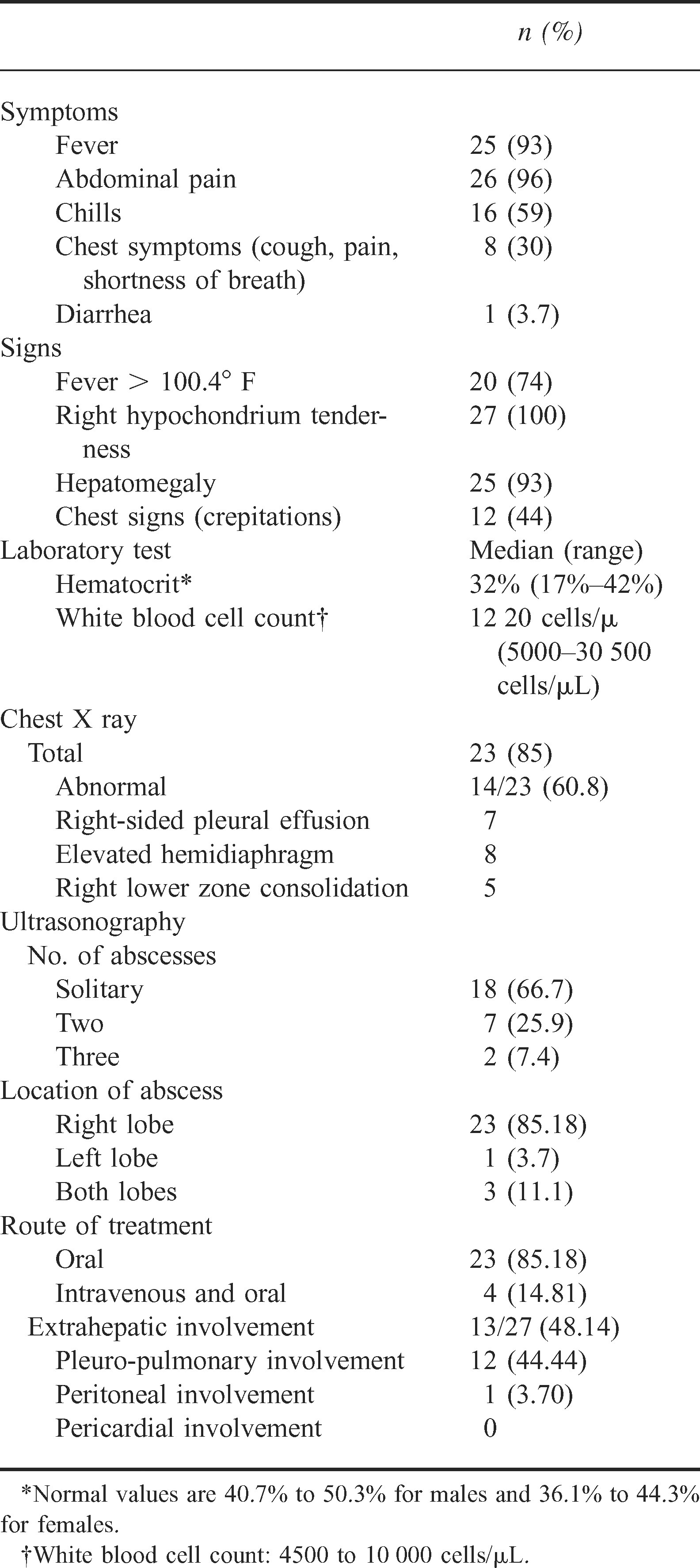
In conclusion, I found that the epidemiology of ALA at my institution is not different from that found elsewhere in the world. It is interesting to note that ALA is not always solitary. About one third of the patients with ALA had multiple abscesses in my series.
Footnotes
Acknowledgments
The author kindly acknowledges Drs Buddha Basnyat and Arjun Karki for their encouragement and moral support and the staffs of Patan Hospital, record sections, for their cooperation while retrieving records.