





Abstract
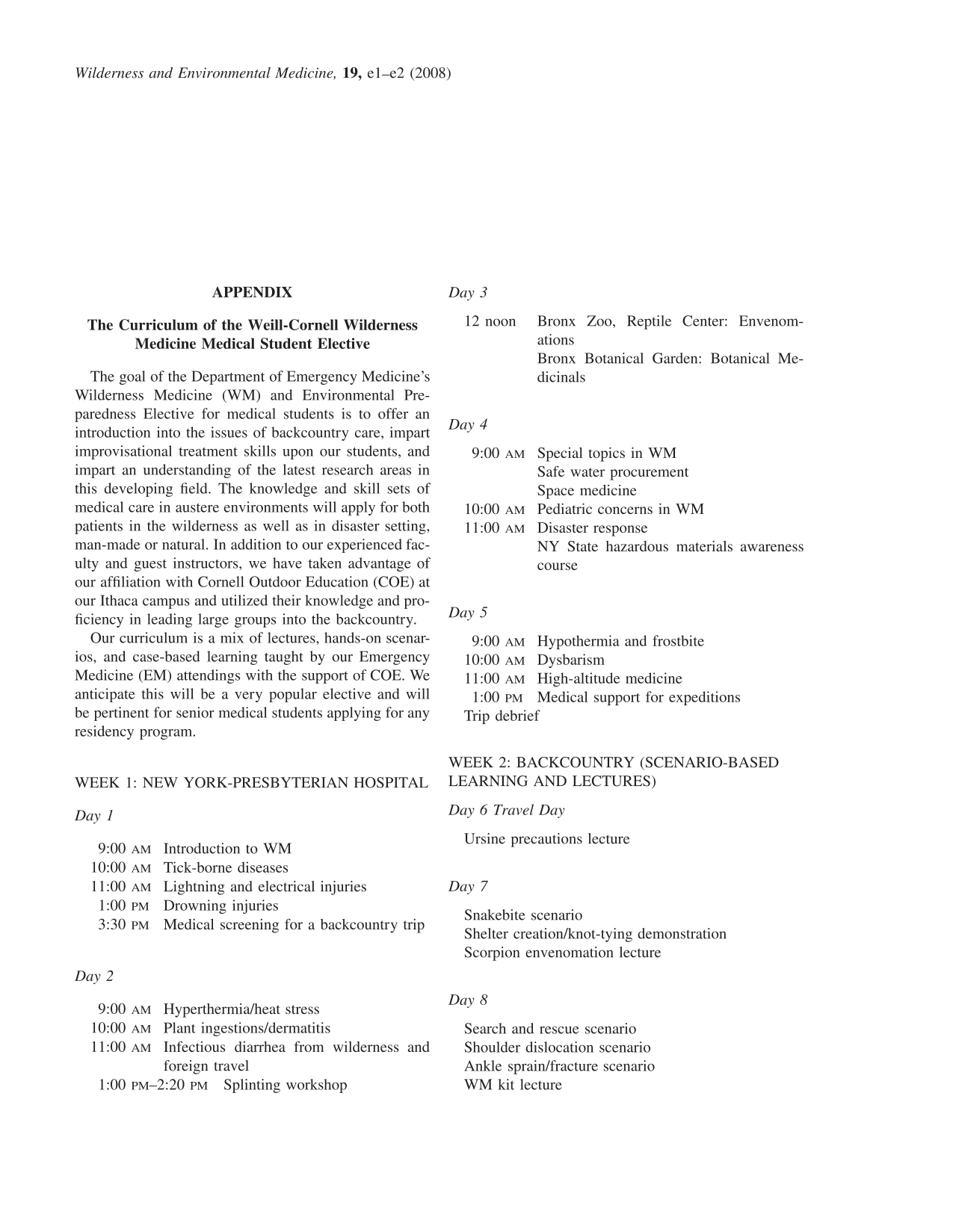
The goal of the Department of Emergency Medicine's Wilderness Medicine (WM) and Environmental Preparedness Elective for medical students is to offer an introduction into the issues of backcountry care, impart improvisational treatment skills upon our students, and impart an understanding of the latest research areas in this developing field. The knowledge and skill sets of medical care in austere environments will apply for both patients in the wilderness as well as in disaster setting, man-made or natural. In addition to our experienced faculty and guest instructors, we have taken advantage of our affiliation with Cornell Outdoor Education (COE) at our Ithaca campus and utilized their knowledge and proficiency in leading large groups into the backcountry.
Our curriculum is a mix of lectures, hands-on scenarios, and case-based learning taught by our Emergency Medicine (EM) attendings with the support of COE. We anticipate this will be a very popular elective and will be pertinent for senior medical students applying for any residency program.
Week 1: New York-Presbyterian Hospital
Day 1
9:00 10:00 11:00 1:00 3:30
Day 2
9:00 10:00 11:00 1:00
Day 3
12 noon Bronx Zoo, Reptile Center: Envenomations Bronx Botanical Garden: Botanical Medicinals
Day 4
9:00 Safe water procurement Space medicine 10:00 11:00 NY State hazardous materials awareness course
Day 5
9:00 10:00 11:00 1:00 Trip debrief
Week 2: Backcountry (Scenario-Based Learning and Lectures)
Day 6 Travel Day
Ursine precautions lecture
Day 7
Snakebite scenario Shelter creation/knot-tying demonstration Scorpion envenomation lecture
Day 8
Search and rescue scenario Shoulder dislocation scenario Ankle sprain/fracture scenario WM kit lecture
Day 9
Anaphylaxis/allergy in backcountry lecture Hyperthermia/heat stress scenario Burns in the wilderness: risk factors and treatment lecture
Day 10
Femur fracture scenario Cervical spine immobilization lecture Litter creation competition Ophthalmologic injuries in the backcountry lecture
Day 11
High-altitude pathophysiology scenario (summit Mt. Humphrey's 12 600 feet)
Day 12
Lightning strike/multitrauma Ruptured tympanic membrane, hyphema, panic Asystolic resuscitation Tension pneumothorax, closed head injury Issues of medical futility Final exam
Day 13
Group travels home
Northeast Wilderness Medicine Conference, Cornell University, ITHACA, NY
September 26–28, 2007: 16.5 CME hours October 22–24, 2008
Wednesday, September 26, 2007
Welcome by Dr. Skorton, President of Cornell University Lecture 1: Paul Auerbach, WM 2007 Lecture 2: Christopher Ralphs, Animal Injuries in the Backcountry Lecture 3: Paul Auerbach, Submersion Injuries and Special Topics in WM Lecture 4: Ron Crystal, Medical Complications of High Altitude Field Sessions
Thursday, September 27, 2007
Lecture 5: Paul Auerbach, Marine Envenomations Lecture 6: Harry Greene, The Natural History of Snakes and Snakebite Accidents Lecture 7: Eric Johnson, ABCs of Dive Medicine Lecture 8: Eric Johnson, Hypothermia Field Sessions Evening Social and Adventure Film Viewing
Friday, September 28th
Lecture 9: Jay Lemery, Incorporating WM into your Medical Practice Lecture 10: Michael Stern, Geriatric Concerns in WM Lecture 11: Michael Callahan, Pandemic Influenza: Mitigation for Expats Lecture 12: Michael Callahan, Disaster Management for Small Groups Field Sessions
Field Sessions
Rock climbing: safety and survival Swift water rescue Backcountry preparation Gorgeous gorges: common calamities on the trail High-angle rope self-rescue Tyrolean traverse over fall creek Tree climbing eco-excursions: injuries and pitfalls Low-angle technical rescue demonstration (New York-Presbyterian Special Operations Division) Rope work: safety and survival Sea kayaking: safety, rescue, and medical concerns Wilderness survival: no gear, no help, no problem Wind surfing: safety, rescue, and medical concerns Incident command and management seminar (New York-Presbyterian Special Operations Division)