






Abstract

Introduction
Much has been written about the environmental impact of tourists in the mountainous regions of Nepal, but there is scant information about the impact of tourism on the indigenous population. The Solukhumbu district is one of 75 districts of Nepal and has a population of 122 965. 1 It is an area of huge economic importance to Nepal because it contains Sagarmatha National Park, a World Heritage Site. Within this area are Mt. Everest and other climbing and trekking peaks, bringing approximately 60 000 tourists a year into the area (Nepal Tourism Board, oral communication, August 15, 2007). These tourists provide employment for thousands of trekking porters who carry their provisions, luggage, and equipment up the valleys and mountains and also carry their rubbish back down. Commercial porters also work in the region carrying supplies for local people, as there are no roads in these valleys and the paths are often too steep for beasts of burden (particularly in the lower valleys). There are no reliable figures available for the number of individuals working as porters in the region.
Many people associate this area with the Sherpas, a high-altitude ethnic group who migrated to Nepal approximately 500 years ago from neighboring Tibet. The Solukhumbu district is mountainous and, as a result, people live and work at hugely varying altitudes from 1500 to 8848 m. While it contains the largest group of Sherpas outside Tibet, not all of these people are Sherpa. Many others who live here come from other ethnic groups such as Rai, Tamang, Magar, and Gurung.
This article concentrates not on Sherpas but rather the low-altitude porters who ascend through the valleys each season to do the work of portering, for both trekking and commercial purposes, on the routes up to and around Everest Base Camp. For the purposes of this essay, high altitude is defined as elevations above Lukla (2840 m). Many people fly into Lukla in order to begin their treks into the Khumbu region, home to Sagarmatha National Park and, of course, Mt. Everest itself. All of the porters interviewed and/or referred to below make their permanent homes at altitudes less than 2840 m.
Figure 1 indicates the different elevations along the route from Jiri, which is the road head for those en route to Everest Base Camp sans aircraft support. Above Jiri all provisions, building materials, medications, etc, must be transported by either air or carried by porters or yaks. Everything between Jiri and Lukla is carried up by porters, as it is too steep for donkeys and too low for yaks (which don’t thrive below 3200 m).
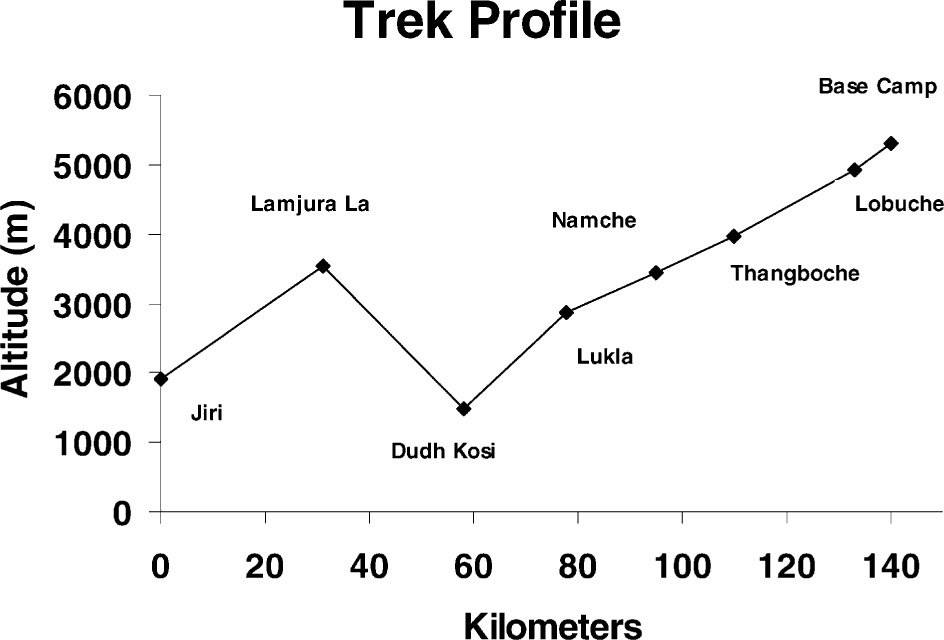
Altitude change and distance covered between Jiri and Everest Base Camp.
Helicopters and small “Twin Otter”–type fixed wing aircraft fly into Lukla, providing an alternative means of transport for goods up the valleys. Weather permitting, 8 or 9 return trips can occur within a day. These planes also carry trekkers and climbers into the region. This means that few trekkers or climbers walk in to the Khumbu from Jiri, providing porters and lodge owners below Lukla with little opportunity for contact with tourists. Thus, portering work being done on the route from Jiri to Everest Base Camp can be seen, in some respects, as 2 different entities—before Lukla and after Lukla. Prior to reaching Lukla, the porters encountered are almost exclusively performing commercial work not related to the trekking industry. Above Lukla, porters during the trekking season are predominantly involved with serving trekkers, although commercial porters delivering supplies to guest houses and taking their wares to market certainly can be seen along the route.
Although the method of carrying loads remains the same between trekking porters and commercial porters (Figure 2), there are 2 distinct systems for payment and weight of load. Trekking porters are paid much more and, in general, carry less weight than commercial porters. This has encouraged many lowland porters to head up into the mountains for work, which can cause problems, as they are often not as well adapted to altitude as, for example, the Sherpa population who already live at that altitude.
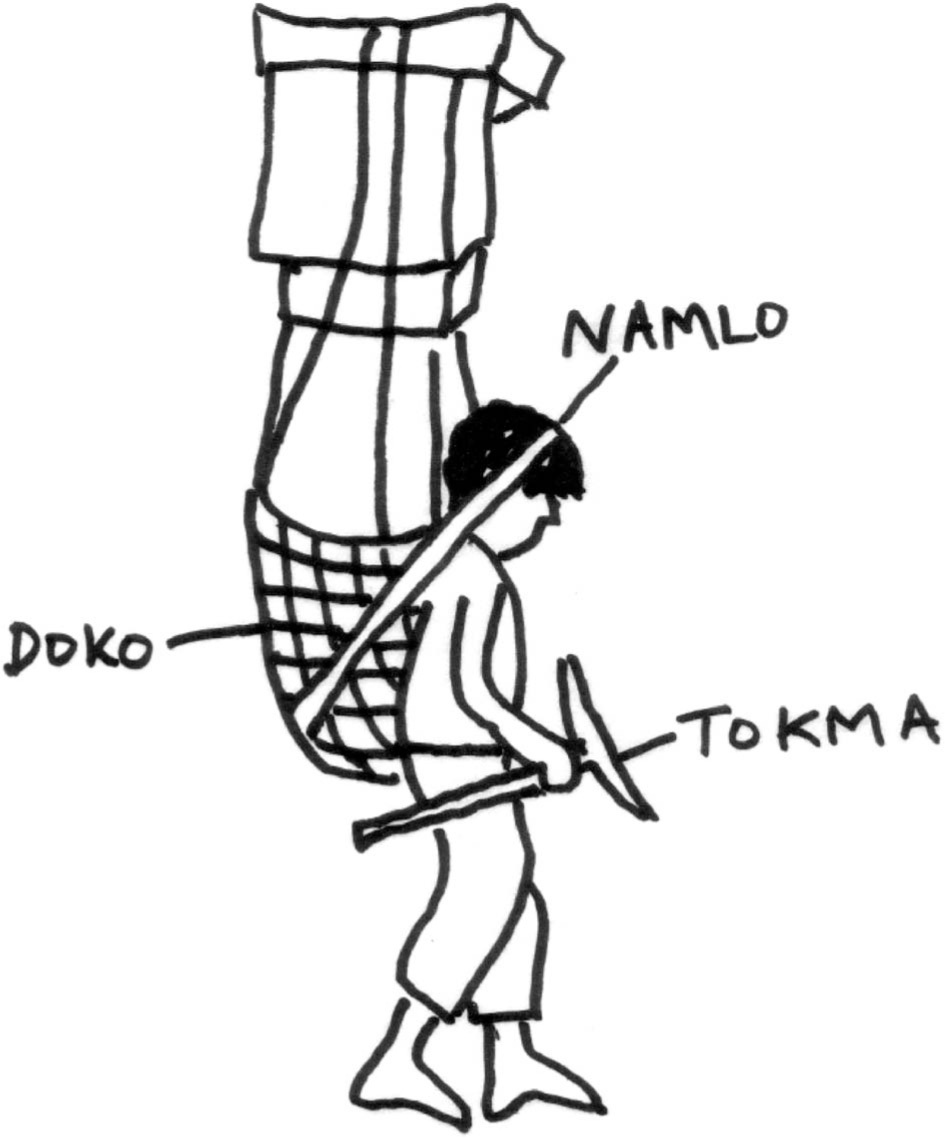
Nepalese porters use special equipment for load carrying: a tumpline (namlo) links the forehead to a basket (doko), which leans along the bent back and is periodically rested on a T-shaped stick (tokma), also used as an alpenstock.
Commercial porters
The lifestyle of the commercial porter does not appear to have changed much over the years. Nepal is one of the world's poorest countries with an average gross national income per capita of $270 US (less than the global gauge for poverty of a dollar a day). 2 Approximately 80% of the population live in rural areas (Tourism for Rural Poverty Alleviation, oral communication, August 1, 2007), and 76% rely on agriculture for a living. 3 In order to supplement their hand-to-mouth existence as subsistence farmers, many people—mainly men—turn to portering. They carry their produce and goods up the valley to sell.
There are no regulations as to how much a commercial porter should carry, nor are there any age restrictions on portering. As a result, very young boys as well as elderly men can be found engaged in this occupation. While Minetti and colleagues state that “porters start carrying about 35 kg at the age of about 12 years old and stop at the age of about 40–45 years old, working for 6–8 hours a day for many months of the year,” 4 we came across several porters who were older than 45 years during a recent trek from Jiri to Everest Base Camp.
Since there are no weight restrictions for porters, and as they get paid per kg (average payment per kg for commercial porters is currently ∼20 rupees [roughly 15 UK pence or $0.30 US]), they often tend to carry unbelievable loads from a Westerner's perspective. Most porters we met were carrying at least their body weight, and it was not unusual to meet porters carrying loads in excess of their body weight.
A 2001 study by Basnyat and Schepens 5 found that of 113 randomly selected porters, their average load was 89% of their body weight. The authors also reported that 88% of men and 71% of women were carrying more than 50% of their body weight, while 20% of men carried more than 125% of their body weight. Our recent anecdotal experience suggests that commercial porters carrying at least their body weight is not an uncommon occurrence.
We took a photo of a group of porters (Figure 3) just outside of Jiri. Their respective ages and weights carried were 15 years old, carrying 50 kg; 20 years old, carrying 75 kg; 14 years old, carrying 50 kg, and 15 years old, carrying 50 kg. They were walking together carrying supplies home to their village, a 3-day walk. When asked whether they found portering difficult, the eldest said that it “takes a while to get used to the load.” He said that initially it really hurts and is almost impossible to carry, but you become used to it after a week or so.
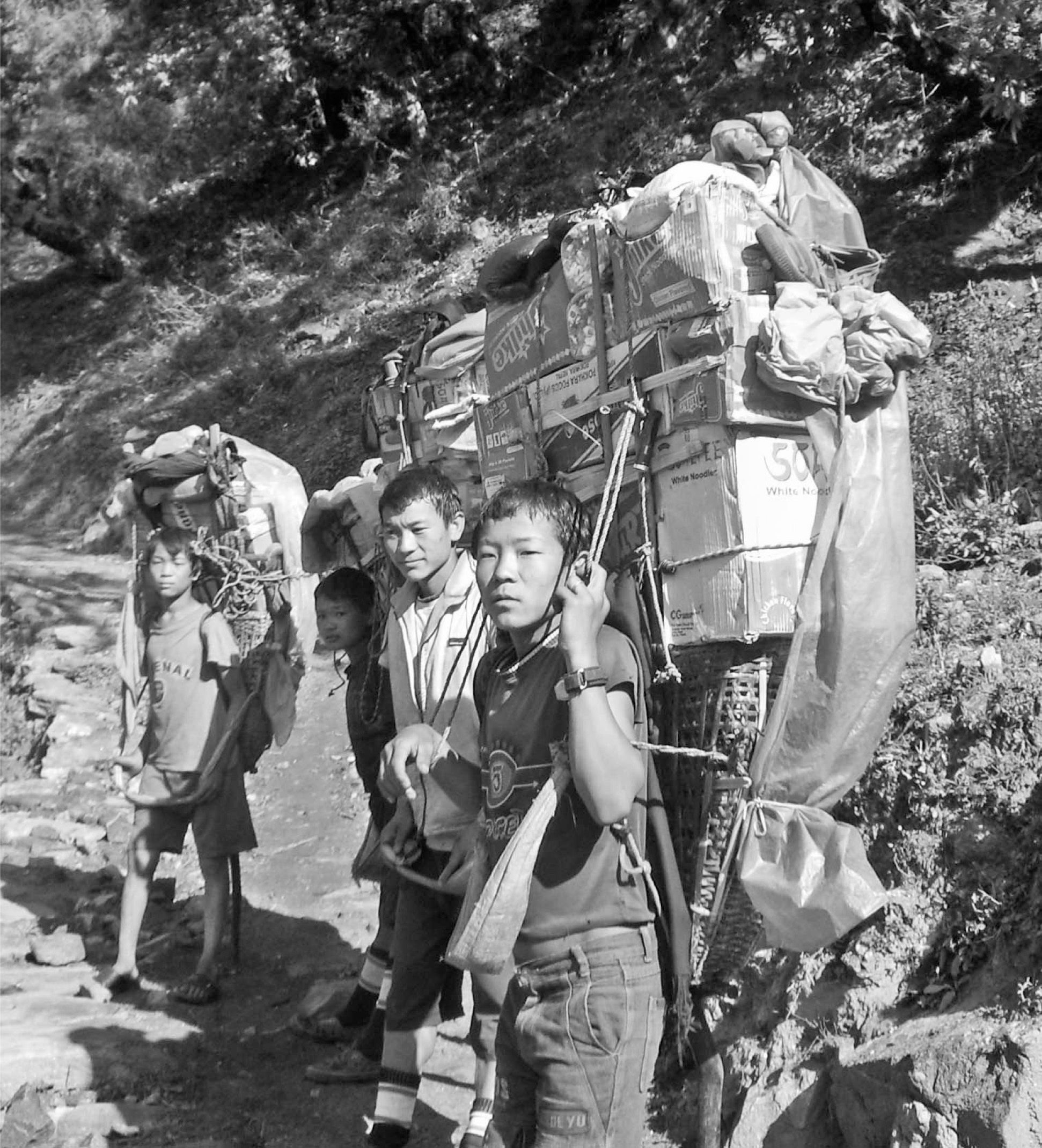
A group of young porters on the trail just outside of Jiri.
Shortly thereafter, we encountered a 24-year-old man who weighed 52 kg carrying a 90-kg load from Jiri to Kakou, a 6-day walk. For this journey, he would be making 1800 rupees or approximately $27.00 US total. When most people are earning less than a dollar a day, this is considered a substantial sum—though arguably not without a price on the load bearer's health. The next day, a man was encountered who was 60 years old (the average life expectancy for men in Nepal is 61 years old 6 ). He was carrying 50 kg from Bhandar to Sete, a 2-day walk, with a load that was roughly his own body weight. This would have been a lucrative load as it would have made him approximately 500 rupees or $7.50 US per day. Perhaps the most shocking load we saw was that carried by a 22-year-old man. He weighed just under 50 kg and was carrying nearly 150 kg. The weight was so heavy that he had an obvious impression in his head where the namlo, or strap, cut across it. He said that he had been to school between the ages of 6 and 11 and had then had to quit school in order to porter. The load was so heavy that he could barely walk 10 m before he had to stop and rest.
After speaking to many similar porters, it is difficult not to conclude that it is a myth that these individuals find it anything like easy work. On the contrary, they seem to find it very strenuous work. One porter related that he would rather do other work, but there was none available nor had he been adequately educated to look for alternative work. Without exception, none of the porters with whom we spoke wanted their children to do this work. They all wanted to use the money they made to pay for their children's education so that they could pursue other paths in life.
While all children between 6 and 10 years have a right to free education in Nepal, in practice, schools charge for books and extra activities, etc, to raise revenue. In reality, this means that many families cannot afford to educate their children. A school visited in Namche Bazaar, which was a community- and government-run institution, charged 1000 rupees per student per month. In personal communication with United Nations Children's Fund (UNICEF) about this, they related that “Nepal is one of the few countries in the world that doesn’t have compulsory education by law” (UNICEF, written communication, September 27, 2007). UNICEF also indicated that according to government figures, 87% of children go to primary school, but approximately 25% do not complete primary school, and many have to repeat classes. In addition, there are big variations between districts. Fifty percent fewer girls go to secondary school than boys, and fewer children from socially excluded groups (eg, lower castes and ethnic minorities) receive formal education. The reality is that if you wish to obtain a decent education for your child in Nepal, you need to be able to pay for it.
Trekking porters
The trekking and climbing industries in Nepal have grown continually since the first mountaineering expeditions in the mid-20th century. They have brought a great deal of wealth and work into the Solukhumbu district, making it one of the most prosperous districts in Nepal. Unsurprisingly, lowland Nepalis often come to this region seeking some of the wealth. For those who do not own or work in a guest house, the next easiest way to tap into the revenue from tourism is to porter.
As an example of the distinct hierarchy that exists amongst porters on an expedition, the new workers will typically start off being a porter carrying loads—be it tourists’ luggage, tents, or kitchen equipment. They may then move on to becoming a kitchen hand, washing up pots and doing some cooking. Subsequently, one will often become a “kitchen boy,” cooking for clients. After this, you are eligible to become a guide. At this level, you are no longer carrying heavy loads. Further up the ladder is the chief cook, and at the top of the hierarchy is the sirdar, who is typically in charge of all of the porters and Sherpas on the expedition.
Two men accompanied our progress the entire journey from Jiri to Everest Base Camp. One, Kumar Rai, acted as guide, and the other, Luckman Rai, as porter. Both belong to the Rai ethnic group and came from villages down in the valley. Kumar was 33 years old and had 2 sons and 1 daughter. He lived in a village about 30 km southwest of Lukla. Luckman was 30 years old, had 1 son and 2 daughters, and lived in a village about 25 km south of Lukla. Both, therefore, came from an altitude of about 2500 m. Kumar had worked his way up to being guide, getting his start the typical way, through portering. This had taken him 11 years. Luckman was hoping to rise up, though he did not speak any English, which is a huge disadvantage. Kumar had taught himself English.
They related that it normally takes 10 years to rise up through the ranks and that family connections could speed up the process. Having said that, to a large extent, rising through the ranks seems to be based on merit. If you are a capable porter, you are likely to be given a chance to obtain a “cook boy” position. Kumar had employed Luckman to porter because he had seen him working in the past and thought he was strong and reliable.
In Lukla, we spoke to Neema Sherpa, who was in charge of the local office of Porter's Progress. Porter's Progress is a non-governmental organization that began in 2000; it focuses on porters’ welfare. Neema told us that there are no laws governing the treatment of trekking porters. However, there are guidelines that have been agreed upon between trekking companies and porters to try to both restrict the weight of their load and standardize their pay.
In effect, this means that trekking porters are considerably better off than commercial porters. The suggested weight restriction is 30 kg per porter, not including their own luggage (which they also carry). Thus, they usually carry 35 to 40 kg. The suggested payment is between 500 and 600 rupees a day, though the Maoists have recently tried to secure 600 rupees a day for all porters. With this pay, the porters have to find their own accommodation and food. Several people related that these plans were rushed through and badly instituted with no government backing. This had been problematic because many tour operators hadn’t had time to adjust their charges to pay for a wage hike.
Most reputable travel companies make sure the porters are properly equipped. This used to be a huge problem, as up until as recently as 2000, porters were going up to altitudes without proper clothing, gloves, or boots. Some were walking through snow in flip flops, and frostbite was a recurring problem. Huge improvements have been made in this area. The trekking company that we utilized, Summit Trekking, had a large storeroom in Lukla full of tents, boots, jackets, trainers, hats, etc, with which to equip their porters.
Neema alleged that the rate of pay for porters had risen enormously in the last 20 years. About 20 years ago, porters may have received 7 rupees a day. Five years ago, they would have obtained 300 or 400 rupees a day, and presently 500 or 600 rupees a day is the accepted rate. This is more than 10 times the national average daily income. Neema was very clear in suggesting that tourism is a good thing for the region because of the money that is brought in. However, he said that the major concerns for porters are due to the fact that weight restrictions and set wages are not properly regulated. For example, we saw no sign of anyone weighing the loads that porters were carrying. They usually carried 2 tourists’ bags on their backs and their own as well. This meant that they were relying on tourists to have 15 kg or less in their bags. Nevertheless, many bags appeared to be overweight. Tourists, in general, didn’t realize that the reason a weight restriction was placed on their baggage was so that the porters weren’t overloaded. Some had thought that the weight restriction was in place merely to avoid paying excess baggage, which they could afford to pay, so they had, in turn, overloaded their bags.
Neema also worried that many porters are still ill-equipped for altitude and cold. Porters often walk ahead of, or behind, trekkers. They also find their own accommodation at night in porter huts or caves (though cave dwelling is decreasing as more porter shelters are built by the likes of Porter's Progress). It is easy for tourists to not notice that porters are cold or uncomfortable if they are out of sight.
Neema's final worry was about the porters’ lack of education and the barriers this posed to finding alternative employment and basic awareness of health dangers, such as acute mountain sickness (AMS). In an effort to combat some of these concerns, Porter's Progress ensures that porters are properly equipped by loaning them good equipment. It runs education programs that teach about AMS and mountain safety and also instructs them in English so that they have an opportunity to progress to become guides.
Mountain Sherpas get life insurance so, for example, if they die summiting Mt. Everest on an expedition, their families get compensated. There is no health insurance available for porters—it is strictly at the discretion of the trekking company to see to it that their porters are kept in good health. Porters don’t get paid if they don’t work, so they are often reluctant to complain of illness. This can be very dangerous when altitude sickness is involved. As the Nepalese physician and altitude specialist, Buddha Basnyat, notes, “Invariably, porters usually present to the clinic when they are too sick to continue.” 7 A reputable trekking company will make a concerted effort to keep an eye on its porters and make sure they are sent down-mountain if they become sick and pay for treatment if they require it. For example, one of our guides, Kumar, became ill with AMS and was treated both on the mountain and in Kathmandu, with Summit Trekking taking responsibility for all costs.
Health issues
Like Western tourists, porters often come from lower valleys and don’t always adapt well to the hypoxic environment at altitude. We met one porter in the hospital at Lukla who was being treated for cerebral edema after having been brought down from Everest Base Camp. The paper regarding the treatment of an acutely dyspneic porter at 5000 m
8
recounts the problems of supplying aftercare for a porter who was unwell. The authors concluded that the porter was most likely suffering from a lung lesion or underlying tuberculosis (vs, eg, altitude illness), which is endemic in the region. He was taken to lower altitude and given a course of antibiotics. At Lukla, the authors lost contact with him. That we had a duty of care to our porters in the acute event was unarguable. But where does the duty of care end? The loss of contact with the porter upon arrival in Lukla was a cause of concern. His compliance with oral therapy became poor once his clinical condition improved, and we were dependent upon translators to emphasise the need to continue the course of antibiotics. His non-compliance represents one of the cultural difficulties encountered, and as he was not portering he had no source of income, so his main priority was to return to work.
8
Understandably, the porter in question wanted to resume work as he needed the income. However, immediate return to work may not have been in the best interest of his health. Additionally, it is likely that he didn’t understand the importance of completing the course of antibiotics. 8
Another paper relevant to this discussion compares the medical problems of porters and trekkers.
9
This study examined the health issues during a 22-day trek at altitudes between 487 and 5100 m among a group of 155 members: 102 Nepalese porters, 31 Nepalese trek staff, and 22 Western trekkers. The porter staff and trekkers had roughly the same rate of illness. It was much lower for the trek staff that were unloaded, the majority of whom were Sherpas. The authors found that the porters experienced the highest diversity and severity of illness, developing a total of 12 different medical problems. Illnesses included fever-suspected typhoid, high-altitude cough, AMS, gastroenteritis, severe anxiety, high-altitude cerebral edema (HACE), and cellulitis-induced septicemia. The authors recommend that: It should be emphasised to trek organisers and physicians that the Nepali staff do not all reside in high altitude areas, particularly the porters, and are likely to be as susceptible to altitude illness as the Western trekkers.
9
A further study showed that
The local non-Sherpa porters (who many trekkers think are immune to altitude sickness) are also at risk from acute mountain sickness (37%) and its life threatening complication, HACE (2%).
10
This study included 199 non-Sherpa Nepalese porters at 4300 m and 62 similar porters at 1500 m. The outcome suggested that lowland porters and trekkers generally had the same reaction to altitude. Thus, it should not be assumed that porters are more adapted to altitude just because they are Nepali.
Another interesting, but poorly investigated, porter health concern is whether the manner in which porters carry their loads allows them to carry heavier loads more efficiently and, therefore, in a way that causes them fewer musculoskeletal problems than one would expect in a group carrying more than their body weight on their backs. A study was performed in 2006
4
in which physiologists compared 5 porters and 5 western mountaineers carrying the same loads 90 km up the Khumbu Valley over 3 weeks. They wanted to discover why porters’ metabolic economy is apparently higher compared to Caucasians. The study revealed that porters take more regular rests and during this time have a very quick recovery to normal heart rate. Porters also walked faster “thus developing a higher vertical mechanical power.”
4
The authors believed that the reasons for the higher metabolic power of porters can be found in training, anatomy, and adaptation. For example, They have less body fat and larger chest width,
11
leading to higher spirometric values.
12
In addition, their maximum heart rate and oxygen consumption are maintained,
13
and convective and diffusive muscle oxygen flow is facilitated
14
in chronic hypoxia. While most of the quoted literature investigated Sherpas, other ethnic groups permanently resident at high altitude in the Himalaya seem to share the same adaptations, possibly through genetics.
15
Nonetheless, it cannot be assumed that lowland porters share the same physiological advantages. Interestingly, the authors of another study assert that “the association between spine stability and average bending angle of the trunk, which is higher in Nepalese porters, has been reported in load carrying experiments.”
16
And Minetti and coworkers
4
conclude that The remarkable performance of Nepalese porters is determined by a more powerful “engine” in a smaller body and by a lower cost of loaded walking. The long-lasting and specific training in hypoxia led to a surprisingly specialised adaptation of this ethnic group to the challenging environment. Owing to the experimental design, we can conclude that porters’ better economy of loaded walking on gradients is related to a better exchange between potential and kinetic energy of the body centre of mass.
This explanation seems to imply that the way in which porters carry their loads makes the process more “economical.” This might explain the lack of observed back, neck, and certain other orthopedic problems amongst porters. However, Neema Sherpa at Porter's Progress cautioned that it is not uncommon for porters to suffer back and neck problems. What was plainly evident to the casual observer, though, was a surfeit of porter knee complaints.
Buddha Basnyat explained that very little research had been done on porters. In a personal interview, he indicated that “this is not a documenting society,” which made clear why there are so few reliable data about porters and why evidence of how their lives have changed is, for the large part, anecdotal. He said that there is no evidence that portering actually damages porters’ bodies (oral communication, April 30, 2007); in fact, he mentioned a study of 102 porters that was prominent for the very absence of musculoskeletal problems. 9 He believed that the suggested limit of 30 kg per porter is reasonable and that they could carry such loads over time without suffering physical problems related to this activity. He did not deny that porters face health problems—for example, he has seen numerous porters with frostbite.
Kit Spencer, Managing Director of the Summit Hotel and Summit Trekking in Kathmandu also provided an interview (oral communication, May 1, 2007). He has been working in the trekking industry for 13 years. He indicated a preference for using Zaos (half cow, half yak) over porters, when they are available. Summit Trekking does employ porters, however, as there are not enough Zaos to cope with the loads up to Mt. Everest. Mr Spencer felt that porters’ lives have improved a great deal since the 1990s, which is when weight restrictions and pay guidance were introduced. Porters are better paid and they carry less now than when he first started in the business, though he preferred limiting the weight of their loads to 25 kg. He also noted that the recent influx of cheap Chinese goods, such as trainers and jackets, into the area has made warm clothing much more readily available and affordable to porters. Mr Spencer thought that portering might well change (in Nepal) in the future, as fewer people want to do this work. As may be seen in many developing countries, the rural population of Nepal is flocking increasingly to urban areas to look for employment. In Mr Spencer's experience, porters did in fact encounter health difficulties, most notably arthritis after the age of about 30 years.
As was the case with commercial porters that were interviewed, discussions with trekking porters left one with a distinct impression: they wanted to pay for their children to be educated so that they did not have to porter. They wanted their children to be doctors, engineers, architects, teachers; anything but porters. Rama Bahadur Baset, a 31-year-old porter and subsistence farmer with 4 children from a village called Pave, has been portering since he was 15 years old. His sole aim is to educate his children so that they do not need to porter to make a living. Another porter encountered at Lobouche Porter's Hut, Raskumar Maling (age 21 years), related that neither he nor the 22-year-old porter with him liked their job; they would prefer to be merchants. He indicated that young people do not want to be porters any more, and certainly not commercial porters, by any means. He sees portering for trekkers as a good way to eventually becoming a cook or a sirdar, but not as an end in itself.
Conclusions
The Solukhumbu district is an area where there are few roads, and none exist on the route up to Mt. Everest. Unless roads are built here, porters will undoubtedly carry goods up these valleys for many years to come. The building of roads would, inevitably, be detrimental to tourism—obviously one of the reasons that people come here is to see outstanding natural beauty untarnished by tarmac.
Portering is the life-blood of the area, and there are few other means of transportation of goods. It is an important source of income for local people. In the late 1980s, porters protested successfully to stop helicopters flying goods into Sangboche (higher than Lukla), because it was taking work out of their hands. There is no doubt that local people value portering as lucrative work. It provides extra income to families who would otherwise be living well below the poverty line. Portering also crosses the lines of the old caste system, which appears to be changing to some extent in Nepal, as it is considered a perfectly respectable occupation. While porters may not want their children to do this job, they still want the job to be available to both themselves and others and are keen to stress the importance of trekkers and climbers employing porters.
There are a few simple things the “trekking industry” in Nepal could do to improve the lot of the trekking porter. Why not weigh the bags they carry as a matter of course? Some companies are already meticulous about weighing equipment going into the mountains on both porters and yaks. A greater number of trekking companies could be strict about this and tell their clients exactly why they have a weight limit on their bags. Many trekkers seem to think the weight limit has to do with excess baggage on planes, so they do not mind bringing more and paying for it. It is conceivable that fewer trekkers would overfill their bags if they knew that it was an extra load for the porters. As for commercial porters, the worry is that they may be damaging themselves by carrying huge weights. However, very little research has been performed to provide evidence for this concern.
One could argue that the most obvious means of improving the lives of porters (and Nepalis in general) would be to provide access to free education in order to enhance employment options. UNICEF explained We of course hope that the Millennium Development Goals
17
will be met by 2015. A new School Sector Reform is in development in Nepal—primary schooling will expand to Grades 1 to 8 (currently 1–5) and the current draft plans for this to be free. Currently the plan does not include any of these grades to be compulsory (UNICEF, oral communication, September 27, 2007).
Dr Nick Mason, who works with the International Porter Protection Group
18
, neatly summarizes how Western tourists can help meet the challenge of improving porters’ lives: Anybody who travels to the mountains and uses local porters should take the time to befriend them; should be aware of their needs and complain vociferously when these proud but vulnerable people's needs are not being met.
Footnotes
Acknowledgments
A.L. would like to thank the Onassis Trust for giving the bursary (scholarship) that allowed for her experience in Nepal. Thanks also to the excellent guide, and now friend, Kumar Rai, and the hard-working and ever-cheerful porter, Luckman Rai; Dr Mike Grocott, the leader of Caudwell Xtreme Everest Medical Research Expedition, who gave A.L. a place on an expedition that was exploring human physiology at extreme altitude; Simon Lowe, Operations Director at Jagged Globe, for helping A.L. organize the trip from Britain; Kit Spencer and his office manager, Andrew, who helped A.L. organize it in Kathmandu; Ben Ayres, founder of Porter's Progress, whose talk at the Royal Geographical Society inspired this project and who has answered some of A.L.’s many questions; Dr Jim Duff, International Coordinator of the International Porter Protection Group, for his knowledge and advice; A.L.’s editor, Gavin Poncia, for supporting A.L.’s application and giving her the time off work to participate in this project.