






Those participating in winter sports are at risk for severe and possibly fatal injuries. As Hungary has no ski resorts of its own, its large population of skiers must travel outside the country to take part in such recreational activities. This fact has led to the concept of “ski camp doctor” training for Hungarian physicians who might accompany organized groups, especially children, on such excursions. Such physicians should be broadly trained and experienced in general medicine, emergency care, travel medicine and wilderness medicine. They should also have basic outdoor skills and be experienced skiers. We describe a course specifically designed to develop the knowledge base and skills necessary for a qualified Hungarian ski camp doctor.
Introduction
In the year 2005, a fatal skiing incident involving children and adults occurred and resulted in extensive discussion in both medical and ski professional groups, and in the Hungarian mass media. 1 –4 As a result of those discussions, medical support for “ski camps,” especially for school-aged children, is often required by group leaders or escorting teachers. Physicians supporting such groups, however, have been mainly recruited from skiers’ family members or acquaintances, and they have variable medical training. These physicians often do not practice in either family medicine or emergency medicine, but rather work in more specialized disciplines. They, therefore, may be less well-trained in first aid, and especially in travel or wilderness medicine, which are important topics in outdoor and extreme sports. 5 Injured participants on these excursions or in these camps should be treated on the spot by a well-prepared physician familiar with current and accepted practices applicable to the prehospital setting. 6 This article describes the experiences of 1 European country, and some of the recommendations for training standards of those who provide medical care for traveling ski groups from that nation. We hope that it may serve as a model for medical professionals from other countries who wish to provide this type of support to travel groups.
Background
Hungary is a small country, with about 10 million inhabitants and without a coastline or high mountains. Adventure travelers and extreme winter sports fans must travel abroad, even for skiing. However, the country has 80 000 licensed SCUBA divers, and more than 500 000 skiers.7,8
Skiing, whether cross-country or downhill, can be dangerous for anyone. For people with chronic diseases, whether cardiovascular, pulmonary, or metabolic, this activity may be classified as an extreme sport. Therefore, it is in the interest of skiers, parents, travel associations, and even travel insurance companies that both injury prevention skills and high-quality medical treatment be provided to participants. For groups that travel out of the country, this might best be provided by a trained doctor traveling with the group.
This concept coincides with the development of a medical discipline that is new to Hungary—travel medicine. For accompanying ski groups, practitioners of travel medicine have to be familiar with a myriad of treatment options for trauma and illness away from normal clinical settings, with particular emphasis and training in altitude illnesses and problems associated with cold environments. 9
Although practiced in the United States for some time, travel medicine, as a discipline, did not exist in Hungary until 2004 when Hungary joined the European Union (EU). Joining the EU, with the consequent increase in tourism, has provided an incentive for the study of travel medicine and wilderness medicine in Hungary. The Hungarian prehospital care system, especially the emergency medical system, 10 recognized the need for further training and study. The first national lecture on travel medicine was presented in 2004 at the Semmelweiss Medical University, Budapest. The Society of Travel Insurance and Medicine Physicians was founded in 2005 within the framework of the Association of Hungarian Life Insurance Physicians (MEBOT). The first Hungarian textbook of travel medicine was published in 2006. 11
Although people with chronic diseases are at greater risk for illness and injury, it is therapeutic for their lifestyle to travel and to participate in sports to the degree that their illness permits; these activities help them achieve a better quality of life. In Hungary, however, recent statistics indicate that up to 22% of the population has foregone travel or sports because of fear of exacerbating their illness. 12 Furthermore, a recent study in the United States demonstrates that although U.S. medical students believe they should be trained to care for people ill or injured outside of the office or hospital, up to 80% believe they are not adequately trained to provide adequate care in this setting. 13
Thus, it is in the interest of Hungary to educate family/general practitioners (and other doctors who may accompany groups traveling abroad) in the nuances of providing care for travelers. This training must be suited to Hungarian postgraduate education protocols. We chose to begin with the preparation of doctors who may travel with and tend to groups that travel abroad to ski. Since skiing may involve significant trauma, under adverse weather conditions, the lessons learned from this setting can be used for a variety of other circumstances.
Objectives
To train and educate a special group of doctors who are able to provide an appropriate level of care to skiers traveling abroad. These physicians, after appropriate training, are considered “ski camp doctors” (SCDs). To prepare a course to meet the needs of those who wish to accompany ski groups or organized ski teams. To maintain a register of those who have completed the training and who desire to accompany groups, and make that list available to organizations and trainers who are interested in having well-trained, effective physicians provide medical support.
Methods
Outlining the Main Responsibilities of an SCD
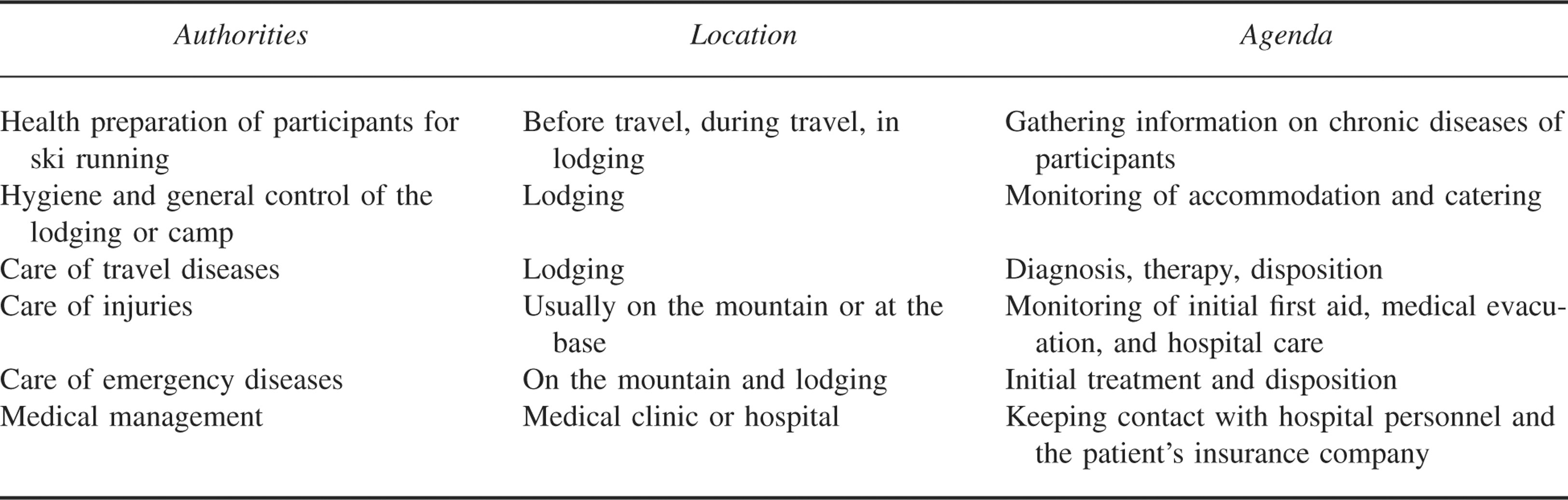
The tasks of the SCD include both prevention and treatment of injuries and illnesses in both children and adults who accompany them. In addition to the initial treatment of the sick and injured, the SCD should be prepared to assist, at least within the EU, in the administration and organization of the medical care around the sick persons. Generally, the agenda of the camp-doctor is grouped around the tasks in Table 1.
Responsibilities of the ski camp doctor
Collecting the Necessary Basic Knowledge for Ski-Camp Doctors
Ski camp doctors should know the basics of general medicine and pediatrics, as well as trauma management. 14 They should also be familiar with ski regulations (FIS 10), avalanche safety, weather reading, 15 proper clothing, and other subjects relevant to winter sports activity.
For immediate evacuation of the injured, the SCD must rely on the local, established system. The coordination of medical evacuation of patients back to their homes requires knowledge of the functions and policies of health insurance companies, as well as being able to provide medical care and support during repatriation. In some European countries, courses for physicians interested in mountaineering training and mountain medicine education programs already exist. Our primarily Hungarian bibliography, however, only makes reference to certain parts of these topics.16,17
The choice of topics for the lectures was based partly upon the International Commission for Alpine Rescue Recommendations of the Commission for Mountain Medicine and partly upon medical literature available within Hungary. 18
Our goal, however, was not to train experts in the field of mountain/alpine medicine, but to make physicians familiar with the basic concepts of alpine medicine, the methods and process of immediate rescue, dedicated topics of emergency medicine and trauma, and the legal and insurance consequences and processes associated with ski accidents or other health problems associated with travel.
Selecting Appropriate Lecturers and Trainers
We organized a postgraduate training course for SCDs using the format of a scientific conference involving well-known experts in the relevant disciplines. In addition to medical professionals, we included top ski instructors, lawyers, and insurance specialists as lecturers. In this way, we tried to assure that necessary information for all aspects of comprehensive care was provided. In addition, we compiled the core medical knowledge into an easily carried manual that was printed and distributed to participants at the course. 12
One of the aspects of the program that proved to be of special interest was that participating physicians (most of whom are dedicated sports enthusiasts) could receive training in ski techniques from skilled ski instructors. As a result, SCDs developed techniques that would allow them to move confidently on the mountain. That improved their ability to respond to an accident site quickly and render medical care on slopes of varying degrees of difficulty. We also emphasized that good physical conditioning was required for SCDs to be able to render care in all conditions and terrains. 19
The course
Due to the complexity of professional and supplemental lectures and training in theory and practice, and the development of skiing techniques in our medical colleagues, we relied heavily on scenario-based training in this course. 20 The training took place at an Austrian ski center with all-year snow. In addition to indoor didactic training, the physicians participated in scenario-based ski exercises during the morning. During this training, they had the opportunity to learn techniques of rescue on and away from establish ski slopes and to improve their physical conditioning, as is strongly recommended for such training. 21 The ratio of indoor/outdoor training and education was nearly 50%:50%.
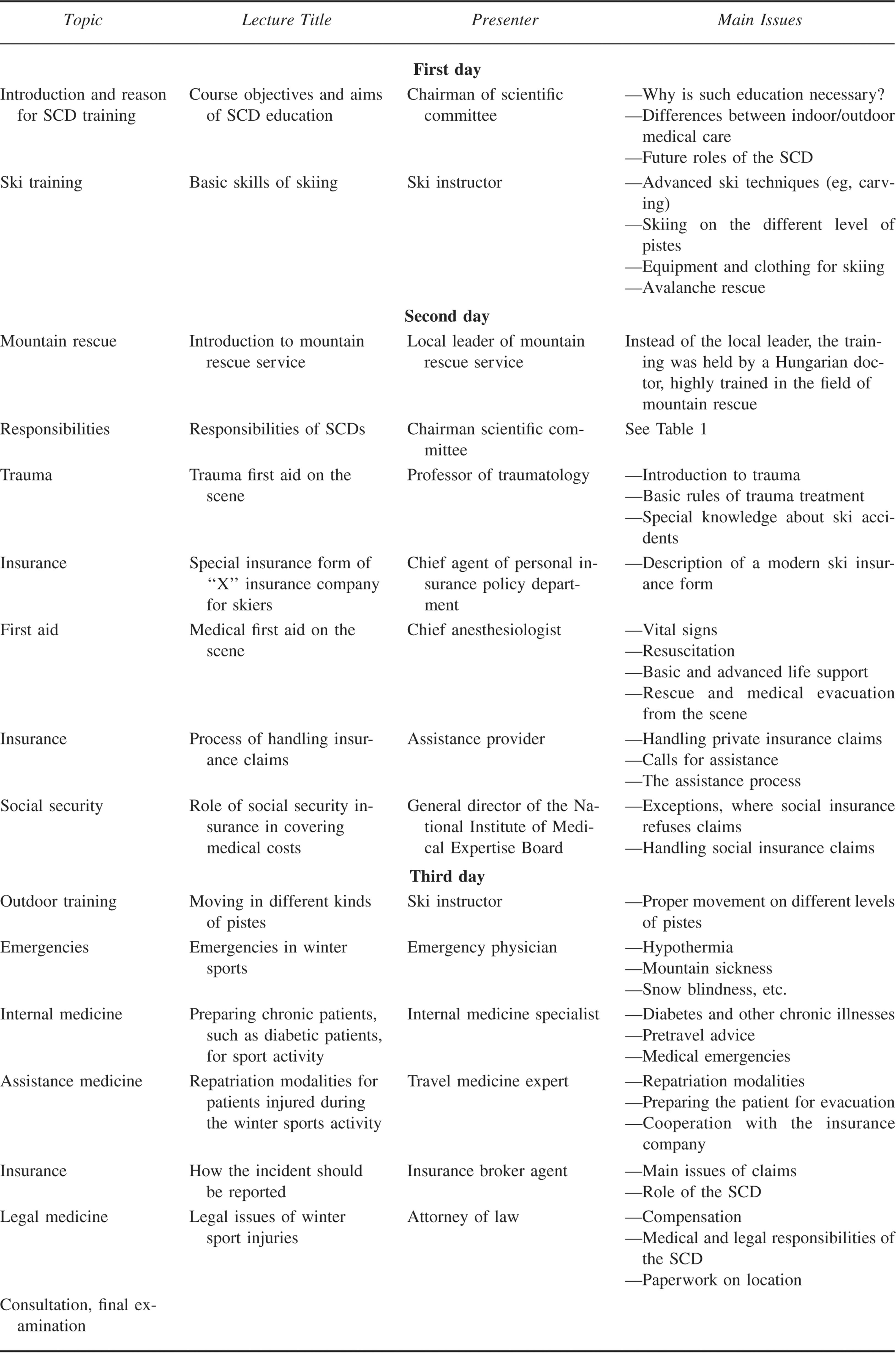
Forty-five physicians attended the initial postgraduate training. The majority of these physicians were trauma specialists and family doctors. The schedule of the course is presented in Table 2.
The curriculum of the ski camp doctor (SCD) course
According to the Hungarian Medical Act, the training was accepted as postgraduate training for physicians, with 10 credit points. In Hungary, 250 credit points (similar to Continuing Medical Education credits in the United States) are required for physicians every 5 years. Our SCD course's topics could be compared with the International Union of Associations for Mountaneering's (IUAA) “Common Courses of Mountain Medicine,” but there are considerable differences (Table 3).
Comparison of the International Union of Associa tions for Mountaineering (IUAA) and ski camp doctor (SCD) courses†
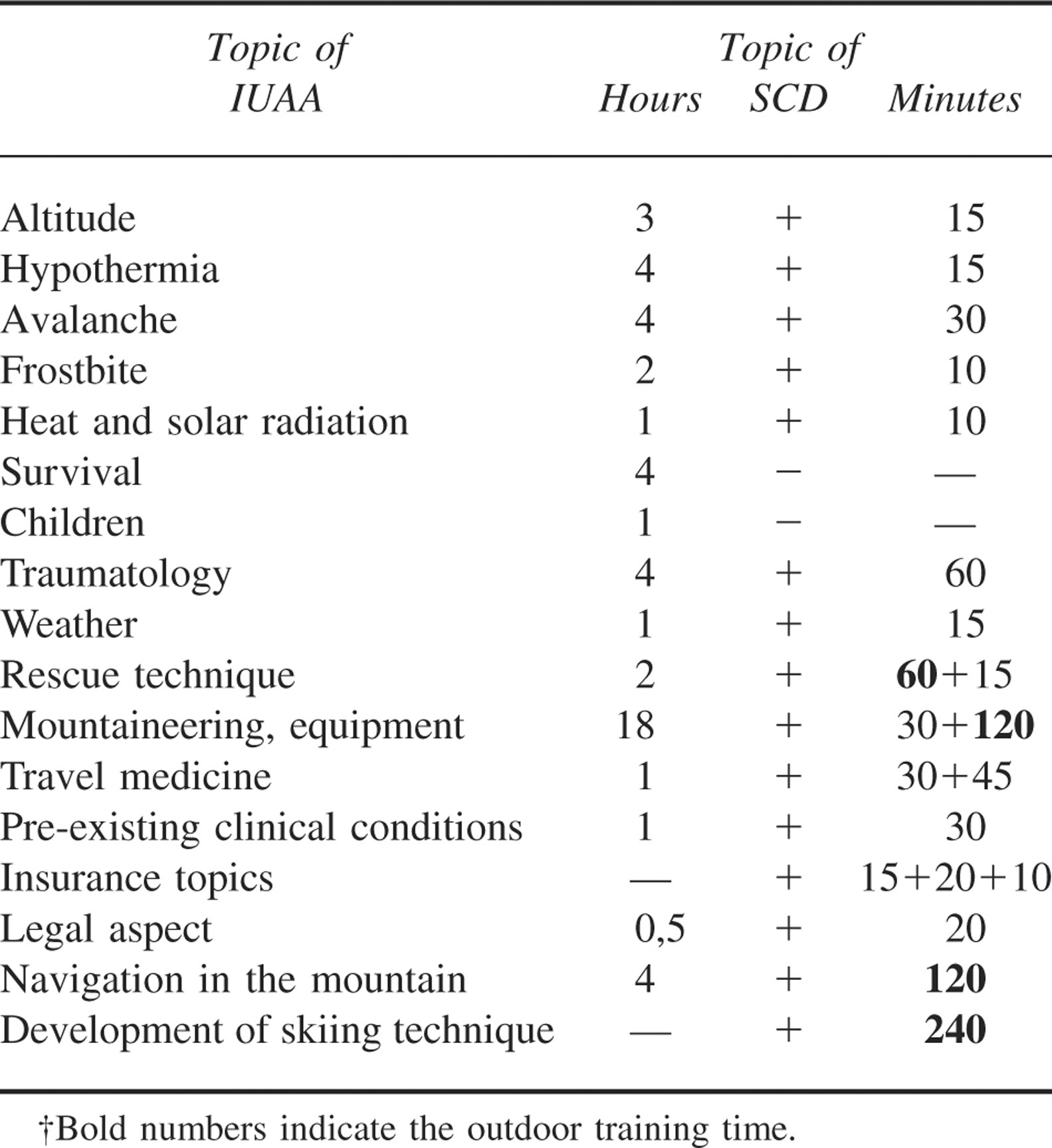
The data show that the SCD training focused on the technical and practical/outdoor training of the doctors (practical 540 minutes vs. theory 370 minutes). This was felt to be suitable for the pre-existing level of physicians’ medical knowledge. While the education program was intended for beginners, some important issues for this first conference were not mentioned—children's care, survival techniques, stress management, etc. As part of training for the prevention of illnesses and injuries, in future courses we plan to discuss alcohol and drug-related problems, especially among the younger members of a group. 7 These topics will be included in the next “advanced” training course's objectives.
The comparison found in Table 3 shows that the “camp-doctor” course is far different (and much shorter) than the traditional alpine medicine education programs currently being conducted.22,23 However, we intend to involve the IUAA and other experts and incorporate their methods into our courses in the future. We believe this is important for making our education program and the doctors’ training level meet international standards.
Conclusions
Ski camp doctors who accompany organized groups going to other countries for outdoor recreation must possess a broad medical knowledge base and an understanding of organizational practices and health insurance issues. The SCD should also become a technically competent skier capable of responding to emergencies in a wide variety of terrains.
Acquisition of these skills makes it possible for camp doctors to function in a number of roles: as medical specialists that prevent or treat injuries and illnesses, as camp organizers, and, possibly, as ski trainers.
Successful completion of training and certification may serve to “license” the SCD. The SCD license would make it possible for the camp doctor to promote, especially for school-aged children, activities supporting health education, health maintenance, and disease prevention within the exciting venue of skiing for organized groups. Although the “license” has not yet been officially registered, we hope ski group leaders will search for certified SCDs when they preplan their ski camps.
We believe that to prevent or mitigate ski injuries of school-aged children, such as the incident that precipitated the development of this program, parents should insist on the involvement and presence of trained and qualified SCDs on such excursions. We hope organizers of ski camps will seek out such trained professionals and that the Hungarian Medical Administration will promote children's safety by using this approach.
In the United States, the National Ski Patrol (