






Abstract
Imported human paragonimiasis has been reported in the United States. However, autochthonous cases are rare. We describe a case of probable Paragonimus kellicotti infection associated with ingestion of crayfish and review all autochthonous cases in this country.
Keywords
Introduction
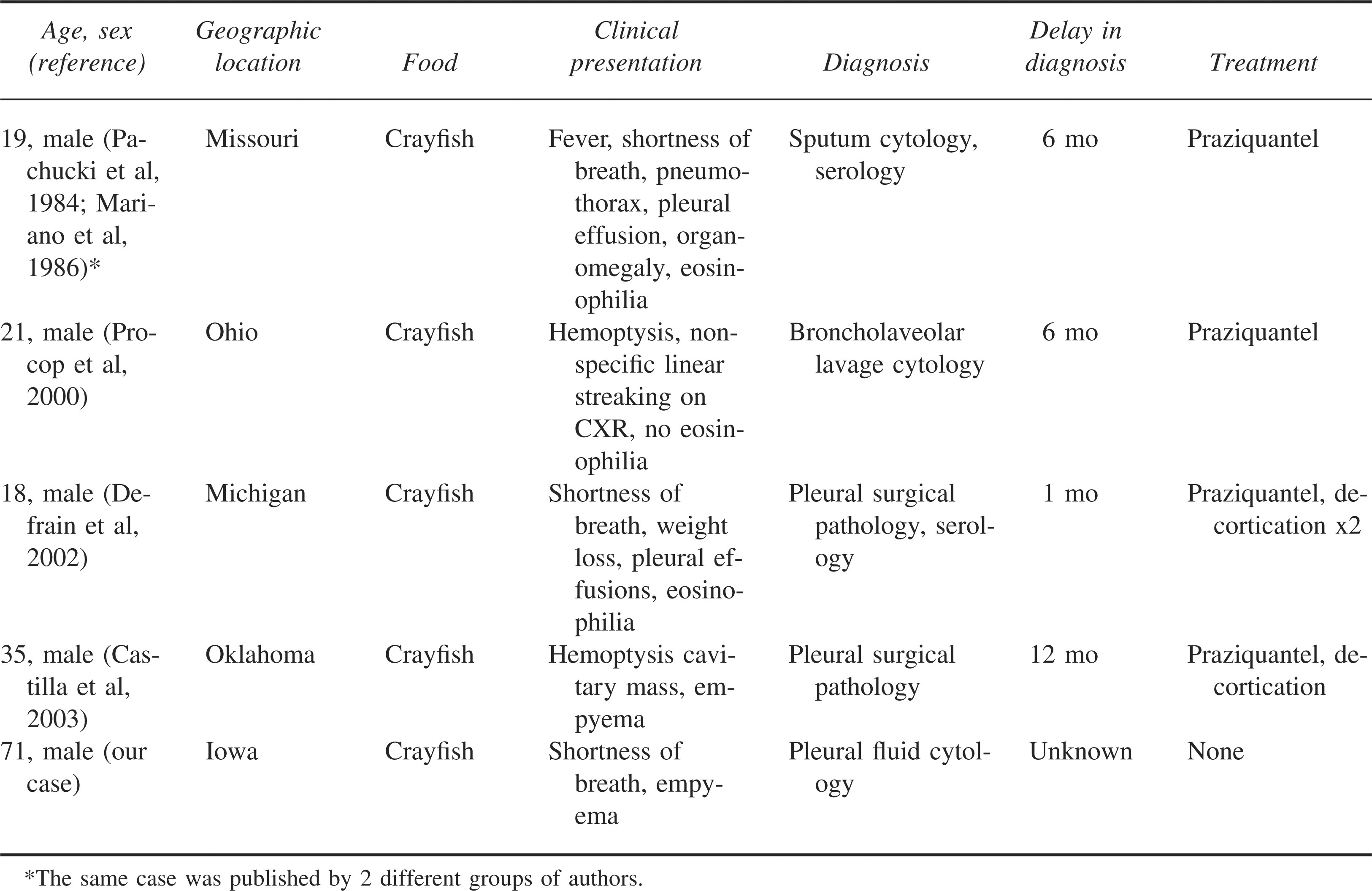
Paragonimus encompasses at least 9 species that are distributed globally, 1 but the majority of human infections occur in Southeast Asia and are caused by P westermani.1,2P westermani does not exist in the United States. However, a unique species, P kellicotti, was described by Kellicot and Ward in 1894 parasitizing cats and dogs.2,3 Since then, several infections with P kellicotti have been described in a variety of domestic and wild mammals (pigs, goats, minks, skunks, muskrats, and wildcats), 4 but only 4 cases of autochthonous human paragonimiasis have been described in the United States (Table). 1 –5 In this article we describe a new case of autochthonous human paragonimiasis in an individual born in the United States who had never traveled abroad or eaten imported food. We discuss the characteristics of all cases reported previously.
Case presentation
A 71-year-old Caucasian man with no medical history was admitted to a hospital in Omaha, Nebraska, in septic shock. The patient was a retired farmer who liked to camp in Iowa and eat crayfish when he was younger. Three weeks before his admission he was noted to be getting progressively short of breath. On the day of his admission he was found unresponsive, febrile, and hypotensive. He required respiratory support and protection of his airway and was, therefore, emergently endotracheally intubated and placed on mechanical ventilation. A chest radiograph demonstrated the presence of a pleural effusion, which was immediately tapped. The thoracentesis revealed a maroon-color, foul-smelling fluid with 1090 nucleated cells/μL, 98% neutrophils, 2% lymphocytes, 310 red blood cells/μL, lactate dehydrogenase: 5001 U/L, glucose: 1 mg/dL, protein <2.0 g/dL, pH 6.8. A gram stain of the fluid revealed polymicrobial flora, and the culture grew Clostridium perfringens, Candida albicans, and Serratia marcescens. Blood cultures grew C perfringens and S marcescens. The initial source of the empyema was a small bowel perforation. The patient expired as a result of multiorgan failure before surgical treatment of his condition could be accomplished.
The pleural fluid obtained at admission was sent for cytology, and the exam revealed multiple organized but degenerated and calcified forms that seemed to be compatible with a parasite (Figure 1). A closer examination of the slides revealed remnants of a trematode, including coiled uterine tubes, fragments of suckers, and structures that appeared to be ova in various states of degeneration. In the absence of a history of travel outside the United States, the parasite was identified as P kellicotti.
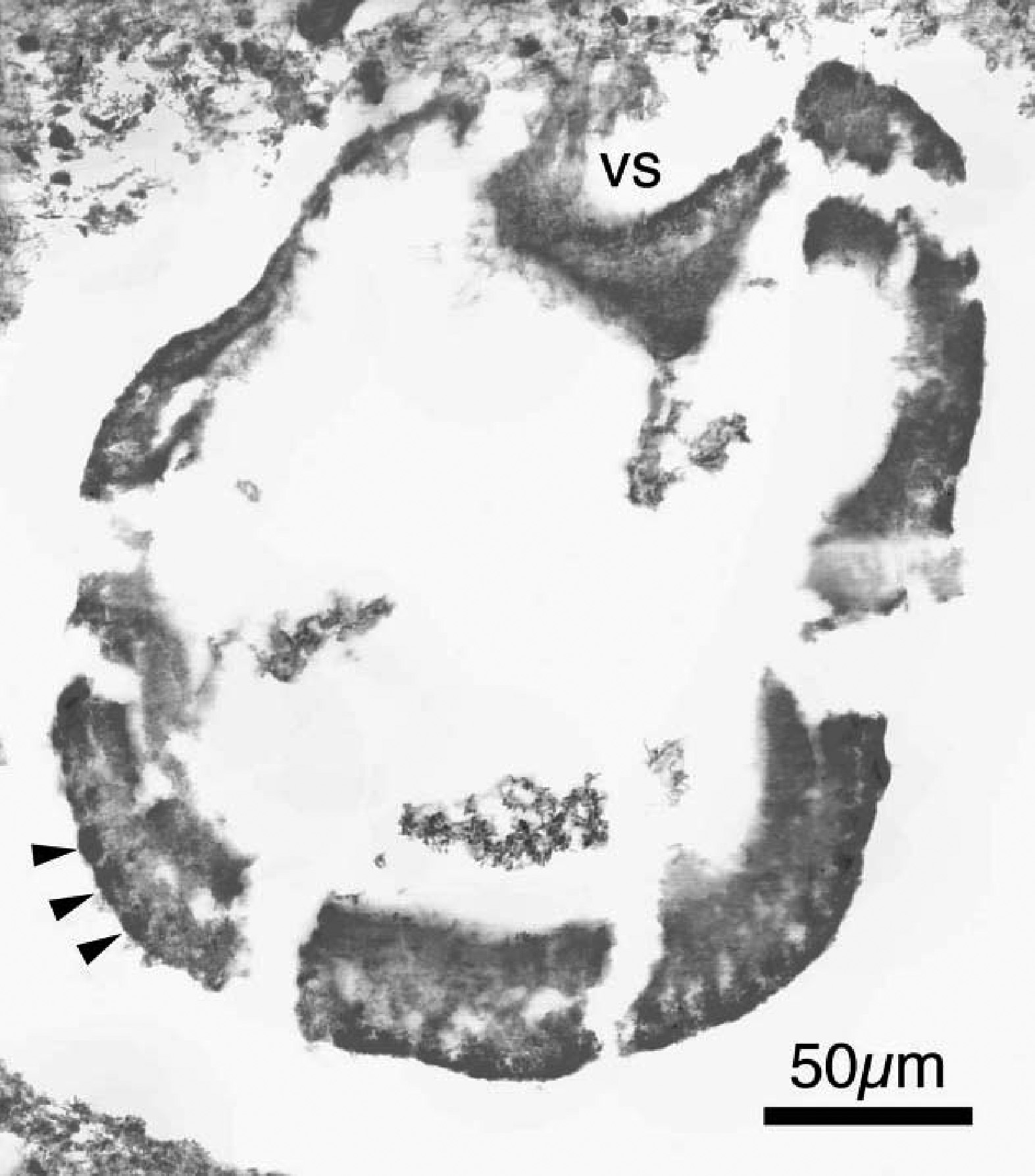
Integument of trematode (presumably Paragonimus kellicotti) showing remnant of ventral sucker (VS) and imbedded portions of spines still in the integument (darts)
Characteristics of patients with autochthonous North American paragonimiasis
Discussion
Paragonimus has a complex life cycle involving 2 intermediate hosts: a snail (Pomatiopsis lapidaria) and a crab or crayfish (Cambarus crayfish in the case of P kellicotti). 1 After improperly cooked crustaceans are eaten by definitive hosts, the Paragonimus metacercariae excyst and trespass the small bowel wall, accessing the peritoneal cavity and eventually migrating transdiaphragmatically to the lung, where they become sexually mature.2,3 The paucity of human cases in the United States may be related to the lack of culinary habits involving ingestion of nonboiled crayfish, in opposition to the relative common practice of eating raw, alcohol-pickled and other incompletely cooked crab meat in Asia. 2 The parasites cause pneumothorax and pleural effusion during the pleural migratory status (about 4 weeks after the initial infection) but once in the pulmonary parenchyma may cause eosinophilic pneumonia or in chronic cases cavitation of the lung resembling tuberculosis. 3
Although the number of human P kellicotti infections is very limited, some characteristics seem to emerge from the few cases published (Table). P kellicotti seems to affect predominantly young men. In all cases, consumption of crayfish and residence in the Midwest of the United States were identified as risk factors. The clinical presentation seems to be similar to P westermani infections, although pleural rather than parenchymal involvement seems to be more common. No cases of extrapulmonary involvement with P kellicotti have been reported, whereas P westermani has been described in multiple aberrant locations. The diagnosis is usually delayed for several months (6 on average) and is rarely considered until laboratory information is available. The diagnostic confirmation is usually made by direct observation of eggs in pleural fluid, pleural biopsy, or lung secretions. All cases recover well with the use of praziquantel and, on occasion, decortication. The case that we describe was associated with death of the patient, but the cause of death was a bacterial infection and not the parasitic disease itself.
The ova of P kellicotti and P westermani may look very similar, but closer examination suggests that P kellicotti may have a uniformly thicker shell and a more pointed end at the operculum. In most cases, the geographic location where the infection was acquired and differences in the branching pattern of ovaries and testes help in differentiating the species.
4
Serology is highly Sections through body of several individual trematodes showing loss of integument but some internal structures present: remnant of gonad (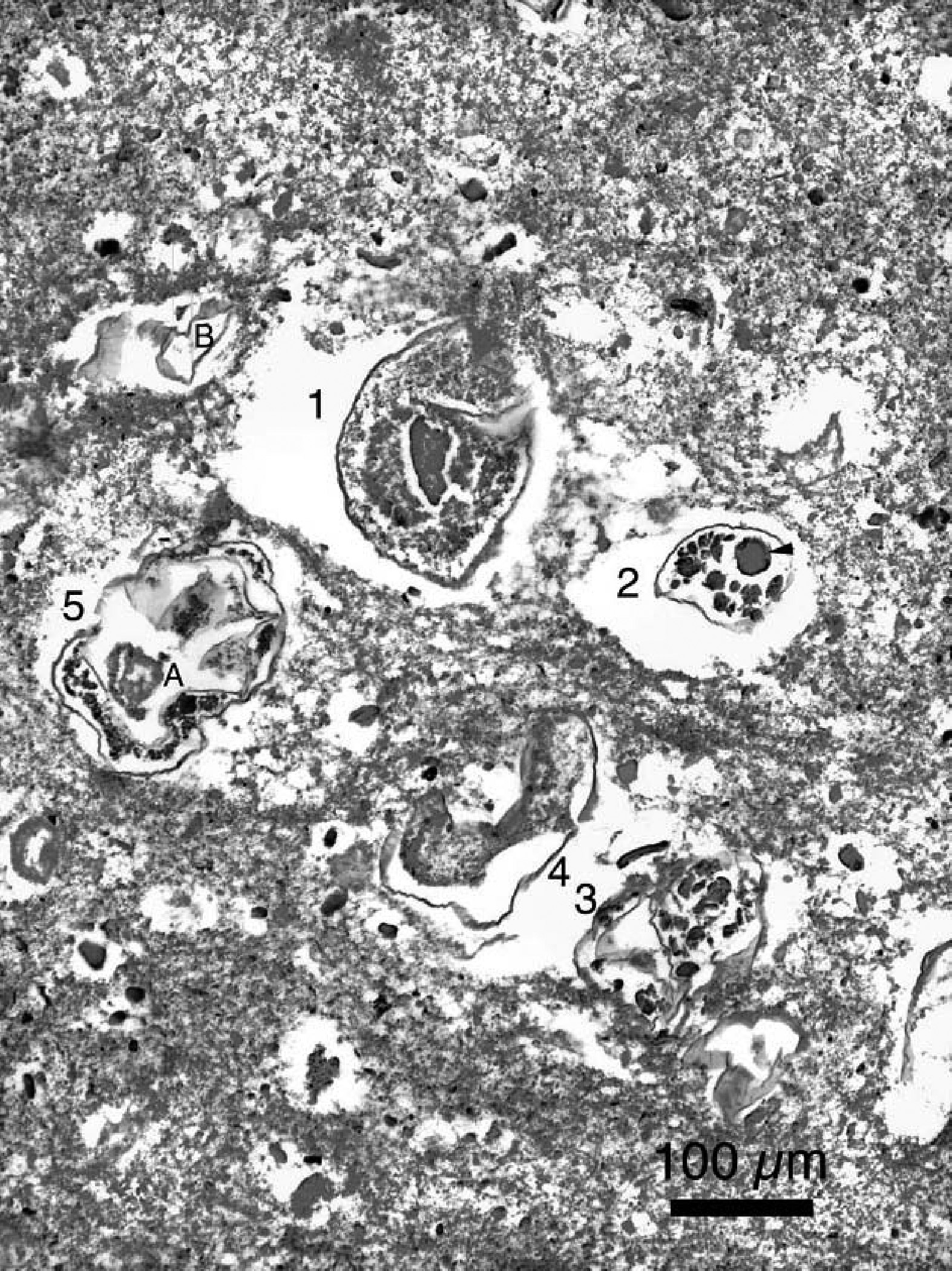
In conclusion, symptomatic autochthonous P kellicotti infection is a rare condition in the United States, usually affecting young men who reside in the Midwest and have a history of eating crayfish. The disease should be suspected in individuals presenting with hemoptysis and pleural disease. Prompt treatment with praziquantel and decortication is usually satisfactory.