




Abstract
We study an inventory control problem of a perishable product with a fixed short shelf life in Dutch retail practice. The demand is non-stationary during the week but stationary over the weeks, with mixed LIFO and FIFO withdrawal. The supermarket uses a service level requirement. A difficulty is that the age-distribution of products in stock is not always known. Hence, the challenge is to derive practical and efficient order policies that deal with situations where this information is either available or lacking. We present the optimal policy in case the age distribution is known, and compare it with benchmarks from literature. Three heuristics have been developed that do not require product age information, to align with the situation in practice. Subsequently, the performance of the heuristics is evaluated using demand patterns from practice. It appears that the so-called STIP heuristic (S for Total estimated Inventory of Perishables) provides the lowest cost and waste levels.
Introduction
Supermarket managers face a trade-off between risking to lose both revenue and goodwill by not having products available when demand arises on the one hand, and discarding surplus products, due to out-dating, on the other hand (Gruen et al., 2002). Food waste is mainly a result of retailer and consumer behaviour (Parfitt et al., 2010). Food waste occurs in two ways; either in markdowns when products are still saleable but approach the end of their shelf life or appear less attractive, or in garbage when products are no longer (re)saleable, usable or edible. In Europe, the total food loss and waste is 31% of the initial production from which 6.1% occurs during food processing, packaging and distribution (HLPE, 2014). Leberorger and Schneider (2014) report a food loss rate of fruit and vegetables of 4.19% in an Austrian food retail company from September 2011 to August 2012. For dairy products, the food loss rate was 1.14%, and for bread and pastry – 2.84%.
Generally, retailers rather build up more stock than risk a stock-out (Thyberg and Tonjes, 2016). Moreover, availability of fresher items significantly affects consumer choice on where to shop (Wyman, 2013). Furthermore, the demand rate is influenced by product availability and freshness (Sebatjane and Adetunji, 2021). So, there is simply a business incentive for retailers to overstock. This is not without risk. Waste represents a loss of business and a risk for already small margins (Cicatiello et al., 2017). Reducing the annual food waste will result in benefits for companies, consumers and the environment in terms of money, volume, energy and sustainability. Retailers are therefore very keen to implement strategies to reduce food waste. To illustrate this, members of the Consumer Goods Forum promised in 2015 to halve the food they waste by 2025 (The Consumer Goods Forum, 2015). This motivates looking for order policies that may help to reduce food waste and at the same time reduce costs for retailers. Many recent studies, such as (Herbon, 2017) and (Buisman et al., 2019), focus on discounting and adapting prices when the product approaches the expiration date, as a way of waste reduction. However, the competitive strategy of the retailer we study focuses on availability of fresh produce for fixed prices, without discounting, applying strict service level requirements. This relates to waste prevention. In the case of dynamic pricing, profit maximization and waste reduction do not necessarily go along, while in our case cost minimization and waste reduction are equivalent.
The Dutch retailer case studied in this paper enhances a highly perishable product inventory system with a fixed shelf life of three days on delivery at the store, noticeable by its best-before or use-by date. The supermarket is replenished every day which implies the retailer has items of different ages in stock. In many practical retail situations, the checkout system only registers the number of items sold but not their age, see Pantsar (2019). Consequently, the retailer is facing an order decision without knowledge of the age-distribution of the remaining items in stock. The observed total number of items in stock may be different from the inventory status according to the checkout system, due to damaged items and the occurrence of more waste than expected based on supply and demand data of the supermarket. In order to minimize waste, supermarkets prefer and stimulate customers to pick the oldest items first (FIFO, First In First Out), by putting those items in front on the shelf. However, practitioners in Dutch retail estimate that about 40% of the customers search for the freshest items and pick according to LIFO (Last In First Out).
Competition among supermarkets stimulates the aim to have fresh produce available. The product availability of a supermarket can be observed by the number of days the items are in-stock (not out-of-stock) in a supermarket. To monitor and ensure product availability, supermarkets generally set a target service level. In case of lost demand and periodic review of inventory levels, a so-called α-service level is most suitable. On the other hand, a supermarket aims at limiting product waste. By appropriate order policies, waste prevention can be improved.
Literature discusses several approaches in case the cash registering enhances the age of the sold products. This means that the age of items that remain in stock is known. In this paper, we will derive the optimal policy for this situation. However, we found that in retail practice the age is often not registered. This means that only the total number of items in stock is known after the products that expired their shelf life have been thrown out. Therefore, our aim is to derive practical heuristics in case the age distribution of the stock is unknown to approximate the situation in practice more accurately.
This paper is organised as follows. Section 2 describes the retail situation and a stochastic dynamic model of the situation. Section 3 discusses various approaches to determine the order quantity and Section 4 shows the results of numerical experiments based on practical data for the approaches. A discussion of findings and conclusions can be found in Section 5.
Model of the Retail Situation Inventory Control
To be able to model the stochastic dynamics for this problem, it is necessary to first identify the underlying characteristics of the practical situation. These characteristics are discussed in Section 2.1 and the model in Section 2.2.
Table with used symbols.
Table with used symbols.
In this study, a period t in the model is a day at the store, from opening until closing time. In the retail practice of perishable products, mostly the order quantity Store opening; Delivery of quantity Ordering of quantity Demand during the day from a mixed LIFO and FIFO withdrawal, ageing of remaining items in stock and disposal of wasted items, at store closure.
At the moment of the order decision, the previous order has arrived, so there is no outstanding order. The order quantity is based on the on-hand inventory and the expected demand during the replenishment cycle. At the end of day t, the inventory level
The demand is independently Poisson distributed with expectation
The general reorder decision problem can be formulated as a stochastic optimization model that minimizes purchasing cost and fulfils the service level constraint. For this specific model, minimization of cost and minimization of waste coincide.
The company we cooperated with in this study viewed demand
First of all, we have to distinguish the situation that the age of the products in stock is known versus a practical situation where this is not the case. In the first case, the order quantity
Broekmeulen and Van Donselaar (2009) proposed the so-called Estimated Withdrawal and Ageing (EWA) heuristic, where knowledge of the number of oldest items, which is going to expire during lead time, is known as part of the total inventory. Notice that the lead time is
Due to the lead time of one day, the optimal order quantity
We developed three heuristics for the order quantity based on the knowledge of the total inventory for the case that the age of the items in stock is not known. An easy way to deal with lack of knowledge of the oldest items in stock is to simulate the system using the table of In the Expected Waste heuristic In the
We evaluate the described order policies. The design of experiments is described in Section 4.1, followed by the obtained results in Section 4.2. In Section 4.3 we discuss some computational aspects.
Design of Experiments
All approaches are evaluated in a rolling horizon simulation of 10,000 weeks using pseudo random samples from the Poisson – and the binomial distribution. The expected demand
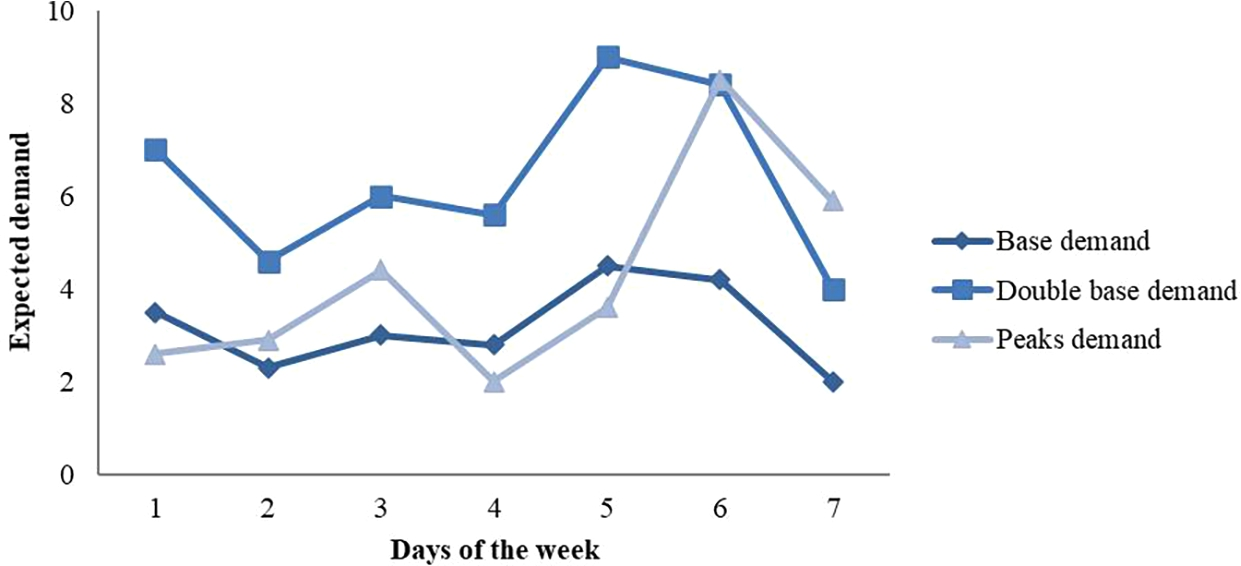
Evaluated expected demand patterns during the week. Day 1 corresponds to Monday.
Expected Poisson demand.
The variable purchasing cost is
Table 3 summarizes the results for the base demand pattern for all described approaches. It shows the average total cost (avgTC) and the average total waste (avgTW) per week. To observe the feasibility of the policy with respect to the minimal service level (SL) constraint, the attained SL is measured for each day. We provide the minimum of these values over the days of the week (minSL) in the table. The policies using information about the oldest items in stock are supposed to do better than the heuristic policies that do not use this information. As expected, one can observe that the costs and the number of wasted items increase when the fraction of LIFO demand increases.
Results for base demand with LIFO fractions
. Average total cost, total waste and minimum service level in the week.
Results for base demand with LIFO fractions
Table 4 compares all approaches for the three demand patterns with a LIFO fraction of
The SEW approach quickly generates easy-to-calculate order quantities with feasible results. The only exception occurs for the peak demand pattern where a minimum average SL of 0.89 is reached for one of the days. The STIP approach, which corresponds to lowest costs and waste and reasonable service levels, fails to reach the target SL of 90% for the double base demand and peaks demand patterns, reaching an average SL of 0.89 for one of the days, which is still close to the target level.
Results for 3 demand patterns with LIFO fraction
The evaluated approaches include four new approaches to determine order policies. The existing policies – EWA Broekmeulen and Van Donselaar (2009) and EWA
ss
Kiil et al. (2018) policy – require knowledge of the oldest items in stock. As a benchmark, we evaluated the newly derived optimal quantity
The EWA, EWA
ss
and SEW approaches offer easy and fast calculation rules to determine the order quantity. Like the determination of table
For the investigated experiments, determination of
Conclusion
The research question of this paper deals with the development and investigation of order policies for a Dutch retail situation with a service level requirement where the age-distribution of the inventory may be known or unknown. We investigated a retail situation where a product has a fixed shelf life of three days upon delivery, demand is non-stationary during the week, but stationary over the weeks, with a mixed LIFO-FIFO depletion and a lead time of one day. For all patterns of expected demand, the policy that provides the minimum amount of waste coincides with the one that minimizes expected cost. This is a logical consequence in absence of the disposal cost or salvage value and not focusing on a profit margin.
In case of having information of the oldest items in stock that are going to expire when not sold, two heuristic approaches can be found in literature, EWA and EWA ss . In this paper, we derive the optimal order quantity as function of the state of inventory where the LIFO-FIFO demand is described by a binomial distribution.
In case of not having age information, the developed S_augmented heuristic performs best, it always meets the service level requirement and has lower costs than the SEW approach and the benchmark EWA approach. The costs and waste in case of partly LIFO demand are slightly higher than those of the EWA ss benchmark. However, the benchmark approaches from literature take the age-distribution of the inventory into account. The STIP approach provides the lowest costs and lowest waste, but in some cases it does not reach the target service level of 0.90, providing an attained SL of 0.89 on one day of the week.
Future research deals with the derivation of heuristics for the practical cases where the shop cannot be delivered on all days of the week. This means that a varying replenishment cycle length has to be taken into account.