In this paper, at first, we define the notion of general fuzzy automaton over a field; we call this automaton vector general fuzzy automaton (VGFA). Moreover, we present the concept of max-min vector general fuzzy automaton. We show that if two max-min VGFA are similar, they constitute an isomorphism. After that, we prove that if two VGFA constitute an isomorphism with threshold α, they are equivalent with threshold α, where . Also, some examples are given to clarify these new notions.
Theoretical computer science is the mathematical study of models of computation. As such, it originated in the 1930s, well before the existence of modern computers, in the work of the logicians Church, Godel, Kleene, Post, and Turing. This early work has had a profound influence on the practical and theoretical development of computer science. Not only has the Turing machine model proved essential for theory, but the work of these pioneers presaged many aspects of computational practice that are now commonplace and whose intellectual antecedents are typically unknown to users. Control theory is a branch of mathematics that deals with the behaviour of dynamical systems studied in terms of inputs and outputs.
Automata theory is one of the longest-established areas in computer science. Standard applications of automata theory include pattern matching, syntax analysis, and formal verification. In recent years, novel applications of automata-theoretic concepts have emerged from numerous sciences, like biology, physics, cognitive sciences, control, linguistics, and biology. For more information, see Aceto et al. (2007), Cassandras and Lafortune (2009), Shamsizadeh et al. (2020), Dovier et al. (2004), Even (1965), Roggenbach and Majster-Cederbaum (2000), Shamsizadeh et al. (2016), Shamsizadeh and Zahedi (2019). Directable automata were introduced in Starke (1969), and also definite automata by Kleene (1956). Wee (1967) and Santos (1968) have introduced the idea of fuzzy automata. Accordingly, fuzzy finite automata have been applied in many areas, such as learning systems, the model of computing with words, pattern recognition, lattice-valued fuzzy finite automata, and clinical monitoring, and also used as models of machine learning systems (Ying, 2002; Li and Shi, 2000). In general, fuzzy automata have provided an attractive systematic way of generalizing discrete applications (Cattaneo et al., 1997; Doostfatemeh and Kremer, 2003; Reiter, 2002; Srivastava and Tiwari, 2002). Moreover, fuzzy automata developed capabilities that are hardly achievable by other tools (Ying, 2002).
Several researchers have contributed to the growth of the fuzzy automata theory. Among these works, the work of Jin and his coworkers (Jin et al., 2013) is directed towards the algebraic study of fuzzy automata based on Po-monoids; the work of Abolpour and Zahedi (Abolpour et al., 2020; Abolpour and Zahedi, 2017) is directed towards the use of categorical concepts in the study of general fuzzy automata with membership values in different lattice structures; the work of Qiu (2001, 2002) is directed towards the algebraic, topological and categorical study of fuzzy automata theory based on residuated lattices; the work of Peeva (1988, 1991) relates to the study of minimizing the states of fuzzy automata and its application to study pattern recognition; the work of Pal and their coworkers (Pal et al., 2019) is directed towards the study of fuzzy automaton based on the residuated and co-residuated lattice, the work of Shamsizadeh and coworkers (Shamsizadeh et al., 2021; Raisi Sarbizhan et al., 2022; Shamsizadeh and Zahedi, 2022; Shamsizadeh, 2022) is directed towards the study of fuzzy automaton based on graph theory and multiset theory and neutrosophic sets; Ghorani, Moghari and coworkers (Ghorani and Moghari, 2022; Ghorani et al., 2022) study fuzzy tree automata based on lattice-valued.
In this paper, we define the notion of general fuzzy automaton over a field. We call this automaton vector general fuzzy automaton (VGFA). Moreover, we present the concept of max-min vector general L-fuzzy automaton. VGFA are used for generation of linear codes, detection and correction of errors, construction of testing sequence, and generation of pseudo-random sequences of numbers. They are also used in experiments that require Monte Carlo methods, in the protection of data stored in computer systems and radio location. We show that if two max-min VGFA are similar, then they constitute an isomorphism. After that, we prove that if two VGFA constitute an isomorphism with threshold α, they are equivalent with threshold α, where . Also, some examples are given to clarify these new notions.
Preliminaries
In this section, we review some notions which are needed in the next section.
A fuzzy finite state automaton (FFA) is a six-tuple denoted by , where:
is a finite set of states,
is a finite set of input symbols,
R is the start state of ,
is a finite set of output symbols,
is the fuzzy transition function which is used to map a state (current state) into another state (next state) upon an input symbol, attributing a value in the interval ,
is the output function.
In an FFA, as can be seen, associated with each fuzzy transition a membership value in . We call this membership value, the value of the transition.
A general fuzzy automaton (GFA) is an eight-tuple machine denoted by , where:
is a finite set of states,
is a finite set of input symbols,
is the set of fuzzy start states,
is a finite set of output symbols,
is the augmented transition function,
is the output function,
is called the membership assignment function. The function , as is seen, is motivated by two parameters μ and δ, where μ is the membership value of a predecessor and δ is the value of a transition. In this definition, the process that takes place upon the transition from state to on an input is represented as Which means that membership value (MV) of the state at time is computed by function using both the membership value of at time t and the membership value of the transition. There are many options which can be used for the function . It can be, for example, or any other applicable mathematical function.
is called the multi-membership resolution function. The multi-membership resolution function resolves the multi-membership active states and assigns a single non-membership value to them.
is the set of elements in [0, 1]. The multi-membership resolution function is a function which specifies the strategy that resolves the multi-membership active states and assigns a single mv to them.
Let be a normed linear space. Define Then is a fuzzy normed linear space.
Vector General Fuzzy Automaton
Let F be a field and . By we denote the vector space of column vectors of dimension n over F. A vector general fuzzy automaton (VGFA) is an automaton with the following properties:
There exists a field F and integers , such that
is a nonempty finite set of states, , where ,
is a finite set of input symbols, , where ,
is the set of L-fuzzy start symbols,
is a finite set of output symbols, , where ;
There exist a matrix A, a matrix B, and a matrix C, all over F, such that
is the augmented transition function, where .
is the augmented output function.
is called the membership assignment function. The function , as is seen, is motivated by two parameters μ and δ, where μ is the membership value of a predecessor and δ is the value of a transition. In this definition, the process that takes place upon the transition from state to on an input is represented as Which means that membership value (MV) of the state at time is computed by function using both the membership value of at time t and the membership value of the transition. There are many options which can be used for the function . For example, it can be , , or any other applicable mathematical function.
is called the membership assignment output function. as is seen, is motivated by two parameters μ and ω, where μ is the membership value of present state and ω is the membership value of an output function. Then Notice that if and only if .
is called the multi-membership resolution function. The multi-membership resolution function resolves the multi-membership active states and assigns a single membership value to them.
is called the multi-membership resolution output function. The multi-membership resolution output function resolves the output multi-membership active state and assigns a single output membership value to it.
We let the set of all transitions of is denoted by Δ. Now, suppose that be the set of all active states at time , for all . We have and where for every . Since is a fuzzy set, to show that a state u belongs to and T is a subset of , we write . Hereafter, we denote these notations by
The combination of the operations of functions and on a multi-membership state leads to the multi-membership resolution algorithm. By using (Doostfatemeh and Kremer, 2005; Shamsizadeh and Zahedi, 2015) we have the following algorithms.
Algorithm: Multi-membership resolution for transition function:
If there are several simultaneous transitions to the active state at time , then the following algorithm will assign a unified membership value to that.
Input: , , , and ,
For , and , compute ,
For , , where n is the number of simultaneous transitions to the active state at time and , ,
Output: for , print: .
Algorithm: Multi-membership resolution for output function:
If there are several simultaneous outputs to the active state at time t, the following algorithm will assign a unified membership value to it.
Input: , , , ,
For , , compute:
For , , where n is the number of simultaneous outputs to the active state at time t, , ,
Output: for , print: .
For every , such that , we have and implies that .
We shall often want to refer to a finite non-empty set as a vector alphabet. If is a vector alphabet, let consist of all finite sequences where and .
The multiplication given by (3) then corresponds to just a simple position:
Let be a VGFA. We define the max-min vector general fuzzy automaton , such that , where and for every ,
Also, for every , and recursively, in which for every , and assume that is the entered input at time , for every .
Actually, the fact that the VGFA acts in discrete time we will also use the notation where , , for .
Notice that when we want to consider a word, we can write it as enumeration. If we have for use of equation (6), we consider w as follows:
Since field F and matrices A, B and C entirely characterize the vector general fuzzy automaton (VGFA), we shall also denote automaton by 13-tuple machine .
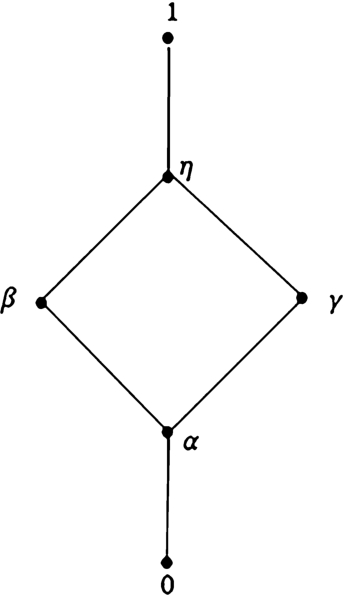
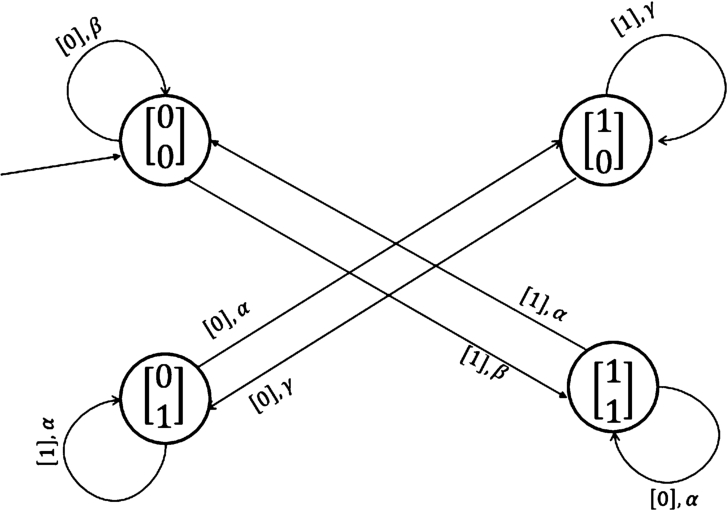
Let L be a bounded lattice as in Fig. 1. Let be a VGFA defined over field of integers modulo 2, such that , , , , , , and δ, ω are defined as follows: If we choose and and , we have Notice that there exists no , since does not belong to Δ. By choosing a different Matrices A and B, it is possible to obtain and . Now, we have The diagram of VGFA is presented on Fig. 2.
Equivalence and Isomorphism for Vector General Fuzzy Automata
Let a VGFAbe given. Then the following properties hold:
, for every,
, for every.
1. We prove the claim by induction on t. If , then we have Now, suppose the claim holds for , so we have . Let . Then 2. By induction on t, it is omitted. □
Let where , be two VGFAs. We say that is similar to if there exists a nonsingular matrix P, such that
if and only if ,
,
,
.
Let F be a field. Let where , be two VGFAs. A homomorphism from onto with threshold α, is a function φ from onto such that for every and and the following conditions hold:
if and only if ,
if and only if .
Actually, I and II show that if and only if
implies that .
We say that φ constitutes an isomorphism with threshold α if φ constitutes an a homomorphism with threshold α that is one-to-one and if and only if .
If φ constitutes an isomorphism with threshold 0, then we say that φ constitutes an isomorphism.
Letwhere, be two VGFAs. Ifis similar to, thenandconstitute an isomorphism.
Let P be a nonsingular matrix such that , , . Let be a map such that , for every . It is clear that φ is well defined. Now, let , for every . Then . Since P is a nonsingular matrix, then . Therefore, φ is one-one. Hence, φ is bijection. Now, let , where . Then . Since and by considering Definition 8 we have , so . Suppose that thus, . By using Definition 8, we have and . Let . Then by Definition 5, we have . It implies that . Therefore, By Definition 5, , hence, . Now, let , where . Then there exists , such that and . So, We show that if and only if . Let . Then and . By Definition 5, we have . By considering Definition 8, we have . Thus, . Also, we have if and only if . Therefore, . The opposite can be proved in a similar way. □
The opposite of Theorem 2 is not true because there exist isomorphic VGFA which are not similar. As an illustration, let us give the following example.
Let L be a bounded lattice as in Fig. 1, be a field and and where . Also, let be a map such that and , for every and , for every , and suppose that , for every and . It is clear that and are isomorphic but not similar because the matrix is not similar to matrix over the field of integers modulo 7.
Let be a max-min VGFA. The language with threshold α, , recognized by , is a subset of defined by
Two max-min VGFAs and are called equivalent with threshold α if , where .
Letandbe two max-min VGFAs. Letandbe isomorphic with threshold α, where. Then they are equivalent with threshold α.
Let , , be two max-min VGFAs and be a homomorphism. Now, let . Then there exist and , such that , where . So, and . Then there exists , such that By Definition 9, we have It is implied that . Therefore, . In a similar way . Hence, . □
General Fuzzy Automaton on Fuzzy Normed Linear Space
Let F be a field and . By we denote the vector space of column vectors of dimension n over F. A general automaton on fuzzy normed linear space (or simply fuzzy norm general automata (FNGA)) is an automaton with the following properties:
There exist a field F and integers , such that
is a nonempty finite set of states, , where ,
is a finite set of input symbols, , where ,
is the set of start symbols,
is a finite set of output symbols, , where ;
There exist a matrix A, a matrix B, and a matrix C, all over F such that
is the augmented transition function, where , , and R is set of real number,
is the augmented output function,
is called the membership assignment function. In this definition, the process that takes place upon the transition from state to on an input is represented as follows: where is a fuzzy normed linear space and U is a linear space over a fileld F,
is called the membership assignment output function. , as it seems, is motivated by two parameters μ and ω, where μ is the membership value of present state and ω is the membership value of an output function. Then
We let the set of all transitions of be denoted by Δ. Now, suppose that is the set of all active states at time , for all . We have and where for every . is a fuzzy set.
For every , such that , we have and implies that .
Let be a FNGA. We define the max-min fuzzy norm general automaton , such that , where and for every ,
Also, for every , and recursively, in which , for every , and assume that is the entered input at time , for every .
Let be an FNGA defined over field of integers modulo 2 such that , , , , , and . Let . If we consider as Example 1, and as Example 1, then we have: Now, we have
Conclusion
General fuzzy automaton over a field are used for generation of linear codes, detection and correction of errors, construction of testing sequence, and generation of pseudo-random sequences of numbers. They are also used in experiments that require Mote Carlo methods, in the protection of data stored in computer systems and radio-location.
In the recent study, we defined the notion of general fuzzy automaton and max-min general fuzzy automaton over a field; we call this automaton vector general fuzzy automaton. Moreover, we presented the concept of max-min vector general fuzzy automaton. We proved that if two max-min VGFA are similar, they constitute an isomorphism. Moreover, we showed that if two VGFA constitute an isomorphism with threshold α, they are equivalent with threshold α, where . Also, we presented a general automaton on fuzzy normed linear space.
Further, we try to present a connection between VGFA and similar automata. Also, we try to present fuzzy finite tree automaton over a fuzzy normed linear space.
References
1.
AbolpourK.ZahediM. (2017). General fuzzy automata based on complete residuated lattice-valued. Iranian Journal of Fuzzy Systems, 14(5), 103–121.
2.
AbolpourK.ZahediM.ShamsizadehM. (2020). BL-general fuzzy automata and minimal realization: based on the associated categories. Iranian Journal of Fuzzy Systems, 17(1), 155–169.
3.
AcetoL.IngólfsdóttirA.LarsenK.G.SrbaJ. (2007). Reactive Systems: Modelling, Specification and Verification. Cambridge University Press.
4.
BagT.SamantaS. (2003). Finite dimensional fuzzy normed linear spaces. Journal of Fuzzy Mathematics, 11(3), 687–706.
5.
CassandrasC.LafortuneS. (2009). Introduction to Discrete Event Systems, Number 1. Springer Science & Business Media, Berlin/Heidelberg, Germany.
DoostfatemehM.KremerS.C. (2003). A fuzzy finite-state automaton that unifies a number of other popular computational paradigms. In: Proceedings of the Artificial Neural Networks in Engineering Conference (ANNIE 03’), pp. 441–446.
8.
DoostfatemehM.KremerS.C. (2005). New directions in fuzzy automata. International Journal of Approximate Reasoning, 38(2), 175–214.
9.
DovierA.PiazzaC.PolicritiA. (2004). An efficient algorithm for computing bisimulation equivalence. Theoretical Computer Science, 311(1-3), 221–256.
10.
EvenS. (1965). On information lossless automata of finite order. IEEE Transactions on Electronic Computers, 14(4), 561–569.
11.
GhoraniM.MoghariS. (2022). Decidability of the minimization of fuzzy tree automata with membership values in complete lattices. Journal of Applied Mathematics and Computing, 68(1), 461–478.
12.
GhoraniM.GarhwalS.MoghariS. (2022). Lattice-valued tree pushdown automata: pumping lemma and closure properties. International Journal of Approximate Reasoning, 142, 301–323.
13.
JinJ.LiQ.LiY. (2013). Algebraic properties of L-fuzzy finite automata. Information Sciences, 234, 182–202.
14.
KleeneS.C. (1956). Representation of events in nerve nets and finite automata. In: ShannonC.E.McCarthyJ. (Eds.), Automata Studies, Vol. 34. Princeton University Press, Princeton, pp. 3–42. https://doi.org/10.1515/9781400882618-002.
15.
LiY.-M.ShiZ.-K. (2000). Remarks on uninorm aggregation operators. Fuzzy Sets and Systems, 114(3), 377–380.
16.
MordesonJ.N.MalikD.S. (2002). Fuzzy Automata and Languages: Theory and Applications. CRC Press.
17.
PalP.TiwariS.VermaR. (2019). Different operators in automata theory based on residuated and co-residuated lattices. New Mathematics and Natural Computation, 15(01), 169–190.
18.
PeevaK. (1991). Fuzzy acceptors for syntactic pattern recognition. International Journal of Approximate Reasoning, 5(3), 291–306.
19.
PeevaK.G. (1988). Behaviour, reduction and minimization of finite L-automata. Fuzzy Sets and Systems, 28(2), 171–181.
20.
QiuD. (2001). Automata theory based on complete residuated lattice-valued logic. Science in China Series: Information Sciences, 44, 419–429.
21.
QiuD. (2002). Automata theory based on complete residuated lattice-valued logic (II). Science in China Series F: Information Sciences, 45, 442–452.
22.
Raisi SarbizhanE.Mehdi ZahediM.ShamsizadehM. (2022). L-graph automata and some applications. The Computer Journal, bxac035. https://doi.org/10.1093/comjnl/bxac035.
23.
ReiterC.A. (2002). Fuzzy automata and life. Complexity, 7(3), 19–29.
24.
RoggenbachM.Majster-CederbaumM. (2000). Towards a unified view of bisimulation: a comparative study. Theoretical Computer Science, 238(1–2), 81–130.
25.
SantosE.S. (1968). Maximin automata. Information and Control, 13(4), 363–377.
26.
ShamsizadehM. (2022). Single valued neutrosophic general machine. Neutrosophic Sets and Systems, 49(1), 33.
27.
ShamsizadehM.ZahediM. (2015). Minimal intuitionistic general L-fuzzy automata. Italian Journal of Pure and Applied Mathematics, 35, 155–186.
28.
ShamsizadehM.ZahediM.M. (2019). Bisimulation of type 2 for BL-general fuzzy automata. Soft Computing, 23(20), 9843–9852.
ShamsizadehM.ZahediM.AbolpourK. (2016). Bisimulation for BL-general fuzzy automata. Iranian Journal of Fuzzy Systems, 13(4), 35–50.
31.
ShamsizadehM.ZahediM.AbolpourK. (2020). Reduction of BL-general L-fuzzy automata. Iranian Journal of Mathematical Sciences and Informatics.
32.
ShamsizadehM.ZahediM.GolmohamadianM.AbolpourK. (2021). Zero-forcing finite automata. International Journal of Industrial Mathematics, 13(4), 477–488.
33.
SrivastavaA.K.TiwariS. (2002). A topology for fuzzy automata. In: Advances in Soft Computing—AFSS 2002: 2002 AFSS International Conference on Fuzzy Systems Calcutta, India, February 3–6, 2002 Proceedings. Springer, pp. 485–490.
34.
StarkeP. (1969). Abstrakte Automaten. VEB Deutscher Verlag der Wissenschaften, Berlin.
35.
WeeW.G. (1967). On Generalizations of Adaptive Algorithms and Application of the Fuzzy Sets Concept to Pattern Classification. Thesis, Purdue University.
36.
YingM. (2002). A formal model of computing with words. IEEE Transactions on Fuzzy Systems, 10(5), 640–652.
37.
ZahediM.HorryM.AbolporK. (2008). Bifuzzy (General) topology on max-min general fuzzy automata. Advanced in Fuzzy Mathematics, 3(1), 51–68.