




Abstract
This contribution presents a brief survey of clipping and intersection algorithms in
This survey is intended to help researchers, students, and practitioners dealing with intersection and clipping algorithms.
Keywords
Introduction
Intersection algorithms are key algorithms in many areas, e.g. in geometry intersection algorithms of two lines in
Algorithms for intersection computation of different geometric entities in
It should be noted that, not only in geometry oriented algorithms, a special care has to be devoted to the cases where differences between mathematics with infinite precision and mathematics with a limited precision might cause problems leading to the unexpected and incorrect results, sometimes also leading to disasters.
Unfortunately, programmers and computer scientists are mostly targeted at “the technology of implementation”. They have a limited understanding of numerical aspects of today’s numerical data representation, limited more or less to the IEEE-754 floating-point representation (Wikipedia, 2021b). Despite the technological progress, the binary128 and binary256 precision are not supported in hardware. It appears that there is no possibility to represent rational, irrational and transcendental numbers used in mathematics, where unlimited accuracy is expected, e.g. what is the difference between the value of
Line, half-line (ray), line segment and triangle-triangle intersection algorithms are considered fundamental in nearly all algorithms dealing with geometrical aspects (Skala, 2022).
Projective Space and Principle of Duality
The majority of intersection algorithms have been developed for the Euclidean space representation in spite of the fact that geometric transformations, i.e. projection, translation, rotation, scaling and Window-Viewport etc., use homogeneous coordinates, i.e. projective representation. This results into the necessity to convert the results of the geometric transformations to the Euclidean space using division operation.
Projective Extension of the Euclidean Space
The conversion of a point
It means that a point
The extension to the
The use of the projective extension of the Euclidean space is convenient not only for geometric transformations, as it replaces addition by multiplication in the case of translation operation, but it enables to represent a point in infinity. Also, it enables to express some geometric entities in a more compact form, e.g. a line in the
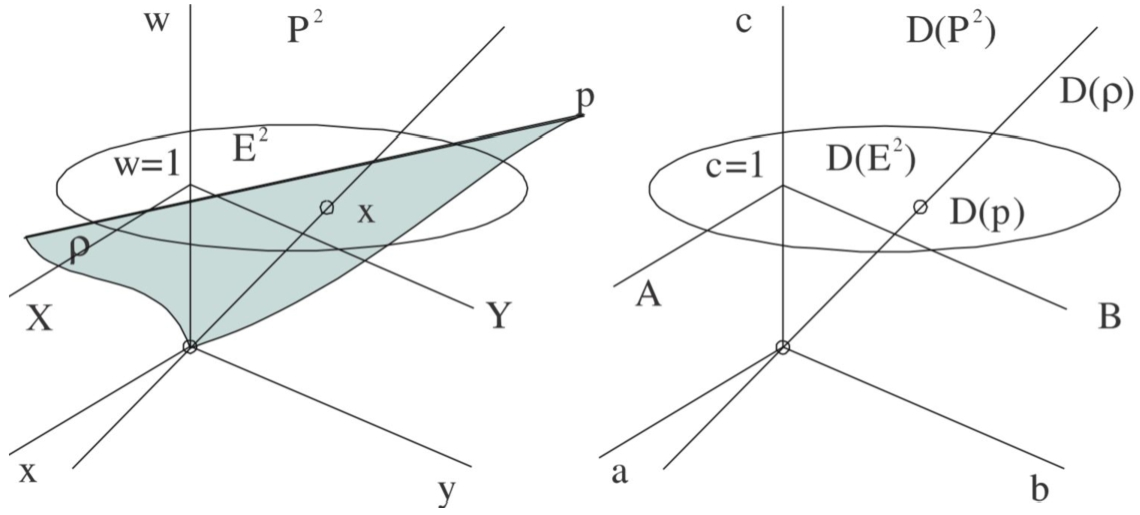
Projective space and its dual.
It is necessary to note that
In many cases, the principle of duality can be used to derive a solution of a dual problem and have only one programming sequence for both problems, i.e. the primary one and the dual. Figure 1 presents the duality in
The principle of duality is one of essential principles in mathematics. In our case of geometric problems described by linear equations, see Eq. (3) and Eq. (4), the principle of duality states that any theorem remains true when we interchange the words: “point” and “line” in the “lie on” and “pass through”, “join” and “intersection” and so on.
Once the theorem has been established, the dual theorem is obtained as described (Johnson, 1996).
In other words, the principle of duality in the
Generally, a system of linear equations
It should be noted that a line in
In computer graphics, some intersection algorithms are called clipping algorithms and serve to determine a part of one geometric entity inside the second one.
In the following, a brief classification of intersection algorithms in 2D and 3D will be presented with short characteristics; a short overview can be found in Wikipedia (2021a).
There are many variants of fundamental algorithms that differ in some aspects; mainly, the timing factor is the primary motivation. However, the claimed speed up mostly depends on the hardware properties (memory caching, processor used, etc.), programmer’s skill and actual language and compiler used.
Algorithms for intersections of different 2D geometric entities have been studied for a long time from various aspects, primarily due to the computation speed, robustness and limited numerical precision of the floating-point representation. The majority of 2D algorithms deal with an intersection of a line or a half-line (ray) or a line segment with 2D geometric entity, e.g. a rectangle, convex polygon (Cyrus and Beck, 1978; Rappoport, 1991), non-convex polygon (Weiler and Atherton, 1977), quadric and cubic curves, parametric curves (Skala, 2021a) and areas with quadratic arcs (Skala, 2015, 1989, 1990a), etc.
There are two main strategies, which are “dual” in some sense: a position of the window, resp. polygon edges against the intersected line, resp. line segment, etc., a position of the vertices of the window, resp. polygon against the intersected line, resp. line segment, etc.
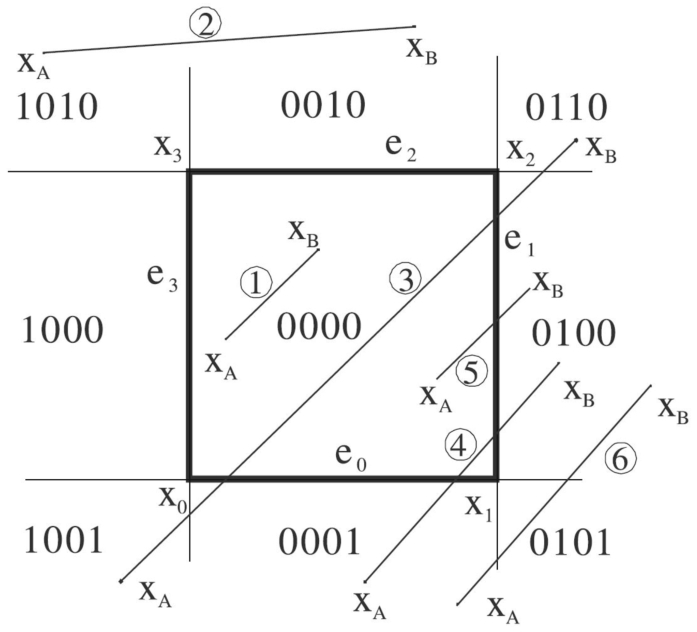
Cohen-Sutherland coding.
Intersection algorithms with a rectangular area (window) are well known as the line clipping or as the line segment clipping algorithms. The first algorithm was developed and used for the flight simulator project led by Cohen (1969) in 1967. Efficient coding of the line segment position coding leading to significant computational reduction was introduced in Sproull and Sutherland (1968) and patented in 1972 (Sutherland, 1972). The Cohen-Sutherland algorithm is described in Newman and Sproull (1979), Comninos (2006), Matthes and Drakopoulos (2019a, 2019b), etc. The Cohen-Sutherland algorithm generates a bit-code LRTB, i.e. [Left, Right, Top, Bottom], for each end-point of the line segment, see Fig. 2. The coding is redundant. However, it enables simple identification of the cases, when the line segment is totally inside or outside as follows:
where
The ultimately deep classification of all the possible cases using arithmetic operation with the codes was described in Skala (2021b), see Table 1 and Fig. 3. The
Numerical summation codes
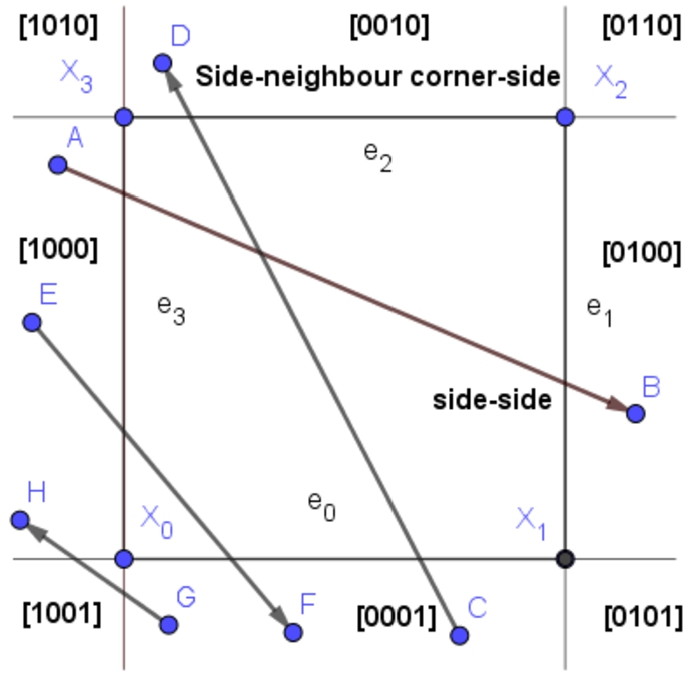
Two specific situations – SS-SnCS: side-side and side-neighbour corner-side.
Distinguishing all the cases leads to more efficient coding and efficient implementation (Skala, 2021b); specific cases are presented in Table 2.
Possible cases: n/a – non-applicable or solved by the C-S coding, C – corner area, S – side area, IN – inside area, End-points: IC – inside-corner, IS – inside-side; Cases: SS – side-side, SnCS – side-near corner-side, SdC – side-distant corner-side, CoC – corner-opposite corner, id – case re-indexing.
The Cohen-Sutherland algorithm can also be extended to the 3D case, i.e. intersection of a line segment with a cube or right-angled parallelepiped.
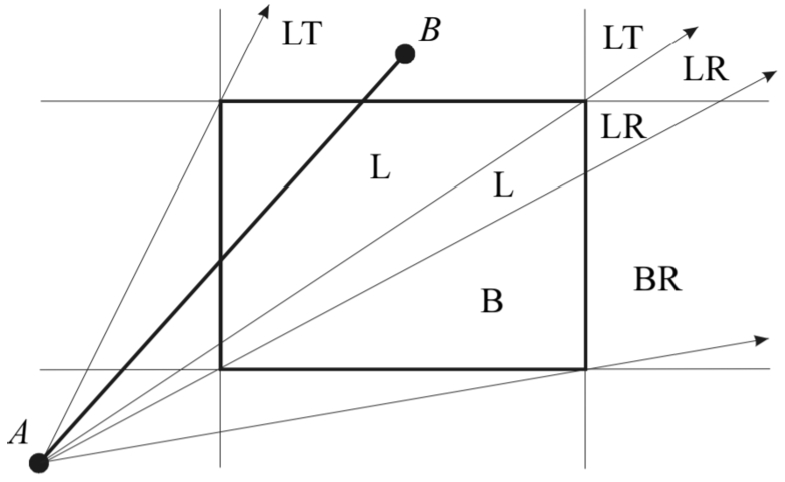
Nicholl-Lee-Nicholl algorithm – window corners position evaluation.
The Cohen-Sutherland algorithm was improved by Nicholl et al. (1987). It uses the window corners position classification in relation to the line segment position, see Fig. 4. The Nicholl-Lee-Nicholl algorithm was improved by Bui and Skala (1998) using some additional classification of possible cases and extended to the
The algorithms (Liang and Barsky, 1983) and (Dörr, 1990) are based on the direct intersection computation of a line with the polygon edges in the parametric form. Analysis of the Nicholl-Lee-Nicholl and Liang-Barsky algorithms was given in Devai (2005). Simple and robust line and line segment clipping algorithms in
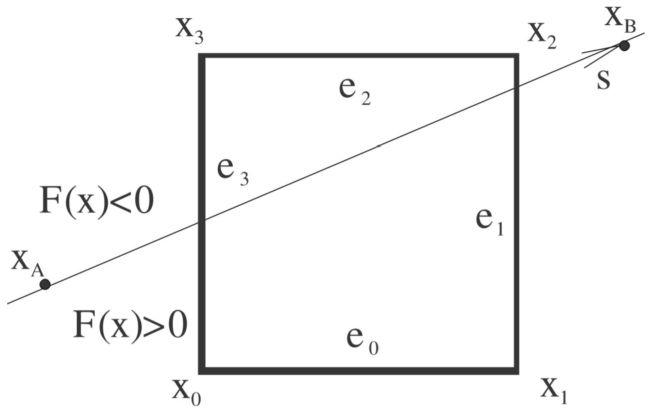
Clipping against the rectangular window in
Let us consider an implicit function
The clipping operation should determine the intersection points
All cases; N/A – non-applicable (impossible) cases.
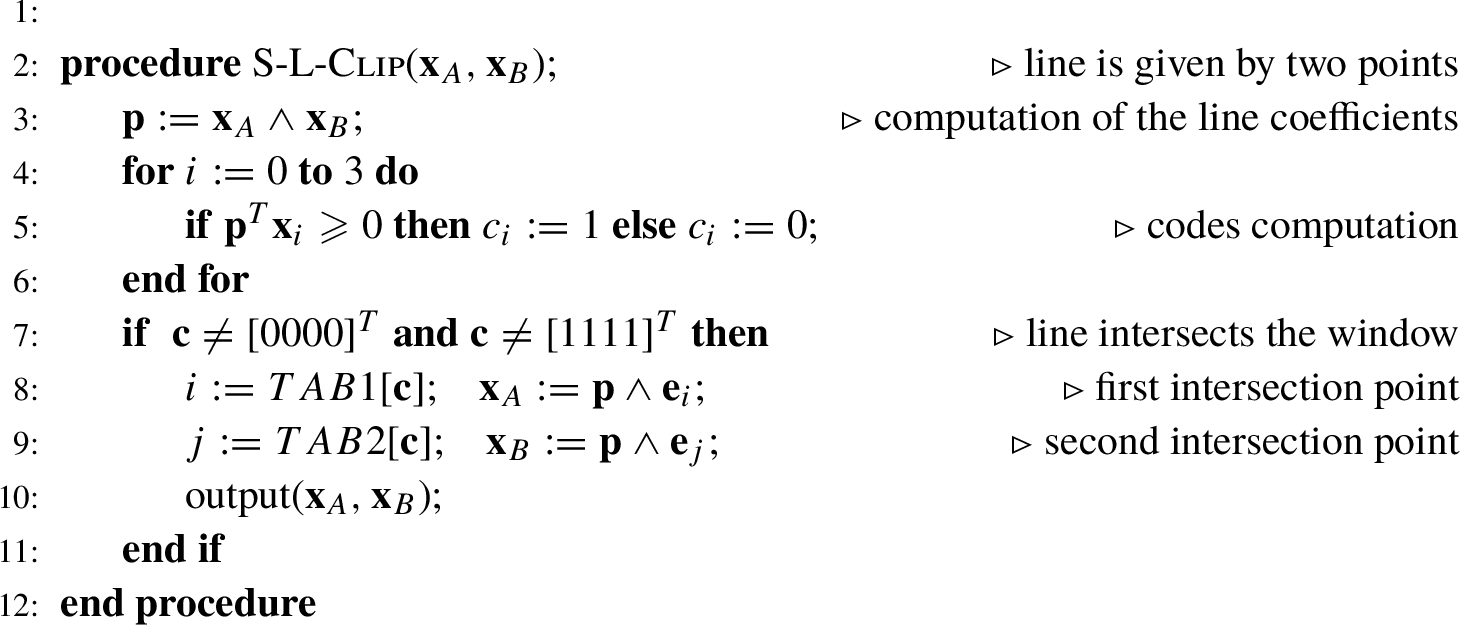
S-L-Clip – line clipping algorithm by the rectangular window
It can be seen, that the S-L-Clip Algorithm 1 is quite simple and easily extensible for the convex polygon clipping case as well. Table 3 can be generated synthetically. It is significantly more straightforward than the algorithm (Liang and Barsky, 1984). It also supports SSE4 and GPU use directly and leads to simple implementations, as the cross-product and dot-product operations, are supported in hardware. It should be noted, that the algorithm is designed for a very general case, as the window corners and the points defining the line, are generally in the projective representation, i.e.
The modification of the S-L-Clip algorithm for a line segment clipping is simple and described in Skala (2004). The advantage of it is that the end-points and the window corners might be given generally in the projective space, i.e.
Other proposed modifications of algorithms can be found in Bui (1999), Andreev and Sofianska (1991), Bao and Peng (1996), Devai (2005, 2006, 1998), Duvalenko et al. (1990, 1993, 1996), Cai et al. (2001), Day (1992a, 1992b), Evangeline and Anitha (2014), Kaijian et al. (1990), Kodituwakku et al. (2013), Kong and Yin (2001), Maillot (1992), Wei et al. (2013), Slater and Barsky (1994), Ray (2012a, 2012b, 2014, 2015), Li (2016), Singh and Lumar (2016), Dev and Saharan (2019).
Some additional modifications of algorithms were published in Brackenbury (1984), Chao et al. (2009), Cheng and Yen (1989), Dimri (2015), Dimri et al. (2022), Elliriki et al. (2019), Hattab and Yusof (2014), Iraji et al. (2011), Jiang and Han (2013), Jianrong (2006), Kumar and Awasthi (2011), Kuzmin (1995), Li et al. (2014), Li and Lei (2012), Meriaux (1984), Molla et al. (2003), Nisha (2017b, 2017a), Sobkow et al. (1987), Sharma and Manohar (1993), Wang et al. (1998a, 1998b, 2012, 2001), Yang (1988), Pandey and Jain (2013), Bhuiyan (2009). The hardware FPGA implementation was proposed in Dawod (2011).
Analysis and comparisons of some clipping algorithms were published recently in Krammer (1992), Skala and Huy (2000), Skala et al. (1995), Nisha (2017a, 2017b), Matthes and Drakopoulos (2022), Ray (2012b).
Generic solutions for polygon clipping were developed by Weiler and Atherton (1977), Rappoport (1991), Vatti (1992), Wu et al. (2004), Xie et al. (2010), Zhang and Sabharwal (2002), Zhang et al. (2022). Boolean operations with polygons were introduced by Rivero and Feito (2000), Martinez et al. (2009).
Algorithms for a line clipping
In the non-convex polygon cases, when the polygon can be self-intersecting, etc., problems with robustness of computation can be expected. Also, in some cases a three-value logic is to be used in order to solve specific cases properly, e.g. a line passes a vertex, a line touches a vertex, a line lies on an edge, etc. (Mccoid and Gander, 2022; Skala, 1989, 1990a).
Convex Polygons
The Cyrus-Beck’s algorithm (Cyrus and Beck, 1978) is probably the famous algorithm for line-convex polygon clipping. It is based on a computation of the parameter t of the given line in the parametric form with edges of the given convex polygon, Fig. 6. The algorithm is of
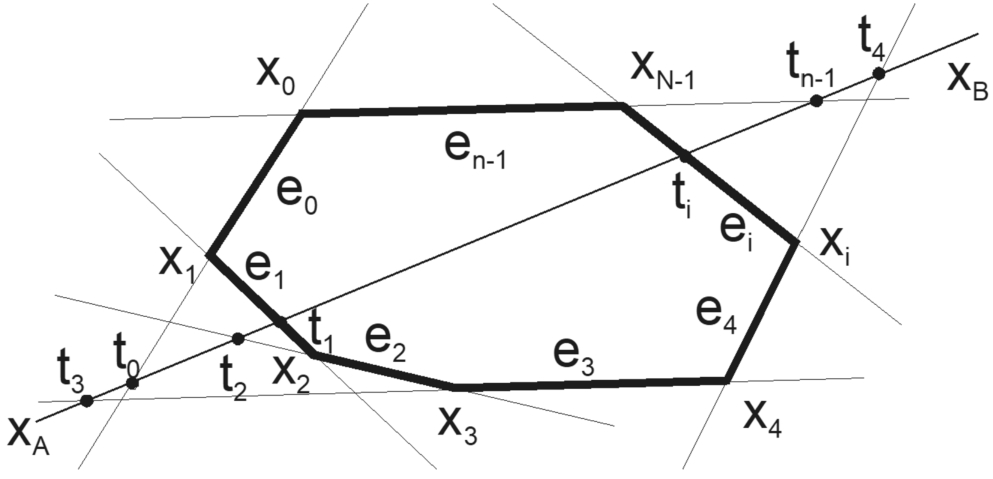
Cyrus-Beck line clipping algorithm.
The Cyrus-Beck’s algorithm is based on direct intersection computation of the given line p in the parametric form and a line on which the polygon edge
Solving those equations, the parameter t for the intersection point is obtained as:
It is hard to detect and solve such cases reliably and programmers usually use a sequence like
However, textbooks do not point out such dangerous construction as far as robustness and computational stability are concerned.
The modification of the Cyrus-Beck’s algorithm using the cross product for more reliable detection of the “close to singular” cases was described by Skala (1993). Probably the most reliable modification of the Cyrus-Beck’s algorithm is to use:
a separation implicit function
the parametric form of the given line for intersection computation with the found edges intersected, see Eq. (12).
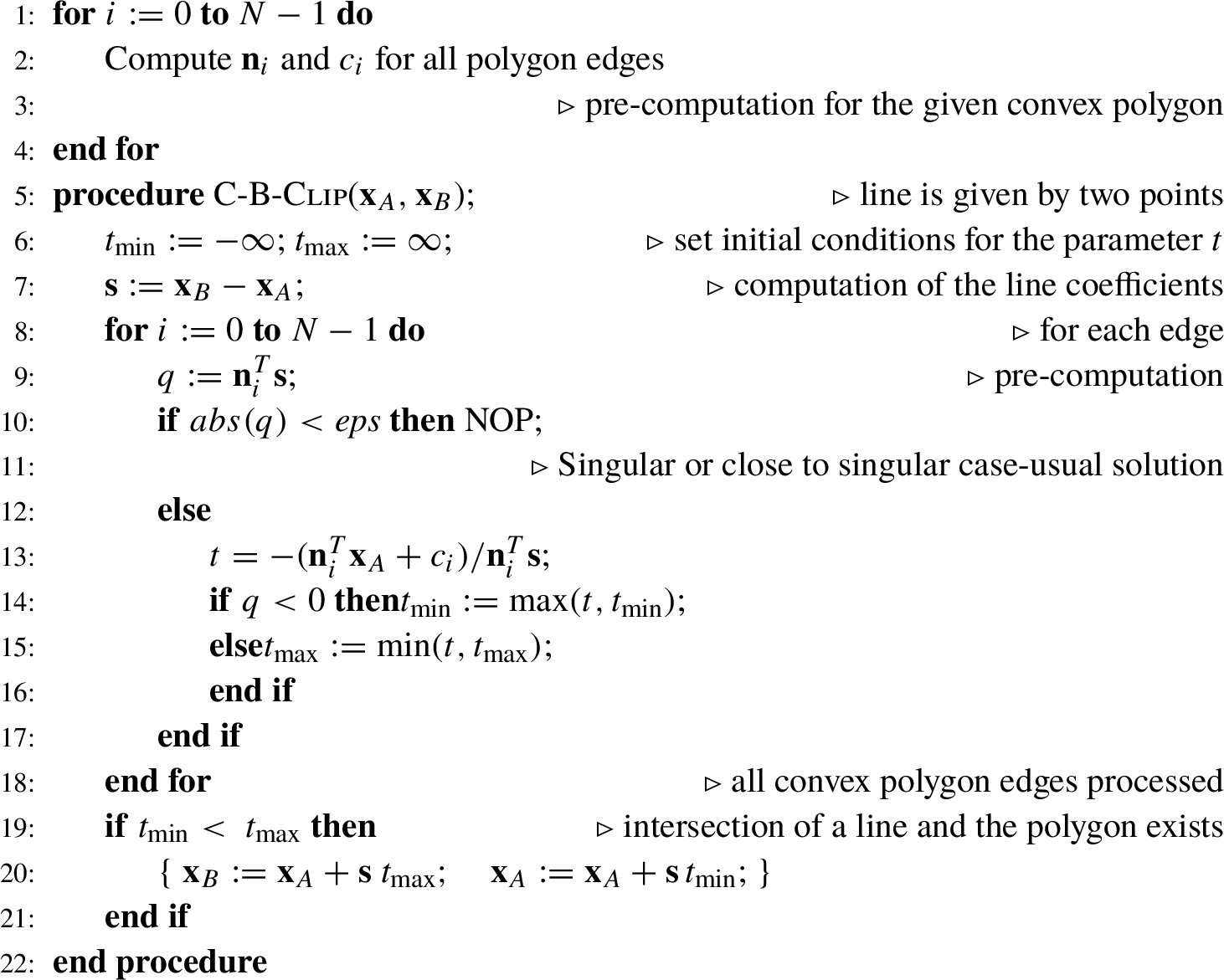
Cyrus-Beck’s line clipping algorithm
The Cyrus-Beck’s algorithm for a line clipping is described by Algorithm 2. It can be easily modified for the line segment clipping just restricting the range of the parameter t to
However, only 2 values (
Some improvements and modifications were described by Skala (1993). As the edges of the convex polygon are ordered, the algorithm with the
Another approach based on the implicit form of the given line and convex polygon vertices classification, the S-Clip algorithm, was developed in Skala (2021c) and modified by Konashkova (2014, 2015). Another algorithm based on the S-Clip algorithm was described in Skala (2021c). An algorithm for a line segment clipping based on the line segment end-points evaluation with the
The Liang-Barsky algorithm (Liang and Barsky, 1984, 1983) based on direct intersection computation of a line with the convex polygon edges in the parametric form has the
The algorithm with the run-time
Other related algorithms or modifications of existing ones were published by: Li (2005), Nishita and Johan (1999), Raja (2019), Sun et al. (2006), Vatti (1992), Wang et al. (2005), Wijeweera et al. (2019), Sharma and Kaur (2016), Sharma and Manohar (1992) use the affine transformation.
Probably, the first algorithm dealing with the non-convex polygon clipping was published in the Reentrant polygon clipping algorithm paper (Sutherland and Hodgman, 1974), followed by the Weiler-Atherton algorithm for polygon-polygon clipping (Weiler, 1980; Weiler and Atherton, 1977; Rappoport, 1991).
Intersections with arbitrary non-convex polygons were described in Greiner and Hormann (1998) and solutions of “the singular” (degenerated) cases were described in Foster et al. (2019). The algorithm (Skala, 1989) uses a three-value logic.
A robust solution of triangle-triangle intersection in
Algorithms that also handle arcs and use a three-value logic to handle singular cases properly, including self-intersecting non-convex polygons, were described in Skala (2015, 1989, 1990a), Wang and Chong (2016), Tran (1986).
Non-Polygonal Window
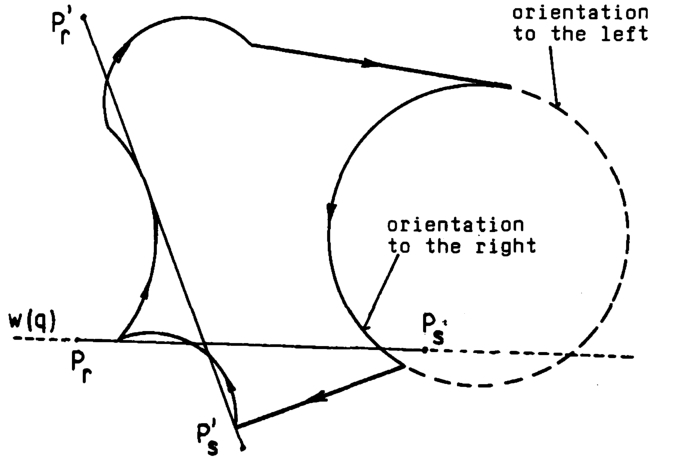
Line clipping by an area with circular segments (taken from Skala, 1989).
The algorithm for circular arc was described in Van Wyk (1984), Gupta et al. (2016), for overlapping areas by Li et al. (2012) and for circular window in Lu et al. (2002b), Kumar et al. (2018), Wu and Li (2022), Wu et al. (2006), Skala (1989), see Fig. 7. The above-mentioned algorithms lead to algorithms for set operations with polygons, i.e. union, intersection etc. of polygons described, e.g. Kui Liu et al. (2007), Martinez et al. (2009).
Homogeneous coordinates are used in computer graphics not only for geometric transformations. Sproull and Sutherland (1968) used the homogeneous coordinates in the Clipping divider in 1968. Arokiasamy (1989) used them with duality in 1989, Blinn (1991), Blinn and Newell (1978) described the clipping pipeline using the projective extension of the Euclidean space and Nielsen (1995) described the use of semi-homogeneous coordinates for clipping. New approach to 2D clipping based on the separation of the convex polygon vertices by the given line was presented in Kolingerová (1994, 1997) and Skala (2004, 2005, 2012, 2020).
In the following, algorithms related to the intersection in 3D will be briefly mentioned in a short introductory overview.
Intersection Algorithms in 3D
Intersection algorithms in 3D are widely used in many applications. An overview of the clipping algorithms is given in the Bui’s PhD (Bui, 1999). The intersection of a line segment with a polygon in 3D was studied in Segura and Feito (1998) and the intersection of polygonal models was analysed by Melero et al. (2019). Algorithms for 3D clipping were overviewed in Skala (1990b) and reliable intersection tests with geometrical objects were published by Held (1998). Boolean operations with polygonal and polyhedral meshes were described by Landier (2017).
Line-Viewing Pyramid
Special attention was recently given to a line clipping by a pyramid in 3D due to the perspective pyramid clipping. The problem was analysed recently by Cohen (1969), Sproull and Sutherland (1968), Blinn (1991), Blinn and Newell (1978), Skala and Bui (2000, 2001).
Convex Polyhedron Case
The Cyrus-Beck’s algorithm (Cyrus and Beck, 1978) is probably the famous algorithm for the line-convex polyhedron clipping in
The algorithm with the
Using pre-computation, the algorithm in
Ray-Convex Polyhedron
The Moeller-Trumbore algorithm for a ray-triangle intersection was published in Möller and Trumbore (1997). Since then many modifications and approaches have been published, e.g. Xiao et al. (2020) using GPUs, Skala (2010, 2008a) uses the computation of the barycentric coordinates in the homogeneous coordinates, Rajan et al. (2020) uses dual-precision fixed-point arithmetic for low-power ray-triangle intersections. Platis and Theoharis (2003) published an algorithm for a ray-tetrahedron intersection using the Plücker coordinates. The intersection with the AABBox is described in Eisemann et al. (2007), Kodituwakku and Wijeweera (2012), Maonica et al. (2017) and Mahovsky and Wyvill (2004). Other algorithms are available in Sharma and Manohar (1993), Skala (1996a), Williams et al. (2005), Llanas and Sainz (2012). The 3D line segment-triangle intersection algorithm is described in Jokanovic (2019), Amanatides and Choi (1995), Lagae and Dutré (2005) (in 2D only) and a ray/convex polyhedron intersection was described in Zheng and Millham (1991). Intersection of a line or a ray with a triangle using the SSE4 instructions was developed and described in Havel and Herout (2010). An extensive list of relevant publications can be found via Wikipedia (2021c).
Intersection with Complex Objects
The intersection computation with implicitly defined objects was published by Petrie and Mills (2020), intersection with a torus was published by Cychosz (1991) and alternative formulations were given in Skala (2013a). Reshetov (2022) published an efficient algorithm for a ray/ribbon intersections computation, ray tracing of 3D Bézier curves given by Reshetov (2017) and a ray/bilinear patch intersection (Reshetov, 2019). The intersection with general quadrics using the homogeneous coordinates was described in Skala (2015) and clipping by a spherical window was published by Deng et al. (2006).
However, as polygonal models are mostly formed by triangular surfaces, a special attention is also targeted to triangle-triangle intersections.
Triangle-Triangle Intersection in 3D
The computation of the intersection of triangles is probably the most important, as nearly all Computer Aided Design (CAD) systems depend on efficient, robust and reliable computation. Figures 8 and 9 present the non-trivial cases, when triangles are split into a set of triangles, which potentially leads to an explosion of small triangles and numerical and robustness problems.
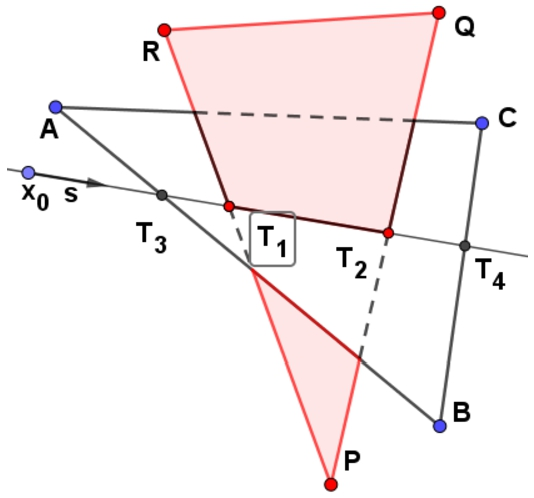
Triangle-triangle intersection case-1.
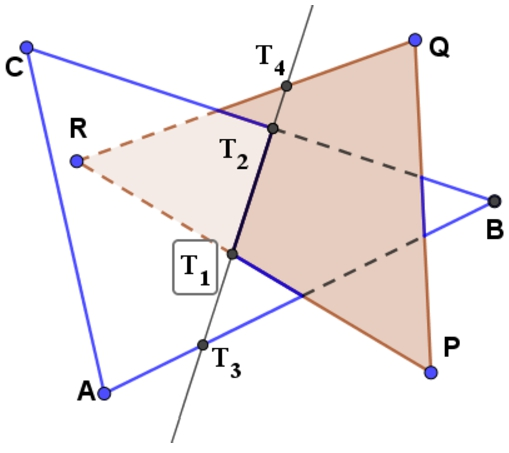
Triangle-triangle intersection case-2.
In the CAD systems, two different data sets are usually used: set of triangles – there is no connection between triangles; typical example is the STL format for the 3D print, triangular mesh – there is information on the neighbours of the given triangles and triangles sharing the given vertex; a typical example is the winged edge or the half-edge data structures, etc.
An efficient triangle-triangle intersection algorithm was developed by Möller (1997). It is based on the mutual triangle intersection with the plane of the other. Other methods or approaches were described by Chang and Kim (2009), Danaei et al. (2017), Devillers and Guigue (2002), Elsheikh and Elsheikh (2014), Guigue and Devillers (2003), Held (1998), Sabharwal and Leopold (2016), Sabharwal et al. (2013), Sabharwal and Leopold (2015), Shen et al. (2003), Tropp et al. (2006), Roy and Dasari (1998), Wei (2014), Ye et al. (2015). A deep analysis of possible situations is given in Lo and Wang (2004). Robust and reliable solution of the triangle-triangle intersection was developed by Mccoid and Gander (2022).
Clipping triangular strips using homogeneous coordinates was described by Maillot (1991) in GEM II (Arvo, 1991). Parallel exact algorithm for the intersection of large 3D triangular meshes was described in de Magalhães et al. (2020) and a comparison of triangle-triangle tests on GPU was described in Xiao et al. (2020). Triangular mesh repair was described by McLaurin et al. (2013).
This contribution briefly summarizes known clipping algorithms with some extent to the intersection in 3D and ray-tracing related algorithms. The list of published papers related to clipping algorithms should be complete to the author’s knowledge and extensive search via Web of Science, Scopus, Research Gate and WEB search with the related topics. The relevant DOIs were included, if found. If other source was found, the relevant URL was included.
There is hope that this summary will help researchers, students and software developers to find relevant papers easily.
However, developers are urged to consider a limited precision of the floating-point representation (Wikipedia, 2021b) and handle numerical robustness issues properly for near singular cases in the actual implementations.
Surprisingly, during this summary preparation it was found that there are still some problems to be addressed and explored more deeply, like a robust and efficient intersection of triangular meshes as application of triangle-triangle intersection algorithms tend to lead to inconsistencies, inefficiency and unreliability, in general.
A short list of relevant books and research journals is given in Appendix A.
Footnotes
In mathematics, a different notation
There is a possibility to postpone division operations if the homogeneous coordinates are used, but comparison operations must be modified appropriately (Skala, 2020,  ).
).
Appendix A
There are many books published related to intersection algorithms, clipping and computer graphics, which give more context and deeper understanding, e.g.:
Salomon, D.: The Computer Graphics Manual – Salomon (2011), Salomon, D.: Computer Graphics and Geometric Modelling – Salomon (1999), Agoston, M.K.: Computer Graphics and Geometric Modelling: Mathematics – Agoston (2005), Agoston, M.K.: Computer Graphics and Geometric Modelling: Implementation & Algorithms – Agoston (2004), Lengyel, E.: Mathematics for 3D Game Programming and Computer Graphics – Lengyel (2011), Vince, J.: Introduction to the Mathematics for Computer Graphics – Vince (2010) (basic mathematical description of mathematics for undergraduates), Foley, J.D., van Dam, A., Feiner, S., Hughes, J.F.: Computer graphics – principles and practice – Foley et al. (1990), Hughes, J.F., van Dam, A., McGuire, M., Sklar, D.F., Foley, J.D., Feiner, S.K., Akeley, K.: Computer Graphics – Principles and Practice – Hughes et al. (2014), Ferguson, R.S.: Practical Algorithms for 3D Computer Graphics – Ferguson (2013), Shirley, P., Marschner, S.: Fundamentals of Computer Graphics – Shirley and Marschner (2009), Marschner, S., Shirley, P.: Fundamentals of Computer Graphics – Marschner and Shirley (2016), Theoharis, T., Platis, N., Papaioannou, G., Patrikalakis, N.: Graphics and Visualization: Principles & Algorithms – Theoharis et al. (2008), Comninos, P.: Mathematical and Computer Programming Techniques for Computer Graphics – Comninos (2005), Schneider, P.J., Eberly, D.H.: Geometric Tools for Computer Graphics – Schneider and Eberly (2003), Ammeraal, L., Zhang, K.: Computer graphics for Java programmers – Ammeraal and Zhang (2017), Vince, J.: Matrix Transforms for Computer Games and Animation – Vince (2012). Hill, F.S., Kelley, S.M.: Computer Graphics Using OpenGL – Hill and Kelley (2006), Angel, E., Shreiner, D.: Interactive Computer Graphics – Angel and Shreiner (2011), Hearn, D.D., Baker, M.P., Carithers, W.: Computer Graphics with OpenGL – Hearn et al. (2010), Govil-Pai, S.: Principles of Computer Graphics: Theory and Practice Using OpenGL and Maya – Govil-Pai (2005). Vince, J.: Geometric Algebra: An Algebraic System for Computer Games and Animation – Vince (2009), Vince, J.: Geometric Algebra for Computer Graphics – Vince (2008), Dorst, L., Fontijne, D., Mann, S.: Geometric Algebra for Computer Science: An Object-Oriented Approach to Geometry – Dorst et al. (2009), Hildenbrand, D.: Foundations of Geometric Algebra Computing – Hildenbrand (2012), Kanatani, K.: Understanding Geometric Algebra: Hamilton, Grassmann, and Clifford for Computer Vision and Graphics – Kanatani (2015), Calvet, R.G.: Treatise of Plane Geometry through Geometric Algebra – Calvet (2007), Guo, H.: Modern Mathematics and Applications in Computer Graphics and Vision – Guo (2014), Lengyel, E: Mathematics for 3D Game Programming and Computer Graphics – Lengyel (2011), Salomon, D.: Transformations and Projections in Computer Graphics – Salomon (2006), Salomon, D.: The Computer Graphics Manual – Salomon (2006), Pharr, M., Jakob, W., Humphreys, G.: Physically Based Rendering: From Theory to Implementation – Pharr et al. (2016), Thomas, A.: Integrated Graphic and Computer Modelling – Thomas (2008) – describes the implementation of algorithms with examples with assembler codes. Newman, W.M., Sproull, R.F.: Principles of Interactive Computer Graphics – Newman and Sproull (1979), Harrington, S.: Computer Graphics: A Programming Approach – Harrington (1987), Mortenson, M.E.: Computer Graphics: An Introduction to the Mathematics and Geometry – Mortenson (1988), Watt, A.: Fundamentals of Three-Dimensional Computer Graphics – Watt (1993), Akenine-Moller, T., Haines, E., Hoffman, N.: Real-Time Rendering – Akenine-Moller et al. (2008), Eberly, D.H.: Game Physics – Eberly (2003), Rogers, D.F., Adams, J.A.: Mathematical Elements for Computer Graphics – Rogers and Adams (1989). Graphics Gems, Ed. Glassner, A. – Glassner (1990), Graphics Gems II, Ed. Arvo, J. – Arvo (1991), Graphics Gems III, Ed. Kirk, D. – Kirk (1992), Graphics Gems IV, Ed. Heckbert, P.S. – Heckbert (1994). ACM Transactions on Graphics (TOG), Computer Graphics Forum (CGF), Computers & Graphics (C&G), IEEE Trans. on Visualization and Computer Graphics (TVCG), The Visual Computer (TVC), Computer Animation and Virtual Worlds (CAVW), Journal of Graphics Tools (JGT), Graphical Models.
There are also computer graphics books using OpenGL interface, e.g.:
More advanced books using Geometric Algebra and Conformal Geometric Algebra approaches are recommended for a deeper study, e.g.:
It is also recommended to study “the historical” books, e.g.:
Many algorithms with codes are presented in GEMS books:
and in the leading computer graphics journals:
The books mentioned above present a wide variety of intersection algorithm principles and applications.
Acknowledgements
The author would like to thank colleagues and students at the University of West Bohemia in Pilsen, VSB-Technical University and Ostrava University in Ostrava for their comments and recommendations, anonymous reviewers for hints and constructive suggestions.
The author is also grateful to several authors of recently published relevant papers for sharing their views and hints provided.