




Abstract
In this study, Intuitionistic Fuzzy Consistency Method (IF-FUCOM) and Grey Relation Analysis (GRA) were combined to assess the effects of Bacillus subtilis bacteria on concrete properties, as well as to determine the optimal bacteria concentration and curing day. Three different concentrations of bacteria were added to the mortar mixes, like 103, 105, and 107 cells/ml of water. Mortar samples were left to cure for 7 days, 14 days, and 28 days to evaluate compressive strength, water absorption, crack healing. According to the proposed algorithm, 105 bacteria are the optimal concentration, while 28 days is the ideal curing time.
Introduction
Structures must become stronger, faster, and more versatile, as well as more durable, with a huge increase in the amount of cement used in the process. Most construction projects today use Portland cement concrete, which is the predominant type of concrete. Because of the low cost of construction materials and the ease of maintenance, concrete structures can be built and maintained.
Recent research found that a biomaterial can be used to treat concrete cracks (Van Tittelboom et al., 2010; Ramachandran et al., 2001). Scientists have discovered that inorganic substances that are deposited by microorganisms inside cement-sand mortar or the pores of concrete can be used for filling cracks (Ghosh et al., 2005; Ramakrishnan et al., 1999). A concrete structure’s inherent weakness is its vulnerability to cracks that allow water to penetrate, causing corrosion and reducing its durability (Chahal et al., 2012).
Ramachandran et al. (2001) pioneered microbial concrete, and since then there has been a considerable volume of research on the topic. As ureolytic bacteria are alkali-resistant and nutrition is not necessary for survival for hundreds of years, the researchers examined Bacillus sphaericus, Sporosarcina pasteurii, and Bacillus megaterium (Arunachalam et al., 2010; Dhami et al., 2013; Achal et al., 2011). In some studies, researchers examined the effects of adding bacteria to concrete on its compressive strength and crack healing. The findings reflect that most of them considered bacterial concentrations between 103 to 107 cells/ml when considering strength enhancement. Contrary to crack healing, researchers use higher concentrations of bacterial cells (107–109 cells/ml) (Majumdar et al., 2012; Mondal and Ghosh, 2018; De Muynck et al., 2008).
The versatility of concrete makes it a popular choice for building materials. Locally available, strong and durable, it is versatile. Despite its capability to resist compression loads to a limit, if the load applied on the concrete exceeds their limit of load resistance, it results in cracks in the concrete, which lowers its strength. Concrete’s serviceability limit is affected by cracks. Concrete may become weaker and less durable as moisture and other chemicals get into it. In addition to that, water absorption is another major issue that reduces the life of concrete. Researchers are currently using bacteria to treat concrete mortar to overcome the problems. The selection of an optimal bacteria concentration and curing day can also pose a problem. Grey Relational Analysis (GRA) can be used in this field to find an optimal solution, since various researchers use it in different fields as an optimization technique (Dagdevir and Ozceyhan, 2021; Güler et al., 2021; Roy et al., 2016; Si et al., 2021). A major drawback of GRA is that it assigns a similar weight to all output characteristics, even though in practice not all output characteristics are equally important (Fangfang, 2021). To overcome the problem, some researchers are using Analytical Hierarchy Process (AHP) along with GRA (Erdoğan and Sayin, 2018; Erdoğan et al., 2020). An advantage, as well as a reason for using the AHP method, is that results can be validated by determining the consistency of the model with actual data. A study suggests that comparing pairwise across nine criteria by the AHP method is extremely difficult since it requires a great deal of comparisons
The BWM has been shown to be able to resolve certain of the previously listed constraints associated with AHP models (Rezaei, 2015). Compared to AHP’s many pairwise comparisons, BWM does only a small number, such as
FUCOM uses pairwise comparisons of criteria to determine criteria priority, and it validates results across a wide range of deviations from maximum consistency in order to determine criteria priority (Pamučar et al., 2018b). As compared to BWM and AHP tools, FUCOM eliminates some of their weaknesses. When using FUCOM, criteria can be compared in pairs (
The drawback of fuzzy sets is that, in some circumstances, it can be quite challenging to determine a precise membership mapping for a fuzzy set (Chiao, 2016). An intuitionistic fuzzy set (IFS), which Krassimir and Parvathi proposed in 1986, is a generalized fuzzy set that considers membership and non-membership degrees, as well as hesitation degrees. IFS can handle ambiguous information in a flexible manner (Gong et al., 2014). As a result, specialists have been paying more and more attention to the IFS, which is now being used in many other domains, including decision-making (Gong et al., 2014). This study addresses a vacuum in the literature, since, as far as the authors are aware, the FUCOM has not yet been used to intuitionistic contexts. In fact, extending FUCOM’s research to the intuitionistic fuzzy environment is motivated in part by this.
In this study, Section 2 discusses IF-FUCOM-GRA, while Section 3 discusses step-by-step methodology with experimental details and results. Results of each method listed in Section 3 are presented in Section 4 in a step-by-step manner. Sections 5 and 6 represent the discussion and conclusion sections, respectively. Motivation of the work: However, despite the fact that many researchers have studied the effects of Bacillus subtilis bacteria on concrete properties, no studies have evaluated the optimal concentration of bacteria as per the above discussed literature. Therefore, the purpose of this study is to determine the optimal bacteria concentration as well as the effect of bacteria on concrete mortar. Intuitionistic Fuzzy FUCOM Grey Relations Analysis has never been used to determine the optimal value in such an environment. Novelty of the work: In this paper, IF-FUCOM is developed that can be used to better define the weight coefficients of criteria. A detailed algorithm is used in this study to calculate the weights of criteria in the intuitionistic fuzzy environment. A new model for dealing with uncertainty bridges the gap between criteria weight coefficients and intuitionistic fuzzy numbers. In order to improve the methodology, a hybrid IF-FUCOM-GRA method has been proposed. It combines novel IF-FUCOM and existing GRA techniques. In this study, the optimal bacteria concentration and curing day for concrete is determined based on its compressive strength, crack healing, and water absorption. The novel IF-FUCOM-GRA method is used to select the perfect bacteria and cure day.
IF-FUCOM-AHP has two phases, IF-FUCOM and IF-AHP, which are discussed respectively in Phases I and II. Phase I and Phase II discussed how to analyse criteria and alternatives to determine the priority value of criteria and alternatives. Figure 1 depicts the proposed method’s computational procedure. Figure 1 illustrates how the method is computed.
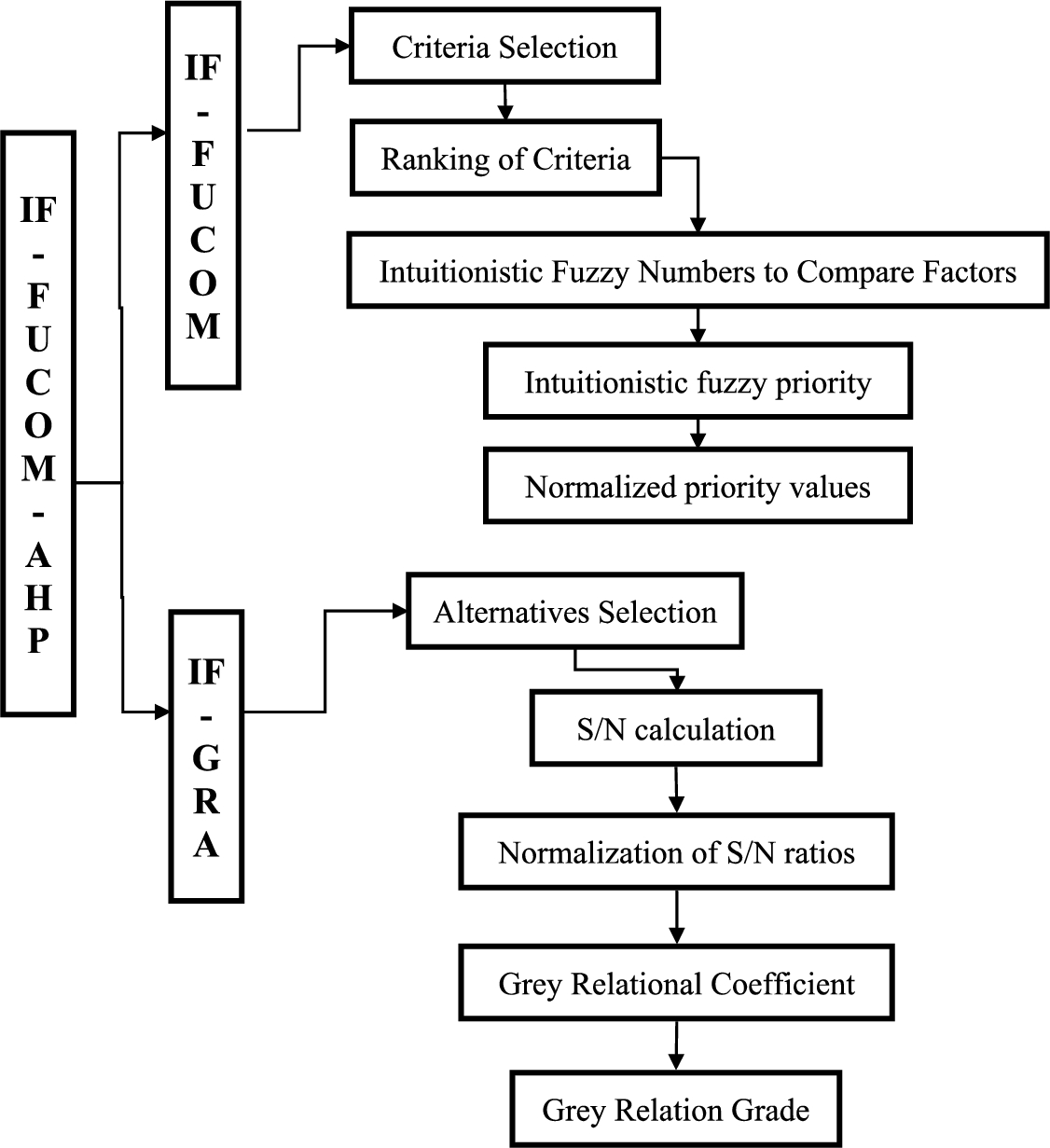
Total scenario of proposed method.
In order to determine the priority value of criteria, FUCOM is used. It is proposed that a modified fuzzy FUCOM approach is used in the current study called Intuitionistic Fuzzy Full Consistency Method (IF-FUCOM) to find the priority values of each criterion. Five steps make up IF-FUCOM. Following are the steps:
Nine-point triangular intuitionistic fuzzy scale (Otay et al., 2017).
The final nonlinear model for computing the ideal Intuitionistic fuzzy values of the relative weights of each factor can then be set to
The highest consistency can only be obtained by following the condition that
Convert optimal Intuitionistic fuzzy priority value
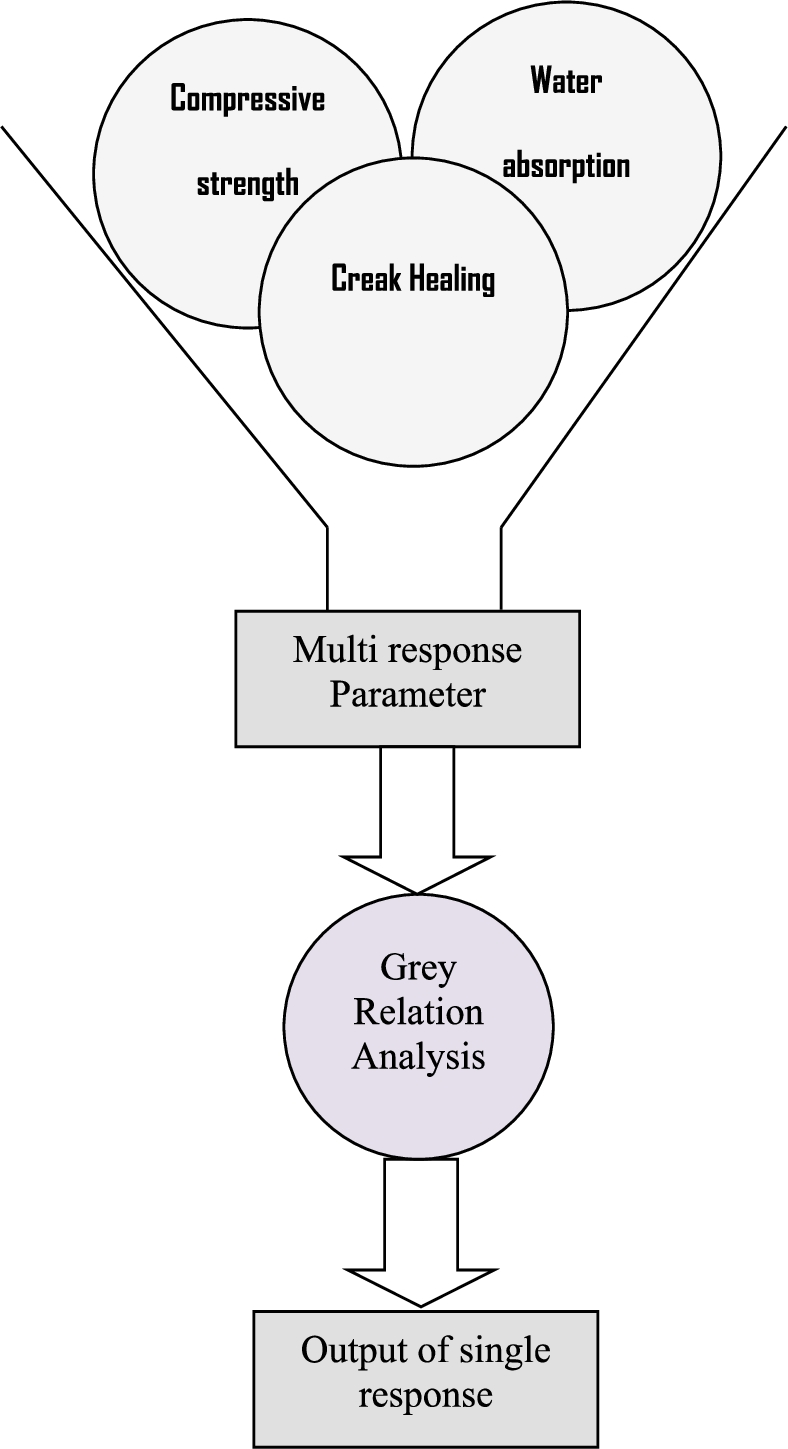
Graph of a straightforward grey relational analysis.
The grey theory is an immense concept used to explore uncertainty, multi-input, and discrete data. Decision analysis is used to estimate the degree of relation according to the grey relational grade. A multi-objective optimization makes it more complex to analyse the effects and relationships between design factors in experiments at their various levels that result uncertain and insignificant information. In this paper, GRA is proposed for investigating and optimizing the complexity of multi-variable problems by exploiting the concept of information. As shown in Fig. 2, GRA reduces a multi-objective question to a single objective answer (referred to as single relational grade).
The present study is conducted based upon Taguchi’s orthogonal array, which corresponds to nine trails, where every trail is known as a comparison sequence. The GRA places these trails into nine subsystems. The effect of these factors on the outcome variable is assessed through regression analysis. Using GRA, the multi-objective problem is transformed into a single-objective problem by using the parameters corresponding to the greatest weighted grey relational grade.
Greater, nominal, and lower signal-to-noise ratio analyses are the three possible approaches. For water absorption in this study, smaller-is-better, however, higher-is-better for compressive strength and creak healing. The
To lessen unpredictability, the
The GRC, a series of information, is used by GRA to assess the relevance of two systems. Equation (13) can be used to calculate GRC
In real engineering systems, different parts have different weights based on the circumstances. Then, equation (14) grades the grey relational coefficient (GRC) (Saaty, 1980).
The objective of this study is to find the optimal bacterial concentrations and curing days for concrete simultaneously while considering compressive strength (CS), crack healing (CH) and water absorption (WA) as outputs using a novel MCDM technique. During the present investigation, there are six phases. A schematic representation of the detailed methodology is shown in Fig. 3.
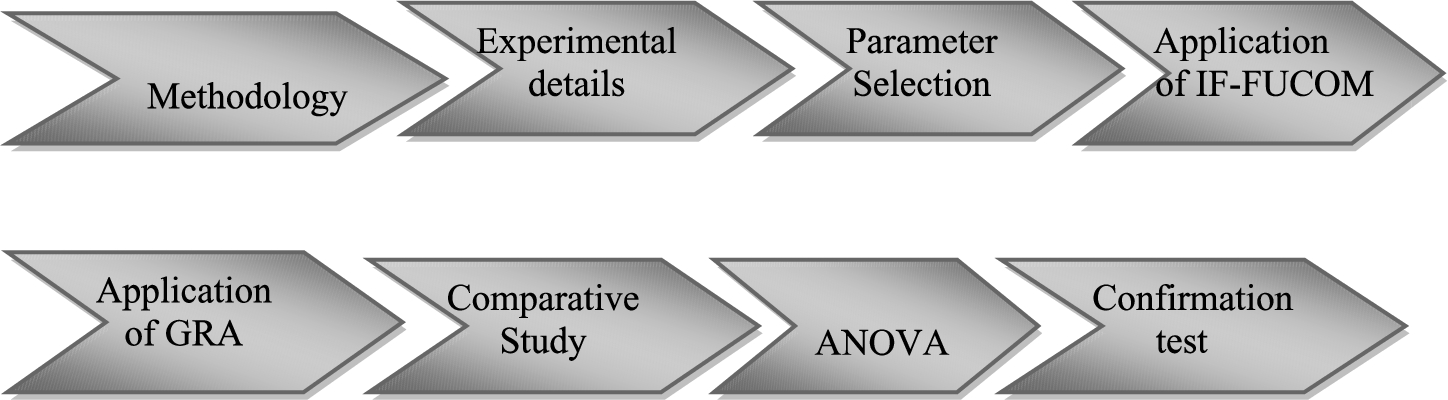
A diagrammatic representation of the methodology.
This section explains the material choice, the bacteria mixing process, and several tests like compressive strength and water absorption.
Ordinary Portland Cement (OPC) 43 Grade conforms to IS 8112 : 2013, locally available Fine Aggregate, Bacillus Subtilis and potable water is used in this study. Here cement to sand ratio and water to cement ratio were 1 : 3 and 0.4 (by weight) respectively. For preparing mortar water, distilled water is used. Mortar cubes of dimension 70.6 mm3 are prepared for both control and bacterial mortar specimens. In fresh water, curing can be conducted at room temperature 27 °C. According to information provided by the manufacturer, OPC cement’s chemical composition and physical properties are presented in Table 2.
Composition and physical properties of cement.
For this experimental work, selected bacterial sample Bacillus Subtilisis is used in this study. For bacterial culture nutrient broth was made (1.0 gm/lBeef Extract, 5.0 gm/lPeptone, 2.0 gm/lYeast Extract, 5.0 gm/NaCl). Growth conditions of Bacteria are maintained at 37 °C temperature. After 6–7 days, about 10 μl of the nutrient broth is obtained and haemocytometer counting is done. Here, the bacterial concentrations in solution used are
Cement and sand is well mixed in 1:3 proportions and a mixture of water and the needed cell concentration is then prepared. After casting and compacting in a vibration machine, specimens are removed and compression tests are performed after 3, 7, 14 and 28 days in air at room temperature (30 °C).
Compressive strength and water absorption of control and bacterial mortar cubes are measured in 3, 7 and 28 days after curing. The compressive strength test was done under compression testing machine.
A 28-day crack healing test is performed on microbial concrete to determine its self-healing ability at different bacteria concentrations. The crack-measuring instrument measured the crack widths. In this study, crack widths range from 0.11 mm to 1.5 mm; water is used to immerse the cracked specimens and their crack dimensions are recorded after 3, 7 and 28 days.
Levels and values of the input parameters.
The PV of each criterion and alternative will be calculated in the section that follows. In the present study, compressive strength (
For the present study, the design factors chosen are bacteria concentration and curing day so as to determine their influence on the outcome parameters of compressive strength, crack healing, and water absorption. Table 3 represents the levels of input parameters (bacteria concentration and curing day) that are considered as control factors for the experiment. In Table 4, based on the number of tests, a Taguchi L9 (32) orthogonal array comprising 9 rows has been calculated.
Results of an experiment using
Collect all factors based on the literature review, and then send them to three experts, and expert responds. Following the determination of the first-level criteria, the ranking is determined on a second level. Dimensions are ranked in this order:
A linguistic assessments of the main dimensions.
The fuzzy linguistic scale was used to transform linguistic variables into Intuitionistic fuzzy numbers (IFNs), as shown in Table 6.
Evaluations transformed by IFNs.
According to expression (1), the relative importance of the criteria is as follows:
To calculate the score, gray relation grading is used after determining the relative weights of each criterion. GRCs are used to calculate gray reasoning grades using equation (14). GRCs are weighted from 0 to 1. IF-FUCOM decides the weight of each characteristic. A gray relational grade of the higher value indicates greater desirability.
A comparative research can identify and quantify the relationships between at least two factors by studying different groups that have been exposed to diverse treatments either by choice or circumstance. A relative study is made possible by contrasting two sets of individuals, entities, or circumstances. In the current work, the proposed technique has been contrasted with three sophisticated models.
Here are three mathematical formulations of the models discussed below.
The weights of the different criteria are determined by experts within related fields who collaborate in a pairwise comparison between each criterion. This comparison matrix is shown below: 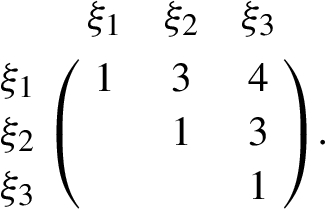
For the purpose of weighing the criteria in BWM, relevant experts are asked to identify the most and least significant factors in the case study, along with the best-to-others and other-to-worst vectors. According to expert consensus,
Best to others criteria.
Others to worst criteria.
The weight of each criterion can be calculated, as well as the consistency rate, using the non-linear mathematical model.
The criteria are ranked in order of importance. The ranking is determined by consensus among experts. According to experts, the relation (17) criteria are ranked. Comparisons are based on a scale of Van Tittelboom et al. (2010), Achal et al. (2011), which is shown in Table 9.
Comparative significance levels for the evaluation criteria.
The relative importance of each criterion can be gauged by calculating the comparison importance values based on the obtained importance values
The final weight coefficients can be determined by applying expression (18)
Statistically, the difference among available scores can be evaluated through Analysis of Variance (ANOVA). In ANOVA, the level of contribution of each of the chosen parameter values over the output responses is analysed (Pattnaik et al., 2013). ANOVA results can be used to determine which variables are responsible for the performance of a selected process and to control these variables to obtain a better result. ANOVA cannot provide data analysis, but this statistical method can assess variance of the data.
A confirmation test is done to verify the forecast and the outcome after the
The six parts of the proposed model are described in the results section.
In the following, all phases are discussed in detail.
To assess the impact of each parameter, the SN ratio of every trail is computed based on equation (9) for compressive strength and equation (10) for crack healing and water absorption. Equations (11) and (12) are used to normalize the acquired value of the SN ratio while taking the higher-the-better and smaller-the-better qualities into consideration, respectively. Equation (13) is used to calculate the GRC after determining the normalized SN ratios for each investigation. Table 10 displays the SN ratios of the output parameters together with the corresponding GRCs.
SN ratioand GRC associated with output parameter.
SN ratioand GRC associated with output parameter.
The IF-FUCOM-GRG result is divided into two parts, namely the result of IF-FUCOM and the result of GRG. All the parts are discussed below.
The best values of the criteria can be found by solving the fuzzy linear model in equation (11), which is shown.
The weight coefficients for the criteria compressive strength
Next, use equations (7) to calculate the crisp weights for the criteria compressive strength (
Use equation (8) to calculate normalized weights for these three criteria, which are 0.499, 0.245, and 0.256.
The weights of the compressive strength (
In GRA, the relative weights of the criteria are obtained by IF-FUCOM. After determining the relative weights of the criteria, the score is calculated using grey relation grading. Using equation (16), GRCs are used to calculate the different grey reasoning grades. GRCs are weighted from 0 to 1, with
Gray relational grade determined by IF-FUCOM.
This study validates the result of the proposed model by comparing it to three existing MCDM techniques. There are four steps in this phase. Determine the PV for each criterion using AHP, BWM, and FUCOM methods in the first three steps. As a last step, determine the weights of the alternatives using GRA.
Calculate the priority value of each criterion using the AHP algorithm as described in Section. The priority value of criteria are
Based on the solution to the above BWM-model (16), the following criteria weights are optimal:
Based on the solution to the above model (18), the following criteria weights are optimal:
In GRA, the relative weights of the criteria are obtained by AHP, BWM, and FUCOM. After determining the relative weights of the criteria, the score is calculated using grey relation grading. Using equation (16), GRCs are used to calculate the different grey reasoning grades. GRCs are weighted from 0 to 1, with
Gray relational grade determined by different MCDM techniques.
The
IF-FUCOM-GRG response table.
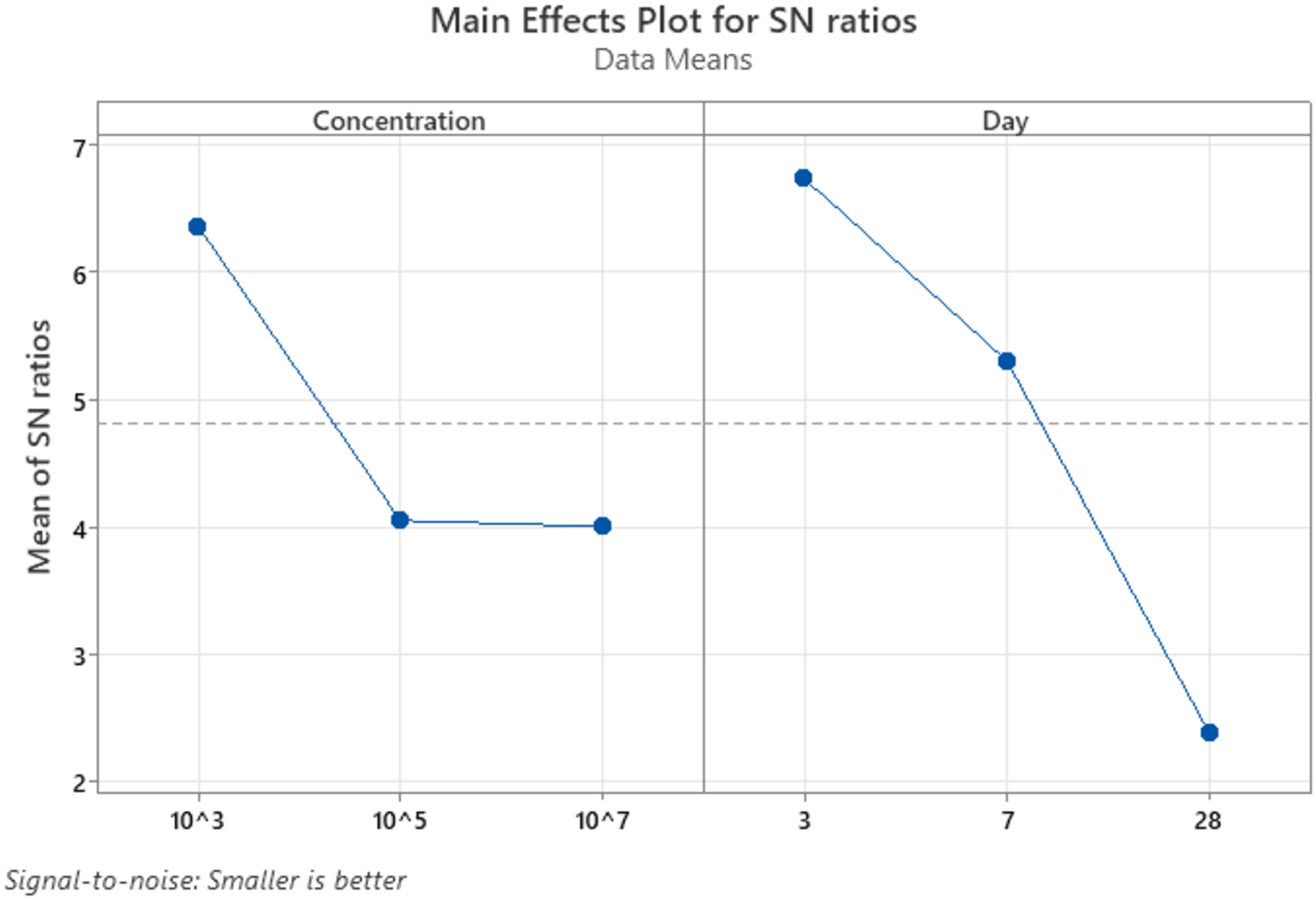
Response of the IF-FUCOM-GRG SN ratio.
ANOVA is employed to determine whether design elements have a substantial impact on response (Haq et al., 2008). ANOVA may examine the percentage importance of input factors. When
Results of the ANOVA for the IF-FUCOM-GRG.
In Table 15, the optimal output parameter is tested for actual and predicted IF-FUCOM-GRA values. Equation (19) predicts the IF-FUCOM-GRA values provided at the optimal output. IF-FUCOM-GRA, as predicted and experimentally determined as an optimum level, are 0.818256 and 0.88929, respectively.
Confirmation test table.
In this study, three criteria, crack healing, water absorption, and compressive strength, are used to determine the optimal bacteria concentration and curing day. The values that corresponded to all three criteria are obtained through experimentation. Using the experimental data, equation (16) calculates the gray relation coefficient. A variety of MCDM techniques are used for weighting criteria, including BWM, AHP, FUCOM, and intuitive fuzzy FUCOM. After that, a comparative study has been conducted among AHP-GRG, FUCOM-GRG, BWM-GRG, and IF-FUCOM-GRG. The comparison shows that IF-FUCOM-GRG produces similar rankings to other methods in most cases. Based on the proposed method, the optimal bacteria concentration is 105, and the optimal curing time is 28 days. The confirmation test result shown in Table 15 predicts IF-FUCOM-GRA grade pretty well, and is almost in agreement with the experimental results.
Conclusion
MCDM problems are solved by considering different levels of importance of the criteria. A number of weighting methods have been used in the literature to determine the importance levels of expert opinions, including SAW, AHP/ANP, SWARA, BWM, and FUCOM. The fuzzy set theory can be used to solve ambiguous and vague problems. It is possible to improve the reliability of these weighting methods by incorporating fuzzy set theory, which reflects the way humans think and reason. The intuitionistic fuzzy set solves this problem by defining the non-membership degree and the two membership levels for each element. In this study, intuitionistic fuzzy sets are combined with FUCOM to come up with the Intuitionistic Fuzzy FUCOM (IF-FUCOM). Moreover, linguistic variables are used instead of crisp values in pairwise comparisons for criteria in the decision-making process.
In comparison to the IF-BWM and IF-AHP models, the IF-FUCOM model has the advantage of offering similar results by using only
In the present study, Intuitionistic Fuzzy FUCOM Grey Relations Analysis is used to select optimal bacteria concentrations and optimal curing time in days. The proposed algorithm obtains a grey reasoning grade according to the grey relational coefficients of each test run in order to convert multi-response optimization to single objective optimization. The intuitionist fuzzy-FUCOM-grey reasoning grades (IF-FUCOM-GRG) are compared with different grades like AHP-grey reasoning grade (AHP-GRG), BWM-grey reasoning grade (BWM-GRG), FUCOM-grey reasoning grade (FUCOM-GRG). All the algorithms have been employed to obtain the optimal input factor corresponding to the estimated values of output response. IF-FUCOM-GRG produces similar rankings with other methods in most cases, but in some cases it produces better results. According to the proposed method, the optimal bacteria concentration is 105, and the optimal curing time is 28 days. Using a confirmation experiment, the computed factor combination based on the highest ranking of IF-FUCOM-GRG is validated.
Limitations of the study:
There are three criteria used in this study to select the best bacteria concentration and curing time. However, the results may vary if other criteria are added.
The ranking order may change as the number of alternatives increases, which is the shortcoming of this model.
Future scope:
In the future, the proposed method can be applied to all fields of science, engineering, and social sciences. Additionally, this method can be used in conjunction with other ranking methods (COPRAS, CODAS, ARAS, TOPSIS, EDAS, MAIRCA, etc.) to select the most appropriate alternative to solve MCDM problems.
This study found optimal bacteria concentrations in concrete mortar, but optimal bacteria concentrations can also be found when cement is partially replaced by other additives like rice husk, fly ash, etc.