




Abstract
In this paper, we propose a light-weight electronic voting protocol. The approach used by our protocol to conceal the ballots does not imply encryption, and guarantees the privacy of the direction of the vote unless all the contestants (parties) agree to do so. Our method is based on the division of the ballot into different pieces of information, which separately reveal no information at all, and that can be latter aggregated to recover the original vote. We show that, despite its simplicity, this scheme is powerful, it does not sacrifice any of the security properties demanded in a formal electronic voting protocol, and, furthermore, even in post-quantum scenarios, neither the casted votes can be tampered with, nor the identity of any elector can be linked with the direction of her vote.
Introduction
Electronic voting introduces a new set of cryptographic properties, to provide confidence to the electors, such as: universal verifiablity, accuracy or mathematically ensured privacy, that are unavailable to traditional voting. It also enables remote voting and multi-device access. Nevertheless, e-voting still fails to gain the trust from the electors and to incentive participation. Most people are reluctant to trust a critical part of democracy to a system they do not fully understand.1
We introduce a voting scheme that makes no use of cryptography without compromising security. Inspired by the work by Shamir (1979), we are able to conceal the vote as fragmented pieces of information. These pieces do not reveal any information about the original vote separately. However, when the pieces are treated as a whole, the vote can be recovered.
Our goal is to create a new, simple, fast and lightweight voting scheme able to engage technology averse and reluctant sectors. The contributions of this paper can be summarized as follows: the voting scheme does not depend on encryption while guaranteeing security; the proposal takes into account that the ballot can be divided into pieces in such a way that any individual pieces does not reveal any vote information; the proposal allows the decentralization of the responsibility of processing the ballots. Overall, our proposal opens the possibility to less conventional electronic voting schemes, looking for other approaches to electronic elections which would reduce reluctance to novice profiles.
The rest of the paper is structured as follows: Section 2 reviews the most relevant literature in electronic voting, Section 4 introduces and fully details our voting protocol, Section 5 analyses the time-complexity of our approach. In Section 6, we review and prove the security properties of our developed scheme. Finally, Section 7 reviews the contributions of our work and concludes the article.
Related Work
In this section, we review the most relevant and similar works in the literature and study how they compare with our presented scheme. Electronic voting is a well-established area of research and many approaches have tackled the problem from different angles.
The first scheme we cite is the Three Ballot voting protocol by Rivest (2006). Although this protocol does not consider digital ballots nor remote casting of them, Rivest’s proposal conceals the electors’ votes without the need of any cryptography, and, therefore, it is related to our approach that neither does so.
Rivest proposes the election to be based on paper ballots. These ballots are formed by three sections which the elector fills according to some rules to show her approval, or rejection, of some candidates. When the ballot is correctly filled, its three sections are separated and casted independently. The elector gets a copy of one of these sections as receipt, to ensure all the votes are counted on the final tally. However, the receipt cannot convince anyone of the direction of the vote. This protocol is extended in Rivest and Smith (2007) in order to make it compatible with any kind of election (e.g.: Borda, Ranking, or Condorcet). Unfortunately, both approaches suffer from the so called “Thee Pattern Attack”, where a coercer may buy or influence votes by requiring the electors to fill the ballots in certain anomalous patterns. Later on, the attacker can check for these patterns on the public bulletin that contains the final tally. This attack does not succeed if the ballot is short, since each pattern is likely to occur many times. However, this short ballot assumption restricts the applicable scenarios for these protocols.
Despite this drawback, these two schemes present simple yet powerful voting protocols. They demonstrate that it is possible to ensure voter’s privacy and vote integrity without encrypting the vote. Similarly to Rivest’s protocol, we deconstruct the ballot in several shares that reveal no information until they are all assembled. However, our proposal allows for a complete electronic voting protocol that is compatible with remote voting and lacks the mentioned weakness that would allow a coercer to know the direction of an elector’s vote.
Rivest’s way of concealing the ballot has not been used outside his proposals. Usually the approach has been electronic and heavily based on cryptography. We now review recent solutions to electronic voting considering the techniques used.
Blind Signatures
Blind signatures were proposed by Chaum (1982), where he presents a method for signing a masked message that cannot be linked to the original content.
In Li et al. (2009), Li et al. introduce a voting system that employs blind signatures to certify the ballot from the multiple authorities involved. The elector obtains a blank ballot from the authentication centre and proceeds to use blind signatures to certify the ballot. Then, the elector removes the blinding factor and the certified ballot is encrypted and sent to a tallying authority. The encryption is used to ensure that the result of the election is kept private until the final tallying. Finally, when the election process finishes, the certification authority reveals the secret key and the tallying authority decrypts, counts and records the votes.
In Nguyen and Dang (2013) the authors present another scheme that uses blind signatures for ballot certification and dynamic ballots to ensure elector’s privacy. Electors register using their personal identification to obtain a digital certificate. Then, to get the signature from the privacy authority, the elector hides his unique id through blind signatures, and sends it together with the serial number of the certificate. To avoid man in the middle attacks, they employ triple DES to encrypt sensible communications. Once the user gets the signature that entitles him to vote, he crafts a dynamic ballot (Cetinkaya and Doganaksoy, 2006) and cast it to the ballot and casting centre. The ballot is encrypted and the elector is required to provide plain-text equivalence tests to proof that the unique identifications are valid.
Another protocol that also employs blind signatures to certify the ballots is described in Larriba et al. (2020). In their work, the authors focus on the efficiency to propose a time-efficient voting scheme that only requires two authorities. In this protocol the elector builds the ballot according some fixed structure. This ballot is blindly signed by an authority that cannot reveal the direction of the vote. The signed ballot is then sent to the authority that plays the role of the polling station. Unless both authorities collude, the method holds all the desired properties.
Plenty of other voting schemes exploit the properties of blind signatures since they provide a flexible method for signing votes and avoiding double voting without compromising elector’s privacy (e.g.: Thi and Dang, 2013; Aziz, 2019; Cruz and Kaji, 2017). Although we also use blind signatures in our scheme, unlike many of the protocols, we do not use them to hide the ballot from unauthorized access.
Homomorphic Cryptography
Homomorphic cryptography allows us to operate with ciphertexts, and obtain, after decryption, the same results as we would obtain working with plain text. This allows to work with sensitive data without needing to know the actual content of the encrypted message. Indeed, blind signatures benefit from the homomorphic cryptography to achieve secure signing. However, please note that homomorphic cryptography allows for many features such as aggregation or proofs-of-inclusion. Many voting protocols employ homomorphic cryptography, usually to aggregate encrypted votes and only decrypt the final result.
In Cramer et al. (1997), the author presents a voting scheme for Yes/No elections based on homomorphic properties. The votes, which are codified as 1 or −1, are encrypted using a threshold El Gamal cryptosystem (ElGamal, 1985). Encrypted votes are then aggregated, since they can be summed as integers, and a final encrypted result is computed. At the end of the election, authorities collaborate to recover the secret key and decrypt the final result.
In Yang et al. (2017, 2018), Yang et al. introduce a homomorphic voting scheme compatible with range voting. Range voting requires electors to assign a numerical score to all candidates for single seat elections. The candidate with the higher score wins. In this system, the votes are structured, and encrypted, as elements in a matrix in which rows represent candidates and columns represent the assigned score. Since votes for the same candidates are placed in the same rows of the matrix, they can be summed altogether to get the final results per candidate. At the end of the election, authorities collaborate to recover the secret key and decrypt the final matrix that agglutinates all the votes.
Ring Signatures
Ring signatures are a special kind of digital signature that allow any user to sign as a member of a collective instead of an individual. The verifier can check that the user who wants to sign belongs to a given group, but cannot identify the signer among the group members.
Tornos et al. (2014) propose a voting scheme that provides signer ambiguity by using ring signatures. A single registration authority is employed to handle proper identification of electors. After the identification process, electors use ring signatures to sign their valid votes privately. To prevent double-voting, they use linking tags in the ring signatures. These tags do not reveal personal information about the signer but prevent her from voting more than once using different rings of users.
In Chen et al. (2008), a voting protocol with custom ring signatures is presented. They propose a ring signature scheme that can only be verified by some designated individuals. These verifiers cannot convince a third party of the integrity of a ring signature without revealing their private key. For the encryption of the vote they employ a threshold scheme in which authorities have to collaborate to recover the secret key at the end of the election. To prevent double voting, electors are required to link the vote with a commitment of their private key. This commitment does not reveal any information about the private key, but prevents malicious electors from voting multiple times. If two, or more, votes with the same commitment are detected, only the one with the latest timestamp will be considered.
Blockchain
Blockchain technology provides a decentralized technology to store and share information. Multiple electronic voting schemes have used blockchain to carry out the election process since they provide a distributed public ledger than can be consulted by anyone. While blockchain is not a cryptographic scheme by itself, and all of these systems use other cryptographic primitives to achieve privacy, it is still a differentiating factor that suffices to make a distinction when studying these protocols.
In Yang et al. (2020), the authors propose a voting protocol for range voting that uses blockchain to structure the election process. In this scheme, each candidate receives a score (e.g.: token on the chain) from the electors and the candidate with the highest score wins the election. To preserve elector’s privacy, they employ an encryption system based on El Gamal and group-based encryption. They employ the homomorphic properties of El Gamal to compute the final tally without compromising individual electors.
In Gao et al. (2019), the authors present an e-voting protocol based on blockchain technology, which also provides anti-quantum resistance properties. To achieve this, they base their method on an NP-complete problem (Niederreiter, 1985) instead of using traditional public key cryptography. Their protocol is equipped with an audit function that allows to detect fraudulent voters while respecting their privacy.
In Larriba et al. (2021), the authors propose a blockchain based scheme that introduces traditional parties inside the election process to raise confidence on the system. To protect elector’s privacy, they employ ring signatures, and to prevent double voting, they employ key images. Key images act as receipts of ring signatures that prevent the malicious elector from creating multiple signatures, without compromising her identity.
In the voting scheme presented here, we do not employ blockchain. However, the public bulletin that is used to communicate the election results, could be implemented using blockchain technology.
System Comparison
Besides the literature review here introduced, we also present a comparison between the reviewed systems. The purpose of this comparison is twofold. First, it allows the reader to directly assess the presented systems. Secondly, it provides a common baseline to later compare the performance of our system, SUVS.
Nonetheless, comparing different systems is not a trivial task. These schemes are based on different cryptographic primitives, with different architectures that involve a custom number of involved parties. The authors not always report, or at least with the same level of detail, the asymptotical complexity of their works. Therefore, we chose the average number of messages sent in the protocol as basic unit for the comparison. Messaging between electors and parties is accessible to minutely measure and network delays can surpass computational times. The results of our analysis are depicted in Table 1.
Table representing the number of messages sent by the elector and the system. In the table: when the number of authorities is not fixed, they are represented as j in the table. v represents the number of processed votes. The ∗ symbol represents systems that are deployed employing blockchain technology.
Table representing the number of messages sent by the elector and the system. In the table: when the number of authorities is not fixed, they are represented as j in the table. v represents the number of processed votes. The ∗ symbol represents systems that are deployed employing blockchain technology.
In this section we introduce the fundamental cryptographic primitives that are employed in our protocol.
Shamir Secret Sharing Scheme
The reconstructive approach is based on Shamir’s
Given a sufficient set of points
Please note that employing Shamir’s secret sharing scheme requires the use of modular arithmetic, however, it does not imply the use of encryption.
Perfect secrecy notion directly derives from information-theory (Shannon, 1949). It implies, as represented in equation (4), that a priori probability of a given message m, in the space of all possible messages
Notation employed in the article.
We devote this section to describe our proposal for a Secure Unencrypted Voting Scheme (SUVS). We present a protocol that requires minimum interaction from the elector and protects the vote using a constructive approach which does not require to encrypt/decrypt the votes. A summary of the notation used along this section can be found in Table 2.
The process is based on the generation of some pieces of information, which separately do not reveal any information about the elector and her vote, but, when combined, these pieces of information reveal the vote.
Our system consists on three different entities: the electors who cast their individual votes; an identification authority (IA) in charge of crediting valid electors and (blindly) certify the ballots; and the parties, whose purpose is twofold: first they represent themselves as an option in the election, and, second, they are responsible of recovering, validating and tallying the casted votes. These entities employ a Public Bulletin Board (PBB) to communicate public information regarding the election. As for the PBB implementation, we note that today multiple blockchain technologies provide the methods to implement a public and distributed bulletin.
SUVS consists on five sequential phases: the system setup; the ballot crafting; the ballot certification; the vote casting; and the tallying phase. Along these phases, the elector generates a private polynomial that acts as her own ballot. The polynomial enables the elector to conceal her vote as set of points and to cast it in the corresponding phase. We take advantage of the properties of polynomial interpolation, which make the recovery of the vote impossible if not all the points are known. In the last phase, parties collaborate to recover the secret polynomial, and its associated vote, from the received points. A scheme of the protocol’s interactions is depicted on Fig. 1. Example 1 illustrate all the processes previous to the final tallying. Now, we describe in detail each one of the phases that define our method.
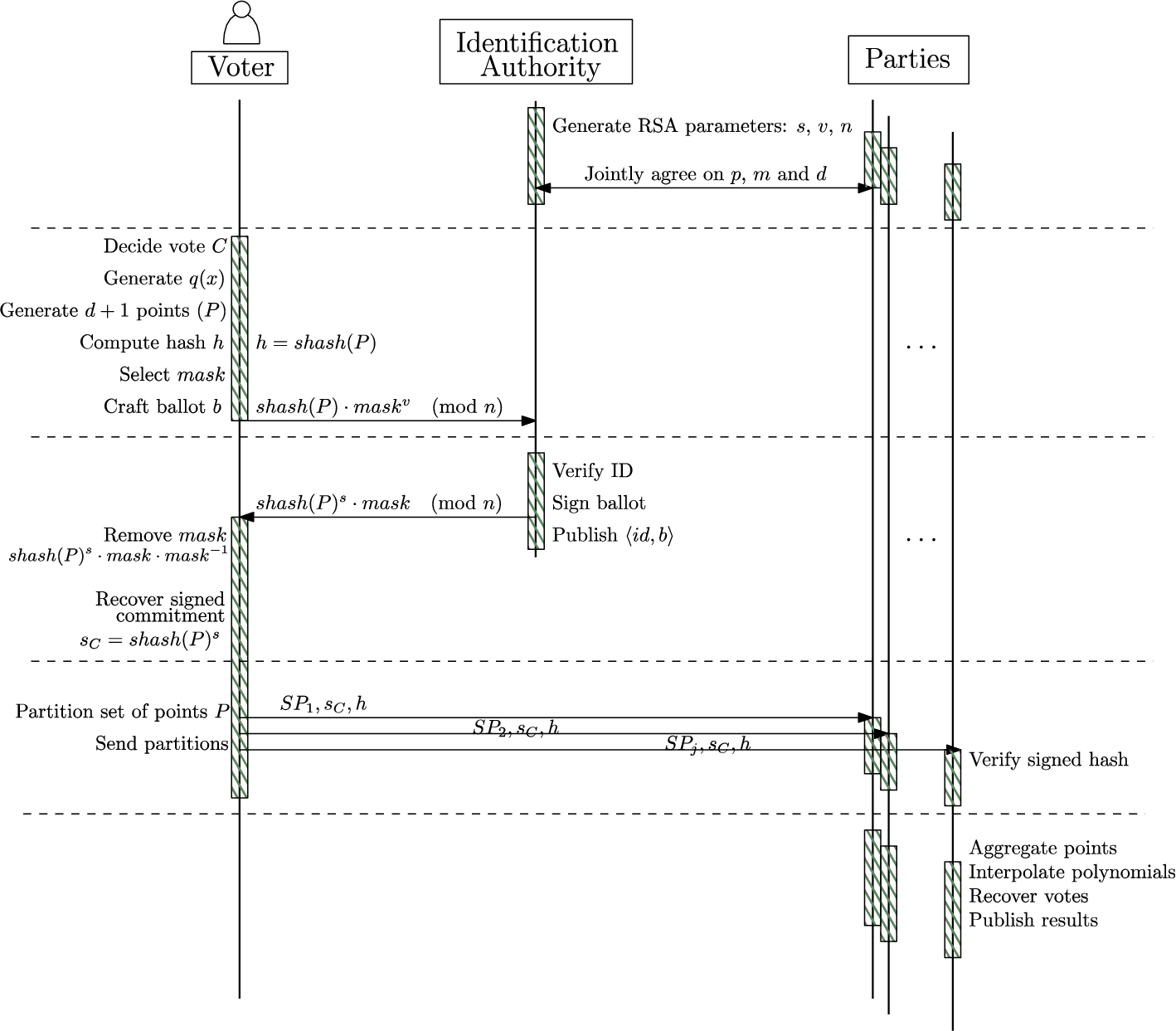
Scheme representing the election phases, its associated agents and their message interchange.
Before the election process, it is required to arrange and configure the methods that will be used to sign the electors’ ballots. The IA is responsible of the elector identification and ballot certification. For this purpose, the IA must generate the parameters to setup a digital signature scheme.
We employ blind signatures to prevent double voting without compromising electors’ privacy. This allow us to certify ballots from valid electors without being able to link the votes with their identity.
We consider in the description of our proposal a RSA cryptographic scheme to implement blind signatures because of its homomorphic properties under modular exponentiation.2 To carry out the blind signatures, the elector uses the public component of the IA signature key v and public RSA modulus n which will be used to certify the ballots.
The IA also states the hash function to be used, sets up the degree d of the polynomials to create, set the maximum number of points the user can generate l, being
At the end of the setup phase, the IA publicly distributes v, n, d and p so that every elector can craft her own ballot.
Ballot Crafting
Once an elector has decided on her vote, she encodes it as an integer C. Then, she proceeds to generate a d-degree polynomial as shown in equation (5):
Then, the elector samples from the polynomial a minimum of
Note that anybody who knows P can interpolate the original polynomial
The set is, actually, the ballot to be casted, which will be split in shares to be sent to the parties. In order to allow the reconstruction of the split vote, the elector digests the sorted set of points P using the hash function selected in the system set up phase. Please note the importance of the points being sorted for the hash function to produce consistent outputs. For this reason, we define a function
In order to prevent double voting, each elector sends her ballot to the IA to be certified. In order to prevent the possibility of matching the ballot with the elector, our proposal blinds the ballots before sending them to the authority.
To do so, the elector selects a random invertible mask, considers the verification key v published by the IA and computes the ballot b as shown in equation (7):
The IA checks if the identification is valid and the elector is on the census of registered voters. If the identification is correct, the IA proceeds to sign the ballot as referenced in equation (8):
Please note that, unless the IA gets to know the mask, the IA cannot never be aware of what message it is actually certifying. After the signature process, the IA replies the elector through a secure channel with the signed ballot. The IA also publishes on the PBB a tuple of the form
The elector receives the signed ballot and proceeds to recover the signed commitment which will certify her vote. Note that the elector is the only one who knows the mask and its inverse. Thus, the elector obtains the signed commitment as indicated in equation (9):
By following these steps, the elector obtains the certified (signed) commitment that will be used in the next phases. These steps are detailed on Algorithm 1. Note that, despite requiring her identity in order to sign the ballot, the IA has no means to link the commitment with the elector. Also note that the elector is able to check if the signed ballot was tampered during the way, because she is able to independently verify the integrity of the signed commitment.
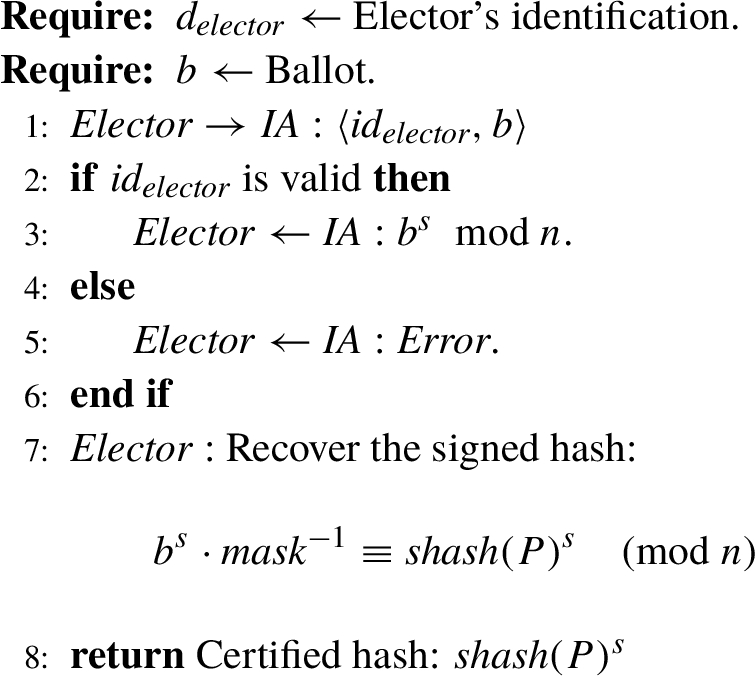
Ballot certification
In this phase, the elector has a set P that can be used to recover her vote and the signed commitment of the set
To finally cast the vote, the elector sends a partition of P (shares of the ballot) together with the certified commitment to all the parties implied in the election tallying. Note that a basic property of polynomial interpolation states the impossibility to recover a d degree polynomial with d or less points of such polynomial. This allows to send different shares of information to different parties with certainty that no information of the original vote will be revealed unless all the parties collaborate to do so.
Thus, taking into account that k parties are implied in the election, the elector partitions P into k non-overlapping subsets
Each one of the parties receive a share
We also note that it is possible to reduce the number of shares to put aside from the process those parties which receive no share of the elector’s ballot. Note also that this does not affect the validity of the vote, but the transparency of the process. However, we force that every party receives one share. By doing this, we ensure that the vote requires the collaboration of all the parties to be recovered. Thus, no subset of malicious parties will be able to recover the vote before the tallying phase.
When all the subsets are sent, the vote has been cast. Note that, unlike what happens in the ballot certification phase, no personal information goes along with the shares of the vote. Thus, parties have no means to associate the received shares with an elector’s identity.3 The casting process is depicted on Algorithm 2.
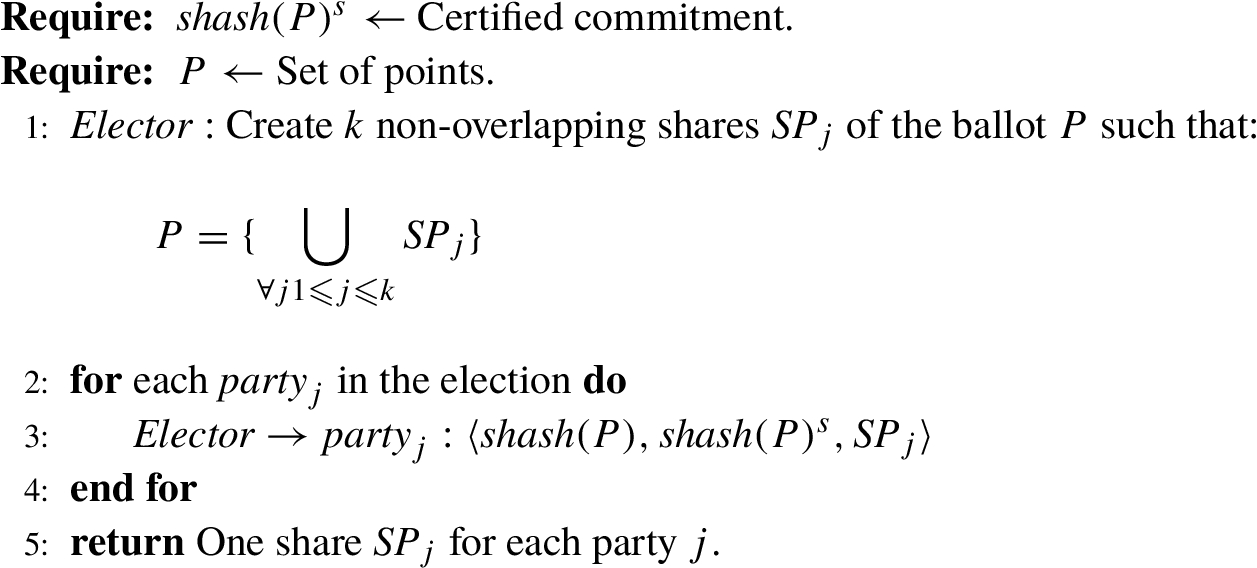
Casting a vote
Once the election is over, no new votes are accepted. The parties can proceed to reconstruct the votes and compute the final tally.
In the first place, the parties consider the certification that accompanies the shares to find the set of shares (each one of them received by a different party) that allow to reconstruct each ballot P. Note that the original sequence can be easily obtained, by ordering the set P, and that is possible to check the validity of the certification.
A set of points P such that its certified commitment
Please note that the interpolation operations are not carried out modulo p. When we forced, on the ballot crafting, the coefficients of the polynomial
The parties publish on the PBB, a 3-tuple per vote containing: the certification of the ballot (i.e. the signed commitment); the ballot itself (i.e. the set of points P that conceal the ballot); and the reconstructed vote C. The final tally obtained by each party can also be published. The PBB is available to everyone to check that their votes have been counted as intended, and to verify the integrity of the final tally. Algorithm 3 contains the steps to compute the final tally.

Tallying votes
In order to depict the process, let us consider an election with three competing candidates. To setup the system, the IA generates a RSA signature key with, respectively,
Once the system has been set up and the values published to the electors, in order to prepare the ballot, each user encodes her vote as an integer modulus p. Let this be
This set of values is actually the ballot the elector will split into pieces. To obtain a commitment of the ballot, the elector computes
Once the usual checks are carried out, the authority computes the certificate signing the commitment using its signature private key:
As explained above, the elector can easily obtain the certificate of the ballot as:
The ballot is then split into three disjoint pieces (the number of candidates), for instance:
In order to rebuild the ballot, the candidates use the certified commitment to select the pieces of the same ballot, check its integrity and interpolate the polynomial using whichever available method.
We devote this section to analyse the time-complexity of our voting scheme. We prove that our protocol is highly efficient and requires minimal effort for the involved parties. We differentiate between the computational complexity related to each individual elector and the complexity of the whole system to process all votes.
We chose bit operation as the unit in our time-complexity analysis. As usual, n denotes the input of the operands and
To certify and cast a vote, the elector needs to carry out a series of steps: generate a polynomial, sample some points, compute a hash function, select some subsets, etc. However, we neglect some of these steps in the time-complexity analysis because of two main reasons: most of them can be performed off-line before the actual election process starts, and they are not relevant in terms of time-complexity analysis because other operations dominate the overall complexity. For example, the sort of a sequence, or hash, of length j is not comparable to the magnitude of
We only consider the mask generation and multiplication and exponentiation operations. They are the most costful operations and dominate the time-complexity functions:
Mask generation. The user must generate a mask and search for its inverse to certify the ballot. To find the inverse, the Euclid’s algorithm which has a complexity of
Modular exponentiation. To craft the ballot the user must perform a modular exponentiation (see Line 7 on Algorithm 1), which has a cost of
Modular multiplication. In addition to the exponentiation, a modular multiplication is also required on Section 4.3. This operation has cost of
Then, the complete time-complexity for an elector to cast a vote can be expressed as:
We now consider the complexity of the whole system. To process a vote, SUVS must apply a blind signature to the ballot, and, at the end of the election it must interpolate a polynomial from a set of points. We do not consider the compilation of the shares with the same certified commitment in the complexity analysis, shares can be indexed and compiled in constant time.
Ballot certification requires one modular exponentiation, which has a cost of
Interpolation using Lagrange’s polynomial requires a linear number of non-modular operations. Addition and subtraction present a time-complexity of
Thus, the total time-complexity of our scheme scales linearly with the number of processed votes v and can be expressed as:
Please also note that the complete number messages sent by the elector in SUVS can be expressed as
We now analyse the security properties of our presented voting scheme. We enumerate the desired properties of a secure election protocol, proving that our system meets them. Please note that the security of our scheme (except for the signature step) does fall under the information-theory paradigm. Therefore, and unlike other computational security-based schemes, we do not need security parameters. Once some basic constraints are achieved (e.g.
Verifiability
Verifiability is a property that ensures that an elector can verify the integrity of her vote at any given phase (casting, recording or tallying). If the audit is extended to any individual (elector or not), then is called universal verifiability.
SUVS voting protocol is end-to-end verifiable.
In order to prove the lemma we will prove, first, that after the identification stage, the elector can verify that her vote was not tampered with during the certification of the commitment, and, second, that at the end of the voting process, any vote was correctly recorded and tallied. First, we note that during the process of commitment certification, the elector is the only one who knows the mask that conceals the commitment. Therefore, only she can remove the mask and apply the public key of the identification authority check if the commitment was correctly certified or it was somehow modified. She also can check on the PBB that the masked commitment received by the IA has not been tampered with. Second, regarding universal verifiability, any individual (elector included) can consult on the PBB all the individual votes, that is: their set of points, and their certified commitment. This information is enough for any interested party to check the validity and integrity of the votes. Thus, our method allows anyone to compute the tally, verifying the validity of all the individual votes, and, therefore, auditing the election process. □
Privacy
Privacy implies the impossibility of linking an elector’s identity with the direction of her vote, even when some authorities or parties implied in the process maliciously participate.
SUVS guarantees the elector’s privacy.
To prove this, we will prove, first, that the identification authority cannot compute the direction of any elector’s vote, and, second, that parties can neither do so. First, note that the elector mask that conceals the commitment of the vote is a private election, the identification authority does not have information to unmask the commitment, and, therefore, the authority cannot gain knowledge of the elector’s commitment. Thus, the identification authority has no way to relate elector’s identification to her final vote, once the PBB is made public. Second, we note that the parties do not receive any personal information from the elector. Hence, they can not relate the vote in any way. □
Democracy
Democracy guarantees that only valid and registered electors are able to cast a vote, and that they only can vote once.
In our protocol, the IA responsibility is twofold: it verifies elector’s identification to check that they are eligible, and, prevents double voting by using blind signatures.
Please note that even if the IA acted maliciously, democracy would be ensured. The received ballots and their associated identity on the public census are published on the PBB for everyone to review. The malicious IA could not forge invalid votes or link valid ones to their elector. However, in a different scenario, an attacker could try to bypass IA’s certification and forge the employed blind signature scheme.
As the RSA scheme remains secure, our electronic voting protocol is democratic.
For a vote to be considered valid, it must be accompanied by a certified commitment. This certification is carried out by the IA through a blind signature scheme based on RSA. Assuming that the Discrete Logarithm Problem (DLP) has no efficient solution for meticulously selected parameters, the attacker has no means, apart from bruteforce, to break the signature scheme. □
Accuracy
Accuracy requires the final tally to match the actual outcome of the election. In order to achieve this: all valid votes must be counted; no invalid votes are considered; and no cast vote can be modified.
SUVS voting protocol is accurate.
We prove the statement in three independent sections:
Valid votes are counted: Parties are responsible of processing all valid received votes. Both individual and universal verifiability (Lemma 1) guarantee that electors can check that all valid votes are included in the final tally.
No invalid votes are considered: In order for a vote to be considered valid, it needs to be correctly certified. As proved in Lemma 3, the creation of fake votes is unfeasible. Thanks to verifiability, electors can also audit the results and check that all individual votes are valid.
Vote modification: Any modification to any of the unencrypted shares of a vote will be detected because it will make the certified commitment not match the shares. As long as the hash function used remains secure, no tampering of the votes will succeed.
□
Robustness
Robustness ensures that no coalition of electors and/or parties would be able to disrupt the election process. We first prove that our method is robust with the only condition that one party remains honest. Then, we prove that it is unfeasible a coalition of users could tamper with new votes.
Robustness of SUVS is ensured if at least one contendant party remains honest.
We note that parties must cooperate to interpolate the polynomials and recover the final votes. If at least one contendant party remains honest, the remaining parties have no way to interpolate the polynomial and access the vote. Of course, at a cost of a high reputational loss, a set of parties can misbehave or refuse to cooperate, in which case the election would have no tally. □
It is unfeasible that, according to SUVS protocol, a coalition of electors could tamper with new votes.
We note that a coalition of malicious electors could take profit of the multiplicative properties of modular exponentiation, and use their certified commitments in order to obtain a new tampered one
Perfect Secrecy
Perfect secrecy, as defined in Section 3, provides security by uncertainty. The concealing of the vote by partition SUVS is based on provided security derived entirely from information theory, creating a system where partial information does not reveal anything about the scheme’s secrets.
As stated in Lemma 2, there is no mechanism to relate an elector to her vote. By providing perfect secrecy, we also ensure that, even in post-quantum scenarios, it is impossible to reveal any information on any vote unless all the parties are malicious or compromised.
SUVS provides perfect secrecy and its encoding is resistant to post-quantum computers.
If an attacker gains knowledge about all the shares of a vote but one, there is no way he could interpolate the polynomial generated by the user and, therefore, gain access to the direction of the vote. Note also that, under modular arithmetics, there exists a combinatorial number of d-degree polynomials consistent with d points. This implies that, even if the attacker could find a polynomial that covers the points and encodes a valid vote, he could never be sure which one was the original vote encoded by the elector. □
Malicious Elector Resistance
A malicious elector may try to craft a ballot in order to achieve double voting.
SUVS is resistant to malicious electors.
SUVS defines the form of the ballot as:
In this paper, we present a new voting protocol whose security is based on the partition of the ballot. To our knowledge, our proposal is the first electronic voting scheme that properly does not encrypt the vote. The responsibility of recovering the votes is distributed among the set of parties involved on the election, who are responsible to compute the final tally of the election. The protocol we propose does not allow the parties to modify the votes for their own benefit, and universal verifiability helps the electors to audit the final tally and ensures a fair election.
The system we propose requires minimal interactions from the electors and scales linearly with the number of processed votes. Thanks to the flexibility of the vote codification, our proposal is compatible with almost any kind of election. We believe these facts, alongside the simplicity of the scheme, make the protocol easy to understand and implement, which are essential features to contribute in the development and deployment of this technology.
As future work, we will study on how to reduce the number of shares the elector distributes among the parties without affecting the reliability and trustworthiness of the system. In such a way, if an elector does not trust a certain party, she can decide to arrange and send the shares of the ballot without considering it. The incorporation of alternative identification methods that would make unnecessary to include an identification authority in the protocol is, of course, of interest.
Footnotes
Please note that as in many works in the literature and for the sake of clarity, we employ she/her when referring to the elector, and he/his when talking about parties and authorities.
Of course, any other method with the same properties could be used instead.
Please note that while parties cannot identify voters, they can reject invalid messages by leveraging the digital signature of the commitment. Invalid signatures must be rejected and this can be used as defense against DDOS attacks.