Present worth (PW) analysis is an important technique in engineering economics for investment analysis. The values of PW analysis parameters such as interest rate, first cost, salvage value and annual cash flow are generally estimated including some degree of uncertainty. In order to capture the vagueness in these parameters, fuzzy sets are often used in the literature. In this study, we introduce interval-valued intuitionistic fuzzy PW analysis and circular intuitionistic fuzzy PW analysis in order to handle the impreciseness in the estimation of PW analysis parameters. Circular intuitionistic fuzzy sets are the latest extension of intuitionistic fuzzy sets defining the uncertainty of membership and non-membership degrees through a circle whose radius is r. Thus, we develop new fuzzy extensions of PW analysis including the uncertainty of membership functions. The methods are given step by step and an application for water treatment device purchasing at a local municipality is illustrated in order to show their applicability. In addition, a multi-parameter sensitivity analysis is given. Finally, discussions and suggestions for future research are given in conclusion section.
Engineering economics is a collection of mathematical techniques which easify the comparison of investment alternatives. The main investment analysis techniques of engineering economics are benefit/cost ratio analysis (B/C), rate of return analysis (ROR), present worth analysis (PW), annual cash flow analysis (ACF) and payback period analysis (PPA). PW analysis is the major technique of engineering economics which finds the equivalent present worth of the future cash flows based on these parameters: first cost , salvage value , interest rate , annual benefits , annual cost , and life .
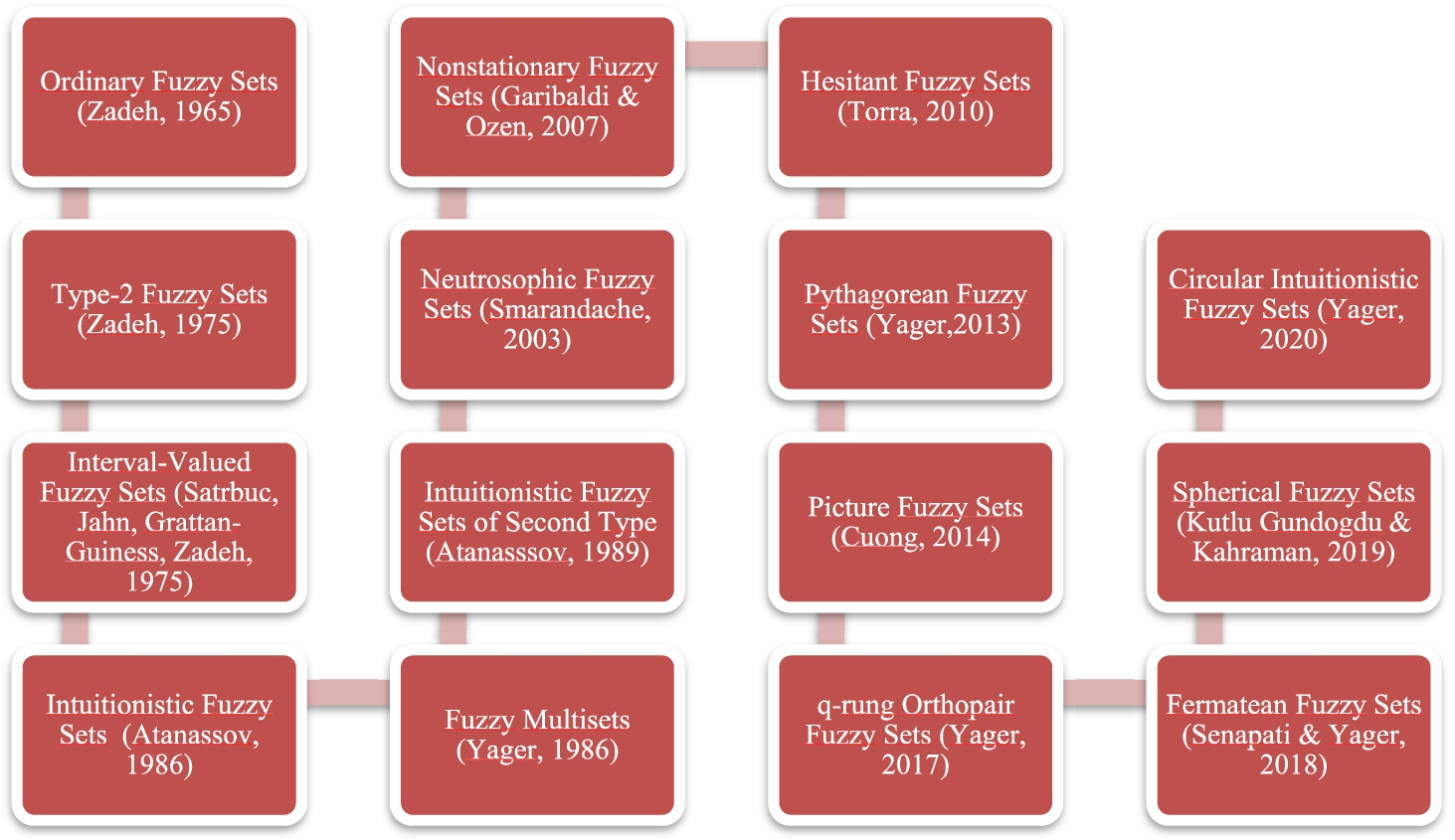
Fuzzy sets theory was developed by Zadeh (1965) in 1965 and the extensions of these ordinary fuzzy sets (OFSs) have been developed by numerous fuzzy set researchers. These fuzzy set extensions have been used in estimating, decision making, engineering economics, and controlling together with other intelligent systems. The extensions of ordinary fuzzy sets can be given as type-2 fuzzy sets in Zadeh (1975), intuitionistic fuzzy sets (IFSs) in Atanassov (1986), fuzzy multisets in Yager (1986), intuitionistic fuzzy sets of second type in Atanassov (1989), neutrosophic sets (NSs) in Smarandache (1999), nonstationary fuzzy sets in Garibaldi and Ozen (2007), hesitant fuzzy sets (HFSs) in Torra (2010), Pythagorean fuzzy sets (PFSs) in Yager (2013), picture fuzzy sets in Cuong (2014), q-rung orthopair fuzzy sets (q-ROFs) in Yager (2017), fermatean fuzzy sets (FFSs) in Senapati and Yager (2020), spherical fuzzy sets (SFSs) in Kutlu Gündoğdu and Kahraman (2019) and circular intuitionistic fuzzy sets (C-IFSs) in Atanassov (2020). In Fig. 1, the historical progress of the fuzzy set theory is given.
Fuzzy set extensions.
Consideration of vagueness in the definition of membership functions is an old issue first time handled by Zadeh (1975). Type-2 fuzzy sets, interval-valued fuzzy sets and hesitant fuzzy sets try to incorporate this vagueness into their models. Similarly, Atanassov (2020) developed C-IFSs as an extension of IFSs in order to handle this issue. A circle around the single valued intuitionistic fuzzy number is defined by a radius r. In this study, the main aim and contribution is to introduce a new extension of PW analysis with interval-valued intuitionistic fuzzy sets (IVIF) and C-IFSs.
The estimation of investment parameters generally involves uncertainty and vagueness. This uncertainty is best handled by the fuzzy set theory in the literature. Most of the publications on fuzzy engineering economics employ ordinary fuzzy sets. However, there are some papers employing intuitionistic fuzzy sets, Pythagorean fuzzy sets, neutrosophic sets, hesitant fuzzy sets, type-2 fuzzy sets, and fermatean fuzzy sets in the investment analysis techniques. In the following, we present the review results on fuzzy PW analysis. Kahraman et al. (1995) presented financial models based on some discounting techniques such as fuzzy equivalent uniform annual worth and fuzzy PW analyses. Iliev and Fustik (2003) used fuzzy net present analysis in evaluating hydroelectric projects based on fuzzy profitability index. This model was created by using triangular fuzzy numbers. Omitaomu et al. (2004) used present value model with triangular fuzzy numbers in the evaluation of information system projects. Kahraman et al. (2004) proposed fuzzy present worth based fuzzy models for quantifying manufacturing flexibility. The fuzzy model included uncertain cash flows and discount rates that were handled as triangular fuzzy numbers. Kahraman and Kaya (2008) studied equivalent fuzzy annual worth analysis in investment assessment. Matos and Dimitrovski (2008) introduced studies using equivalent uniform annual worth analysis with trapezoidal fuzzy numbers. Kuchta (2008) presented fuzzy PW analysis applications in optimization. Dimitrovski and Matos (2008) introduced uncorrelated and correlated cash flows in fuzzy PW analysis with arithmetic operations. Shahriari (2011) proposed a fuzzy net present value methodology that uses triangular fuzzy numbers in investment analysis. Kahraman et al. (2015) presented hesitant and intuitionistic fuzzy present and annual worth analyses. These developed methods use triangular hesitant fuzzy data, triangular intuitionistic fuzzy data, interval-valued hesitant data, and interval-valued intuitionistic fuzzy data in engineering economic problems for better forecasting. Kahraman et al. (2018a) introduced Pythagorean PW analysis for investment decision problems. Sarı and Kahraman (2017) applied net PW analysis with type-2 fuzzy sets. One of the PW analysis papers which uses neutrosophic sets belongs to Aydin et al. (2018). They introduced simplified neutrosophic PW analysis. The investment parameters’ membership functions were defined by neutrosophic sets. The method was compared with classical and intuitionistic fuzzy PW analysis. Kahraman et al. (2018b) proposed ordinary fuzzy PW analysis, type-2 fuzzy PW analysis, intuitionistic fuzzy PW analysis, and hesitant fuzzy PW analysis in wind energy investment analysis. Aydin and Kabak (2020) developed future and present worth techniques in investment analysis with neutrosophic sets. Sergi and Sari (2021) extended PW analysis with fermatean fuzzy sets. The literature review is summarized in Table 1.
This paper is organized as follows: In Section 2, preliminaries of IVIF and C-IFSs are given. In Section 3, interval-valued intuitionistic fuzzy PW analysis extension is given. In Section 4, circular intuitionistic fuzzy PW analysis extension is given. In Section 5, a real life problem is solved with these proposed extensions in order to show the applicability of these proposed methods with a sensitivity analysis. Finally, conclusion is given in Section 6 with future suggestions.
Preliminaries
In this section, the preliminaries of interval-valued intuitionistic fuzzy sets and C-IFSs are given with definitions.
Interval-Valued Intuitionistic Fuzzy Sets
Intuitionistic fuzzy sets (IFSs) (Atanassov, 1986) were introduced by Atanassov in 1986. IVIFSs are an extension of IFSs that is developed by Atanassov and Gargov (1989) which have extensively been employed in the literature. IVIF numbers’ preliminaries are summarized in the following:
Let X be a non-empty set. An IVIF set in X is an object given as in Eq. (1) (Atanassov and Gargov, 1989): where for every .
Let be the IVIF number where and . Aggregated IVIF number () by interval-valued intuitionistic fuzzy hybrid geometric operator is obtained as in Eq. (4) (Wei and Wang, 2007): where and . is the weights of expert i, where .
Let be an IVIF number. Defuzzification formula () for is given as in Eq. (5) (Atanassov and Gargov, 1989):
Let be an IVIF number. The score function of an IVIF number is given as in Eq. (6) (Xu, 2007, 2010): where .
Let be an intuitionistic fuzzy number. The score function of this number is given as in Eq. (7). where .
Let be an IVIF number. The accuracy function of an IVIF number is given in Eq. (8) (Xu, 2007): where .
Circular Intuitionistic Fuzzy Sets
C-IFSs are introduced by Atanassov (2020) as an extension of the IFSs which each element is represented by a circle with radius r. C-IFSs is defined in Definition 8.
Let E be a fixed universe. A C-IFS in E is an object having the form as in Eq. (9). where and is a radius of the circle around each element , is called Circular-IFS and the functions and represent the degree of membership and the degree of non-membership of the element to the set , respectively.
The degree of indeterminacy is calculated as in Eq. (11):
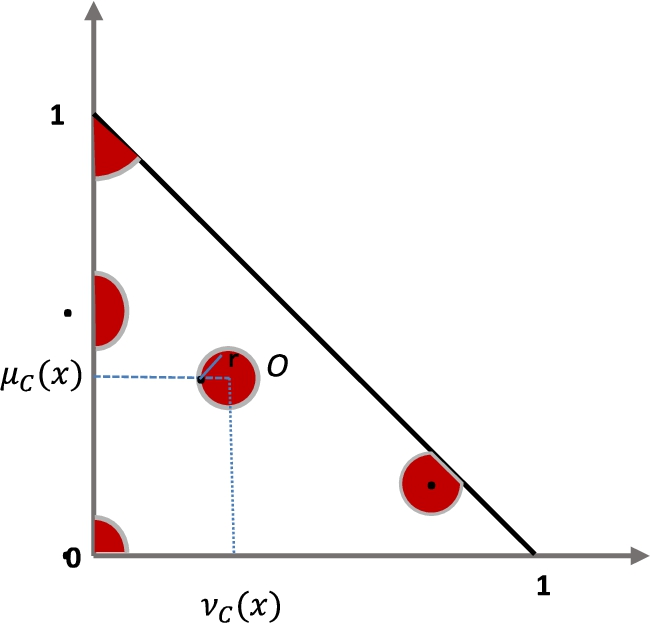
In contrast with the standard IFSs, where each element is represented by a point in the intuitionistic fuzzy interpretation triplet, each element in C-IFSs is represented by a circle with centre and radius r.
In an IFS , let intuitionistic fuzzy pairs have the form . j is the number of IFSs , each including IF pairs. Then, C-IFSs is calculated as follows. The arithmetic average of the IF pairs is given as in Eq. (12): where is the number of intuitionistic fuzzy pairs in .
Then, the radius of the is the maximum of the Euclidean distances given as in Eq. (13): For universe , the C-IFS can be built as in Eq. (14):
Let’s have five circle forms as it is shown in Fig. 2, where the basic geometric interpretation of C-IFS is given. Therefore, can be rewritten in the form where O is a function representing a circle, whose radius is r and whose centre is .
C-IFSs is an extension of the standard IFSs and each standard IFS has the form , therefore, C-IFS with can’t be represented by a standard IFS.
C-IFS geometrical representation.
Let and be two circular intuitionistic fuzzy numbers. The operations given here are based on the minimum and maximum of the radiuses separately since they give the results with minimum and maximum level of uncertainty, respectively. Smaller radius represents smaller vagueness whereas larger radius represents larger vagueness for IF pairs. Their operations can be described in Eqs. (17)–(24):
Aggregation of the intuitionistic fuzzy numbers is realized by using Definition 12.
Let be a set of IFNs and be weight vector of with , then an intuitionistic fuzzy weighted geometric operator is given in Eq. (25) (Xu and Yager, 2006):
Interval-Valued Intuitionistic Fuzzy PW Analysis
The parameters of , , , , i, and n are given with interval-valued intuitionistic fuzzy values which are expressed by circular intuitionistic fuzzy numbers (IVFN) in Eqs. (26)–(31):
Aggregation of IVIF numbers is performed by Eq. (25). Later, parameter values can be computed by multiplying the defuzzified values of membership functions with parameter values. The score function and defuzzification function of memberships are used for obtaining crisp values for each parameter. After defuzzification process the present worth is obtained by Eq. (32): where : Intuitionistic fuzzy , : Intuitionistic fuzzy , : Intuitionistic fuzzy , : Intuitionistic fuzzy , : Intuitionistic fuzzy , : Intuitionistic fuzzy interest rate (i), : Intuitionistic fuzzy life (n).
Circular Intuitionistic Fuzzy PW Analysis
The parameters of FC, SV, AB, AC, i, and n are given by circular intuitionistic fuzzy numbers (CIFN) as in Eqs. (33)–(38): where .
In this method, aggregation of IFSs is performed by Eq. (25).
Later, parameter values can be computed by multiplying the defuzzified values of membership functions with parameter values. The score function and defuzzification function of memberships are used for obtaining crisp values for each parameter. After defuzzification process the present worth is obtained by Eq. (39): where : Circular intuitionistic fuzzy PW, : Circular intuitionistic fuzzy , : Circular intuitionistic fuzzy , : Circular intuitionistic fuzzy , : Circular intuitionistic fuzzy , : Circular intuitionistic fuzzy interest rate , : Circular intuitionistic fuzzy life .
Application
A water treatment device will be purchased by a local municipality. The interval-valued intuitionistic fuzzy data of this device are given in Table 2. Three experts having different experiences assign three different intervals for each of investment parameters and determine their interval-valued intuitionistic fuzzy membership and non-membership degrees. w values in Table 2 represent the weights of experts based on their experience levels.
Interval-valued intuitionistic fuzzy parameters.
Parameter
Expert
w
Alternative
First cost
E1
0.5
0.2
0.3
E2
0.25
0.45
0.3
E3
0.35
0.3
0.35
Annual benefit
E1
0.5
0.2
0.3
E2
0.25
0.45
0.3
E3
0.35
0.3
0.35
Annual cost
E1
0.5
0.2
0.3
E2
0.25
0.45
0.3
E3
0.35
0.3
0.35
Salvage value
E1
0.5
0.2
0.3
E2
0.25
0.45
0.3
E3
0.35
0.3
0.35
Interest rate
E1
0.5
0.2
0.3
E2
0.25
0.45
0.3
E3
0.35
0.3
0.35
Life
E1
0.5
0.2
0.3
E2
0.25
0.45
0.3
E3
0.35
0.3
0.35
We apply two levels of aggregation: Aggregation within each parameter and aggregation between parameters. In Table 3, the aggregated membership functions and expected weighted interval-values within each parameter are given. Then, aggregation between parameters is applied. For both of aggregation levels, Eq. (4) is used.
Aggregation within each parameter.
Parameter
Experts
Experts’ weights
Weighted interval-values
Aggregated membership functions
FC
E1
0.4
216000
258000
E2
0.25
221000
260500
E3
0.35
220000
260000
AB
E1
0.4
44000
54000
E2
0.25
45250
55250
E3
0.35
45000
55000
AC
E1
0.4
14000
24000
E2
0.25
15250
25250
E3
0.35
15000
25000
SV
E1
0.4
88000
108000
E2
0.25
90500
110500
E3
0.35
90000
78500
IR
E1
0.4
0.088
0.108
E2
0.25
0.091
0.111
E3
0.35
0.09
0.11
n
E1
0.4
20.8
22.8
E2
0.25
22.1
25.05
E3
0.35
21
25
Expected value calculations are given in Table 4. For instance, the value is calculated as follows:
Values after aggregation within each parameter.
Parameter
Expected interval-values
Aggregated membership functions
FC
AB
AC
SV
IR
Life
The aggregation between parameters is the next step. Lower and upper values are obtained with Eq. (31). For the lower , we select the upper values for , , and lower values for , and life. Similarly, for the lower , we select the upper values for , life and lower values for , , and . and are obtained as −86,767.344$ and 212,187.693$, respectively. The aggregated membership function in order to calculate final , the membership functions are obtained by selecting the minimum values for membership degrees and maximum values for non-membership degrees. In this way, we finally obtained the interval-valued membership function as: . In order to defuzzify membership function, Eq. (5) is used and we obtained it as 0.529. Final crisp using interval-valued intuitionistic fuzzy sets is calculated as follows:
Now, circular intuitionistic fuzzy analysis will be applied. Table 5 presents the circular intuitionistic fuzzy investment parameters. First, within aggregation operation, then between aggregation operation is applied. The results of within aggregation operation are also given in Table 5.
Circular intuitionistic fuzzy parameters.
Parameters
Experts
W
Alternative
Membership function
Within aggregated membership functions ()
r
First Cost
E1
0.5
0.486
0.627
0.2
0.592
0.3
0.627
E2
0.25
0.020
0.153
0.45
0.097
0.3
0.153
E3
0.35
0.018
0.129
0.3
0.122
0.35
0.129
Annual Benefit
E1
0.5
0.048
0.093
0.2
0.093
0.3
0.022
E2
0.25
0.062
0.080
0.45
0.080
0.3
0.062
E3
0.35
0.041
0.080
0.3
0.101
0.35
0.041
Annual Cost
E1
0.5
0.061
0.151
0.2
0.151
0.3
0.010
E2
0.25
0.100
0.160
0.45
0.066
0.3
0.160
E3
0.35
0.315
0.315
0.3
0.200
0.35
0.145
Salvage Value
E1
0.5
0.048
0.093
0.2
0.093
0.3
0.023
E2
0.25
0.133
0.133
0.45
0.075
0.3
0.029
E3
0.35
0.176
0.177
0.3
0.036
0.35
0.177
Interest Rate
E1
0.5
0.039
0.105
0.2
0.105
0.3
0.025
E2
0.25
0.144
0.144
0.45
0.002
0.3
0.139
E3
0.35
0.090
0.090
0.3
0.052
0.35
0.052
Life
E1
0.5
0.032
0.085
0.2
0.085
0.3
0.031
E2
0.25
0.046
0.059
0.45
0.059
0.3
0.055
E3
0.35
0.034
0.074
0.3
0,074
0.35
0,043
A radius is calculated for each parameter as in Eq. (13) and value is obtained by selecting the maximum value among them. The weights vector of experts for aggregating membership functions is where . Eq. (25) is used for aggregation operations. Table 6 includes the expected values of parameters together with the aggregated membership functions and their values.
Expected parameters, aggregated membership functions and values.
Parameters
Expected parameters
Within aggregated membership functions
FC
0.627
AB
0.101
AC
0.315
SV
0.177
IR
0.144
Life
0.085
For instance, the value of is calculated as follows:
Table 7 gives us the values of the investment parameters for both optimistic and pessimistic cases, separately.
Optimistic and pessimistic membership functions.
Parameters
Optimistic membership functions
Pessimistic membership functions
FC
AB
AC
SV
IR
Life
Membership functions (Max μ, Min ϑ for optimistic), (Max ϑ, Min μ for pessimistic)
The score values for optimistic and pessimistic membership values are calculated as 1 and −0.741, respectively using Eq. (7).
Table 8 shows the average values of expected interval-values for the parameters.
Expected interval-values and average values of parameters.
Parameters
Expected interval-values
Midpoints
FC
238,987.500
AB
49,662.500
AC
18,262.500
SV
93,812.500
IR
0.099
Life
22.664
Based on the parameter values in Table 8, is calculated as 62,710.2$. The PWs for optimistic and pessimistic cases are obtained as in Eq. (40):
Sensitivity Analysis
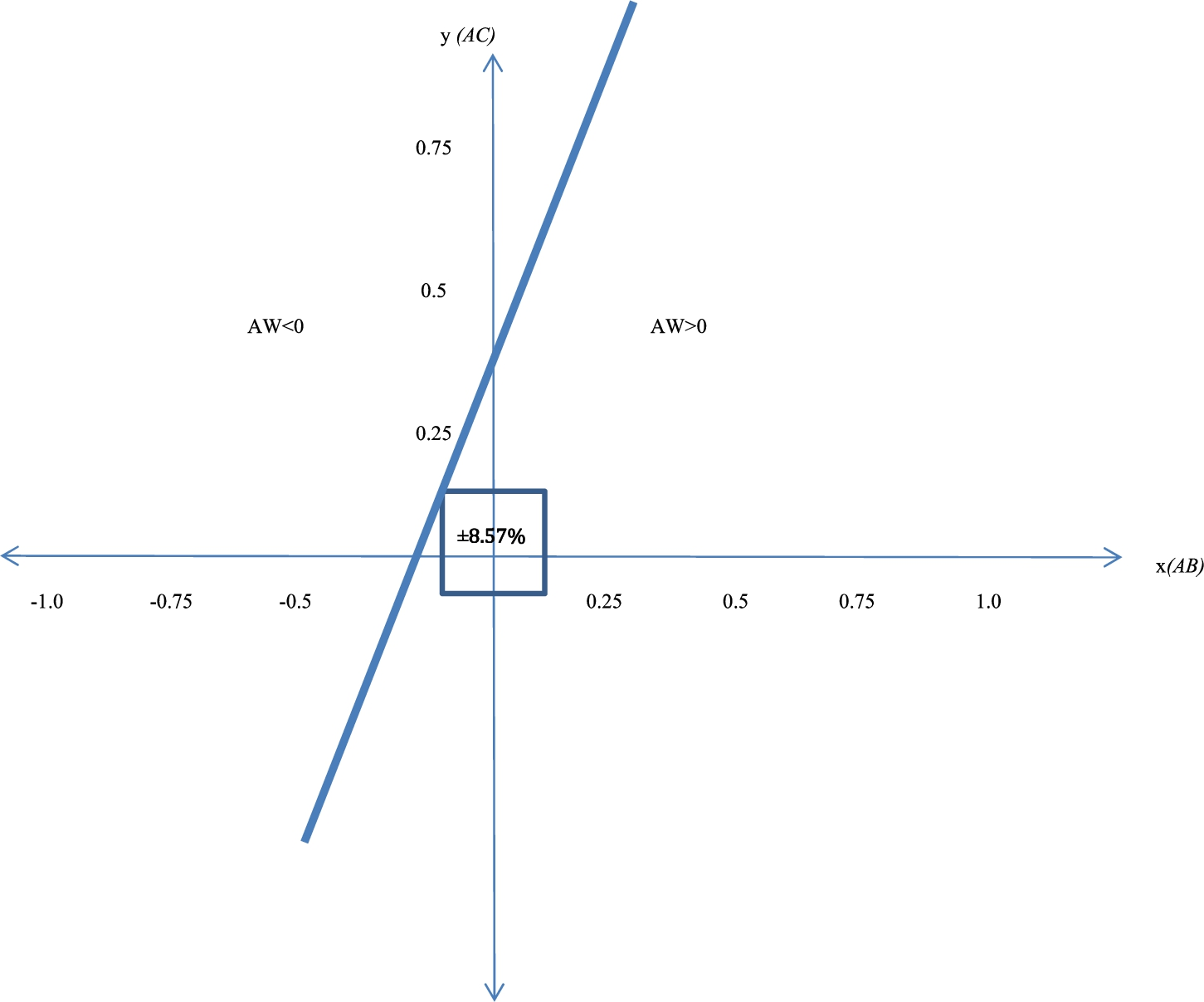
Sensitivity analysis is based on the midpoints of the parameters which are given in Table 8. The experts indicate that the most critical parameters are and . In Eq. (41), annual worth (AW) formula is given:
Fig. 3 shows that possible and values over the square ±8.57% have no risk for the investor. In other words, the investor will remain insensitive to changes in AB and AC up to 8.57% changes in any direction.
Two parameters sensitivity analysis.
Conclusion
C-IFSs (Atanassov, 2020) are the latest extension of IFSs based on the similar idea of type-2 fuzzy sets, which try to incorporate the vagueness and impreciseness of membership functions into the problem modelling. In this study, a comprehensive literature review has been presented and no investment analysis using circular intuitionistic fuzzy sets has been observed in this literature review. We have proposed new analysis methods based on C-IFSs and IVIF sets. All investment parameters have been handled as fuzzy variables. However, score and defuzzification functions have been used whenever it is required. C-IFSs could successfully model the uncertainty in the assignment of membership functions by incorporating a circle whose radius is r. Interval-valued intuitionistic fuzzy sets have been used in engineering economic analyses as an alternative to single valued circular intuitionistic fuzzy analyses. The expected value of the interval-valued intuitionistic fuzzy present worth has been calculated as $33,162.894 whereas it is the interval $ [] in single valued circular intuitionistic fuzzy analysis. The midpoint of this interval is $69,678.525. The difference between these results comes from the different points of view to the uncertainty of membership and non-membership degrees. For further research, other extension types of fuzzy sets such as q-rung orthopair fuzzy sets and picture fuzzy sets can be employed for the calculation of fuzzy and the results can be compared with the methods presented in this paper.
AtanassovK.T. (1989). More on intuitionistic fuzzy sets. Fuzzy Sets and Systems, 33(1), 37–45.
4.
AtanassovK.T. (2020). Circular intuitionistic fuzzy sets. Journal of Ambient Intelligence and Smart Environments, 39(5), 5981–5986.
5.
AydinS.KabakM. (2020). Investment analysis using neutrosophic present and future worth techniques. Journal of Intelligent and Fuzzy Systems, 38(1), 627–637.
6.
AydinS.KahramanC.KabakM. (2018). Evaluation of investment alternatives using present value analysis with simplified neutrosophic sets. Engineering Economics, 29(3), 254–263.
7.
CuongB.C. (2014). Picture fuzzy sets. Journal of Computer Science and Cybernetics, 30(4), 409–420.
8.
DimitrovskiA.MatosM. (2008). Fuzzy present worth analysis with correlated and uncorrelated cash flows. In: KahramanC. (Ed.), Fuzzy Engineering Economics with Applications. Studies in Fuzziness and Soft Computing, Vol. 233. Springer, Berlin, Heidelberg, pp. 11–41.
9.
GaribaldiJ.M.OzenT. (2007). Uncertain fuzzy reasoning: a case study in modelling expert decision making. IEEE Transactions on Fuzzy Systems, 15(1), 16–30.
KahramanC.KayaI. (2008). Fuzzy equivalent annual-worth analysis and applications. In: KahramanC. (Ed.), Fuzzy Engineering Economics with Applications. Studies in Fuzziness and Soft Computing, Vol. 233. Springer, Berlin, Heidelberg, pp. 71–81.
12.
KahramanC.TolgaE.UlukanZ. (1995). Fuzzy flexibility analysis in automated manufacturing systems. In: IEEE Symposium on Emerging Technologies & Factory Automation, Vol. 3, pp. 299–307.
13.
KahramanC.BeskeseA.RuanD. (2004). Measuring flexibility of computer integrated manufacturing systems using fuzzy cash flow analysis. Information Sciences, 168(1–4), 77–94.
14.
KahramanC.Çevik OnarS.ÖztayşiB. (2015). Engineering economic analyses using intuitionistic and hesitant fuzzy sets. Journal of Intelligent and Fuzzy Systems, 29(3), 1151–1168.
15.
KahramanC.OnarS.C.OztaysiB. (2018a). Present worth analysis using Pythagorean fuzzy sets. In: KacprzykJ.SzmidtE.ZadrożnyS.AtanassovK.KrawczakM. (Eds.), Advances in Fuzzy Logic and Technology 2017. EUSFLAT2017, IWIFSGN 2017. Advances in Intelligent Systems and Computing, Vol. 642. Springer, Cham, pp. 336–342. https://doi.org/10.1007/978-3-319-66824-6_30.
16.
KahramanC.Çevik OnarS.ÖztayşiB.SarıİU.İlbaharE. (2018b). Wind energy investment analyses based on fuzzy sets. In: KahramanC.KayakutluG. (Eds.), Energy Management—Collective and Computational Intelligence with Theory and Applications. Studies in Systems, Decision and Control, Vol. 149. Springer, Cham.
17.
KuchtaD. (2008). Optimization with fuzzy present worth analysis and applications. In: KahramanC. (Ed.), Fuzzy Engineering Economics with Applications. Studies in Fuzziness and Soft Computing, Vol. 233. Springer, Berlin, Heidelberg, pp. 43–69.
18.
Kutlu GündoğduF.KahramanC. (2019). Spherical fuzzy sets and spherical fuzzy TOPSIS method. Journal of Intelligent and Fuzzy Systems, 36(1), 337–352.
19.
MatosM.DimitrovskiA. (2008). Case studies using fuzzy equivalent annual worth analysis. In: KahramanC. (Ed.), Fuzzy Engineering Economics with Applications. Studies in Fuzziness and Soft Computing, Vol. 233. Springer, Berlin, Heidelberg, pp. 83–95.
20.
OmitaomuH.O.NsoforC.G.BadiruA.B. (2004). Integrative present value analysis model for evaluating information system projects. In: IIE Annual Conference and Exhibition, pp. 2065–2070.
21.
Sarıİ.U.KahramanC. (2017). Economic analysis of municipal solid waste collection systems using type-2 fuzzy net present worth analysis. In: Intelligence Systems in Environmental Management: Theory and Applications. Springer, Cham, pp. 347–364.
22.
SenapatiT.YagerR.R. (2020). Fermatean fuzzy sets. Journal of Ambient Intelligence and Humanized Computing, 11, 663–674.
23.
SergiD.SariI.U. (2021). Fuzzy capital budgeting using fermatean fuzzy sets. In: KahramanC.Cevik OnarS.OztaysiB.SariI.CebiS.TolgaA. (Eds.), Intelligent and Fuzzy Techniques: Smart and Innovative Solutions. INFUS 2020. Advances in Intelligent Systems and Computing, Vol. 1197. Springer, Cham.
24.
ShahriariM. (2011). Mapping fuzzy approach in engineering economics. International Research Journal of Finance and Economics, 81, 6–12.
25.
SmarandacheF. (1999). A Unifying Field in Logics. Neutrosophy: Neutrosophic Probability, Set and Logic. American Research Press, Rehoboth.
26.
TorraV. (2010). Hesitant fuzzy sets. International Journal of Intelligent Systems, 25(6), 529–539.
27.
WeiG.WangX. (2007). Some geometric aggregation operators based on interval-valued intuitionistic fuzzy sets and their application to group decision making. In: 2007 International Conference on Computational Intelligence and Security. IEEE, Harbin, pp. 495–499.
28.
XuZ. (2007). Methods for aggregating interval-valued intuitionistic fuzzy information and their application to decision making. Kongzhi Yu Juece/Control and Decision, 22(2), 215–219.
29.
XuZ.S. (2010). A distance measure based method for interval-valued intuitionistic fuzzy multi-attribute group decision making. Information Sciences, 180, 181–190.
30.
XuZ.S.YagerR.R. (2006). Some geometric aggregation operators based on intuitionistic fuzzy sets. International Journal of General Systems, 35, 417–433.
31.
YagerR.R. (1986). On the theory of bags. International Journal of General System, 13(1), 23–37.
32.
YagerR.R. (2013). Pythagorean fuzzy subsets. In: Joint IFSA World Congress and NAFIPS Annual Meeting (IFSA/NAFIPS), 24–28 June, Edmonton, Canada, pp. 57–61.