




Abstract
This paper models and solves the scheduling problem of cable manufacturing industries that minimizes the total production cost, including processing, setup, and storing costs. Two hybrid meta-heuristics, which combine simulated annealing and variable neighbourhood search algorithms with tabu search algorithm, are proposed. Applying some case-based theorems and rules, a special initial solution with optimal setup cost is obtained for the algorithms. The computational experiments, including parameter tuning and final experiments over the benchmarks obtained from a real cable manufacturing factory, show superiority of the combination of tabu search and simulated annealing comparing to the other proposed hybrid and classical meta-heuristics.
Keywords
Introduction
Organizations with manufacturing operations are sensitive to scheduling their tasks and operations to obtain better performance. The measures of performance in such organizations can be on-time product delivery, less inventory cost, less tardiness, less earliness, etc. Therefore, applying scheduling policies, overall production cost may be decreased and less lead time for the products is obtained. To obtain a good schedule of tasks and operations in manufacturing organizations, the concepts of scheduling problems are used. In a scheduling problem, different goals may be optimized under different limitations and assumptions depending on the condition of production system under study. The goals such as earliness, tardiness, makespan, setup time, etc. (see Allahverdi et al., 2008; Santander-Mercado and Jubiz-Diaz, 2016; Nair et al., 2016) may be of interest for managers of manufacturing organizations. Such scheduling problems under the given goals are mathematically modelled as a linear programming model (LP), or a mixed integer linear programming model (MILP), or even as a mixed integer nonlinear programming model (MINLP). For such models of scheduling problems the studies of Pinedo (2008), Vakhania et al. (2014), Hajiaghaei–Keshteli et al. (2014), Ku and Beck (2016), Ahmadi et al. (2016), He et al. (2016), Qu et al. (2016), Mahmoodirad et al. (2019), Niroomand et al. (2019), Mahmoodirad and Niroomand (2020), etc. can be referred.
In addition to the goals that typically classify the scheduling problems, these problems may occur in different production systems. The most famous production system is single machine system where the tasks should be scheduled to be produced on one machine. In this topic, the studies of Ozgur and Bai (2010), Ji et al. (2013), Wu et al. (2013), Fang and Lu (2016), Che et al. (2016), Ying et al. (2016), Hajiaghaei-Keshteli and Aminnayeri (2014), etc. can be exampled. The case of parallel machine scheduling problem is also interesting where two or more identical machines perform the same duties (see Lee et al., 2012; Kim and Lee, 2012; Zinder and Walker, 2015; Li et al., 2015). The task scheduling of job shop production systems considering various goals and limitations has been in a wide focus. The studies of Karimi-Nasab and Seyedhoseini (2013), Niu et al. (2013), Jamili (2016), Mirshekarian and Šormaz (2016), Koulamas and Panwalkar (2016), etc. work on different versions of job shop scheduling problems. The scheduling problems of batch processing production systems is one of the most difficult ,scheduling problems. In this type of problems, the jobs are to be performed in a limited numbers defined as the batches. The batch processing concepts may also be combined with all the above-mentioned systems. In this topic the recent studies of Dong and Wang (2012), Bellanger et al. (2012), Mor and Mosheiov (2014), Chu et al. (2014), Zhou et al. (2016), etc. may be of interest. Notably, in all the above-mentioned scheduling problems, the tasks may have either sequence dependent setup times or independent setup time. In the case of sequence dependent setup time, the problem becomes more complex to be solved as any sequence of tasks may result in a different total setup time. Moreover, the scheduling problems are even studied in certain and uncertain environments. In a certain environment all the data of the problem, e.g. task processing time, setup time, worker/machine cost, task delivery due date, etc., are of certain values. But these values in an uncertain environment cannot take a single value as those may be a fuzzy number, interval value or stochastically determined value. For the case of uncertain scheduling problems, the studies of Leite and Dimitrakopoulos (2014), Lu et al. (2014), Ebrahimi et al. (2014), Rahmani and Heydari (2014), Taassori et al. (2015), Hao et al. (2015), Tavana et al. (2018), Niroomand et al. (2018), etc. can be referred.
The mathematical models of scheduling problems has been tackled by exact and meta-heuristic approaches in the literature. Generally, the introduced models of literature are of NP-hard problems. Therefore, they cannot be solved exactly with available general purpose solvers in medium and large sizes. For this reason the decomposition based algorithms like Lagrangian relaxation, Bender’s decomposition, etc. have been used to solve some larger than small sized instances of such problems (see Chu and You, 2013; Parastegari et al., 2013; Xiao et al., 2015; Shi et al., 2015; Wolosewicz et al., 2015). On the other hand, to tackle the large and very large instances of these problems the researchers have applied meta-heuristic algorithms. These algorithms have been used either in their classic version or in a hybridized version (Zheng et al., 2020; Guo et al., 2020; Hosseini Shirvani, 2020). The most frequently used algorithms in the literature are genetic algorithm, simulated annealing, variable neighbourhood search, tabu search, etc. (see Gomes et al., 2014; Reisi-Nafchi and Moslehi, 2015; Kurdi, 2015; Zhang and Wong, 2016; Martin et al., 2016; Akbari and Rashidi, 2016; Niroomand et al., 2016; Quintana et al., 2017; Hsieh, 2017; Hu et al., 2016; Ghadiri Nejad and Banar, 2018; Misevičius et al., 2018; Vizvári et al., 2018; Dugonik et al., 2019; Ullah et al., 2020; Hassanpour, 2020; Aliya et al., 2020; Fernández et al., 2020; Hussain and Khan, 2020).
This paper contributes to solve an important scheduling problem in cable industries with a single machine as a case study which has been in focus of the literature previously. As an important objective function, the total production cost, e.g. the sum of the costs related to inventory holding, setup, and processing, are to be minimized. Two novel hybrid meta-heuristic algorithms equipped with some theorems are introduced to tackle the problem efficiently. The proposed algorithms hybridize tabu search method with the classical algorithms such as simulated annealing algorithm and variable neighbourhood search separately. The obtained results prove the effectiveness of the proposed approaches comparing to the approaches used in the previous studies.
The next sections of the paper are addressed here. The next section explains the scheduling problem of cable industries. The problem is formulated in Section 3. The proposed hybrid meta-heuristic algorithms are detailed in Section 4. The proposed algorithms are experimentally examined and compared in Section 5. The paper ends with a conclusion in Section 6.
Problem Definition and Case of the Study
The case of this study is a problem which exists in a cable manufacturing system. This case study is exactly the same as the case that was focused in Niroomand and Vizvari (2015) with the same data set. The company produces various models of cables. They use metal (mainly copper) and plastic as the raw materials to produce the cables on a single machine. The cable types differ in the diameter of copper and plastic cover colour. The copper is supplied to the company in large scales as “wire road”. As the wire road has just one diameter size, so while performing a “drawing” task it is changed to the wires with favourable diameters as demanded by the customers of the company. To finish the production of the cable, the raw wire which is just a copper string is covered by the plastic cover. The company also receives the plastic cover from the suppliers in various colours. Therefore, a type of cable can be defined by a special diameter size and a special colour of plastic cover. In the company of this case, according to the demand of the customers, cables of different sizea and different coloura should be produced in a planning horizon. The following real data can more describe the process of this company:
Number of various sizes (diameters) of the copper (w) in the demand of one planning horizon;
Number of various colours of the plastic cover (v) in the demand of one planning horizon;
Demand values for all types of cable (
All demands are responded on a predetermined single due date;
Labour wage (cost) per unit of time (mainly seconds);
The following data for setup times between two consecutive types of cable on production machine:
This is known that
In each of the above-mentioned setups
Considering labour cost for setup times and scrap cost for the setup types, setup cost for each setup type is defined. The setup costs have the following relation:
Processing cost and time (machine cost per unit of time plus labour cost during machine process) for each cable type (for a bath of cable type based on metres) is known. The operating time increases when the cable diameter size is increased. There is no relation between the operating time and the colours of cables;
The cost of holding the cables for unit of cable known for the produced cables. It does not depend on the cable type. The produced cables are held in the inventory until the due date.
The company is interested to obtain such sequence of the cables to optimize the total production related cost which is the sum of setup (and scrap) cost, processing cost, and inventory cost.
In continuation, a mathematical formulation and some hybrid meta-heuristic algorithms are suggested to optimize the total production cost of the described problem.
The problem of the cable company is formulated as a mixed integer linear problem (MILP) in this section. This formulation also was suggested by Niroomand and Vizvari (2015). The notations used in the mathematical formulation are presented by Table 1.
The following assumptions are used to formulate the problem of the cable company:
All types of cables are sequenced and produced to respond their demand;
When the production of a type of cable starts, its whole demand is produced with no interruption;
The inventory holding time (and its cost accordingly) for a cable type is the interval between the completion time and the single due date;
The customers do not accept to receive the cables before the single due date.
The notations used in the mathematical formulation.
Based on the introduced assumptions, the mathematical formulation of the problem is written as follow:
According to Wan and Yuan (2013), most of the mathematical formulations used to optimize the scheduling problems, are categorized as NP-complete and NP-hard type problems. Therefore, as the model (1)–(11) is a typical form of single machine scheduling problems, it can be an NP-complete or NP-hard problem. Furthermore, complexity of the model (1)–(11) has been experimentally proved by Niroomand and Vizvari (2015). Therefore, the model should be tackled heuristically. For this aim Niroomand and Vizvari (2015) have introduced some meta-heuristic approaches to solve the model. In this study, also some new hybrid meta-heuristics are introduced to solve the model in order to obtain solutions better than what Niroomand and Vizvari (2015) obtained.
The NP-hardness of the model (1)–(11) is a source of motivation for introducing meta-heuristic solution approaches. Earlier, Niroomand and Vizvari (2015) tackled this model by applying some meta-heuristics. Before introducing any new approach, it is necessary to briefly explain their methodology.
In the study of Niroomand and Vizvari (2015), three approaches are used to obtain an initial solution, e.g. (1) the cables with the same colour are grouped and the total processing time of each group is calculated. Then, the groups are arranged in descending order of the total processing time, (2) the cables are grouped according to the size, and the total processing time of each group is calculated. Then, the groups are arranged in descending order of the total processing time, (3) no grouping policy is applied, and the cables are arranged in descending order of their processing time. In that study it is proved that the first initial solution takes less total setup time which decreases the setup dependent labour cost which is a part of the objective function (1). Of course, all the three initial solutions try to have less inventory holding cost (because of descending order of processing times). Finally, they applied two meta-heuristic approaches, e.g. simulated annealing (SA) and variable neighbourhood search (VNS), using each of the obtained initial solutions separately. As a typical experimental result of their study, the initial solution (1) results in a much better final solution than the others.
In this study, we develop some hybrid meta-heuristics combining tabu search algorithm with SA and VNS separately. These hybrid approaches use the initial solution (1) proposed by Niroomand and Vizvari (2015) and try to improve it to obtain a better final solution than what was obtained by Niroomand and Vizvari (2015). In the rest of this section, the initial solution and the proposed hybrid algorithms are explained.
Encoding-Decoding Method and Initial Solution Generation
Any solution generated in the meta-heuristic approaches of this study is represented as a vector of numbers. Each number shows a cable type. So, a vector illustrates a sequence of cables to be produced according to their order in the vector. For instance, a solution represented by vector (4, 2, 3, 1, 5) is shown by Fig. 1.

A production schedule of the solution shown by vector (4, 2, 3, 1, 5).
In the solution represented by Fig. 1, the completion time of cable 5 is considered as the given due date of the cables (T). So, automatically a required idle time (
Now, to generate a good initial solution, a sequence of cables should be minimized from three points of view, e.g. total setup cost, total inventory holding cost, and total processing cost. As the processing times are constant values, so the total processing cost is always fixed and cannot be decreased. Therefore, in an initial solution we try to decrease the other cost types.
In order to generate an initial solution with lowest possible setup cost, the following theorem is introduced.
If in the vector of a solution, the cables with the same colour are produced consecutively in a way that the last cable of a colour has the same size with the first cable of the next colour, the solution has the minimum possible setup cost. In this case, the cables with the same colour are called a set of cables. An example of this type of solutions for 3 colours
According to the data given in Section 2, in general case when there exist n cables with v colours and w sizes, the number of
For any solution which follows the concepts of Theorem 1, it is possible to decrease its inventory holding cost by applying the following rules. These rules may help to generate a more efficient solution from inventory holding cost point of view.

A schematic representation of the example of Theorem 1.
An evidence for this rule is mentioned here. Consider two sets A and B with an extra assumption that the inventory holding time of all units of cables of each set starts together immediately after processing all cables of that set. If an initial order of these sets is A and then B, supposing that the interchanged order of these sets results in less total inventory holding time, therefore,
Inventory holding time of sequence
So,
Inventory holding time of sequence
Then,
The above-mentioned theorem and rules are used to generate a good initial solution for the meta-heuristic approaches that will be introduced in the rest of this section. The procedure of generating an initial solution is summarized in the pseudo code that is shown by Fig. 3.
As the initial solution obtained by Algorithm 1 will be used in some meta-heuristic approaches which are presented in the following sections, three neighbourhood search operators are introduced in this sub-section. These operators are designed in a way to respect the previously mentioned theorem and rules.
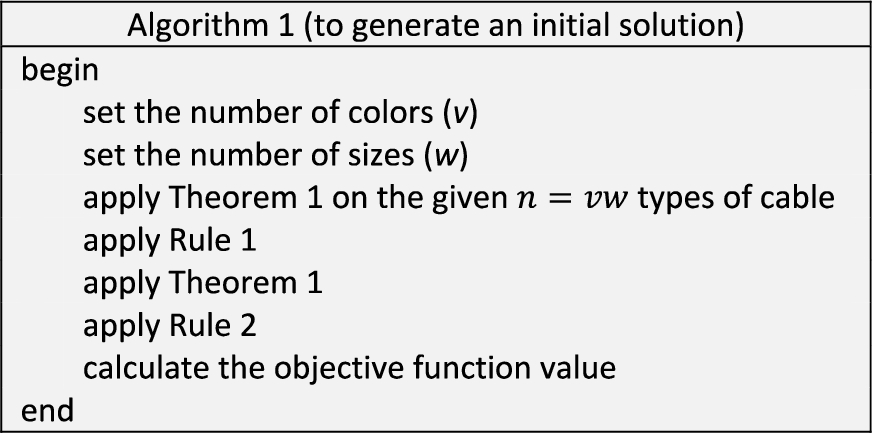
Pseudo code for generating an initial solution.
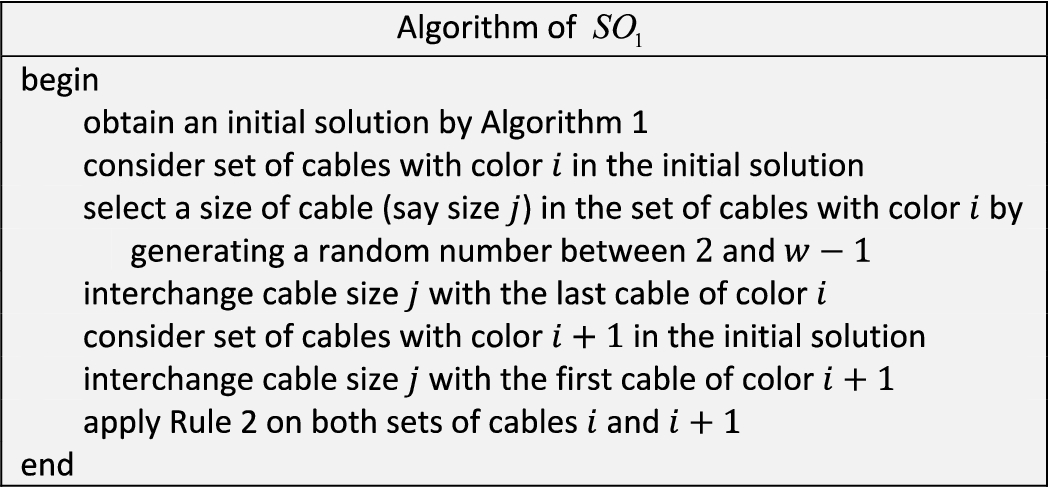
Pseudo code of neighbourhood search operator 1 (
Applying
Neighbourhood Search Operator 3 (
)
Using
Tabu Search Hybridized by Simulated Annealing (TS-SA)
Tabu Search (TS) (see Lamghari and Dimitrakopoulos, 2012; Li and Gao, 2016) and Simulated Annealing (SA) (see Kirkpatrick et al., 1983; Niroomand et al., 2016) are two famous single solution based meta-heuristic algorithms which have been widely applied to solve combinatorial optimization problems.
TS starts with a current solution (initial solution). This current solution is also marked as the best solution. Then TS uses some directions of searching space and finds some neighbour solutions. The best neighbour solution of the discovered neighbours can be used for three purposes, (1) it is saved as the best solution if it is better than the current best solution, (2) the best neighbour and also its neighbourhood direction is marked as a tabu solution and direction and saved in a tabu list, and (3) it is saved as the current solution. Then the algorithm is repeated for a number of iterations. In order to avoid repeating some previously considered current solutions, in each iteration the neighbour solutions obtained by tabu searching directions are not considered as a new current solution unless they are better than the best obtained solution. This condition is named aspiration criteria. Considering tabu list and aspiration criteria together is one of the advantages of TS which avoid cycling in searching procedure. When last iteration is done, the best solution is introduced as the best obtained solution of TS.
SA starts with an initial solution (called current solution and also best solution) in an initial state called initial temperature (current temperature). In the current temperature for a number of iterations, the current solution is tried to be improved by generating its neighbour solutions. Each generated neighbour solution could be used for the following purposes, (1) to be used instead of the best solution and the current solution if it has better objective function value than the best solution, (2) to be used instead of the current solution if it has better objective function value than just the current solution, and (3) to be used instead of the current solution if the condition
In this study, TS is hybridized by SA. To combine these two algorithms and fit them to the problem of Section 3, in the first iteration of the TS the following is done: The initial solution obtained by Section 4.1 is used as current (initial) solution. Each colour of the cables in the initial solution is considered as a searching direction (except for the last one, because neighbourhood search operator 1 cannot be applied in this case). In each searching direction of the initial solution (current solution), an SA algorithm using neighbourhood search operator 1, is applied as a local search to obtain the best possible neighbour solution in each searching direction separately. The best obtained neighbour among all searching directions is saved instead of the current solution of the TS and this searching direction is added to the list of tabu directions.
The TS-SA algorithm continues to the consequent iterations considering the current solution. Pseudo code of this hybrid algorithm is shown by Fig. 5, where the parameters used in the algorithm are noted in Table 2.
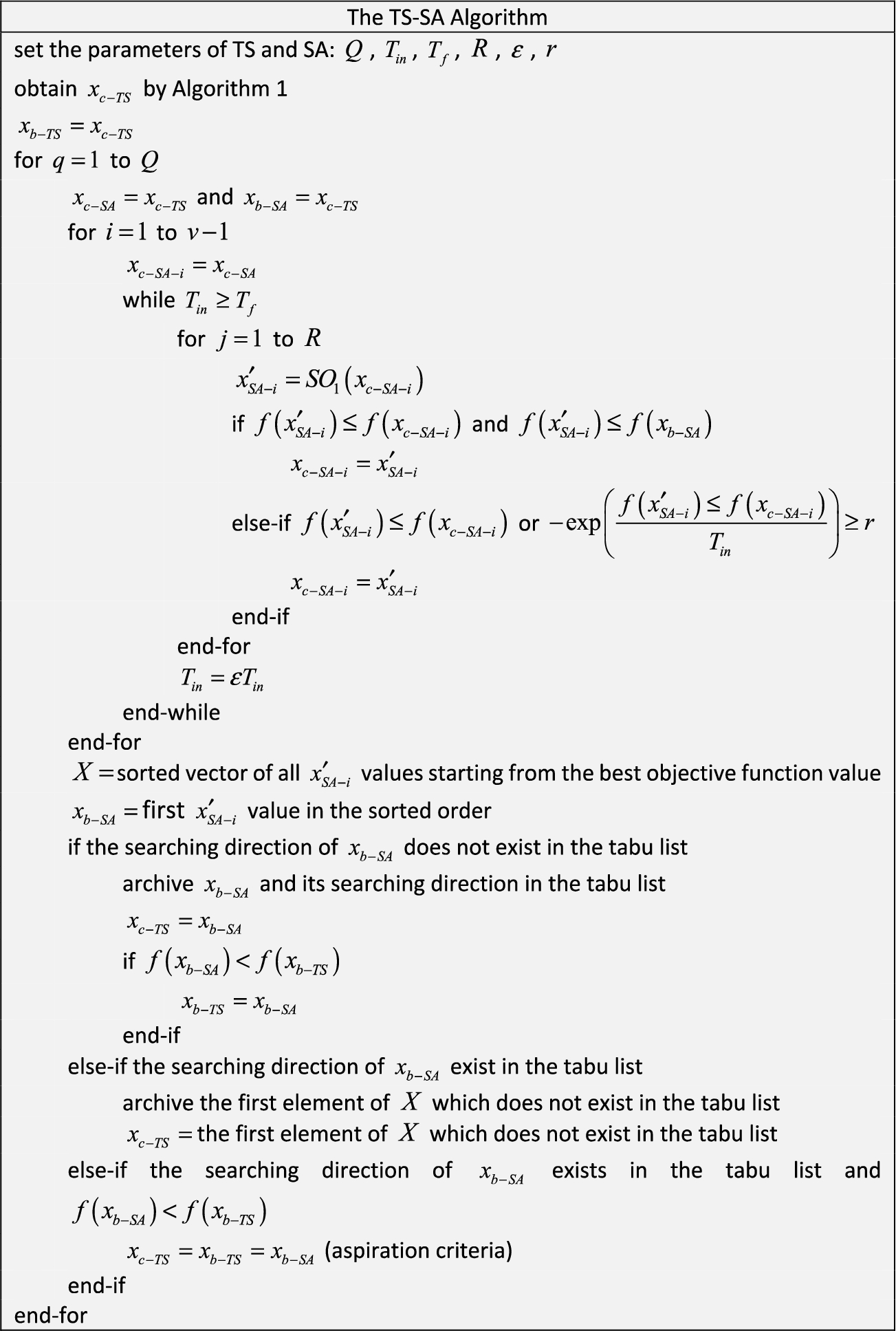
Pseudo code of the TS-SA algorithm.
Another hybridization of the TS is done by help of Variable Neighbourhood Search (VNS) algorithm. The structure of this hybrid algorithm (TS-VNS) is the same as the structure of TS-SA algorithm. The only difference is that instead of the SA algorithm, a VNS algorithm is used. The VNS is of single solution based meta-heuristics which starts with an initial (current) solution and uses a set of some different neighbourhood search operators to explore neighbour solutions. Focusing on the initial (current) solution, first search operator is applied for a number of iterations. The best obtained neighbour solution is saved as the current solution and the algorithm is repeated in the same way for other neighbourhood search operators. At the end, current solution is introduced as the best obtained solution of the VNS.
Pseudo code of this hybrid algorithm is shown by Fig. 6, where the parameters used in the algorithm are noted in Table 3.
In this study, the hybrid meta-heuristic algorithms are proposed in order to improve the performance of the classical algorithms TS, VNS, and SA. Therefore, the proposed TS-VNS and TS-SA have the following advantages comparing to the classical algorithms: The classical TS has a simple neighbourhood search structure. The proposed TS-SA applies the SA as a local search mechanism in order to improve the search structure of TS. The proposed TS-VNS uses the VNS as a local search mechanism in order to improve the search structure of the TS. The proposed hybrid meta-heuristic algorithms applies more neighbourhood search methods comparing to the classical algorithms.
The proposed algorithms of previous section are to be experimentally evaluated in this section. For thus aim, the proposed algorithms are coded in MATLAB and to perform all the required experiments the codes are run on a computer with an Intel Core 2 Duo 2.53 GHz processor and 4.00 GB RAM. To evaluate and study the behaviour of the algorithms the following is needed:
obtaining some benchmark problem from the factory under study,
tuning the parameters of the algorithms,
final experiments and comparing the results with literature.
The above-mentioned requirements are done in the sub-sections of this section.
Notationsused in the TS-SA algorithm.
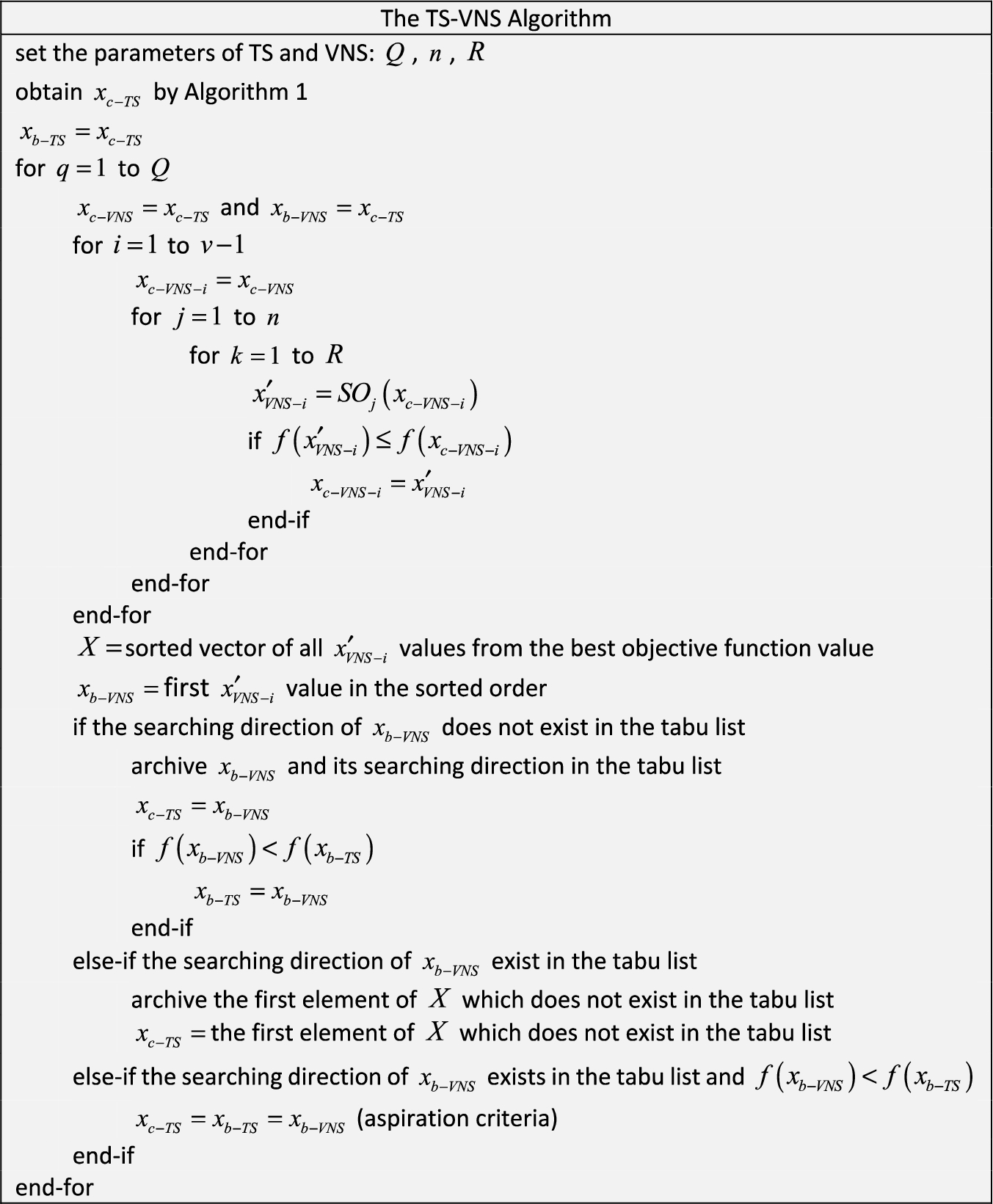
Pseudo code of the TS-SA algorithm.
To study the performance of the proposed algorithms, some benchmark problems are needed. The study of Niroomand and Vizvari (2015) contains just one benchmark (obtained from the case of the study) which is a large-sized benchmark containing 15 colours and 10 sizes. In this study, that benchmark is considered as the largest benchmark and for generating some other benchmarks, its sizes are decreased. Notably, the values of data (explained in Section 2) in the generated benchmarks remain unchanged, just the size of matrices and vectors which contain data are decreased by removing extra rows and columns. These benchmarks are detailed in Table 4.
Notationsused in the TS-VNS algorithm.
The benchmarks used for computational experiments.
Any meta-heuristic algorithm consists of some parameters which should be fixed in advance. As most of algorithms behave randomly, the values given for their parameters may affect the quality of obtained solutions. Generally larger values for parameters result in larger CPU running time and maybe better result. This relation cannot be true always. Therefore, parameters of meta-heuristic algorithms should be tuned before performing final experiments. The tuning procedure can be done to optimize one or more responses obtained from running an algorithm for a benchmark. In most of studies, the tuning procedure is done to study the effect of parameters’ levels for obtaining solutions with better objective function. As a more complete study on the behaviour of parameters, except quality of solutions, CPU running time also can be considered as another response, meaning that a multi-response study can be done to tune the parameters of a meta-heuristic algorithm.
To tune the parameters of the proposed algorithms of this study, two responses of objective function value (quality) and CPU running time are considered to be optimized. To optimize the parameters’ levels according to these two responses, a method based on regression analysis is done. The method previously was introduced by Pasandideh et al. (2015). The steps of this method are explained here:
The data and results of parameter tuning.
Notably, when performing Step 6 of the tuning procedure, the
The best level obtained for each parameter is applied to perform the final experiments on the benchmarks.
The best level of the parameters reported in Table 5 is applied in the proposed algorithms to perform the final experiments on all the benchmarks of Table 4. To compare the results of the proposed algorithms with the methods of literature, the SA and VNS algorithms of Niroomand and Vizvari (2015) are simulated and applied. Notably, these algorithms are used with the best levels of their parameters reported in Table 5, except for the parameter Q (as these methods do not have such parameter). All the four algorithms for each benchmark are allowed to run for
The result obtained by the algorithms.
The result obtained by the algorithms.
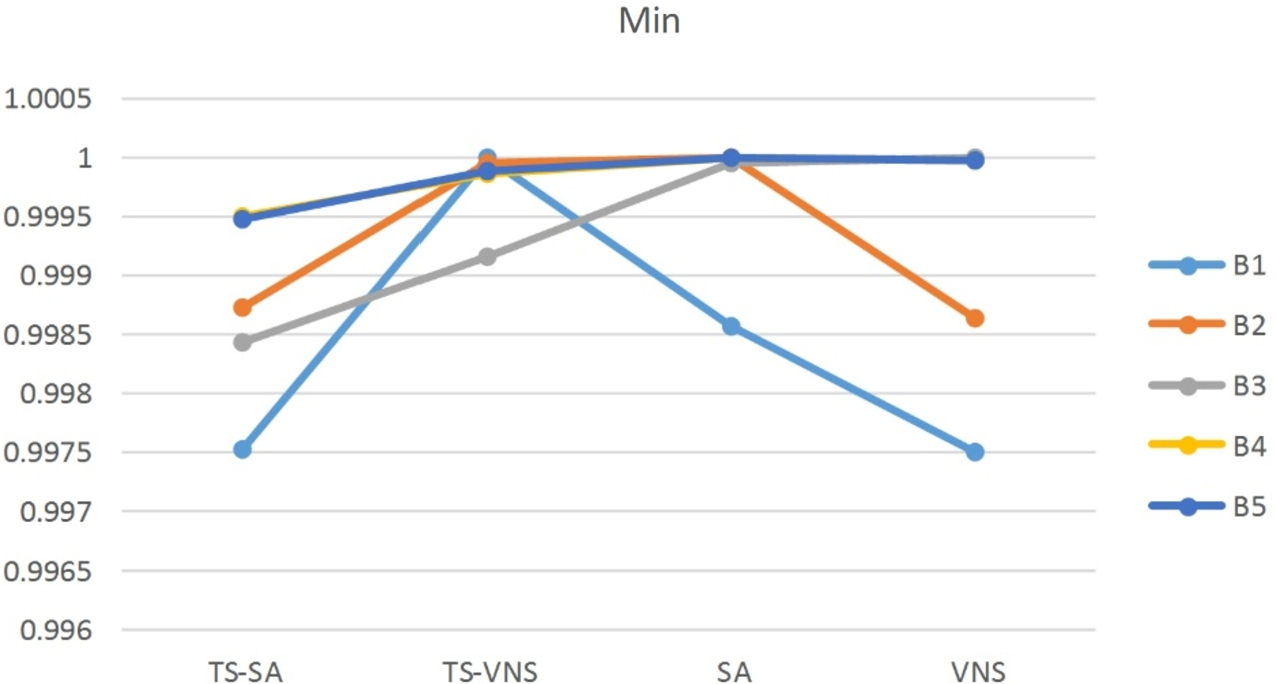
Normalized plot of minimum obtained values for all the benchmarks by the algorithms.
The results of Table 6 are normalized to be plotted for graphical illustrations. The graphs of normalized results for minimum, average and maximum values of Table 6 are shown by Figs. 7–9. As can be seen from the table and figures, in most of the benchmarks the TS-SA performs better than the other algorithms in the case of minimum, average, and maximum obtained solutions. There is just one exception that in the second benchmark (B2) the minimum obtained value for the VNS is better than the others. For the case of exact solution method, as mentioned above, 10800 seconds of running time is allowed to the GAMS for each of the benchmarks. The values of 5626.30 and 32362.48 obtained for the benchmarks B1 and B2 are not optimal and the optimality gap of 100% still remains for each of them after 10800 seconds of running time. For the benchmarks B3, B4, and B5, after 10800 seconds the GAMS is unable to introduce any feasible solution. This fact shows the complexity of the problem. Concludingly, the proposed meta-heuristics perform better than the exact solution method of the GAMS. Also, the stability of the solutions obtained over 10 runs of each algorithm for all the benchmarks can be studied. For this aim, the difference of maximum and minimum values of each algorithm for each benchmark is calculated and plotted in Fig. 10. In this case, the TS-SA and TS-VNS algorithms perform better than the SA and VNS algorithms.
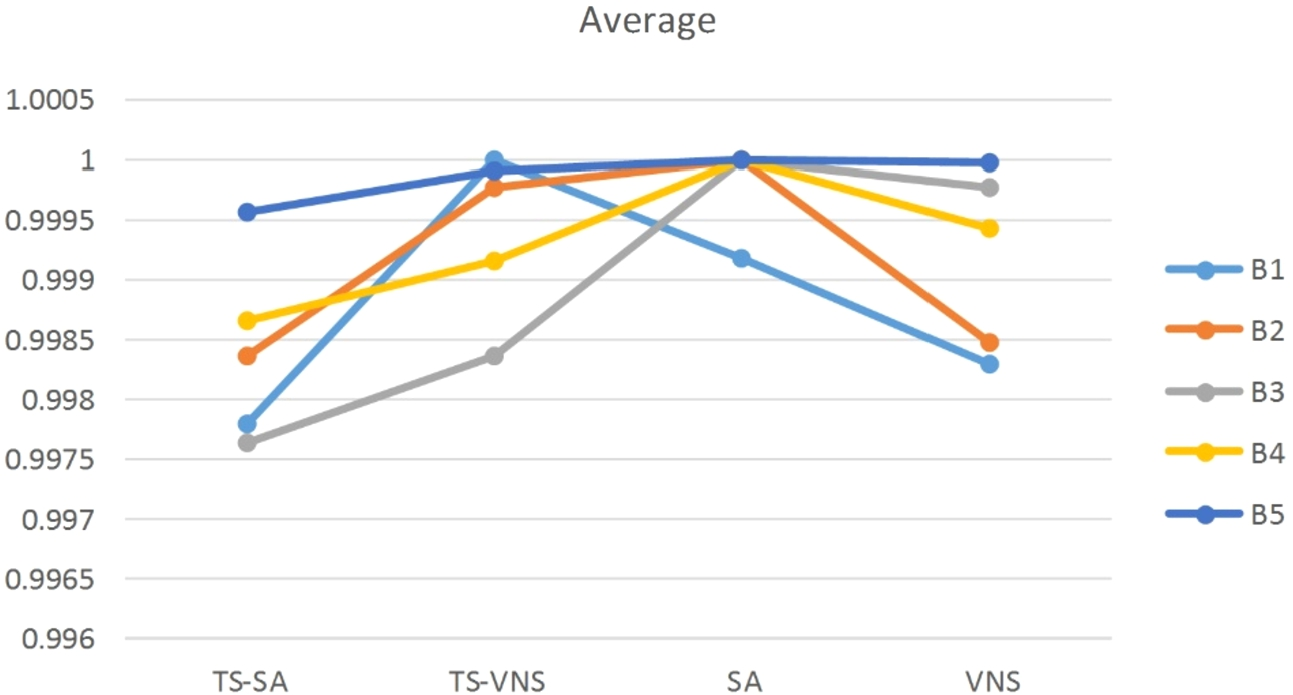
Normalized plot of average of the obtained values for all the benchmarks by the algorithms.
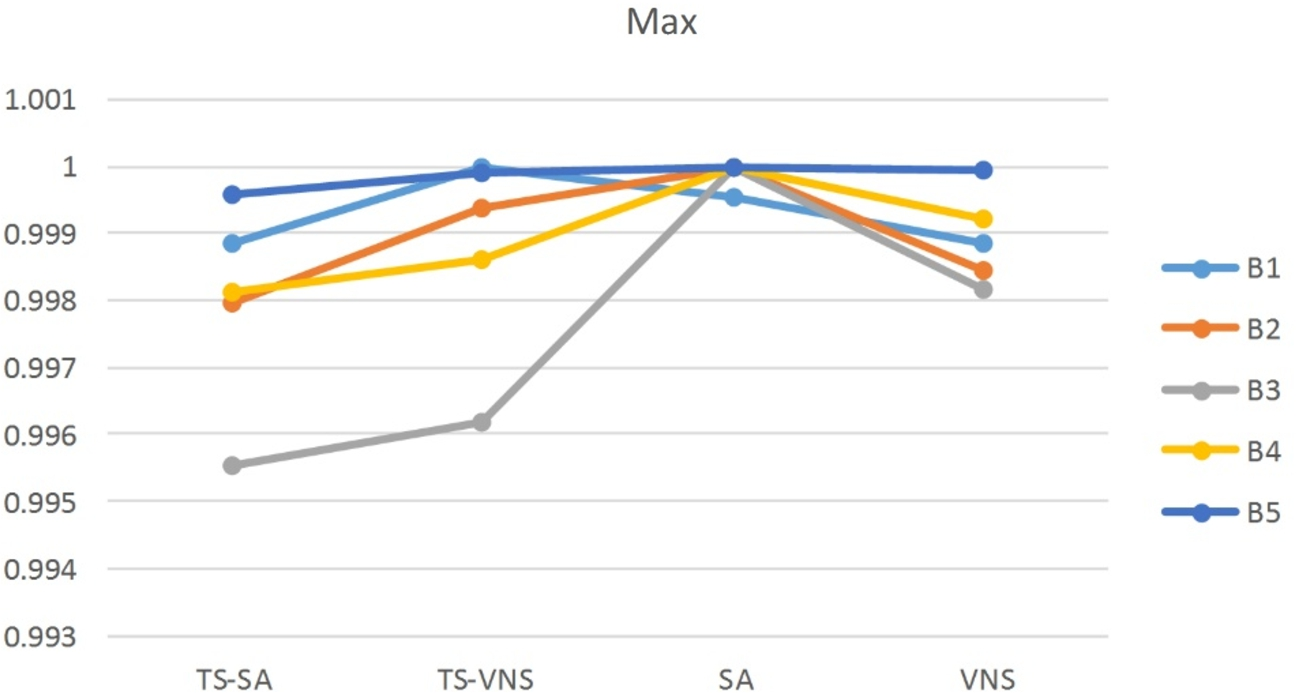
Normalized plot of maximum obtained values for all the benchmarks by the algorithms.
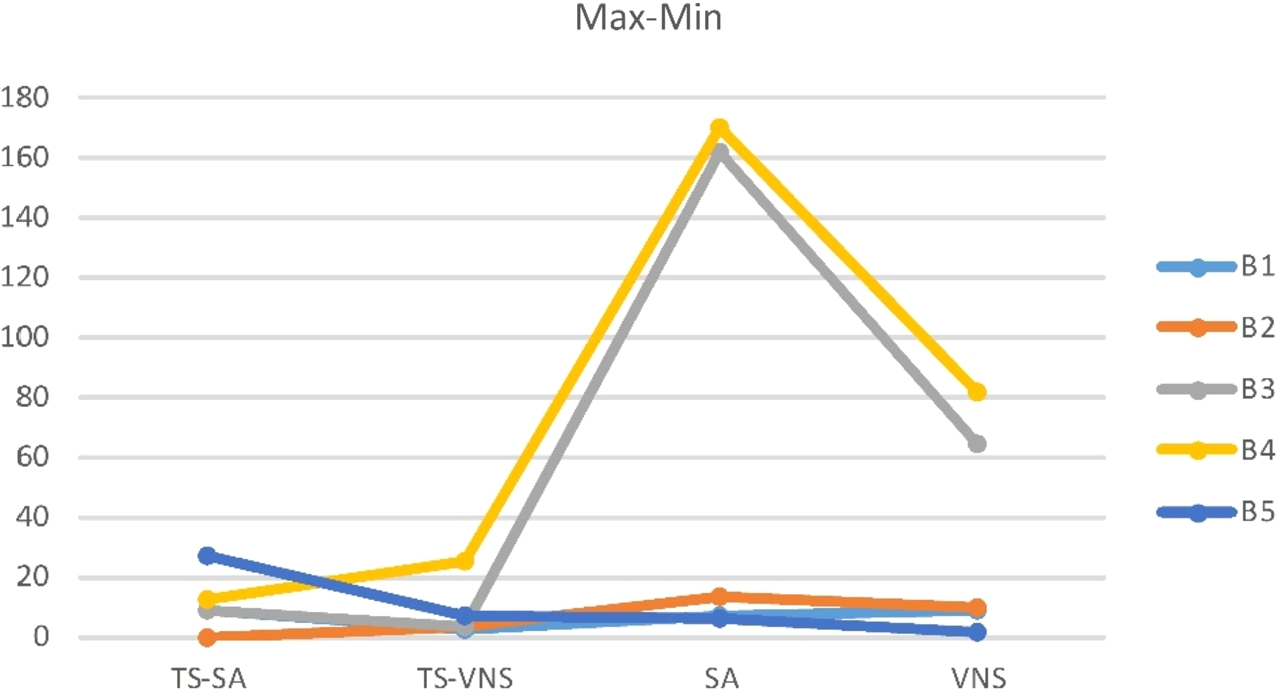
The difference between maximum and minimum values obtained by each algorithm for each benchmark.
The study focused on solving an important scheduling problem of cable manufacturing industries. For the case that the cables vary in diameter size of cooper and plastic cover colour, the system was modelled as a single machine scheduling problem which minimizes the total production costs including processing cost, setup cost, and inventory holding cost. Two hybrid meta-heuristics which combine simulated annealing and variable neighbourhood search algorithms with tabu search algorithm separately (say TS-SA and TS-VNS algorithms) were proposed. Applying some theorems and rules of the literature, a special initial solution with optimal setup cost was obtained for the algorithms. The computational experiments over the benchmarks obtained from a real cable manufacturing factory show better performance of TS-SA comparing to TS-VNS and the methods of literature.
Footnotes
Acknowledgements
The authors are grateful to the editors and reviewers of the journal for their helpful and constructive comments that improved the quality of the paper.