




Abstract
This paper aims to develop a Fermatean fuzzy ELECTRE method for solving multi-criteria group decision-making problems with unknown weights of decision makers and incomplete weights of criteria. First, a new distance measure between Fermatean fuzzy sets is proposed based on the Jensen–Shannon divergence. The cross entropy for Fermatean fuzzy sets is defined. Three kinds of dominance relationships for Fermatean fuzzy sets are proposed. Then, two optimization models are constructed to obtain positive ideal decision-making information and negative ideal decision-making information, respectively. Accordingly, the credibility degree of each decision maker is calculated. Decision makers’ dynamic weights are determined by their credibility degrees. Besides, to obtain the weights of criteria, an optimization model is constructed based on grey relational analysis for Fermatean fuzzy numbers. Finally, the strong, medium and weak Fermatean fuzzy concordance and discordance sets are identified to construct the Fermatean fuzzy concordance and discordance matrices, respectively. A practical case study is carried out to illustrate the feasibility and applicability of the proposed ELECTRE method. Comparative analyses are performed to demonstrate the superiority and effectiveness of the proposed ELECTRE method.
Introduction
With the increasing complexity of the socio-economic environment, it is difficult for single Decision Maker (DM) to consider all relevant aspects of a problem, because of the limitation of individual’s knowledge or experience. Multi-Criteria Group Decision-Making (MCGDM) is a widely used efficient method for the complex decision-making problems. DMs or experts express their opinions or preferences about alternatives with respect to different criteria to obtain the best alternative (Wu et al., 2019). For traditional MCGDM, the decision information is represented by crisp numerical values. However, due to the complexity and vagueness of decision-making problems, it is usually challenging for experts to evaluate an object with crisp numerical values. Therefore, various types of fuzzy sets have been applied to MCGDM problems, such as Fuzzy Set (FS) (Zadeh, 1965; Choua and Shen, 2008; Chiclana et al., 2007), Intuitionistic Fuzzy Set (IFS) (Atanassov, 1986; Jiang and Hu, 2021), Pythagorean Fuzzy Set (PFS) (Yager, 2014; Mohagheghi et al., 2017; Zhou and Chen, 2020), etc. Although IFS and PFS are extensively scrutinized by scholars, their applications are relatively limited due to many limitations over the selection of the membership and non-membership grades.
Since Fermatean Fuzzy Set (FFS) proposed by Senapati and Yager (2019c) is able to model the uncertainty in real-life decision-making problems better than IFS and PFS, FFS has received increasing attention. The advantage of FFS is illustrated by an example that an expert may express his/her preference for an alternative over criterion with membership degree 0.8 and non-membership degree 0.9, then it is clearly
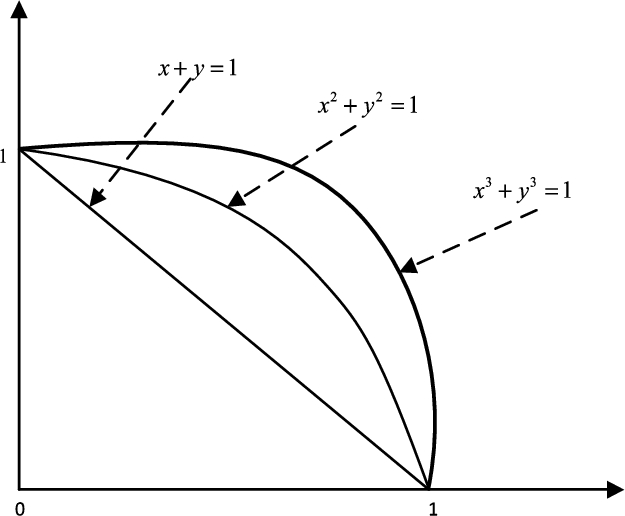
Comparison of spaces of FMGS, PMGs and IMGs.
Since the seminal work of Senapati and Yager (2019c), FFS has been investigated by many scholars. Senapati and Yager (2019c) combined the technique for order preference by similarity to ideal solution (TOPSIS) approach with FFS to handle the multi-criteria decision-making (MCDM) problem. Senapati and Yager (2019b) defined four new weighted aggregated operators including Fermatean fuzzy weighted average operator, Fermatean fuzzy weighted geometric operator, Fermatean fuzzy weighted power average operator, Fermatean fuzzy weighted power geometric operator. Senapati and Yager (2019a) introduced some operations over FFS, then developed a weighted product model based on Fermatean fuzzy information to solve the MCDM problem. Based on Dombi operations, Aydemir and Gunduz (2020) presented a series of aggregation operators for FFS. They then extended TOPSIS with the proposed Fermatean fuzzy Dombi operators. Although some researches are conducted on MCDM methods in the FFS context, there still remain some drawbacks to be handled. The weights of criteria are given by experts in advance. Besides, most of existing decision-making methods for FFSs are aggregation operator-based methods and compromising methods rather than outranking methods. The outranking methods may lead to compensation effect.
Outranking methods are treated as the suitable means for making a successful assessment on the competing criteria. The most widely used outranking method is ELECTRE (elimination and choice translating reality) method, which was proposed by Roy (1991). Since then, numerous studies have been conducted to extend ELECTRE method under fuzzy decision environments, such as triangular fuzzy numbers (Zandi and Roghanian, 2013; Kabak et al., 2012), trapezoidal fuzzy numbers (Hatami and Tavana, 2011), FS (Ferreira et al., 2016), IFS (Shen et al., 2016; Wu and Chen, 2011; Çalı and Balaman, 2019; Mishra et al., 2020; Kilic et al., 2020), interval-valued intuitionistic fuzzy set (Chen, 2014a; Hashemi et al., 2016; Xu and Shen, 2014), hesitant fuzzy set (Chen and Xu, 2015; Mousavi et al., 2017), PFS (Akram et al., 2019, 2021, Chen, 2020) neutrosophic set (Peng et al., 2014; Karasan and Kahraman, 2020; Zhang et al., 2015), etc. However, to the best of our knowledge, no research on ELECTRE method within the context of FFS has yet been conducted.
Recently, many researchers have focused on the construction of outranking relation by using different indices, e.g. the value of score function (Wu and Chen, 2011; Xu and Shen, 2014; Liao et al., 2018), distance measure (Zhang and Yao, 2017; Chen, 2014b), possibility measure (Chen, 2014b, 2015). In general, outranking relation can be sorted as strong dominance and weak dominance. In essence, these two dominance relations are insufficient to describe the degree of superiority and demonstrate superior relation among alternatives. Furthermore, the weights of concordance and discordance sets play an important role in the solution of a MCDM problem with ELECTRE method, which may eventually affect the ranking or selection of alternatives. However, most current ELECTRE methods (Wu and Chen, 2011; Kilic et al., 2020; Chen and Xu, 2015; Akram et al., 2019; Razi, 2015) directly give the weights of concordance and discordance sets on the basis of the subjective judgments of DMs, which lacks the basis of scientific theory and may be unreasonable.
Previous studies on FFS and ELECTRE methods have achieved fruitful research results, some challenging gaps can be identified as follows: Firstly, some methods (Senapati and Yager, 2019a, 2019b, 2019c) under FFSs environment were developed to solve the single expert MCDM problems, which is not suitable for solving group decision-making problems. Literature (Senapati and Yager, 2019a, 2019b, 2019c; Aydemir and Gunduz, 2020) failed to consider the determination of criteria weights, which may lead to unreasonable and unreliable decision-making results. Secondly, distance measure of FFSs in (Senapati and Yager, 2019c) might generate the counter-intuitive results in some cases (see Example 2 in Section 3). Thirdly, there is no research on ELECTRE method with FFS. In addition, due to the computational complexity, many ELECTRE methods (Wu and Chen, 2011; Kilic et al., 2020; Chen and Xu, 2015; Akram et al., 2019; Razi, 2015) provide a priori weights of concordance and discordance sets, which can be easily influenced by DMs’ subjective randomness.
To achieve the aforementioned main objective and fill outlined research gaps, this paper proposes a Fermatean fuzzy ELECTRE method for MCGDM problems. The main contributions and innovations of this paper are outlined below. Firstly, a new distance measure between FFSs is designed by making use of the Jensen–Shannon divergence. The objective weights of concordance and discordance sets are generated by applying the weighted distance measure based on the proposed new distance measure, which is subjectively given by experts in a majority of the studies related to ELECTRE literature (Wu and Chen, 2011; Kilic et al., 2020; Chen and Xu, 2015). Secondly, the weights of DMs are dynamic with respect to each alternative over different criteria, which are generated using the credibility degrees of each DM. As for the DMs’ weights, previous studies usually give them in advance (Wang et al., 2020) or views them as unchangeable for different criteria over different alternatives. Thirdly, the grey relational coefficient and grey relational degree of the FFSs are defined and applied to compute the weights of criteria. Fourthly, in order to show the dominance degree between the pairwise FFNs more exactly, this paper uses membership degree, non-membership degree and indeterminacy degree to compare the outranking relationship for each pair of FFNs. Based on this, the outranking relationship for FFNs can be extended into three situations: strong dominance, medium dominance and weak dominance.
The remainder of this paper is organized as follows: Section 2 introduces some basic concepts associated with FFSs. In Section 3, some information measures for FFSs, including distance measure, cross entropy measure, and grey relational degree, are defined. Outranking relationships for FFSs are introduced in this section, where the related properties of outranking relationships are discussed. An ELECTRE method for MCGDM problems with FFNs is proposed in Section 5. Section 6 illustrates the concrete implementation of the proposed ELECTRE method using a case study on site selection of fangcang shelter hospitals (FSHs), and demonstrates the superiority and effectiveness of the proposed ELECTRE method by comparative analyses. Section 7 gives some conclusions and future research directions
This section reviews some concepts, operational rules, comparative methods and aggregation operator of FFSs. The existing Euclidean distance measure of FFNs is also reviewed.
Fermatean Fuzzy Sets
In this section, some basic concepts related to FFSs are briefly reviewed. Let X be a universe of discourse such that For any FFS F and In addition, Let
Let Let Let If If Let (Senapati and Yager, 2019c).
(Senapati and Yager, 2019c).
This section shortly reviews distance measure related to FFSs. Let (Senapati and Yager, 2019c).
In this section, we put forward some new information measures for FFSs, including distance measure, cross entropy measure, and grey relational degree. They will be used later.
A New Distance Measure for FFSs
In this section, we recall Jensen–Shannon divergence measure. Secondly, a distance measure between FFSs is defined based on Jensen–Shannon divergence. Then, some desirable properties of the proposed new distance measure are inferred.
(Kullback and Leibler, 1951).
Let X be a discrete random variable, and
To solve this problem, Lin (1991) proposed a new directed divergence measure as
An obvious relation between
Jensen–Shannon divergence measure can be derived from Eq. (8) as follows:
In this paper, we define Fermatean fuzzy distance based on Jensen–Shannon divergence.
Let
In the line with Definition 9, a new distance measure for FFSs is given below.
Let X be a universe of discourse, and G and H be two FFSs. A new distance measure for FFSs, denoted as
Some desirable properties of
Let G, H and M be three arbitrary FFSs in a universe of discourse X, then some properties hold:
(P1) Let G and H be two FFSs in a universe of discourse X. For the necessity, If (P2) Since (P3) Four hypotheses are formulated as follows:
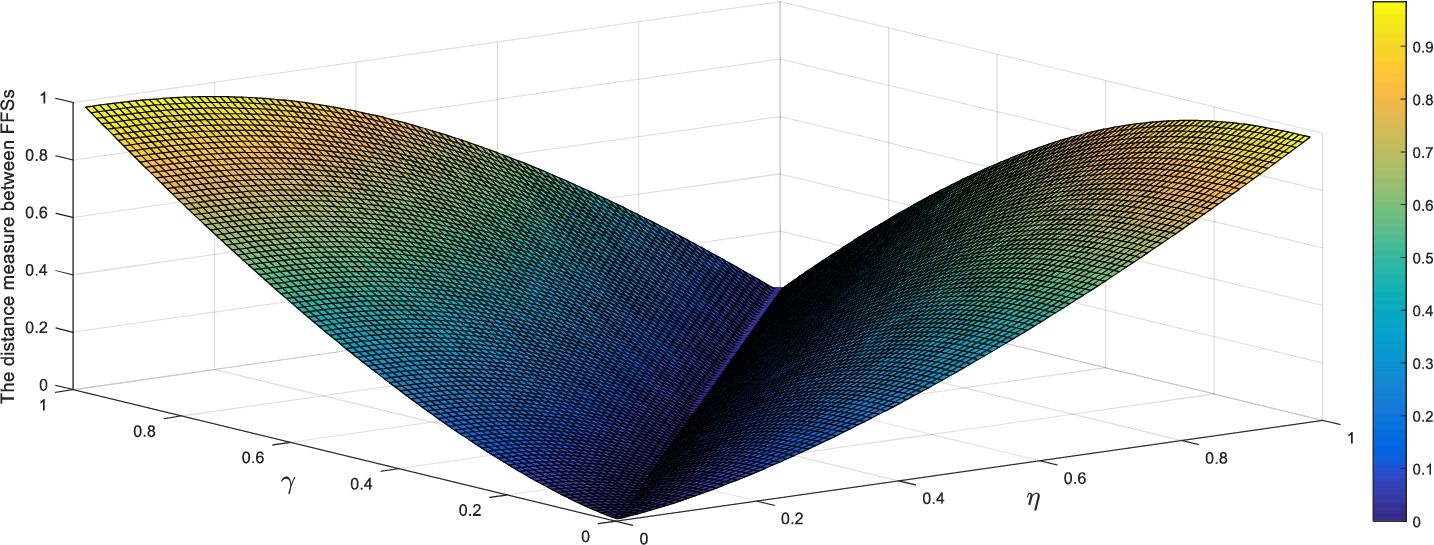
According to Hypothesis 1 and Hypothesis 2, it holds that In the same way, according to Hypothesis 4, we can get As a result, Analogously, it follows that Hence, this completes the proof of (P4) Consider two FFSs G and H in a universe of discourse X, one has It has been proven in Gallager (1968) that, for and This completes the proof of Theorem 1. □ Let G and H be two FFSs in the universe of discourse X. These FFSs over X are defined as The parameters η and γ are the membership and non-membership degrees, respectively, which range from 0 to 1, meeting the condition Using Eq. (11), the distance for FFSs can be measured, as shown in Fig. 2. In consideration of the distance measure results of Example 1, we can verify the non-negativity, symmetry and boundedness properties of distance measure for FFSs. It can be seen from Fig. 2 that the distance measure for FFSs is always greater than or equal to zero when the parameters η and γ take different values within As shown in Fig. 2, it is obvious that the distance measure for FFSs satisfies symmetry property. Let us cite a concrete instance that From Fig. 2, we clearly know the values of distance measure are
The FFSs distance measure in Example 1.
In this section, in order to testify the superiority and reasonability of the proposed distance measure, we compare the proposed distance measure with the existing Euclidean distance measure (Senapati and Yager, 2019c) in Example 2. Let
Comparisons of Euclidean distance measure and the proposed distance measure.
The distance measure results obtained by two methods are shown in Table 2. Carefully observing Table 2, the main conclusions are described as follows.
(1) Compared with the Euclidean distance measure (Senapati and Yager, 2019c), the proposed distance measure has satisfactory performances under Case 1–Case 14. The values of the Euclidean distance measure are equal under Case 1–Case 14. These results seem counter-intuitive, which are highlighted in bold in Table 2. The proposed distance can measure the difference under Case 1–Case 14, which demonstrates the feasibility of the proposed distance.
(2) The discrimination degrees of the proposed distance measure are significantly higher than those of the Euclidean distance measure under Case 15 and Case 16 or Case 17 and Case 18. It can be seen from Table 2 that the discrimination degrees of Euclidean distance measure under Case 15 and Case 16 or Case 17 and Case 18 are only 0.01, while the discrimination degrees of the proposed distance measure under the corresponding cases are over 0.06.
As one of the most popular information measure, cross entropy is used to measure the divergence information and extensively applied in current literature. However, cross entropy measure for FFSs is rare. Inspired by Song et al. (2019), this paper gives a definition of Fermatean fuzzy cross entropy. Let X be a universe of discourse such that Since Let X be a universe of discourse such that
Let G, H and M be three arbitrary FFSs in a universe of discourse X, then
(P1) For two FFSs in X defined as Then, we can get that Therefore, (P2) If Since (P3) In this case of Therefore, Theorem 2 is proved. □
In this section, grey relational theory is extended to FFSs environment, and the FFSs grey relational coefficient and grey relational degree are defined for the first time.
The grey system theory first created by Deng (1982) is a useful method to study the problems with insufficient, poor and uncertain information. As an indispensable part of grey system theory, the basic idea of grey relational analysis (GRA) is to judge whether the geometric shapes of sequence curves are closely related according to their similarity degrees. The closer the curve is, the greater the correlation between the corresponding sequences is, and vice versa. GRA has been widely applied in addressing different kinds of MCMD problems (Li et al., 2020; Wu, 2009; Hamzaçebi and Pekkaya, 2011), due to being computationally simple, robust and practical. In the following, GRA is introduced. Let The grey relational degree is defined as: Let X be a universe of discourse such that In view of grey relational coefficient between FFSs, the grey relational degree between FFSs G and (Deng, 1989).
In this section, outranking relationships for FFSs are introduced on account of classic outranking model. In addition, the related properties of outranking relationships are discussed.
Although the current two kinds of outranking relationships are widely applied in ELECTRE method, they are inadequate to differentiate between each Fermatean fuzzy pair. In line with the concept of score function, accuracy function and degree of indeterminacy, it is obtained that a better alternative has larger score degree or larger accuracy with the condition that score degrees of alternatives are the same. A larger score degree alludes to a larger degree of membership or smaller degree of non-membership; a larger accuracy degree alludes to a smaller degree of indeterminacy. In order to investigate a proper outranking method under an FFSs environment, we propose three kinds of dominance relationships for FFSs to show their interrelationships more comprehensively and explain their dominance degrees more specifically. Let (1) Strong dominance: If (2) Medium dominance: If (3) Weak dominance: If (4) Indifference: If
Let
There are the following properties for the strong dominance:
Irreflexivity:
Asymmetry:
Transitivity:
There are the following properties for the medium dominance:
Irreflexivity:
Asymmetry:
Transitivity:
There are the following properties for the weak dominance:
Irreflexivity:
Asymmetry:
Transitivity:
There are the following properties for the indifference relationship:
Reflexivity:
Symmetry:
Transitivity: The transitivity property for strong dominance relationship can be testified as follows: Let The proof of other properties for strong dominance, medium dominance, and weak dominance are straightforward. □
This section develops a Fermatean fuzzy ELECTRE method for MCGDM.
Problem Description of MCGDM Using FFNs
Assuming there are m non-inferior alternatives
Determine Dynamic Weights of DMs with Respect to Each Criterion over Different Alternatives
Aggregating all individual decisions into a collective decision is regarded as a key part of MCGDM process. Therefore, how to determine the weights of DMs is one of the main activities for MCGDM problems, because different weights of DMs may generate different collective decision matrices and then can have significant impact on the final result. Hence, methods for determining the weights of DMs have received much attention by researchers, however, most of existing methods usually assume that DMs’ weights for all alternatives and criteria are changeless (Yue, 2012; Lin and Chen, 2020; Wan et al., 2013; Ju, 2014; Wan et al., 2015). In the actual decision-making process, it is unlikely that each DM is expected to be good at commenting on all alternatives and criteria due to differences in educational background, knowledge, experience, preference, and title, the weights of each DM may change with different criteria and different alternatives. Hence, distributing different weights to each DM with respect to different alternatives under different criteria is more reasonable and in line with the actual decision-making situation. Therefore, the study of dynamic DM weights is of some practical significance. According to Geng et al. (2017), dynamic weights refer to assigning different weights to each DM with respect to different criteria over different alternatives. DM’s weights will vary with different criteria and different alternatives. However, to the best of our knowledge, there are only several scholars (Geng et al., 2017; Wu et al., 2019) involving this issue up to now. In particular, determining the objectively dynamic weights of DMs in the context of Fermatean fuzzy information remains an unexplored area. To fill the research gap, this paper proposes a new method for determining dynamic weights of DMs. Inspired by Geng et al. (2017), based on the proposed the cross entropy, dynamic weights of DMs are determined as follows:
Let
The credibility degree is determined in line with cross entropy. If
It is obvious that the DM
Using Eq. (3),
Criteria weights play a pivotal role in MCDM problems, because they have an important and direct influence on ranking results. Due to the increasing complexity, time pressure or lack of data in practical situations, the weights of criteria are usually unknown. Therefore, it is an interesting research topic to deduce plausible weights for criteria by selecting suitable methods in the real-life MCDM process, since plausible weights can ensure scientific and plausible decision-making results. In the current literature, methods for deriving criteria weights can be divided into two categories: the subjective weight-determining methods, the objective weight-determining methods.
The subjective weight-determining methods, such as the Delphi method (Dalkey and Helmer, 1963), the AHP method (Saaty, 1987; Kaya and Kahraman, 2011) and SRF method (Figueira and Roy, 2002), determine the weights of criteria based on experiences and subjective judgments. The subjective weight-determining methods are impacted by subjective randomness of the DM’s preference. In addition, when there are a great number of assessment criteria, the subjective weight-determining methods are not suitable for identification of weights of these criteria (Çalı and Balaman, 2019). Different from the subjective methods, the objective methods are capable of eliminating man-made instabilities and obtaining more realistic weights according to mathematical model. A majority of them have focused on calculation of entropy value so as to derive the criteria weights. Entropy weight method, which is a straightforward method for weight determination, has been extensively applied to diverse decision-making fields (Zhang and Yao, 2017; Xu and Shen, 2014; Ye, 2010; Liu and Zhang, 2011), however, it can deduce irrational weight values in some cases (Das et al., 2015).
Since its inception in Deng (Wang, 1997), GRA method has been widely employed for obtaining objective weights of criteria (Wei, 2011a, 2010; Luo et al., 2019; Meng et al., 2015), because its greatest strength is that it is computationally simple, robust and practical (Wei, 2011b). This is a discerning evidence that the GRA method is deemed to be a more feasible method to obtain criteria weights in this study.
In the following, we utilize GRA method to determine the criteria weights with incomplete information.
Firstly, the Fermatean Fuzzy Positive Ideal Point (FF-PIP)
Then, based on the proposed distance measure for FFSs in Section 3.2, the distances of the rating values
Next, the grey relational coefficients of the rating values
Subsequently, the degrees of grey relational coefficient of the alternative
According to the GRA method, the optimal alternative should have the “largest degree of grey relation” from the positive-ideal solution and the “smallest degree of grey relation” from the negative-ideal solution. Based on this idea, a multiple objective optimization model (M-1) is established to get criteria weights with incomplete weight information with respect to alternative
A weak ranking:
A strict ranking:
A ranking with multiples:
An interval form:
A ranking of differences:
Since each alternative is non-inferior, there exists no preference relation on all alternatives. We may aggregate the above multiple objective optimization model with equal weights into the following single-objective optimization model (M-2):
By solving the model (M-2), we obtain the optimal weight vector of criteria
Then, we will substitute
Then, let
The weight vector
In the following, an optimization model motivated by the ideal of TOPSIS method is constructed to determine the weight of each criterion in incomplete weight information context. The main steps are described as follows:
(1) Determine the Positive Ideal Weight Vector (PIWV) and Negative Ideal Weight Vector (NIWV) of the criterion weight for each alternative.
According to the above analysis, PIWV and NIWV are defined as
(2) Calculate the distance of each criterion weight from the PIWV and NIWV respectively.
According to the ideal of TOPSIS method, a multiple objective optimization model (M-3) is constructed to derive criteria weights with incomplete weight information,
The above multiple objective optimization model is equal to the following single objective optimization model (M-4) by using equal weight linear weighting method:
The optimal solution
For each Fermatern fuzzy pair of
Strong concordance set is portrayed as:
Medium concordance set is portrayed as:
Weak concordance set is portrayed as:
The discordance set Strong discordance set is portrayed as: Medium discordance set is portrayed as: Weak discordance set is portrayed as:
This paper applies objective weighting method based on the proposed distance measure to identify the weights of concordance and discordance sets. The weights of strong, medium, and weak concordance sets are computed by Eqs. (43), (44) and (45), respectively.
The weight of strong concordance set
The weight of medium concordance set
The weight of weak concordance set
The weights of strong, medium, and weak discordance sets are computed by Eqs. (46), (47) and (48), respectively.
The weight of strong discordance set
The weight of strong discordance set
The weight of strong discordance set
In Eqs. (43)–(48),
The concordance matrix and discordance matrix are constructed based on the concordance and discordance index, respectively. In order to specify an outranking relationship between
After determination of all concordance indices, the concordance matrix V is generated as follows:
The discordance index for a pair of alternative
Based on the discordance index, the discordance matrix D is defined as follows:
As mentioned above, the concordance index
Thus, it may be known that the net superiority index
Furthermore, the net inferiority index of alternative
The net inferiority index
To rank alternatives an overall evaluation index is defined as
The overall evaluation index
On the basis of the overall evaluation index, the optimal alternative can be selected as follows:
On the basis of the above analyses, the steps of the proposed Fermatean fuzzy ELECTRE method are summarized as follows: Form the group decision matrices. DMs give their evaluations of all alternatives regarding to each criterion with linguistic terms. Then, these linguistic assessments can be transformed into FFNs, and thus build up the group decision matrices. Aggregate all individual decision matrices into a collective one using Eq. (23). Obtain criteria weights using Eqs. (24)–(36) and models (M-1)–(M-4). Construct strong, medium and weak concordance sets and discordance sets based on Eqs. (37)–(39) and Eqs. (40)–(42), respectively. Identify the weights of strong, medium and weak concordance and discordance sets by using Eqs. (43)–(45) and Eqs. (46)–(48), respectively. Construct concordance matrix and discordance matrix using Eq. (49) and Eq. (50), respectively. Compute the net superiority index and the net inferiority index using Eq. (51) and Eq. (52), respectively. Compute the overall evaluation indices for all alternatives by Eq. (53). Choose the optimal alternative based on Eq. (54).
In this section, a practical case concerning site selection of FSHs for COVID-19 in Wuhan is provided to show the implementation process of the proposed ELECTRE method. Then, some comparisons are carried out to verify the superiority and effectiveness of the proposed ELECTRE method.
Description of Site Selection of FSHs
Nevertheless the spread of the COVID-19 around the world, it was unfortunately detected at the end of 2019 in Wuhan, the capital city of Hubei Province, China. By February 26, 2020, there have been 47824 confirmed cases in Wuhan, accounting for 60.9% of the total confirmed cases in China. Owing to the lack of medical resources, especially the number of beds for patients with confirmed COVID-19 is seriously insufficient, a large number of confirmed patients failed to be isolated and treated in time, causing cross infection in the community and accelerating the spread of the epidemic. In order to collect and treat patients with mild COVID-19, the Chinese government launched an emergency construction of FSHs. The rapid establishment and operation of FSHs have played an irreplaceable role in COVID-19 prevention and control.
Site selection is the first and most critical step in the construction of FSHs. Without loss of generality, this paper only considers the site selection for the first FSHs in Wuhan. Site selection takes three aspects into consideration: first, it should be far away from residential areas and densely populated places, and be in the downwind position of this area; second, it should be convenient for transportation of patients and medical staff; third, the internal structure of the site is convenient for rapid transformation and has certain functionality.
There exist five candidate buildings (alternatives) suitable for being reconstructed to FSHs in Wuhan. They are Wuhan Sports Center (
The experts (or DMs) panel consists of five experts. They were selected from the areas of disease control and prevention, scientific research institution, public health education, architectural design and research institute, etc. They had more than ten-year working experience and high-level academic titles.
In light of technical requirements for design and reconstruction of FSHs issued by Department of Housing and Urban-Rural Development of Hubei Province (see
The hierarchical structure of this group decision-making problem is shown in Fig. 3.

Hierarchical structure of case study.
The main steps of the proposed ELECTRE method can be described as follows:
Each DM is required to present his/her evaluations of alternative
Performance ratings of alternatives as linguistic values.
Performance ratings of alternatives as linguistic values.
Evaluation values described as linguistic variables by five DMs.
Evaluation values described as FFNs by five DMs.
Since criteria are classified into cost criteria and benefit criteria in this paper, it is necessary to convert raw data into comparable value by a normalization procedure. During the normalization, cost criteria must be converted into benefit criteria. The mathematical expression of the decision matrix
The normalized decision matrix is presented in Tables 6.
Normalized evaluation values described as FFNs from five DMs.
(i) Determine PIDM and NIDM by using Models (19)–(20), respectively. For example, PIDM is presented in Table 7.
PIDM.
(ii) Calculate credibility degree for DM
Credibility degree for
(iii) Calculate the dynamic weights of DMs using Eq. (22). The obtained dynamic DMs’ weights for different alternatives and criteria are shown in Table 9.
Dynamic weights for
Collective Fermatean Fuzzy decision matrix.
(1) Determine the FF-PIP
(2) Compute the distances between
Distance between
Distance between
(3) The grey relation coefficients with reference to
Grey relation coefficients with reference to
Grey relation coefficients with reference to
(3) Calculate PIWV and NIWV by model (M-2) and Eq. (32). Alternative
(4) Obtain optimal criteria weights by model (M-4). We get the following optimal criteria weights:
The outranking relationships of all binary alternatives with respect to different criteria can be obtained based on Definition 15. Combining the outranking relationships and Eqs. (37)–(42), the concordance and discordance sets can be determined. The strong, medium and weak concordance sets are determined using Eqs. (37), (38) and (39), respectively. The strong, medium and weak discordance sets are determined using Eqs. (40), (41) and (42), respectively. The results are shown as follows:
The weights of the strong, medium, and weak concordance sets are computed using Eqs. (43), (44), and (45), respectively. The results are
The concordance indices and the discordance indices can be computed based on Eqs. (49) and (50), respectively. Afterwards, the concordance matrix and the discordance matrix are generated as follows, respectively.
Using Eqs. (51) and (52), the net superiority index and the net inferiority index are obtained as follows:
The overall evaluation indices for all alternatives can be computed based on Eq. (53). The results are
The ranking order of the five alternatives is
In this section, comparisons are conducted to further demonstrate the superiority and effectiveness of the proposed ELECTRE method.
Comparison with IFS and PFS Environments Using the Proposed ELECTRE Method
The decision-making results of the proposed FFS ELECTRE method are compared with those obtained by the IFS ELECTRE method and PFS ELECTRE method with the identical original assessment data of the criteria in Table 4. The performance ratings of each alternative on each criterion given by DMs in terms of linguistic variables under IFS and PFS environments and mapping relations transformed linguistic terms into IFNs and PFNs are shown in Table 3. The decision-making results derived by the proposed ELECTRE method under different decision environments are shown in Table 15, in which the numbers in brackets are comprehensive evaluation indices for alternatives. Moreover, Fig. 4 presents the ranking orders of alternatives under different decision context.
Rankingorder of alternatives under different decision environments.
Rankingorder of alternatives under different decision environments.
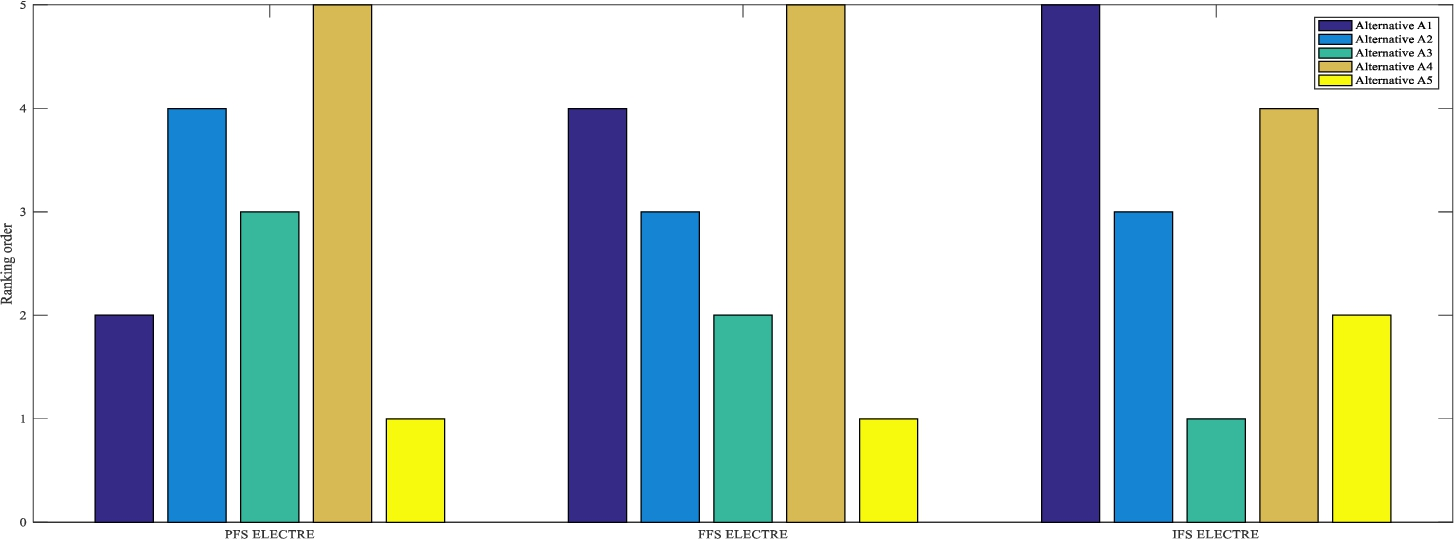
Alternatives ranking orders under different ELECTRE methods.
As shown in Table 15 and Fig. 4, the final ranking orders of alternatives have distinct differences between the three methods. For example,
(1) The proposed method can obtain decision-making result according with the actual situation. The optimal alternative obtained by the proposed ELECTRE method is
(2) The proposed method can easily discriminate the best alternative. The dominance of the ranking first alternative is the difference between the normalized comprehensive evaluation scores of ranking first and ranking second alternatives. In order to get the dominance of the ranking first alternative, the comprehensive evaluation score of each alternative is standardized by
(3) The proposed method allows the DMs to express their opinions more freely. Compared with IFS and PFS, FFS provides a broader scope for preference elicitation.
To certificate the superiority and effectiveness of the proposed ELECTRE method, a comparative analysis is conducted with some existing methods, including the Fermatean fuzzy TOPSIS method (Senapati and Yager, 2019c) and Fermatean fuzzy MABAC method (Wang et al., 2020). The ranking orders obtained by two comparative methods and the proposed ELECTRE method are revealed in Fig. 5.
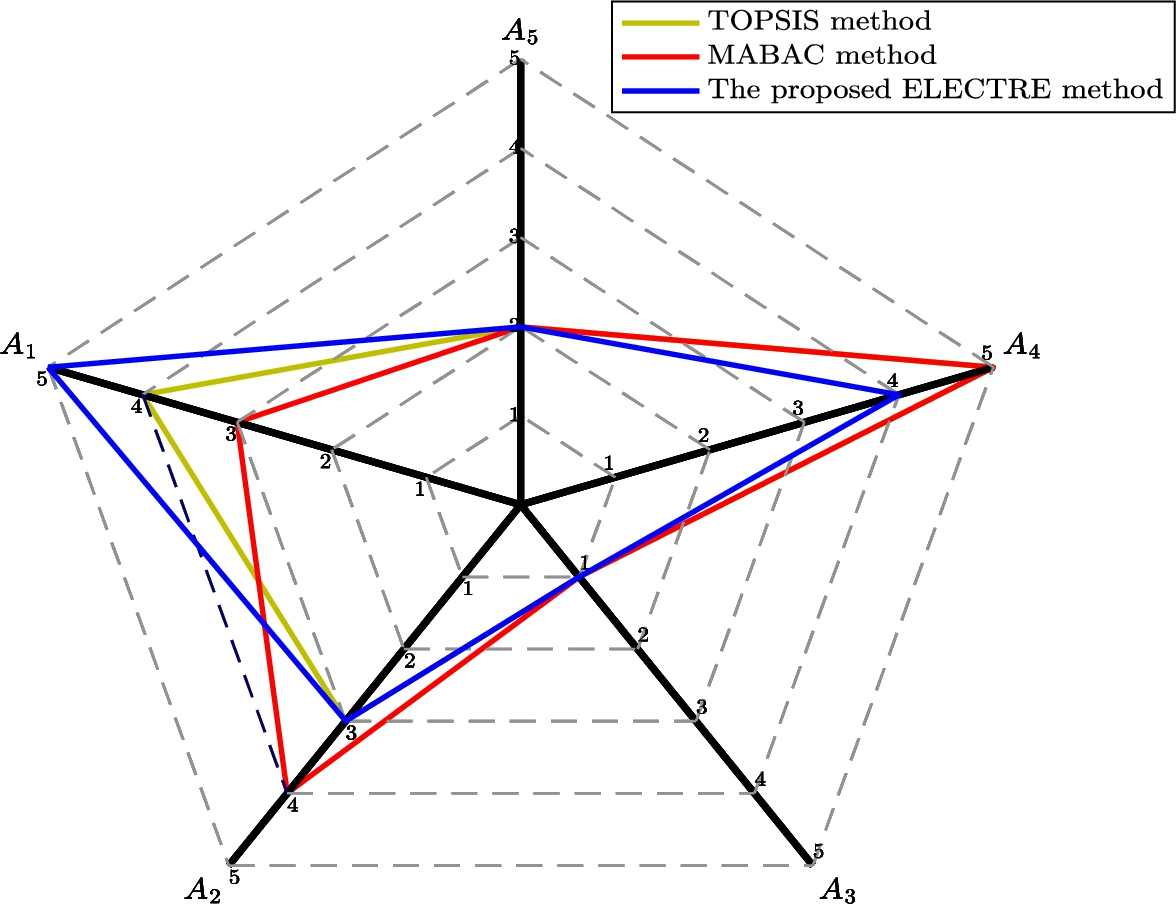
Ranking orders of alternatives obtained by using different ELECTRE methods.
The proposed method is superior to other two comparative methods in the following aspects:
(1) Superiority in obtaining more convincing and reasonable ranking orders of alternatives. As can been seen from Fig. 5,
Number of times an alternative is assigned to different ranks (
(2) Superiority in obtaining the optimal ranking order. To validate the superiority of the proposed ELECTRE method, we adopt an aggregation technique (Jahan et al., 2011) to find out the optimal ranking order from the TOPSIS method, the MABAC method and the proposed ELECTRE method. First,
Values of
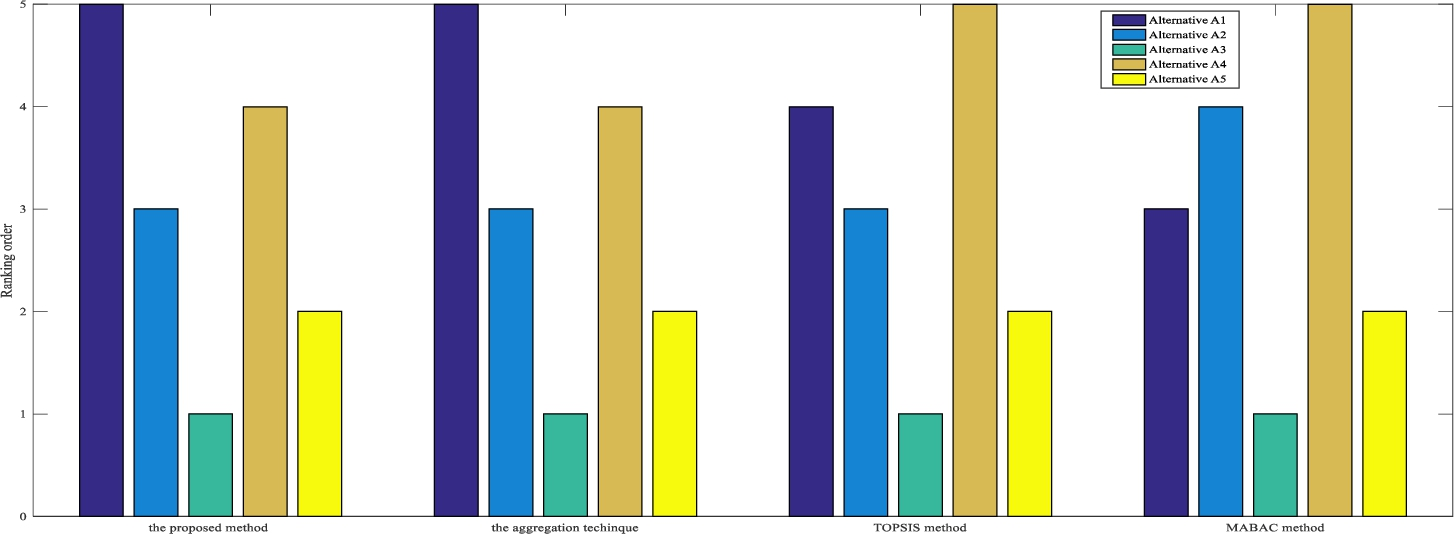
Ranking results of different methods.
This paper proposed an ELECTRE method aimed to solve MCGDM problems with completely unknown DMs’ weights and incomplete criteria weights under Fermatean fuzzy environment. These are advantages of the proposed method. First, the proposed method can determine dynamic and objective DMs’ weights based on the credibility degrees of each DM, which is measured by the proposed cross entropy. Second, the proposed method not only determines the weights of the criteria, but also obtains the weights of the concordance set and discordance set. As a result, the proposed ELECTRE method can make the decision-making result more accurate compared with the existing ELECTRE methods which only give the weight of criteria and concordance set and discordance set in advance. Third, the proposed method is suitable for complex MCGDM problem with non-compensatory criteria.
Although the proposed method can effectively deal with Fermatean fuzzy MCGDM problems, there still exist some limitations. Firstly, the main limitation of the proposed method is inability to capture a discrete decision-making problem with non-commensurable and conflicting criteria. Secondly, it determines the objective weights of criteria, but it hardly obtains the weights when the interactions among the criteria exist. Thirdly, only two information measures for FFSs are taken into consideration in this study. The future work can be extended as follows. The VIKOR method is to be extended into Fermatean fuzzy MCGDM problems, due to its advantage of treating decision-making with non-commensurable and conflicting criteria. A new MCGDM method will be proposed by integrating ELECTRE and Fermatean fuzzy DEMATEL technique which considers the impacts of interactions among the criteria. Some information measures for FFSs including similarity measure, entropy measure and correlation measure will be defined.