




Abstract
There exist various types of similarity measures for intuitionistic fuzzy sets in the literature. However, in many studies the interactions among the elements are ignored in the construction of the similarity measure. This paper presents a cosine similarity measure for intuitionistic fuzzy sets by using a Choquet integral model in which the interactions between elements are considered. The proposed similarity measure is applied to some pattern recognition problems and the results are compared with some existing results to demonstrate the effectiveness of this new similarity measure.
Introduction
Zadeh (1965) introduced the concept of fuzzy set by using a membership function and Atanassov (1986) expanded this concept to the concept of intuitionistic fuzzy set (IFS) by using both a membership function and a non-membership function. The theory of intuitionistic fuzzy sets has been extensively studied by many authors (see e.g. Szmidt and Kacprzyk, 2000, 2003; Xu and Yager, 2006; Ye, 2009, 2010, 2018; Xu, 2010; Melo-Pinto et al. 2013; Balasubramaniam and Ananthi, 2014; Mani and Jerome, 2014; Lu and Ye, 2016; Das et al., 2016; Luo and Zhao, 2018). The concept of similarity measure is one of these study areas. A similarity measure is an important tool for measuring the degree of similarity between two IFSs and various versions of the concept of the similarity measure have been applied to various fields such as pattern recognition, medical diagnosis, decision making, face recognition systems, clustering (see e.g. De et al., 2001; Hung and Yang, 2004; Liu, 2005; Vlachos and Sergiadis, 2007; Li et al., 2007; Xu and Chen, 2008; Ye, 2012; Luo and Ren, 2016; Ngan, 2016; Hwang et al., 2018; Song et al., 2019). Many similarity measures of IFSs have been investigated in the literature and the concept of cosine similarity measure is one of them. The concept of cosine similarity measure for fuzzy sets is defined as the inner product of two vectors divided by the product of their lengths, that is, the cosine of the angle between the vector representations of fuzzy sets and it has been investigated by many researchers (Gerstenkorn and Manko, 1991; Ye, 2011, 2016; Garg, 2018; Wei, 2018; Wei and Wei, 2018; Wei et al., 2019; Wang et al., 2019).
The concepts of fuzzy measure (or capacity or non-additive measure) and the Choquet integral were introduced by Choquet (1953). Since that time, fuzzy measures and integrals have been studied on a rather mathematical point of view, especially in multi criteria decision making field. The purpose of the multi criteria decision making field is to order alternatives based on multiple contradictory criteria and choose the best alternative (see e.g. Grabisch, 1996; Ünver et al., 2018). Actually a fuzzy integral is a generalization of weighted mean. Yang and Ha (2008) introduced a similarity measure for IFSs by using a Choquet integral model where a generalized fuzzy measure was used to characterize interactions among elements of IFSs. Also, the Choquet integral model instead of a weighted average model was used to compute this similarity measure.
The purpose of a pattern recognition problem is to decide whether an object belongs to a set or a class. Many studies have been made to solve such a problem and many similarity measures have been proposed by several researchers (see e.g. Dengfeng and Chuntian, 2002; Liang and Shi, 2003; Mitchell, 2003; Liu, 2005; Wei and Ye, 2010; Hwang and Yang, 2013; Zhu and Ye, 2013; Song et al., 2014; Boran and Akay, 2014; Chen and Chang, 2015; Jiang et al., 2019).
In this study, we provide a new cosine similarity measure for IFSs by considering the Choquet integral, inspired by a weighted cosine similarity measure for IFSs which has been given by Ye (2011). First of all, we give the basic definitions that are used throughout the study, and then we recall the concepts of fuzzy measure and Choquet integral. Then we propose a new cosine similarity measure based on the Choquet integral for IFSs. To demonstrate the effectiveness of the new similarity measure, we apply it to a pattern recognition and a medical diagnosis problem. We also compare the results of the proposed cosine similarity measure with some previous results in the literature.
Preliminaries
In this section we recall some definitions of fuzzy set theory, correlation coefficient, some cosine similarity measures and some weighted cosine similarity measures for IFSs.
(Zadeh, 1965).
A fuzzy set A of a given set X is defined with a function which is called the membership function of A and is denoted by
In the following definition we recall the concept of IFS that was introduced by Atanassov (1986).
(Atanassov, 1986).
An IFS A in X is given by
It is clear that each fuzzy set is an intuitionistic fuzzy set, but the converse is not true in general. Now, we recall a correlation coefficient between IFSs which is actually the motivation of the cosine similarity measure between two IFSs.
(Gerstenkorn and Manko, 1991).
Let
The correlation coefficient k satisfies the following properties (Gerstenkorn and Manko, 1991):
If
Various similarity measures were defined to quantify the degree of similarity between IFSs. Chen (1995) proposed a similarity measures between vague sets. Hong and Kim (1999) and Fan and Zhangyan (2001) pointed out limitations of the similarity measure of Chen (1995) and proposed a new similarity measure for IFSs. Later, Li et al. (2007) proposed a new similarity measure and Dengfeng and Chuntian (2002) generalized their similarity measure of IFSs by using Minkowski distance and applied this measure to the pattern recognition. Then, Mitchell (2003) modified this similarity measure. Later, Hung and Yang (2004) proposed simple and well suited similarity measures for IFSs by using Hausdorff distance and applied it to the pattern recognition. Now, we recall some cosine similarity measures from the literature.
Let
It is clear that
(Ye, 2011).
Let
(Ye, 2011).
Let
The concept of Choquet integral is a generalization of the concept of weighted mean. Yang and Ha (2008) proposed a similarity measure between IFSs by considering the Choquet integral. Now, we recall the concepts of fuzzy measure and Choquet integral. Let
Let Let (Choquet, 1953).
then the set function
(Yang and Ha, 2008).
Choquet Cosine Similarity Measure
In this section, by considering the Choquet integral we construct a new cosine similarity measure. Let
Let
If
The proposed cosine similarity measure can be used to evaluate the degree of similarity between two IFSs. Therefore, it can be applied to pattern recognition problems with the intuitionistic fuzzy information. It is more delicate than the cosine similarity measures in the literature since it considers interactions between criteria.
Let
Moreover, the decision maker can also use measures such as λ-fuzzy measures (Larbani et al., 2011), k-additive fuzzy measures (Grabisch, 1997), p-symmetric fuzzy measures (Miranda et al., 2002) in the measurement determination process in order to ease the decision making process. Here, we use hypothetical fuzzy measure and a λ-fuzzy measure in the process of solving the pattern recognition and the medical diagnosis problem, respectively.
We consider a pattern recognition problem which is adapted from Ye (2011). Let Consider the following hypothetical fuzzy measure σ on X: Cosine values.
The cosine values are given in Table 1 and the results of similarity are given in the Table 2. For example, for
Comparison of classification results of Example 1.
According to the recognition principle of maximum degree of similarity between IFSs, the process of assigning the pattern Q to
Medical diagnosis is the process of determining which disease explains the symptoms of a patient. In this process, patterns of symptoms are compared with patterns of disease. We take the medical diagnosis problem which is discussed by Ye (2011).
Let us consider a set of diagnosis and symptoms as follow.
Suppose that a patient, with respect to all the symptoms, is represented by the following IFS:
Moreover, assume that each diagnosis
The goal is to classify P into one of the diagnosis
Standard preference table.
Table 4 depends on the expert view and it is giving the consistent reciprocal comparison matrix with consistency index 0.0941903 used in (AHP).
Reciprocal comparison matrix.
The weights that are calculated by (AHP) are given in Table 5.
Weight of singletons.
Now, we are ready to construct a fuzzy measure which is a λ-fuzzy measure (see, Takahagi, 2000). By taking
Fuzzy measure.
We calculate the Choquet cosine similarity measure of the IFSs. For this purpose we need the cosine values obtained in Table 7.
Cosine values.
The results of the cosine similarity measure are given in Table 8. For example, for
Therefore, we obtain
Comparison of classification results of Example 2.
The numerical results presented in Table 2 and Table 8 show that the result of the proposed cosine similarity measure is consistent with Ye (2011). The difference of this cosine similarity measure from the existing similarity measures is that it is established by considering the interaction between the criteria. Indeed, in both similarity measures proposed by Yang and Ha (2008) and the cosine similarity measure algorithms proposed in this study, the interaction between the criteria using the fuzzy measure is considered. However, as the variables α, β, γ and p change, the result may change and the decision maker has to explain what he/she pays attention to when choosing these variables. When these variables are independent of special selection, both ordering of their
Figure 1 illustrates the calculation of the Choquet integral of
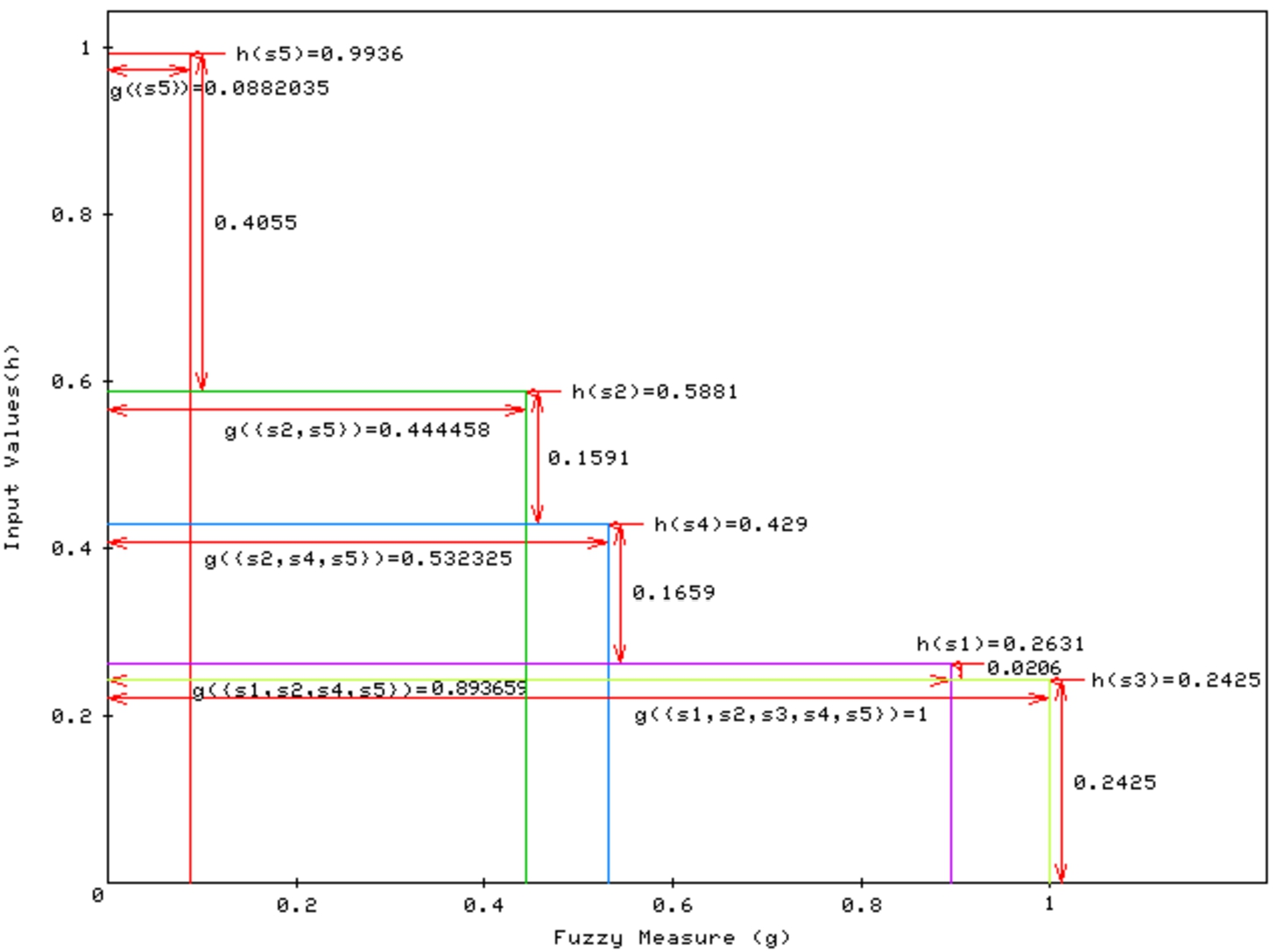
Choquet integral of
In this paper, we propose a new cosine similarity measure based on the Choquet integral, inspired by the cosine similarity measure given for intuitionistic fuzzy sets in the literature. In addition, we apply this new similarity measure to a pattern recognition and a medical diagnosis problem and we obtain results that are consistent with the results obtained in the past. If we consider the sensitivity of Choquet integral compared with the weighted mean, we can say that the similarity measure proposed in this paper is more sensitive than the one proposed in the past. In the future, different kind of similarity measures and fuzzy sets can be considered. The applications can be extended to some other real life areas such as face recognition systems and classification.
Footnotes
Acknowledgements
Figure 1 was created in Multipurpose Fuzzy Measure and Fuzzy Integrals calculation software by CGI by Dr. Eiichiro Takahagi (takahagi@isc.senshu-u.ac.jp).
The authors are grateful to the Referees for carefully reading the manuscript and for offering substantial comments and suggestions which enabled them to improve the paper.