Using different operational laws on membership and non-membership information, various intuitionistic fuzzy aggregation operators based on Archimedean t-norm and t-conorm or their special cases have been extensively investigated for multi-criteria decision making. In spite of this, they are not suitable for some practical cases. In this paper, symmetric intuitionistic fuzzy weighted mean operators w.r.t. general weighted Archimedean t-norms and t-conorms are introduced to deal neutrally or fairly with membership and non-membership information to meet the need of decision makers in some cases. The relationship among the proposed operators and the existing ones is discussed. Particularly, using the parameters in the aggregation operators, the attitude whether the decision maker is optimistic, pessimistic or impartial is reflected. At last, an example is given to show the behaviour of the proposed operators for multi-criteria decision making under intuitionistic fuzzy environment.
Since the introduction of fuzzy sets by Zadeh (1965), various generalizations of fuzzy sets have been provided, such as intuitionistic fuzzy sets introduced by Atanassov (1986), abbreviated here as A-IFS (the reasons for this are presented in Dubois et al., 2005), grey set (Deng, 1989), vague set (Gau and Buehrer, 1993), interval-valued fuzzy set (Sambuc, 1975; Zadeh, 1975), and so on. Deschrijver and Kerre (2003, 2007) investigated the relationships among some extensions of fuzzy set theory, and proved that A-IFS, grey set, vague set and interval-valued fuzzy set are equivalent. As we know, it is constructed through the membership degree, the non-membership degree and the hesitancy degree, which can describe the uncertainty and fuzziness more objectively than the usual fuzzy set. Thus A-IFS has attracted more and more attention from researchers and has been used to solve many problems, especially the multi-criteria decision making (MCDM) problems.
An effective method to deal with the MCDM problem under intuitionistic fuzzy environment is to calculate the aggregation values of the alternatives. At present, plenty of aggregation operators in fuzzy environment have been extended to fit different situations in intuitionistic fuzzy case. All kinds of mean operators, such as quasi-arithmetic means (Hardy et al., 1934), (generalized) Bonferroni mean (BM, GBM) (Bonferroni, 1950; Yager, 2009) and (induced) ordered weighted averaging (OWA, IOWA) operators (Yager, 1988; Yager and Filev, 1999), are hot topics in aggregation, and a lot of related work has been done. With respect to the operations defined for intuitionistic fuzzy numbers (IFNs) based on algebraic product t-norm, probabilistic sum t-conorm and OWA operator, Xu and Yager (2006), Xu (2007) generalized the weighted geometric averaging operator to the intuitionistic fuzzy weighted geometric/averaging (IFWG/IFWA) operator, the intuitionistic fuzzy ordered weighted geometric/averaging (IFO WG/IFOWA) operator and the intuitionistic fuzzy hybrid geometric/averaging (IFHG/IFHA) operator and applied them to the MCDM problem under intuitionistic fuzzy environment. Although the IFHA (IFHG) operator generalized both the IFWA (IFWG) and IFOWA (IFOWG) operators by weighting the given importance and the ordered position of the arguments, there is a flaw pointed out by Liao and Xu (2014) that these hybrid aggregation operators do not satisfy some desirable properties, such as boundedness and idempotency; the developed operators not only can weigh both the arguments and their ordered positions simultaneously, but also have some desirable properties, such as idempotency, boundedness, and monotonicity. Based on the generalized OWA operator proposed by Yager (2004b), Li (2010) and Zhao et al. (2010) introduced the generalized IFWA, generalized IFOWA, and generalized IFHA operators, and applied them to multiple attribute decision making with intuitionistic fuzzy information. Using the operations defined in Xu (2007), Xu and Yager (2011) investigated the BM under intuitionistic fuzzy environments, developed an intuitionistic fuzzy BM (IFBM) and discussed its variety of special cases. Then, they applied the weighted IFBM to multicriteria decision making. Considering that the algebraic product and Einstein t-norms are two prototypical examples of the class of strict Archimedean t-norms (Klement et al., 2000), Wang and Liu (2011, 2012) proposed the intuitionistic fuzzy Einstein weighted geometric/averaging (IFEWG/IFEWA) operator and the intuitionistic fuzzy Einstein ordered weighted geometric/averaging (IFEOWG/IFEOWA) operator. By using Archimedean t-norm and t-conorm, Xia et al. (2012) defined the Archimedean t-norm and t-conorm based intuitionistic fuzzy weighted averaging (ATS-IFWA) operator and the Archimedean t-norm and t-conorm based intuitionistic fuzzy geometric (ATS-IFWG) operator to provide more choices for the decision makers by these parameterized t-norms and t-conorms. By extending the quasi-arithmetic ordered weighted averaging operator to different intuitionistic fuzzy situations, Yang and Chen (2012) introduced three kinds of new operators: the quasi-IFOWA operator, the quasi-intuitionistic fuzzy Choquet ordered averaging operator and the quasi-IFOWA operator based on the Dempster–Shafer belief structure. Tan et al. (2013) provided a critical analysis of Yang and Chen’s operations to elicit their disadvantages, and associating with operations in Xia et al. (2012), proposed a new quasi-IFOWA operator based on Archimedean t-norm and t-conorm to overcome these faults, and obtained some consistent conclusions. Beliakov et al. (2011) declared that the IFWA operator is not consistent with the limiting case of ordinary fuzzy sets, which is undesirable, and proposed a new construction method for the IFWA operator based on the Łukasiewicz t-norm, which is consistent with operations on ordinary fuzzy sets. Similarly to IFBM, Beliakov and James (2013) presented two alternative methods to extend the generalized Bonferroni mean to intuitionistic fuzzy sets. Particularly, they constructed a general form of intuitionistic fuzzy aggregation operators by pairing the usual aggregation operators and their duals. Since the above intuitionistic fuzzy aggregation operators are using different aggregation operators on membership and non-membership information, it was pointed out in Xia and Xu (2012) that it is necessary to develop some neutral aggregation operators in order to be neutral in some cases and to be treated fairly. For example, it is pointed out in Xu and Ma (2019), Yang et al. (2019) that when aggregating some individual intuitionistic fuzzy preference relations into a collective one, such operators are necessary. Based on algebraic product t-norm, new intuitionistic fuzy aggregation operators, which treat the membership and non-membership information fairly, were defined (Liao and Xu, 2015). Furthermore, due to the absence of parameters in these t-norms, the existing neutral aggregation operators can not provide more choices for the decision makers. Motivated by the idea of Beliakov and James (2013), Calvo and Mesiar (2003), Tan et al. (2013), Xia and Xu (2012), Xia et al. (2012), in this paper, some new intuitionistic fuzzy aggregation operators based on weighted Archimedean t-norm and t-conorm, which fairly treat membership and non-membership information and provide more choices for the decision maker, are developed.
To do so, the remainder of this paper is organized as follows: The basic concepts of weighted Archimedean t-norms and t-conorms and intuitionistic fuzzy sets are introduced in Section 2. In Sections 3 and 4, symmetric intuitionistic fuzzy weighted mean operators w.r.t. weighted Archimedean t-norms and t-conorms are defined, in which using parameters the attitude whether the decision maker is optimistic, pessimistic or impartial is reflected and the relationship among the proposed operators and the existing ones is discussed. Section 5 provides an example to illustrate the behaviour of the proposed operators. In the final section, our research is concluded.
Preliminaries
To make the presentation self-contained, in what follows, we review some basic concepts.
If we assign specific forms to the function g, then some weighted Archimedean t-norm from the well-known Archimedean t-norms (Klement et al., 2000) can be obtained:
, then Schweizer–Sklar t-norm reduces to the Łukasiewicz t-norm.
Furthermore, let
$ A=H(T,S)$
be a composed aggregation operator based on a continuous t-norm T, a continuous t-conorm S and a binary aggregation operator H, Calvo and Mesiar (2003) introduced weighted t-norms based aggregation operator
indicate the amounts of guaranteed membership and non-membership of x in A, respectively, and satisfy
${\mu _{A}}(x)+{\nu _{A}}(x)\leqslant 1$
.
We recall for an intuitionistic fuzzy set the membership grade of x in A which is represented as a pair
$({\mu _{A}}(x),{\nu _{A}}(x))$
is called a intuitionistic fuzzy number (IFN) (Xu, 2007) and the set of all IFNs is denoted as
$ \mathcal{IFN}$
. Here, the expression
${\pi _{A}}(x)=1-{\mu _{A}}(x)-{\nu _{A}}(x)$
is called the hesitancy of x. The IFN
$ \alpha =({\mu _{\alpha }},{\nu _{\alpha }})$
has a physical interpretation, for example, if
$ \alpha =(0.3,0.2)$
, then it can be interpreted as “the vote for resolution is 3 in favour, 2 against, and 5 abstentions (Gau and Buehrer, 1993). The following partial order ⩽ on
$ \mathcal{IFN}$
, which is defined for
$ \alpha =({\mu _{\alpha }},{\nu _{\alpha }})$
and
$ \beta =({\mu _{\beta }},{\nu _{\beta }})$
as
$ \beta \leqslant \alpha $
if and only if
${\mu _{\beta }}\leqslant {\mu _{\alpha }}$
and
${\nu _{\alpha }}\leqslant {\nu _{\beta }}$
. For an IFN α, a score function s (Chen and Tan, 1994), which is defined as the difference of membership and non-membership function, can be denoted as:
$ s(\alpha )={\mu _{\alpha }}-{\nu _{\alpha }}$
, where
$ s(\alpha )\in [-1,1]$
. The larger the score
$ s(\alpha )$
is, the greater the IFN α is. To make the comparison method more discriminatory, an accuracy function h (Hong and Choi, 2000) is defined as follows:
$ h(\alpha )={\mu _{\alpha }}+{\nu _{\alpha }},$
where
$ h(\alpha )\in [0,1]$
. When the scores are the same, the larger the accuracy
$ h(\alpha )$
is, the greater the IFN α is. However, it is obvious that
are natural generalizations of fuzzy weighted geometric mean, arithmetic mean and Harmonic mean, respectively.
However, Deschrijver and Kerre (2008) provided a natural extension of an aggregation function to the environment of interval-valued fuzzy set, and Beliakov and James (2013) gave the definition for A-IFS representation as follows:
(See Beliakov and James, 2013).
Given an aggregation function
$ agg:{[0,1]^{n}}\to [0,1]$
, the natural extension of the aggregation function
Symmetric Intuitionistic Fuzzy Weighted Mean Operators w.r.t. Weighted Archimedean t-Norms and t-Conorms
Considering the work of Beliakov and James (2013), Calvo and Mesiar (2003), Tan et al. (2013), Xia and Xu (2012), Xia et al. (2012), in this section we develop some symmetric intuitionistic fuzzy weighted mean operators w.r.t. weighted Archimedean t-norms and t-conorms to fairly treat membership and non-membership information and provide more choices for the decision maker by considering his/her attitude with parameters.
Symmetric Intuitionistic Fuzzy Weighted Mean Operators w.r.t. Weighted Archimedean t-Norms
Let
${\alpha _{j}}$
$(j=1,2,\dots ,n)$
be a collection of IFNs and
${T_{\omega ,g}}$
be a weighted Archimedeant-norm with an additive generatorg. Then
It can be proved in a similar way as in Proposition 3.3. □
Next, we assign the additive generator g to different forms, some specific symmetric intuitionistic fuzzy aggregation operators can be obtained as follows:
to neutrally aggregate the IFNs and the Eqs. (10), (11) and (12) can be considered as the cases when the decision maker is optimistic, pessimistic or impartial. With respect to the existing symmetrical intuitionistic fuzzy aggregation operators (Beliakov et al., 2011; Liao and Xu, 2015; Xia and Xu, 2012), the proposed aggregation operators based on weighted Archimedean t-norm and t-conorm possess the following advantages:
these existing operators (Beliakov et al., 2011; Liao and Xu, 2015; Xia and Xu, 2012) can only treat membership and non-membership information fairly, and provide a single choice for the decision maker; the proposed ones can not only treat membership and non-membership information fairly but also provide more choices for the decision maker;
the existing operator (Liao and Xu, 2015) can not reduce to the corresponding fuzzy one; the proposed ones can be considered as generalizations of the existing aggregation operators in fuzzy cases;
the existing operator (Xia and Xu, 2012) is not suitable for dealing with IFNs
$(1,0)$
or
$(0,1)$
; the proposed operators can solve the case.
The Relationships Among the Proposed Aggregation Operators and the Existing One
The following lemma is obvious but useful to investigate the relationships among the proposed aggregation operators and the existing ones:
: technology (e.g. manufacturing capability, design capability, ability to cope with technology changes), and
${C_{4}}$
: organizational culture and strategy (e.g. feeling of trust, internal and external integration of suppliers, compatibility across levels and functions of the buyer and supplier). The set of evaluative criteria is denoted by
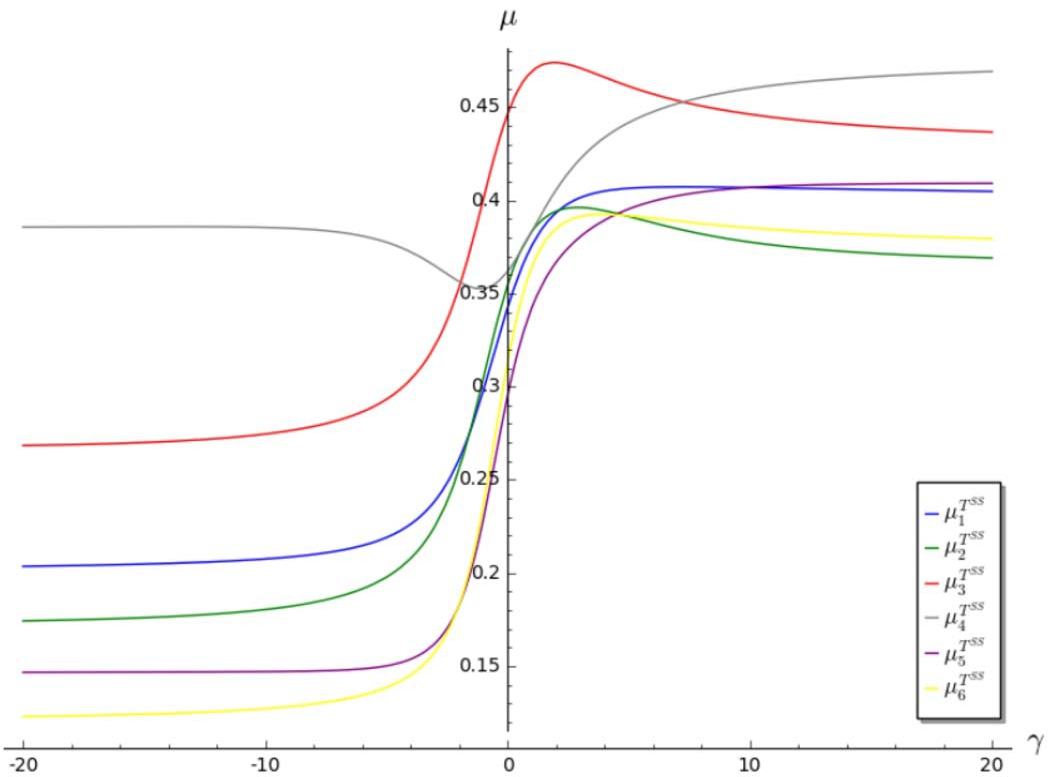
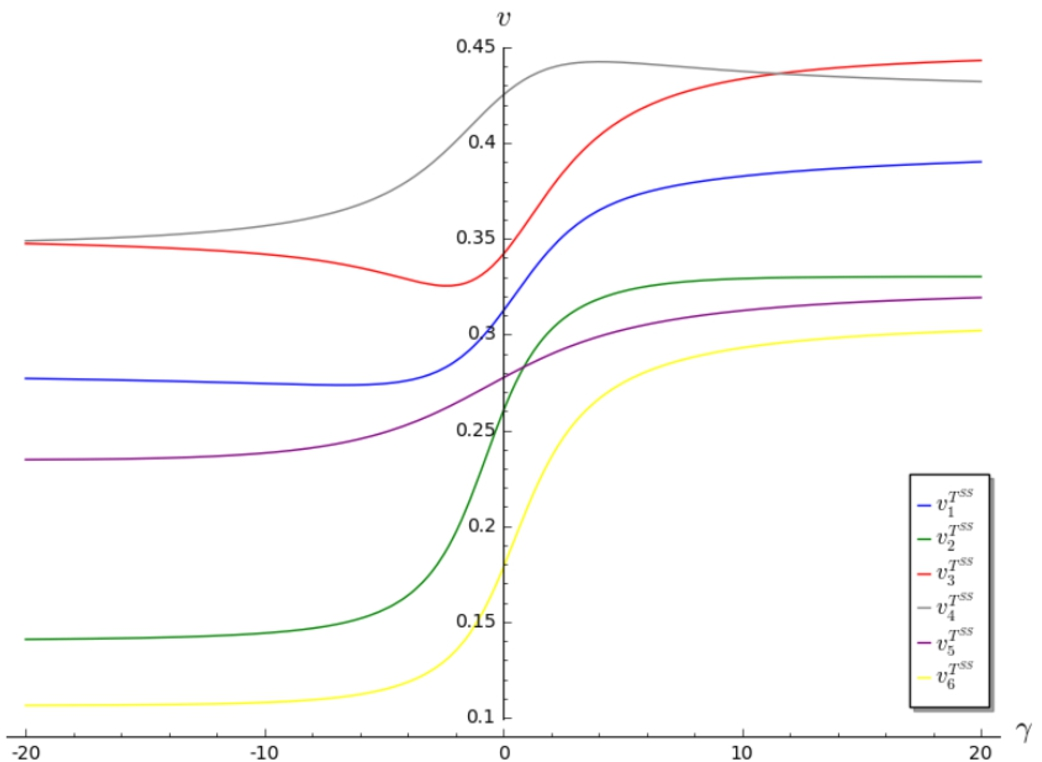
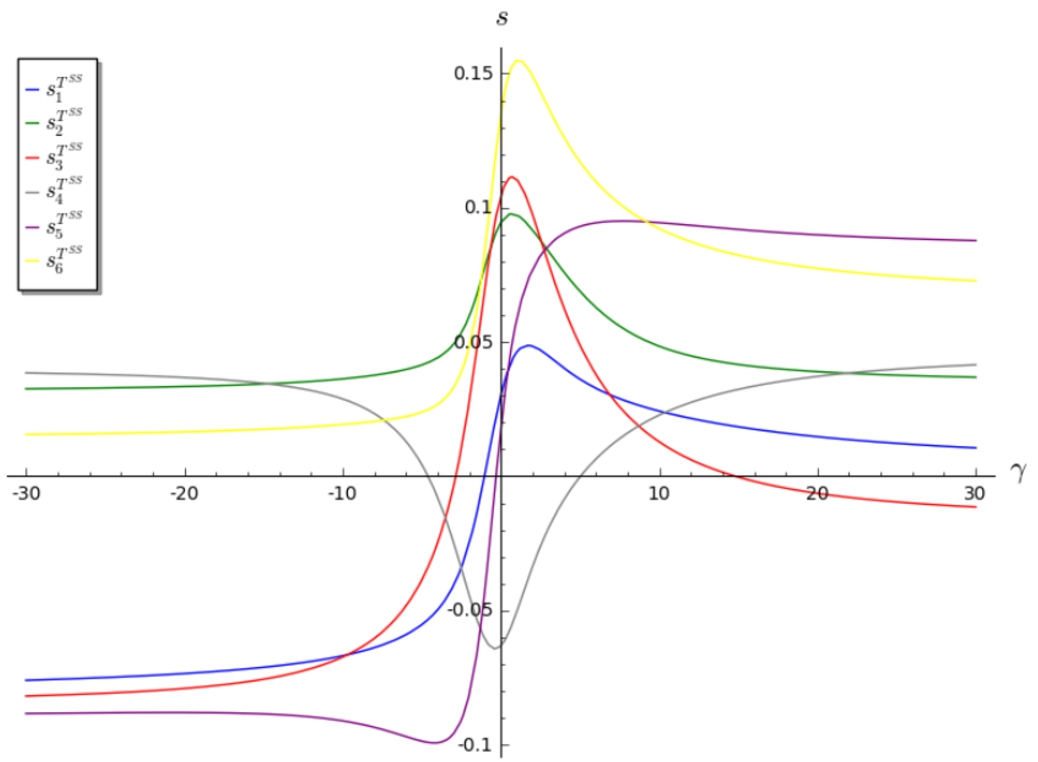
Obviously, the aggregated results and the ranking orders of the alternatives vary with the parameter γ, that is, they can be considered as the function with γ as its independent variable. Thus we can illustrate them by their functional images as follows:
gives the variation of the memberships of the aggregated results by
Various aggregation operators have been constructed to adapt to different situations. In this paper, we proposed the SIFWM operators w.r.t. weighted Archimedean t-norms and t-conorms to neutrally deal with membership and non-membership of intuitionistic fuzzy information. Comparing the existing symmetrical operators with the proposed ones, we found that
the existing symmetrical operators in Beliakov et al. (2011), Xia and Xu (2012) are special cases of the proposed ones with constant parameters which only reflect the impartial attitude of the decision maker;
the proposed symmetrical operators can not only reflect the impartial attitude of the decision maker but also the optimistic or pessimistic attitude by a parameter, which provides more choices for the decision maker in the procedure of decision making.
In the future, we will utilize the symmetrical aggregation operators in other fuzzy environments such as linguistic, bipolar, Pythagorean and intuitionistic multiplicative fuzzy environment (Alghamdi et al., 2018; Alonso et al., 2013; Ma and Xu, 2016, 2018) to investigate the consensus in group decision making problems (Del Moral et al., 2018; Dong et al., 2018; Urena et al., 2019).
Footnotes
Acknowledgements
The authors would like to thank the editors and the anonymous reviewers for their insightful and constructive comments and suggestions that have led to this improved version of the paper.
AlghamdiM.A.AlshehriN.O.AkramM. (2018). Multi-criteria decision-making methods in bipolar fuzzy environment. International Journal of Fuzzy Systems, 20, 2057–2064.
3.
AlonsoS.PerezI.J.CabrerizoF.J.Herrera-ViedmaE. (2013). A linguistic consensus model for Web 2.0 communities. Applied Soft Computing, 13, 149–157.
4.
BeliakovG.JamesS. (2013). On extending generalized Bonferroni means to Atanassov orthopairs in decision making contexts. Fuzzy Sets and Systems, 211, 84–98.
5.
BeliakovG.PraderaA.CalvoT. (2007). Aggregation Functions: A Guide for Practitioners. Springer, Heidelberg, Berlin, New York.
6.
BeliakovG.BustinceH.GoswamiD.P.MukherjeeU.K.PalN.R. (2011). On averaging operators for Atanassov’s intuitionistic fuzzy sets. Information Sciences, 181, 1116–1124.
7.
BonferroniC. (1950). Sulle medie multiple di potenze. Bolletino Matematica Italiana, 5, 267–270.
ChenT.Y. (2011). Bivariate models of optimism and pessimism in multi-criteria decision-making based on intuitionistic fuzzy sets. Information Sciences, 181, 2139–2165.
10.
ChenS.M.TanJ.M. (1994). Handling multicriteria fuzzy decision-making problems based on vague set theory. Fuzzy Sets and Systems, 67, 163–172.
11.
Del MoralM.J.ChiclanaF.TapiaJ.M.Herrera-ViedmaE. (2018). A comparative study on consensus measures in group decision making. International Journal of Intelligent Systems, 33, 1624–1638.
12.
DengJ.L. (1989). Introduction to grey system theory. Journal of Grey Systems, 1, 1–24.
13.
DeschrijverG.KerreE.E. (2003). On the relationship between some extensions of fuzzy set theory. Fuzzy Sets and Systems, 133, 227–235.
14.
DeschrijverG.KerreE.E. (2007). On the position of intuitionistic fuzzy set theory in the framework of theories modelling imprecision. Information Sciences, 177, 1860–1866.
15.
DeschrijverG.KerreE.E. (2008). Aggregation operators in interval-valued fuzzy and Atanassov’s intuitionistic fuzzy set sheory. In: BustinceH.HerreraF.MonteroJ. (Eds.), Fuzzy Sets and Their Extensions: Representation, Aggregation and Models. Springer, Heidelberg, New York, pp. 183–203.
16.
DongY.ZhaoS.ZhangH.ChiclanaF.Herrera-ViedmaE. (2018). A self-management mechanism for non-cooperative behaviors in large-scale group consensus reaching processes. IEEE Transactions on Fuzzy Systems, 26, 3276–3288.
17.
DuboisD.GottwaldS.HajekP.KacprzykJ.PradeH. (2005). Terminological difficulties in fuzzy set theory – the case of intuitionistic fuzzy sets. Fuzzy Sets and Systems, 156, 485–491.
18.
GauW.L.BuehrerD.J. (1993). Vague sets. IEEE Transactions on Systems Man and Cybernetics, 23, 610–614.
19.
HardyG.H.LittlewoodPólya GJ.E. (1934). Inequalities. Cambridge University Press, Cambridge.
20.
HongD.H.ChoiC.H. (2000). Multicriteria fuzzy decision-making problems based on vague set theory. Fuzzy Sets and Systems, 114, 103–113.
LiD.F. (2010). Multiattribute decision making method based on generalized OWA operators with intuitionistic fuzzy sets. Expert Systems with Applications, 37, 8673–8678.
23.
LiaoH.XuZ.S. (2014). Intuitionistic fuzzy hybrid weighted aggregation operators. International Journal of Intelligent Systems, 29, 971–993.
24.
LiaoH.XuZ.S. (2015). Consistency of the fused intuitionistic fuzzy preference relation in group intuitionistic fuzzy analytic hierarchy process. Applied Soft Computing, 35, 812–826.
25.
MaZ.M.XuZ.S. (2016). Symmetric Pythagorean fuzzy weighted geometric/averaging operators and their application in multicriteria decision-making problems. International Journal of Intelligent Systems, 31, 1198–1219.
26.
MaZ.M.XuZ.S. (2018). Hyperbolic scales involving appetites-based intuitionistic multiplicative preference relations for group decision making. Information Sciences, 451–452, 310–325.
27.
SambucR. (1975). Fonctionsϕ-floues. Application l’aide au diagnostic en pathologie thyroidienne. Ph.D. Thesis, Univ. Marseille, France.
28.
TanC.JiangZ.ChenX. (2013). Some issues on quasi-arithmetic intuitionistic fuzzy OWA operators. Applied Mathematics & Information Sciences, 7, 955–961.
29.
UrenaR.KouG.DongY.ChiclanaF.Herrera-ViedmaE. (2019). A review on trust propagation and opinion dynamics in social networks and group decision making frameworks. Information Sciences, 478, 461–475.
30.
WangW.LiuX. (2011). Intuitionistic fuzzy geometric aggregation operators based on Einstein operations. International Journal of Intelligent Systems, 26, 1049–1075.
31.
WangW.LiuX. (2012). Intuitionistic fuzzy information aggregation using Einstein operations. IEEE Transactions on Fuzzy Systems, 20, 923–938.
XuZ.S.YagerR.R. (2006). Some geometric aggregation operators based on intuitionistic fuzzy sets. International Journal of Intelligent Systems, 35, 417–433.
34.
XuZ.S.YagerR.R. (2011). Intuitionistic fuzzy Bonferroni means. IEEE Transactions on Systems, Man, and Cybernetics–Part B: Cybernetics, 41, 568–578.
35.
XuC.Y.MaZ.M. (2019). Symmetric intuitionistic multiplicative aggregation operator for group decision making in intuitionistic multiplicative environments. Journal of Intelligent & Fuzzy Systems, 36, 5909–5918.
36.
XiaM.XuZ.S. (2012). Entropy/cross entropy-based group decision making under intuitionistic fuzzy environment. Information Fusion, 13, 31–47.
37.
XiaM.XuZ.S.ZhuB. (2012). Some issues on intuitionistic fuzzy aggregation operators based on Archimedean t-conorm and t-norm. Knowledge-Based Systems, 31, 78–88.
38.
YagerR.R. (1988). On ordered weighted averaging aggregation operators in multi-criteria decision making. IEEE Transactions on Systems Man and Cybernetics, 18, 183–190.
39.
YagerR.R. (2004a). Weighted triangular norms using generating functions. International Journal of Intelligent Systems, 19, 217–231.
YagerR.R. (2009). On generalized Bonferroni mean operators for multi-criteria aggregation. International Journal of Approximate Reasoning, 50, 1279–1286.
42.
YagerR.R.FilevD.P. (1999). Induced ordered weighted averaging operators. IEEE Transactions on Systems Man and Cybernetics, 29, 141–150.
YangW.JhangS.T.FuZ.W.MaZ.M. (2019). Aggregating intuitionistic fuzzy preference relations with symmetrical intuitionistic fuzzy Bonferroni mean operators in group decision making. Information Sciences.
45.
ZadehL.A. (1965). Fuzzy sets. Information Control, 8, 338–353.
46.
ZadehL.A. (1975). The concept of a linguistic variable and its application to approximate reasoning. Information Sciences, 8, 199–249.
47.
ZhaoH.XuZ.S.NiM.F.LiuS.S. (2010). Generalized aggregation operators for intuitionistic fuzzy sets. International Journal of Intelligent Systems, 25, 1–30.