





Abstract
In this study, a modified method to generate patterns is proposed to address fit and efficiency issues in personalized pattern generation. The cloud points containing all the information of a 3D scanned human body were converted into a personalized digital mannequin by Creacompo II Torso software from Toray Sixteen flattened panels, obtained by cutting and flattening the digital mannequin, were adjusted to generate a trouser pattern. The correlation of the fit of the trousers made based on the generated pattern and three structural parameters (the hem width, waist dart, and crotch curve) of the pattern were analyzed by virtual fitting experiments. The generation algorithm of the basic trouser pattern after alteration was developed. Verification was conducted by fittings. This work serves as an important reference for customized garment pattern design and the automatic generation of personalized patterns.
Keywords
Introduction
Economic and technological advancement produces picky consumers in the clothing industry, which in turn calls for more demanding requirements on garments’ style, comfort, and fit 1 from the supply side. Meanwhile, the production model has also changed dramatically, moving from the past mass production and sales mode to the personalized consumption mode. The rapid changing process brings two problems to the garment customization industry. (1) Personalized needs are often difficult to meet due to market immaturity, as well as the lack of professional and technical support in areas like pattern-making technology 2 (2) The garments, produced from the patterns, suffer from lack of fit.
Many scholars have developed garment patterns with the help of computer technology and artificial intelligence. Generally, personalized patterns can be generated through the following three methods. (1) The relationships between the human body size and the pattern can be mapped through the usage of a back propagation (BP) Neural Network based on an existing pattern database.3,4 This method takes advantage of the computer's ability to pick out the most suitable pattern from a pattern database. 5 Liu et al. constructed a jeans’ pattern recommendation system. Three geometric constraint parameters were input, while the corresponding jeans’ pattern was output. 6 (2) Based on the pattern generation of the parametrical technique, the spatial relationships between the points, lines, and surfaces within the pattern could be established by topological, sequential, and measuring relationships in the Clothing Computer-Aided Design (CAD) System computer language.7,8 Jiang et al. proposed a method to automatically generate a custom apparel style for a given human model based on existing apparel and human models. 9 (3) Based on the pattern generation of the graphical technique, such as the modeling technique and the flattening algorithm of a curved surface,2,10,11 one could construct the required pattern with the help of 3D data. Alubel et al. presented a novel method to generate block patterns using a systematic 3D design approach and a reverse (2D-3D-2D flattening) engineering method. 10 Peng et al. proposed a new surface flattening method based on energy fabric deformation. 11 Liu et al. proposed a novel interactive pattern-making technology, which includes modeling of human bodies, garments unfolding, 3D garment alteration, and 2D garment generation. 2 Mesuda et al. proposed a pattern generation method by means of virtual draping. 12 Recently, NURBS (Non-Uniform Rational B-Splines) modeling 13 has been used in 3D CAD systems, which is beneficial for graphical pattern generation.
To solve the garment fitting issue, many scholars have used the methods of surface modeling and surface flattening to generate patterns.10,11,12 However, such methods contain obvious disadvantages. (1) The method is not suitable for complicated styles. (2) Ease allowance between the human body and the garment is not determined accurately. (3) Fabric properties are rarely considered in the flattening process. 6 (4) The surfaces of the human body and the garment are so complex that local deformations are inevitable in the flattening process. 11 All in all, flattened pieces are not suitable for a pattern's structural design. 14
Several CAD programs for generating patterns from body measurements are available. In 2001, the European Apparel and Textile Confederation (EURATEX) put forward the Electronic Made-to-Measure System with the combination of a 3D body scanner, computer technology, and CAD systems. Some companies have been working on intelligent customized services with the assistance of clothing CAD systems, like the Made-to-Measure Pattern-Making System from Gerber and the Modaris-Fitnet System from Lectra. 15 Three-dimensional virtual-reality technology is widely applied in pattern design, which offers less time and material costs with efficiency and accuracy, as well as easy accessibility16,17
This study seeks to address the fit issue arising from personalized garment patterns and improve pattern generation. Specifically, we proposed a modified garment pattern generation method, based on 3D measurement and the geometrical principle, for personalized female trousers. This method not only fulfils the fit requirement for trousers, but also increases pattern diversity with varied structural parameters. This study aims to provide a reference for customized garment pattern design and automatic generation of a personalized pattern.
Research Methodology
Modeling 3D Digital Mannequin
The experiment used Anthroscan Bodyscan (Human Solutions GmbH), a non-contact color 3D scanner. The scanned subject was a 24-year-old female with a height of 165 cm in a light-colored fit scanning suit with no shoes. The temperature was 27 °C ± 3 °C, and the relative humidity (RH) was 65 ± 2% in the laboratory. During scanning, the subject stood naturally on the marked position.
To obtain useful information for pattern making, it is necessary to reconstruct the out-of-order cloud points from scanning the subjects body. Reverse engineering methods 18 were used to reconstruct the shape of the scanned body by B-spline surfaces. The continuity among the connected B-spline surfaces was adjusted. The surface curvature of the reconstructed body model was extremely complex, which may suffer serious energy loss, to some extent, referring to the variety of the surface area of the body model, during the flattening process. To reduce the potential distortion, the study chose one available digital mannequin from Creacompo II Torso (Toray Industries, Inc.) software to match the body model. There were nine existing horizontal NURBS curves and eighteen existing vertical NURBS curves on the surface of the digital mannequin. The curves on the right-half digital mannequin are shown in Fig. 1.
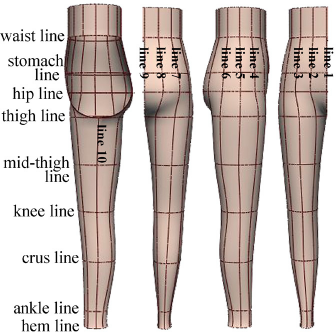
The curves on the digital mannequin.
On the surface of the digital mannequin, the points where horizontal curves and vertical curves intersect were labelled as feature points. The feature points had been adjusted to facilitate the perfect match between the digital mannequin and the scanned body, as shown in Fig. 2. Horizontal and vertical curves were kept for aesthetics and fluency issues.
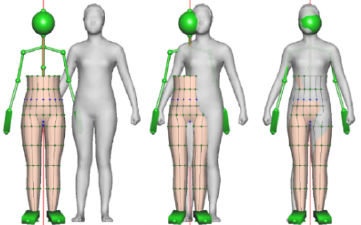
Matching process of the digital mannequin.
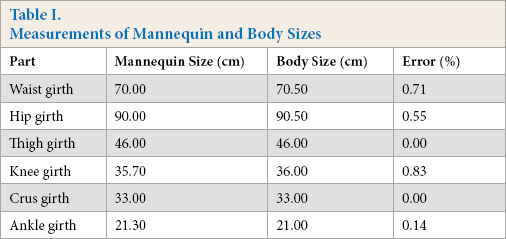
Six girth measurements of the human body (i.e., the body size) and the altered digital mannequin (i.e., the mannequin size) are shown in Table I. The relative errors based on body size were within 1.00%. The adjusted digital mannequin matched well with the scanned body.
Measurements of Mannequin and Body Sizes
Flattening the 3D Digital Mannequin
In garment CAD, the flattening of body and garment is crucial yet challenging. Flattening methods used in the garment industry can be basically classified into three types: decomposition-based, 14 geometry-based, 19 and energy-based methods. 20 The decomposition-based method decomposes the object surface into several simple surfaces, then flattens them one-by-one with the continuity of the adjacent surfaces. The geometry-based method uses geometric properties, such as the node-angle, arc-length, and area, to minimize the differences between the 3D surface and the 2D flattened surface. The energy-based method, through a flattening algorithm, deforms the edges of the triangular mesh by minimizing the strain energy This study adopted the decomposition-based method to cut the digital mannequin reasonably The geometry-based method was used to verify the flattening results. According to 3D-2D transformation, the areas and the edge lengths of the 3D body surfaces and 2D flattened surfaces should be equal. Therefore, positioning of the key points of the 3D surfaces should correspond to those from the 2D flattened surfaces. 18
To facilitate structural design and industrial production of trousers, it is necessary to set the cutting lines reasonably 21 when dealing with mannequins flattened pieces. In this study, the cutting lines were determined and adjusted based on the existing curves of the personalized digital mannequin, combined with feature lines of the human body and the structural lines of the garment pattern. ISO 8559-1989 Garment Construction and Anthropologic Surveys: Body Dimensions and ISO 7250-1-2008 Basic Human Body Measurements for Technical Design-Part 1: Body Measurement Definitions and Landmarks were used as references. The cutting lines on the right-half digital mannequin consisted of ten vertical curves, as shown in Fig. 1, and three horizontal curves, including the waist line, thigh lines, and hem lines. Then the surface of the mannequin was divided into sixteen pieces. As displayed in Fig. 3, sixteen vector images were obtained after flattening all of the divided pieces, namely the flattened panels. The edge lengths of the 3D divided pieces and those of the 2D flattened panels were equal. They were named as the term “Panel” with a number assigned to each panel.
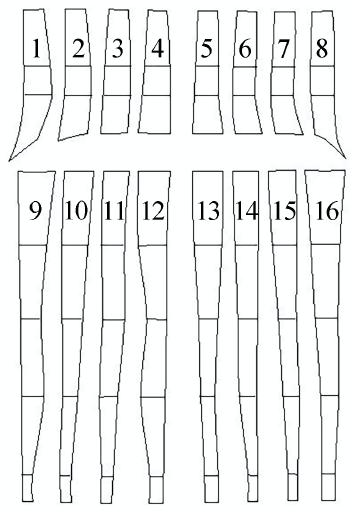
Flattened panels.
Generation of the Trouser Pattern
Sixteen flattened panels, containing the body's features, could be the initial trouser patterns. They were pieced together to generate trouser patterns based on a basic trouser block pattern, as shown in Fig. 4. Taking the back piece of trousers, Panels 1–4 were pieced together to be the top part of the back trouser, which covered the waist, abdomen, and hip of the human body, and generated the waistline, crotch curve, outseam, and waist darts. Panels 9–12 were pieced together to be the bottom part of the back trouser, which covered the leg of the human body, and generated the inseam, outseam, and hem line, as shown by comparison of Fig. 3 with Fig. 4.
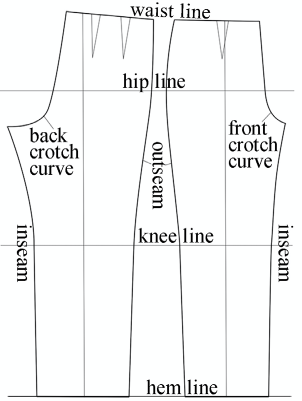
The basic pattern.
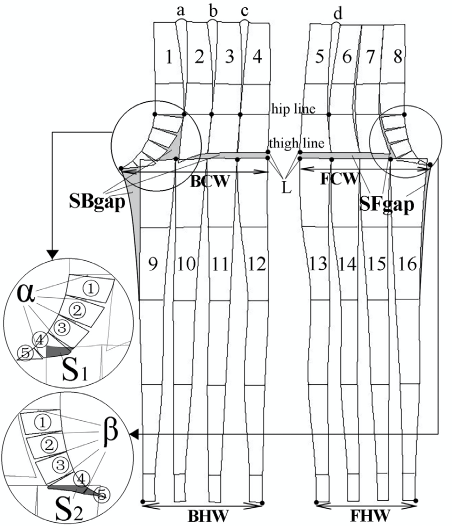
However, the edges of flattened panels were too complex to be put together without any gap or overlap, 22 as shown in Fig. 5. The gap was considered the extra space between the top and bottom parts of the trousers. The overlap was considered the space covered by more than one panel. The rule of pattern generation from panel alteration requires a balance between the gap and overlap to generate a better fitting pattern. Besides, the lengths of structural lines of the generated trouser pattern should be greater than or equal to the aggregated lengths of related edges of all flattened panels from the pattern. For instance, the overlap between Panel 1 and Panel 9 increased after the top and bottom parts of the back trousers had been pieced closer. Consequently, the area of the generated pattern became smaller than that of the mannequin's related surface. To address the fit issue arising from the undersized area, the elastic fabric may be used. 6 Another way is to rotate or cut and fan out Panel 1 to increase the gap area, as shown in Fig. 6. The amount of outspreading Panel 1 should be controlled, in the sense that a larger outspread amount creates more gathering and folds in superfluous area of the gap, whereas a smaller outspread amount, which causes area insufficiency, leaves more fabric badly pulled.
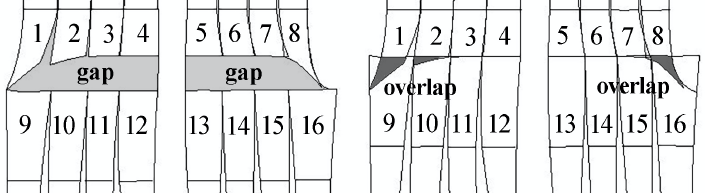
Piecing the top and bottom parts together.
Generation of the trouser pattern.
The area of the gap is determined by the alteration of the waist darts and the hem width. Moreover, the areas of the gap and overlap in the crotch are determined by the alteration of the crotch curve, which impacts the fit of the trousers. 23 Therefore, the hem width, waist dart, and crotch curve were considered as the three structural parameters for trouser patterns generation.
Twelve experiments of panel alteration were conducted as shown in Table II. BHW refers to the hem width of the back trouser, while FHW refers to the hem width of the front trouser. L refers to the longitudinal distance between the top and bottom parts of the trousers. While a, b, and c refer to the waist dart widths of the back trouser, d refers to the waist dart widths of the front trouser. For different panels, a is the rotation angle of Panel 1, (3 is the rotation angle of Panel 8, S1 is the area of overlap between Panels 1 and 9, while S2 is the area of overlap between Panels 8 and 16. BCW and FCW refer to the back crotch width and the front crotch width respectively.
Panel Alteration in 12 Experiments
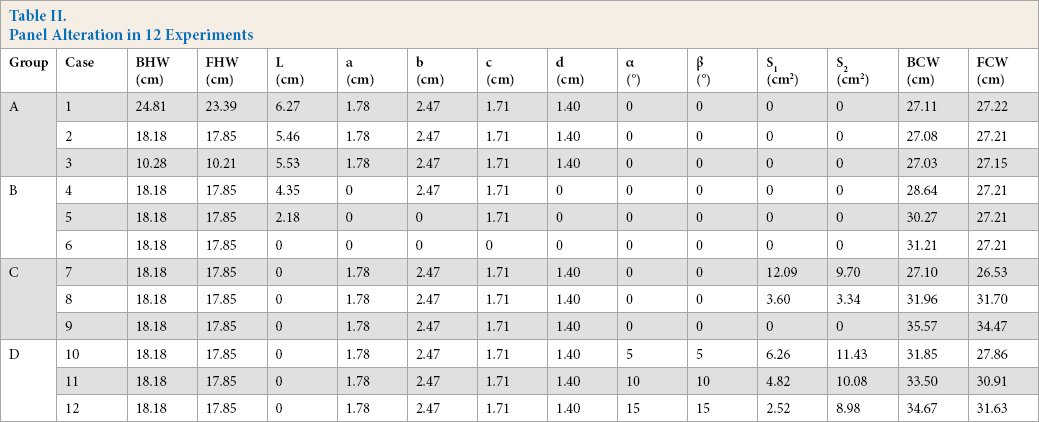
As shown in Fig. 6, in Group A, Panels 9, 12, 13, and 16 were rotated to alter the BHW and FHW respectively. In Group B, Panels 1–3 and 6–8 were rotated to alter the back dart widths (a, b, and c) and the front dart width (d) respectively. In Group C, Panels 1 and 8 were rotated to alter the BCW and the FCW respectively. In Group D, the rotation angle for five parts of Panel 1 (α) and that of Panel 8 (β) were altered to alter the back crotch curve and the front crotch curve respectively. The area of the overlap between Panels 1 and 9 (S1) and that between Panels 8 and 16 (S2) varied from case to case. So did the area of the gap in the back crotch (SBgap) and that in the front crotch (SFgap).
The alteration of the 2D pattern could be reflected in the simulation of the 3D garment in real time. The four-view drawings of the right-half trousers in twelve cases were acquired by Pattern Magic II software (Toray Company), as shown in Figs. 7–10. The fabric under an abnormal acting force, like the pulling force, is displayed in color in the inside view. Specifically, the degree of pressure and the area that the fabric suffers pressure has been reflected by coloring, which constitutes a great evaluation index to predict the fit of trousers. 24
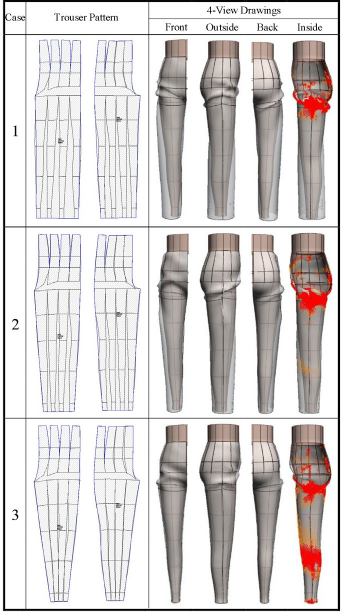
Virtual fitting in Group A.
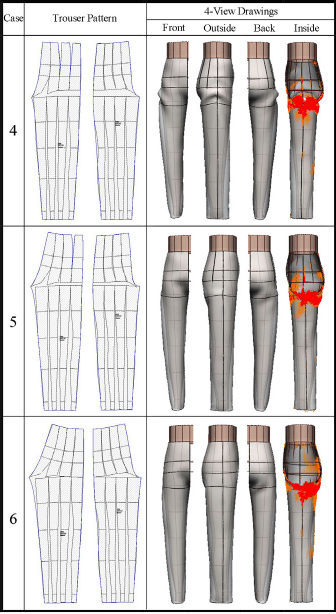
Virtual fitting in Group B.
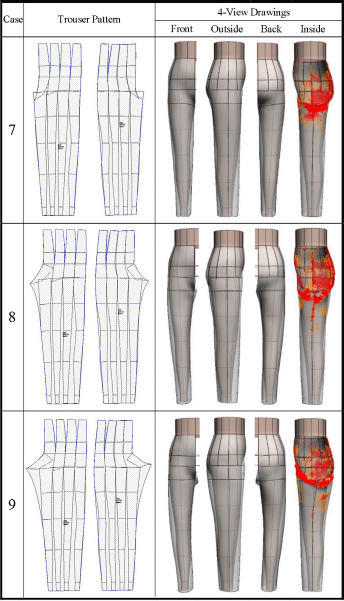
Virtual fitting in Group C.
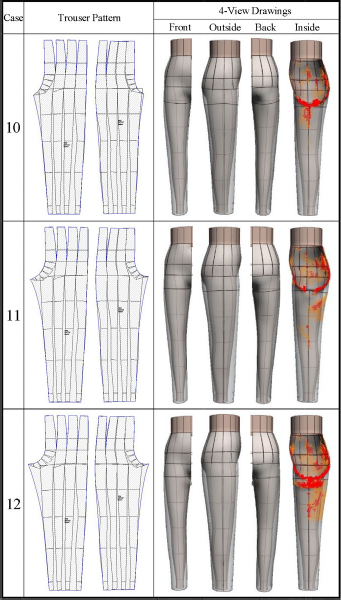
Virtual fitting in Group D.
Results and Discussion
Fit Evaluation
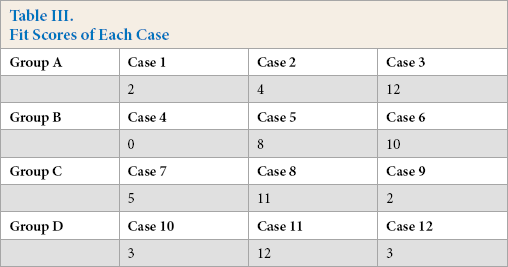
The aim of the evaluation for the twelve cases was to find the correlation between the fit of the trousers and panel alteration. Three professional pattern makers, who have been working in the female apparel industry for more than ten years, completed the score table about the fit of three pairs of trousers from each group, based on the fitting effects shown in Figs. 7–10. They judged the fit of the trousers according to two reference indexes, including the appearance of the trouser and the fabric pressure. The appearance of the trouser was evaluated by the amount of gathering and folds. The fabric pressure of the trouser was evaluated by the area of the colored part. The paired comparison method 25 was used in the fit evaluation. Three samples of the same group were compared with each other according to the appropriate arrangement and combination. If the fit of Case 1 was better than that of Case 2, Case 1 was given 2 scores, while Case 2 was given 0 scores. If the fit of Case 1 and Case 2 were the same, both were given 1 score. The better fit of the sample, the higher the score. The fit score of each sample was the sum of all scores from three professionals, as shown in Table III.
Fit Scores of Each Case
Furthermore, the areas of the gap and overlap in the crotch, which was calculated from the fitting effects, are shown in Figs. 11–12. Based on the analysis of the fit scores and the areas of the gap and overlap, the panel alteration for fit trousers could be generated.
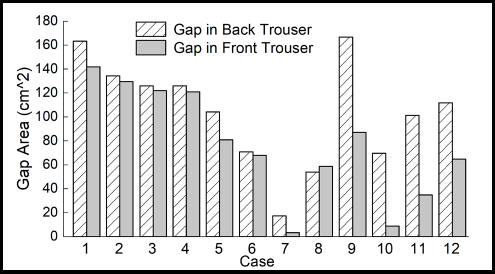
Area of the gap in the crotch.
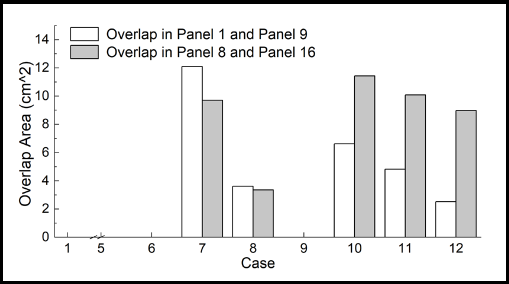
Area of the overlap in the crotch.
Analysis of the Structural Parameters
In Group A, the FHW and BHW were the independent variables. The hem widths of Case 2 were larger than those of Case 1, and smaller than those of Case 3. The smaller hem widths resulted in the smaller areas of the gap and the better appearance of the trouser. Therefore, the score of Case 2 was higher than that of Case 1, and lower than that of Case 3.
In Group B, the front waist dart width and back waist dart widths were the independent variables. The waist dart widths of Case 5 were smaller than those of Case 4, and larger than those of Case 6. The smaller waist dart widths resulted in the smaller areas of the gap and the better appearance of the trouser. Therefore, the score of Case 5 was higher than that of Case 4, and lower than that of Case 6.
In Groups C and D, the front crotch curve and back crotch curve were the independent variables. In Group C, the bottoms of Panels 1 and 8 were rotated to decrease the areas of the overlap in the front and back trousers. While in Group D, the bottoms were cut first, and each segment was rotated one-by-one. The rotation angles of Case 8 were larger than those of Case 7, and smaller than those of Case 9 in Group C. The rotation angles of Case 11 were larger than those of Case 10, and smaller than those of Case 12 in Group D. The larger rotation angles resulted in less overlap, more gap, and longer inseams in the front and back of the trousers. Compared with the lengths of the related edges of Panels 9 and 16, the inseams of Cases 7 and 10 were so short that the fabric in the crotch was pulled badly, and the inseams of Cases 9 and 12 were so long that more gathering and folds appeared, which caused the appearances and the scores of Cases 8 and 12 to be the best in Groups C and D respectively.
Algorithm of Panel Alteration
Given that no overlap exists between panels, both the hem width and the size of waist darts influences the gap in the crotch. The less the area of the gap, the better fit the trouser. On the other hand, given the existence of overlap in the crotch, the rotation angles of the panels influence the areas of the gap and overlap in the crotch. Thus, the less the areas of the gap and overlap, the better fit the trouser.
To balance the areas of the gap and overlap, the algorithm of the panel alteration was used to find the appropriate lengths of the structural lines of the trousers pattern. The relationships between the length of the structural line of the pattern and lengths of related edges of the flattened panels were calculated according to the following algorithm.

T, O, CC, IS, and OS are the lengths of the structural lines of the pattern and the related edges of the flattened panels, as shown in Fig. 13.
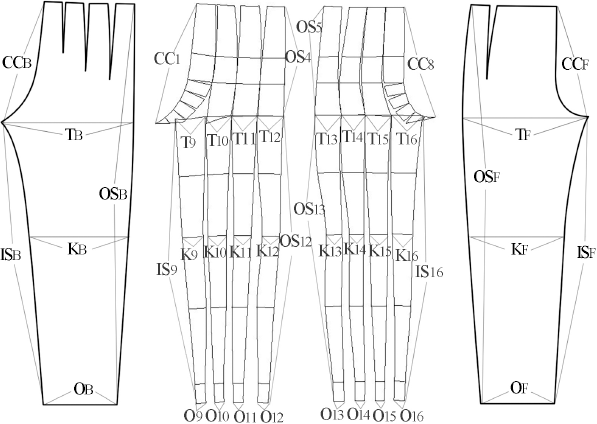
Comparison diagram of the pattern and panels.
Optimized Basic Pattern
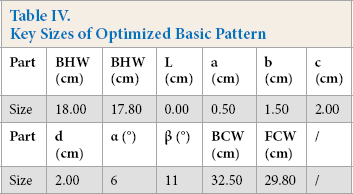
Based on the algorithm of panel alteration, the generation algorithm of the basic trouser pattern that has been altered accurately was calculated, as shown in Table IV. Based on the contour of the altered flattened panels, the waist lines, inseams, outseams, and hem lines were redrawn smoothly. Two darts were set at the three-way points of the back waist line, while one front waist dart was set between Panels 5 and 6 in that the convexity of the hip was larger than that of the stomach. The dart tips of back waist darts were on the stomach line. The dart tip of front waist dart was 1.50 cm below the stomach line. The optimized basic pattern is shown in Fig. 14.
Key Sizes of Optimized Basic Pattern
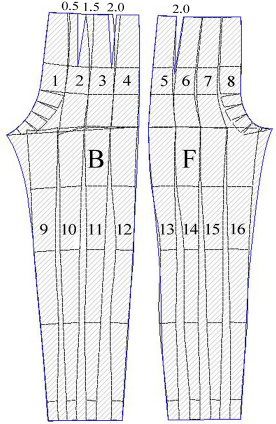
The optimized basic pattern.
Verification
To verify the fit of the trousers made based on the generated basic pattern, sample fitting and virtual fitting were both conducted. The real sample, made of muslin in a moderate thickness, was manufactured based on the pattern. The fitting effects of the four-view drawings of two fitting methods are shown in Fig. 15. Both samples fitted well in the waist, hip, knee, and crus. There were a few oblique folds in the back crotch as a result of the gap between Panels 1 and 2. The sample in the legs fitted properly and smoothly. In short, the samples fitted the scanned subject well.
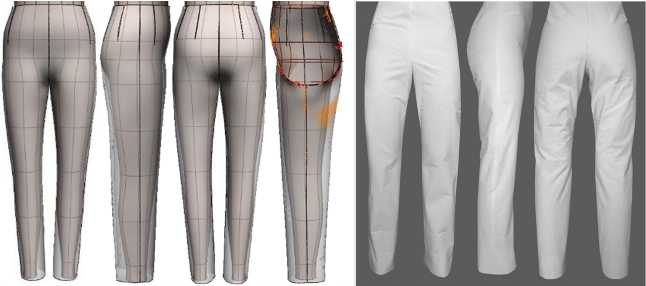
Fitting effects of two fitting methods.
Conclusion
In this study, a method to generate patterns of personalized female trousers based on 3D human body data was proposed for the garment customization industry. The digital mannequin was altered to match the reconstructed body model by altering the feature points. Sixteen flattened panels were obtained by cutting and flattening the altered digital mannequin. Twelve experiments of panel alteration were conducted to find out the correlation of the fit of the trousers made based on the generated pattern and three structural parameters, including the hem width, waist dart, and crotch curve.
Compared to other pattern-making methods from newly-published papers in related fields, the proposed method altered the flattened panels to generate a trouser pattern, which not only fulfils the fit requirement of trousers, but also increases patterns’ diversity with varied structural parameters. Such merits lie in the fact that the flattened panels contained the surface features of the human body, while various trouser patterns can be generated with structural parameters by altering the flattened panels.
This research can be an important reference for customized garment pattern design and the automatic generation of personalized patterns. However, a limitation of the method was that fabric properties were not considered in the flattening and pattern generation processes, which could be examined in future work. Moreover, this method is helpful to pattern generation for customers with special body shapes.
Footnotes
Acknowledgments
The authors would like to acknowledge the financial support from the International Cooperation Fund of Science and Technology Commission of Shanghai Municipality (Grant No. 21130750100).