






Abstract
A novel modacrylic fiber with the capability to absorb ∼80% of all infrared radiation was evaluated for use in personal thermal comfort applications. Using an infrared (IR) imaging camera to monitor optical changes over time and heat flux measurements, it was concluded that this altered modacrylic fiber possesses both a unique thermal signature as well as increased heat flux compared to 100% cotton. A design of experiments (DOE) was conducted to determine if blending this material with other fibers would result in a fabric with a higher thermal conductivity. It was observed that blends of nylon and the altered modacrylic tended to have the highest conductivity and would provide a cooling effect if used in a garment.
Introduction
The textile interface between a body and fabric serves as the junction of both conductive and radiative (infrared) heat transfer. 1 Approximately 40–50% of a human's heat exchange with the environment is a result of infrared radiation.2,3 Both short and long wave infrared radiation have been shown to influence thermal comfort. The former comes in the form of solar radiation and predominantly occurs in outdoor environments. The latter stems from sources of radiant heat, such as the human body or hot surfaces that emit far infrared (FIR) energy. 4 In both cases, the amount of radiant heat emitted from the body allowed to flow into the environment is heavily affected by the thermal insulation value (Rct) of the textile. A low Rct value corresponds to a high thermal conductivity and indicates that the textile will rapidly transfer radiant heat from the body, through the fabric, and to the environment. The movement of energy in this direction will provide a cooling sensation to the wearer. Conversely, a textile with a high Rct value correlates to a low thermal conductivity. In this case, emitted heat will provide an insulating effect as it will not be easily transferred from the body to the environment. A study by DenHartog et al. 4 modelled the effects of FIR radiation on heat transfer through protective clothing, and found that as thermal radiation increases, heat gain on the skin increases. Along with that finding, they also ascertained that the intrinsic clothing insulation (Rcf) and infrared reflectance/emittance properties of the material are also factors that have a significant impact on heat gain. In general, all electromagnetic waves’ interactions with a surface can be described using Beer's Law (Fig. 1). Beer's Law states that light encountering a material can be absorbed, reflected, scattered, and/or transmitted. 5 Absorption occurs when the energy from the light increases the kinetic energy of the substance. Reflection is the amount of light energy cast back from the surface and does not impart much of the energy to the surface. Scattering occurs when the incident wave of light is amplified within the substance, allowing the energy to eject at a different angle from which it entered. Finally, transmission occurs when the wave passes completely through an opaque material. 5
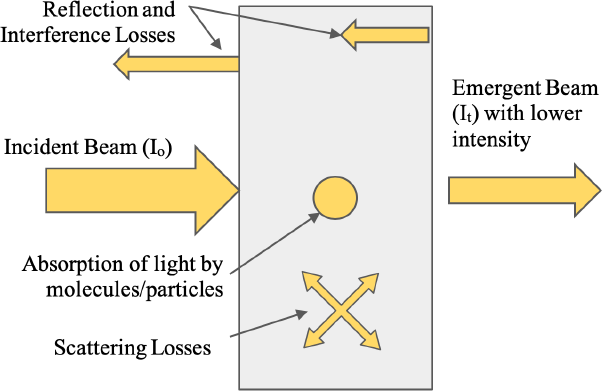
Schematic representation of the interaction between incident electromagnetic waves and a material according to Beer's Law.
The principles of Beer's Law also have implications on the emissivity of materials. According to Kirchhof's Law, the absorptivity of a material is equal to its emissivity. Therefore, the definition of a black body radiator is a substance that absorbs, and therefore emits, 100% of all incident radiation. 6 As most materials are not black bodies, a portion of incoming radiation is either reflected or transmitted by the substance. The quotient between the actual emittance and theoretical emittance of a black body is equal to the emissivity (ε) constant of a material. The emissivity of a perfect blackbody equals 1. Several attempts have been made to dynamically control the emissivity and infrared radiation of textiles to provide both heating and cooling effects in a single material.3,7 However, these studies make use of polymer coatings or non-polymeric materials to achieve these results.
The degree to which a material can absorb infrared energy can determine the insulative capabilities of a material. Absorption of infrared energy by a material's molecules causes an increase in kinetic energy. Increased kinetic energy leads to more motion of the molecules, which in turn causes an increase in temperature, since temperature, by definition, is the average kinetic energy of a material. To quantify how absorptivity affects thermal properties, the following equations can be used to calculate total thermal insulation (Rct), intrinsic thermal insulation (




Although there are numerous variables that impact a user's experience of thermal comfort, 8 fabric insulation and thermal conductivity were considered as priorities for this project as both properties determine the rate of heat transfer through a material. 9 As this novel fiber has never before been studied, only fundamental thermal properties were included within the scope of this research. While properties such as comfort, breathability, and air flow are important to the overall experience of comfort, they are all properties that can be tailored via processing methods depending on the product end use. Since breathability is such a key factor for thermal comfort, but could not be included within the project scope, background research to hypothesize the wicking characteristics of this fiber was conducted. A material's ability to wick moisture is heavily dependent on the material's moisture absorption, and that is determined by the polarity 10 of the molecules within the material. Materials with high bond polarity are highly attracted to water, which causes high absorption and therefore poor wicking. These high polarity materials, such as cotton, are also called hydrophilic materials. Low polarity substances, like nylon, polyester or modacrylic, are known as hydrophobic materials. Since the polymers that make up the modacrylic studied (polyacrylonitrile (PAN) and polyvinylchloride (PVC)), are both only slightly polar, it is assumed the moisture absorption and therefore wicking ability of this modacrylic would be similar to other synthetic, hydrophobic materials. Knowing that breathability can be altered by processing parameters (i.e. yarn and fabric structure), it was assumed that this fiber would have similar breathability to polyester and superior breathability to nylon.
Current applications utilizing IR wavelengths are present over a wide range of technical, industrial, and performance fields. A material made with Lycra known as Thermolite uses a near-IR wavelength sensitive chemical additive activated by solar light sources to increase the temperature of a garment to provide insulation. 11 In the protection/ military product space, Milliken has developed a chemical coating for fibers that allows military uniforms to appear the same temperature as their surroundings when viewed by a thermal (IR) camera or sensor. 12 Hsu et. al. developed a dual-mode textile fiber capable of passive radiative heating and cooling by utilizing a bilayer thermal emitter enclosed in a nanopolyethylene fiber with asymmetrical thickness. This structure allows for the adaptation of both the emissivity and thickness of the fiber depending on the ambient environment. 2 Additionally, Zhang et al. discovered a method to dynamically regulate IR radiation in textile fibers using metatextiles, which modify their shapes in response to the atmospheric temperature and relative humidity of the user's skin. 7 All of this research indicates that unique IR absorption can have a significant effect on a user's thermal comfort.
The goal of any high-performance material is to keep wearers cooler in hot environments or warmer in cool environments. This project and the aforementioned research demonstrate that the transfer of fluids, be it air or water/sweat, is not the only material property that can affect heat transfer and make for a high-performance material. Therefore, the research in this project focused on how this modacrylic's unique response to IR energy affected its inherent thermal properties. The experiments conducted in this research test the fabric insulation and thermal conductivity to provide insight into how the fiber itself transfers heat. Quantifying the thermal properties of the modacrylic will help to determine a product space that would be well suited for the use of this modacrylic fiber. More specifically, knowing these properties will determine if this material is best suited for use in cooling applications or insulating applications. A material with the ideal thermal conductivity in conjunction with other properties (e.g. breath-ability, diffusion, fabric, and structure) could make for an excellent high-performance fabric. Should this material have a high fabric insulation and low thermal conductivity, potential applications could include a wide array of products aimed at trapping heat and keeping a user warm. Conversely, a result of a low fabric insulation and high thermal conductivity could be an indicator that this fiber could be used in products geared towards keeping users cool, as it will allow heat to flow more easily away from the body. Depending on the interaction of this fiber's thermal properties with other properties not included in the scope, it could one day be used in products from sleeping bags to firefighter gear to workout clothes.
A novel type of modacrylic fiber (KIRAF) with the potential for use in thermal comfort applications was developed and its thermal properties were investigated. An alteration in the material composition of conventional modacrylic fiber allowed this material to absorb significantly more radiation in the mid-far infrared range (Fig. 2). It is composed of ∼50% polyacrylonitrile (PAN) and 50% polyvinylidene chloride (PVDC) with a modification in its chemical structure that allowed absorption of more IR energy than general modacrylic fiber. The mechanism by which the infrared absorption of the fiber was altered is proprietary.
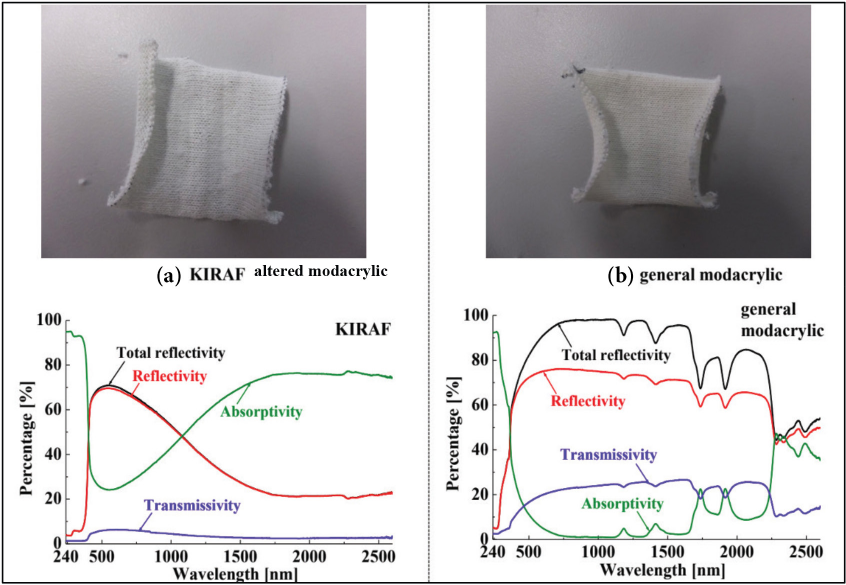
Comparison of electromagnetic wave interaction of the (a) altered and (b) general modacrylic.
Experimental
Materials
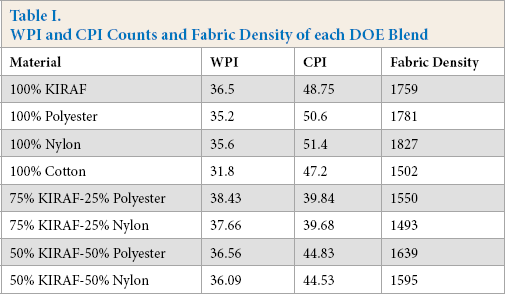
The sample fabrication process began by processing the staple modacrylic fiber into yarn. The raw fiber was opened using a B5/5 Rieter opening and cleaning machine, carded using a Rieter C4 card, and then drawn using a Rieter RSB851 drawframe. Following drawing, the 60 g/yd sliver was prepared for open-end spinning. The parameters for the Rieter R20 open end spinning machine were as follows: 3.89 TM, 40 SV rotor (72,130 rpm), 6-groove steel navel, 128-m/min delivery speed, OS 21/6 DN L4 combing roll (7500 rpm), and soft twist yarn tube. Working with the Wilson College of Textiles Spinning Lab, a 24/1 Ne, open-end spun, 100% altered modacrylic yarn was produced. In addition to this yarn, 40 lb of 70 denier polyester and nylon yarns were obtained from Unifi. To match the 24/1 Ne of the modacrylic yarn, the nylon and polyester yarns were plied three times for each fiber, resulting in yarns of ∼25/1 Ne. In total, 40 1-lb packages of altered modacrylic and 40 0.25-lb packages of both polyester and nylon were produced. Following the spinning process, the yarn was knitted into single-knit jersey fabrics on a 24 gauge, Mayer and Cie Relanit 4 circular knitting machine. Blend ratios of altered modacrylic and nylon or polyester in the final fabrics were achieved by controlling the type of yarn feed to each knitting needle (i.e., the 50/50 blends were created by tying in 20 packages of modacrylic and 20 packages of nylon or polyester). A list of the seven samples produced, along with the wales per inch (WPI), courses per inch (CPI), and fabric density of each sample, can be found in Table I. Each of these samples were also scoured and washed to ensure that any waxes or oils on the machine state fabric would not interfere with subsequent evaluation. The scope and time frame of this research restricted processing options to spinning systems and fabric construction methods readily available at the Wilson College of Textiles. Further research into the properties of this fiber should include a design of experiments encompassing multiple spinning systems, yarn counts, and fabric structures.
WPI and CPI Counts and Fabric Density of each DOE Blend
Measurables
Specific Intrinsic Thermal Insulation
The specific intrinsic thermal insulation, is the resistance to dry heat transfer provided by the fabric system alone, normalized for fabric thickness. is calculated from Rct, the total thermal insulation value of a fabric system, including the surface air layer. The target range for changes is based on the desired response. For an insulative material, the needs to be as high as possible. For a non-insulative material, the needs to be as low as possible, however, it cannot be lower than the insulation of air (∼0.024). 13 In all project experiments, Rcf was measured using TermDac software developed by Thermetrics and hot plates developed by Thermetrics or Measurement Technology Northwest Inc.
Heat Flux
Heat flux is the transfer of thermal energy through a material. The presence of fabric creates a temperature gradient between a warm surface and the ambient environment. Heat flux was measured by using thin film PHFS-01 and PHFS01-e heat flux sensors developed by FluxTeq. These sensors operate by using a differential-temperature thermopile design to measure the movement of thermal energy per unit area through the sensor surface. The flux is calculated using Eq. 5.
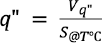
In this equation, q” corresponds to the heat flux absorbed through the sensor, ΔVq” is the output heat flux voltage, and S@T°C is the sensor sensitivity calibrated at the sensor's temperature at the time of measurement. Orienting the sensors properly on the body corresponds to negative values if heat is transferred away from the body to the environment. Each sensor was connected to the FluxDaq+ data logger to continuously record and plot the changes in heat flux over time. Heat flux is affected by the conductivity and insulation potential of a fabric. The target for heat flux measurements was for the altered modacrylic results to be significantly different than all other samples tested. Increased flux would indicate superior cooling properties, whereas decreased flux would indicate insulating properties.
Fabric Temperature
Fabric temperature was also measured using FluxTeq sensors. Within each sensor was a thermocouple capable of indicating the temperature difference between the top of the sensor surface and a reference location. The fabric surface temperature was calculated using Eq. 6.
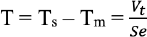
Ts is the sensor top surface temperature, Tm is the output voltage location temperature, Vt is the thermocouple output voltage, and Se is the Seebeck coefficient.
Fabric Thickness and Weight
Both thickness and weight were as similar as possible for uniform testing conditions and comparable test results. However, uniformity of fabric weight and thickness are difficult variables to control when using different materials, so calculations were performed to account for the differences. Weight and thickness are related to fabric density, which directly affects heat transfer through a fabric.
Thermal Image Evaluation
To determine under what environmental conditions the unique thermal properties of the fiber were most apparent, two additional types of testing were performed. The first was optical evaluation of thermal images captured with a forward looking infrared radar (FLIR) camera. To do this, first a prototype was created by sewing 4 × 4 in. modacrylic patches into a 100% cotton T-shirt (Fig. 3). It is important to note that patches were not sewn onto the cotton T-shirt, but rather into the shirt. This was done to ensure patches were on the same plane and same distance from the skin as cotton. During this cycle of testing, a male subject was asked to wear the prototype in a standing, stationary position for a total of 30 min in varying environments. Every 5 min, an image was captured to monitor thermal changes visible to an IR camera with increased exposure to a specified environment. Tests were conducted indoors at 70 °F, and outdoors in direct sunlight at both 67 °F and 40 °F.
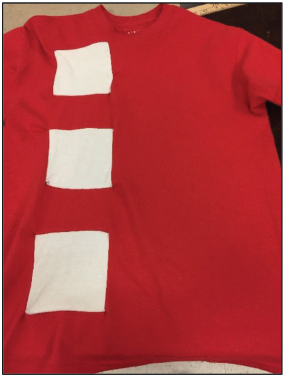
Prototype used to evaluate thermal signature and heat flux properties. 4 × 4 in. patches were distributed equally across the right side of the cotton T-shirt, with 4” spacing from the top and bottom of the garment as well as between each patch.
Heat Flux Evaluation
Following thermal image evaluation, the heat transfer properties in varying environments were then measured using FluxTeq sensors. Over the course of 20 min, a test subject was asked to sit stationary in the following environments: indoors at 70 °F, outdoors in direct sunlight at 60 °F, and indoors at 70 °F two feet away from a 250 W powered IR lamp. Measurements of the heat flux through the sensors were continuously recorded for the duration of each test. The data from each test was then plotted to create a graph of heat flux vs. time.
Design of Experiments
A design of experiments (DOE) was conducted to determine which material and blend ratio would result in a fabric with the greatest thermal conductivity. This DOE utilized the various blend samples listed in Table I. Within the thermal comfort product space, athletic wear is one of the most well-known and marketable personal thermal comfort product types. Polyester and nylon are two of the most commonly-used fabrics within athletic wear and were therefore used as variables for this evaluation. Using ASTM Standard 1868 Standard Test Method for Thermal and Evaporative Resistance of Clothing Materials Using a Sweating Hot Plate Part A, the thermal conductivity of each DOE sample was determined. In all iterations, air moved at 1 m/s across the fabric surface, the relative humidity (RH) was kept at a constant 65%, and the test environment was 25 °C. Calculations of heat transfer were done using measurements of thermal transport using the large skin model hot plate manufactured by Measurement Technology Northwest Inc. Fabric samples of size 20 × 20 in. were placed individually on the 35 °C hot plate and the flux required to keep the plate at 35 °C was recorded using TermDac software. Measurements were only taken from a 10 × 10 in. section in the middle of the hot plate to ensure that the only through plane heat transfer was measured, and lateral heat loss through the edges of the sample was not affecting the results. Additionally, heat flux data were only recorded after 30 min of steady state data, where the coefficient of variation was less than 1.5%. Regarding the weight and thickness of each sample, ASTM D3776-small swatch option and ASTM D1777 (Option 1) were used, respectively. The deliverables for this evaluation were Rct, Rcf, Rbp, It (clo value), weight, and thickness. From those values, and conductivity were calculated.
Results and Discussion
Thermal Conductivity
The data from the sweating guarded hot plate (SGHP) tests were analyzed using JMP software to determine the optimal blend material and ratio to maximize thermal conductivity. Optimization showed that blends of nylon with the altered modacrylic resulted in fabrics with higher thermal conductivity than blends with polyester. Furthermore, a fabric comprised of ∼37% altered modacrylic and 63% nylon was predicted to maximize the thermal conductivity and therefore provide the most effective cooling sensation.
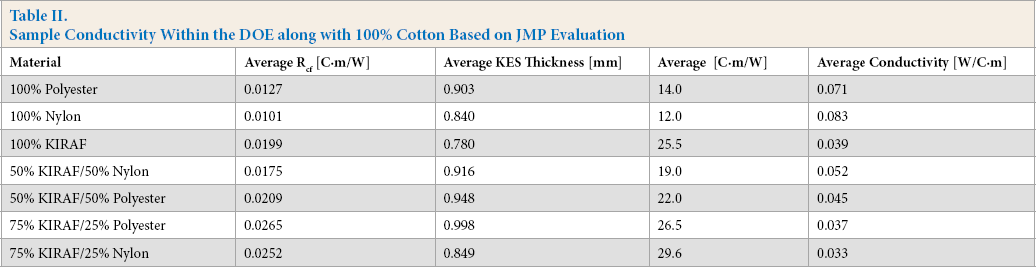
During analysis of the DOE data, it became apparent that the test results came back differently than hypothesized. Based on Kirchhof's Law, the thermal conductivity of the altered modacrylic was expected to be higher than that of nylon and polyester, because the same amount of radiant heat absorbed by this material should be emitted away from the heat source. However, the results from the SGHP tests showed the opposite. The thermal conductivity of the altered modacrylic was much less than both nylon and polyester (Table II).
Sample Conductivity Within the DOE along with 100% Cotton Based on JMP Evaluation
The prevailing theory on why such results occurred currently involves the differences between the fabric densities of all DOE samples. Although the variables within the sample fabrication processes were controlled to the highest extent possible, there were notable differences in yarn count between the altered modacrylic, nylon, and polyester which caused radical differences between the fabric density of each sample (Table I and Fig. 4). According to the JMP analysis, the fabric density of the 100% samples of each material were statistically different from those of the blended samples and can therefore not be directly compared. It is believed that heavier yarn counts allowed more air within the microstructure of the yarn and fabric, causing a significant difference in air permeability, compressibility, thickness, and fabric density. Since air is an excellent insulative substance, the amount of air within the free space of a fabric affects the insulation and thermal conductivity of a material. Furthermore, increased air within the fabric structure could influence both the unloaded thickness and compressibility of the sample.
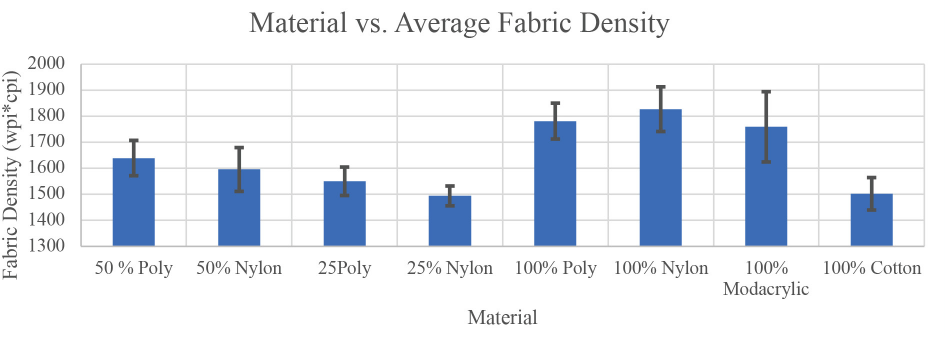
Analysis of variation of fabric density of each material within the DOE. 100% modacrylic, nylon, and polyester were statistically different than all the blends with modified modacrylic and 100% cotton.
Fabric thickness is defined under a predetermined pressure, which means high compressibility makes it difficult to measure unloaded thickness. Since unloaded thickness is used to normalize the fabric insulation, differences in thickness measurements between samples could be a source of variation. The initial thickness measurements were recorded based of a 0.6-psi load following ASTM D1777 (Option 1). To account for potential variation in compressibility due to fabric densities, a second measurement of thickness using the Kawabata Evaluation System (KES) at 0.07 psi was completed. These measurements were then used to calculate more accurate average values and conductivity (Table II). While using KES did provide more accurate conductivity values, the variation from dissimilar fabric density was most likely still a confounding variable in this experiment
Thermal Signature Properties
Based on qualitative evaluation of the images captured using the FLIR camera, it was concluded that as the temperature difference between the body and environment increased, the KIRAF patches became more visible to the IR camera. Assuming the average skin temperature was ∼85 °F, the temperature differences between the skin and environment in Fig. 5a–c were 15 °F, 18 °F, and 45 °F, respectively. In Fig. 5a, the modacrylic patches were not distinguishable from the surrounding cotton. However, in Fig. 5c, the modacrylic patches were clearly distinguished from the cotton. This result implied that modacrylic would most likely be most effective in an environment where the temperature gradient between the user and the environment was large.
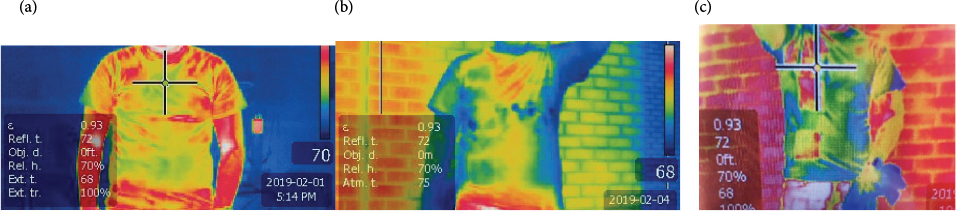
Thermal images from FLIR evaluation of a test subject wearing the first prototype in various environments. (a) Indoors at 70 °F, (b) outdoors in direct sunlight at 67 °F, and (c) outdoors in direct sunlight at 40 °F. Each image is after 30 min of exposure to the specified environment.
Heat Transfer Properties
Consistent differences in the heat flux from the body to the environment between the modacrylic patches and cotton were observed in all tests. The most notable difference between the two materials was an average of 20 W/m2 (Fig. 6). This difference indicates that, under similar conditions, the altered modacrylic would transfer more heat from a wearer to the environment than cotton; providing a cooling sensation to the user. Human studies would need to be completed to determine whether a 20 W/m2 difference in heat flux would result in a noticeable difference to a user. It is also important to note that changes in the direction of flux occurred when a source of IR energy was applied to the prototype. In both the direct sunlight and IR lamp scenarios, a positive heat flux was recorded. This means heat was flowing from the environment to the body, providing a warming effect to the wearer. However, in the absence of an IR source, a negative heat flux was recorded, meaning heat was flowing from the body to the environment, providing a cooling effect to the wearer. Based on these observations, the team concluded that the presence of a source of radiant heat determined the direction of heat transfer.
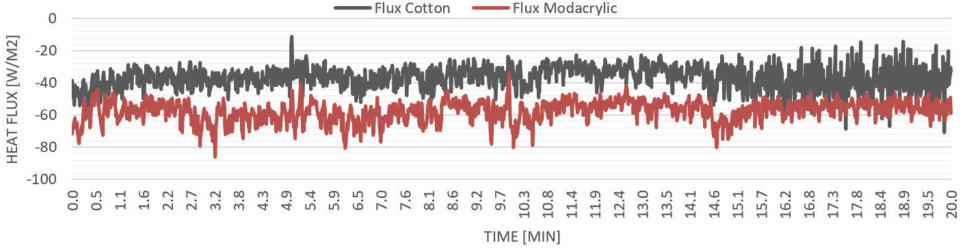
Graph of heat flux vs. time of altered modacrylic and cotton using an indoor environment at 70 °F with no source of infrared waves.
Summary and Conclusions
The thermal properties of a modacrylic like fiber that was modified to absorb ∼80% of incident infrared radiation were investigated in this report. Based on the test results from these evaluations, it is apparent that this fiber possesses unique thermal properties in comparison to cotton, polyester, and nylon. Testing showed that this fiber had a significantly higher heat flux from the fabric to the environment than cotton, and the differences between the modacrylic fiber and cotton were most apparent with greater temperature differences between the body and the environment. To further investigate the thermal properties of this material, as well as to determine if a blend with other high-performance materials typically seen in the sportswear market could improve thermal properties, a design of experiments was conducted. A sweating guarded hot plate was used for this experiment to ensure the accuracy and statistical significance of results.
The outcome of these experiments indicated that a blend of 37% altered modacrylic and 63% nylon would result in fabrics with the lowest fabric insulation and therefore highest thermal conductivity. However, variation in fabric density between the DOE samples was most likely a confounding variable within this evaluation, and therefore it cannot confidently be said that this blend ratio was truly superior than all others tested in this experiment. Tough the outcome of the DOE did not provide concrete evidence of the unique thermal properties of the altered modacrylic, thermal image and heat flux evaluations did provide proof that this fiber exhibited significantly different interactions with radiant heat than cotton.
More investigations into how IR absorption affects the thermal conductivity and insulation of this fiber should be completed to determine the ideal application and market space for the integration of this fiber into consumer products focused on thermal comfort. Since variation in fabric density had a significant effect on the thermal conductivity, the same design of experiments should be conducted ensuring all fabric densities, weights, and thicknesses are statistically similar enough to make direct comparisons. Repeating this experiment will simulate the performance of this fiber in a next-to-skin scenario to make conclusions about the effectiveness of the novel fiber in personal thermal comfort garments.
Furthermore, an additional test method that has the potential to quantify the thermal properties due to IR absorption is known as integrating sphere spectroscopy. This technology has the capability to measure the absorptance and reflection of a material over the infrared spectrum in a heat exchange scenario. Repeating the DOE combined with integrating sphere spectroscopy should provide invaluable information about the unique thermal properties of this unique modacrylic fiber. Regardless, it is apparent from the visible differences seen in the thermal images as well as the measured heat flux, this fiber has unique thermal properties that should be further investigated. Theoretically, because of these inherent thermal properties, the potential for this altered modacrylic to perform in cooling applications could be further improved using moisture management constructions. Currently, most products that boast cooling effects only provide thermal comfort through wicking structures.14,15 Should further investigation prove that this fiber will provide a cooling effect, the use of it in a moisture wicking structure could result in a far superior product than anything currently on the market.