






Abstract
Experiments were performed to improve the filtration efficiency of conductive fibrous filters by applying electrostatic charges. Ordinary polyester staple fiber and organic conductive fiber were blended in 90/10, 80/20, 70/30, and 60/40 ratios. Quantitative conductive needle felts were prepared by needle punching. The conductive fibrous filters were applied to a dc voltage supply (from 0 to 6 kV), and the relationship between filtration efficiency and the high voltage applied was studied. The results suggested that there was an approximately linear relationship between the filtration efficiency and the applied voltage value. The conductivity of filter material increased with increased blending ratio of the conductive fibers, basis weight, and thickness.
Introduction
The air that we breathe is extremely polluted due to the presence of various contaminants (particles) that include beach sand, carbon black, pollen, coal dust, atmospheric dust, bacteria, tobacco smoke, viruses, diesel soot, and pesticides, to name a few. 1 These particles should be removed from the air because health risks associated with submicrometer aerosol particles are a serious concern. 2 Such small particles have prolonged atmospheric residence times, 3 and are able to penetrate deep into human airways; these can result in pulmonary disease, cardiovascular health effects, immune system impairments, and other environmental and health-related problems. 4
There are numerous ways to remove airborne particles. Electrostatic precipitation and filter media are commonly available and are capable of removing these particles from a polluted air stream. The removal of particles from flue gases is mainly achieved by means of electrostatic precipitators, which have been developed to a technical level that allows them to remove ∼99% of the mass of fly ash from the flue gas. The remaining 1% consists primarily of particles with a diameter less than 1 μm, which pass through the electrostatic precipitators. Other kinds of filters, such as bag filters, can be used to remove submicron particles. This is a more effective technology for removing aerosols from a gas stream than electrostatic precipitators. However, there would be a substantial increase in the pressure drop through these filters.
With the increasing demand for higher filter performance, various types of electrostatic filters have been considered since they are expected to have a higher collection efficiency, especially for fine particles which cannot be removed efficiently by conventional mechanical filters. 5
Conventional fibrous filters that rely solely on mechanical action can only capture very small particles if their fibers are very thin and closely packed. However, a major disadvantage of this filter type is the high level of resistance imposed on the air flow that passes through. 6 To achieve a high collection efficiency, electrostatically augmented filters, 7 electret filters, and fluidized or packed-bed filters have also been investigated.
An electret is defined as a dielectric material that exhibits an external and internal electric field in the absence of an applied electric field. 8 Electret filters have been widely studied and used in air filtration, because electret filters can carry a permanent electric charge primarily through the long-range electrostatic attraction of dust particles. These filters can be much looser than conventional fibrous filters, which promote high-filtration efficiency without an increase in the pressure drop. 9 In general, the collection efficiency of an electret filter is greater than that of a conventional fibrous filter, particularly for fine particles that are smaller than 1 μm. Electret filters consist of synthetic fibers that have a permanent electrostatic charge. The electrostatic charge on the fibers can be introduced by corona discharge or by polarizing the material in an external electric field. However, the charge stability of the electret media is reduced under the effect of relative humidity, and charge decay is a serious problem during storage and use. To solve a common problem of static decay in electret filter material, the characteristics of the collection efficiency of the filters energized with a dc voltage are reported in this paper. The project focuses on the application of a high-voltage electric field as a factor improving the collection efficiency of conductive fibrous filters.
Experimental
Materials
The organic conductive fiber (2.5 dtex × 65 mm) and polyester fiber (4 dtex × 60 mm) were supplied by Jiangsu Lantian Environmental Protection Group Co. Ltd. The organic conductive fiber was obtained by reducing Cu2+ adsorbed on the fiber surface, and coating a conductive layer on the surface.
Sample Preparation
To prepare the conductive test samples, the common methods used include conductive fiber blending, conductive coating, and plating. Conductive fibers mainly include inorganic conductive fibers (e.g., metal and carbon fibers) and organic conductive fibers (i.e., conductive polymers). Conductive fibrous filters in this experiment were prepared using an organic conductive fiber, and it was blended with polyester staple fiber in 90/10, 80/20, 70/30, and 60/40 ratios. The conductive needle felt, with different basis weight (about 180 to 400 g/m2) were prepared by dry laying and needle punching. The preparation process was as follows: fiber opening→ mixing→ carding →laying →pre-acupuncture→main acupuncture.
Methods and Testing Sample Morphologies
The morphologies of the conductive fibrous filters were observed using a Super Depth of Field 3D Microscope (Z16APOA, Leica Microsystems).
Physical Properties
According to the relevant standards and test methods for performance testing of nonwoven fabrics, thickness, surface density, and air permeability of the conductive nonwoven materials prepared were measured. Surface density was measured according to GB/T24218.1-2009, and the units are g/m2. 10 Thickness was measured according to GB/T24218.2-2009 by a digital fabric thickness meter (YG141LA, Laizhou Electronic Instrument Co. Ltd.), with a presser foot area of 25 cm2 and pressure of 100 cN. 11 The air permeability was measured according to GB/T5453-1997 by a digital fabric permeability tester (YG (B)461E, Ningbo Textiles Instrument Co. Ltd.), and the units were L/(m2·s). 12 The resistance value in a certain length of the material was measured using a digital multimeter (VC9807A+, Shenzhen Shenggao Electronic Technology Co. Ltd.), and the surface specific resistance of the conductive nonwoven materials was calculated.
Electrostatic Filtration Properties
The experimental setup for measuring and researching the electrostatic filtration efficiency of the conductive fibrous filters under high voltage is shown schematically in Fig. 1. First, the SX-L1050 filter tester (Suzhou Suxin Environmental Technology Co. Ltd.) was modified such that the samples were held by pieces of insulating rubber on the top and bottom (to form a “sandwich” structure) to ensure system security, because the specimens were insulated from the metal parts. With the whole metal test station earthed, the entire test platform was effectively protected.
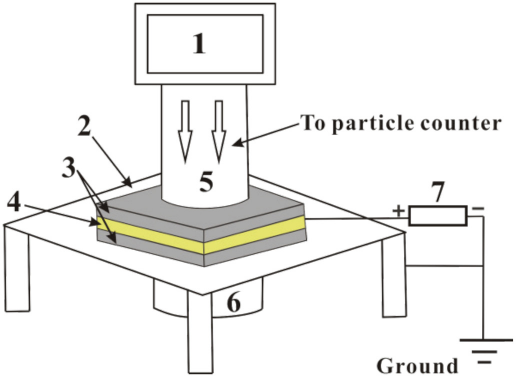
Schematic of modified filter tester. (1) Aerosol generation system, (2) metal test stand, (3) insulated rubbers, (4) conductive fibrous filters, (5) condensation particle counters (upstream), (6) condensation particle counters (downstream), and (7) high voltage dc power supply.
The conductive fibrous filters were applied to a dc voltage supply with voltages ranging from 0 to 6 k V. The relationship between the filtration efficiency and the applied high voltage was then studied.
The filtration efficiency of the samples without applying the high-voltage (0 kV) was tested. When the high-voltage dc power supply was turned on for the test samples, a large amount of static charge would be applied to the conductive fibrous filters. In operation, a positive voltage (1 to 6 kV) was applied to the filters by adjusting the power supply and the filtration efficiency of samples was measured at different voltages. The thickness of the insulation rubber layer was about 40 mm to avoid breakdown on a high voltage.
The SX-L1050 filter test system includes the aerosol generation system, a particle detection system consisting of two identical condensation particle counters used to measure the particle concentration upstream and downstream of the filters, a pressure drop transducer, and a porous-metal flow measurement device. Polystyrene particles (PSL) were used for the experiment, and the aerosol particle size was 0.3 μm, which was called the most penetrating particle size (MPPS). At this size, diffusion was the main mechanism of particle deposition. 10 The test area was 100 cm2, and the average gas velocity vertical to the conductive fibrous filters was 5.33 cm/s (i.e., flow 32 L/min).
The filtration resistance was measured by the Topas AFC-131 filter table, as shown in Fig. 2. The filter table can test the filtration resistance of the filter material at different flow rates.
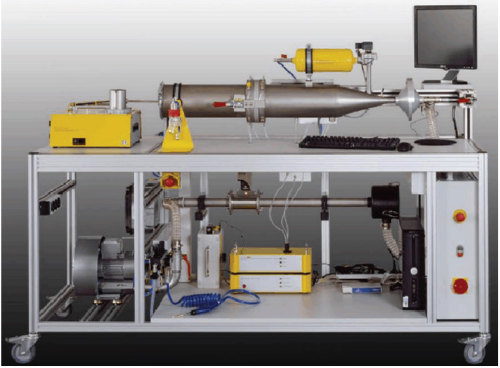
Topas AFC-131 filter test station.
Results and Discussion
Filter Morphology and Properties
Figs. 3a–d show the surface morphologies of the conductive fibrous filters with blend ratios of 90/10, 80/20, 70/30, and 60/40, respectively. The color of the sample became darker as the content of conductive fibers increased.
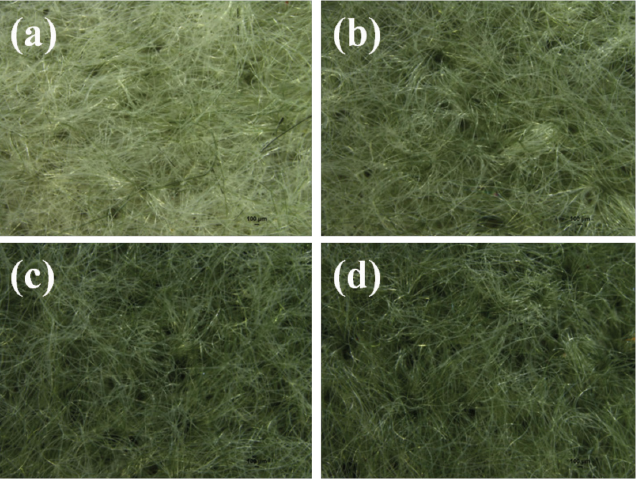
Surface morphologies of the conductive fibrous filters. (a) 90/10 blend ratio, (b) 80/20 blend ratio, (c) 70/30 blend ratio, and (d) 60/40 blend ratio.
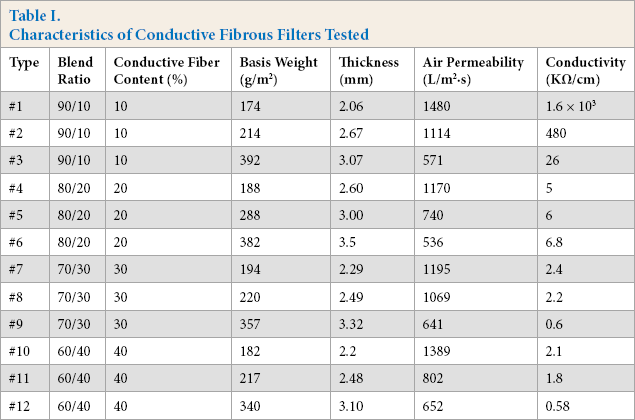
The characteristics of these conductive fibrous filters are given in Table I. Electrical conductivity provided the transportation of electrical charge through the materials. The electrical conductivity of the material increased as the blending ratio of the conductive fiber, the basis weight, and the thickness increased. In addition, as the weight or thickness increased, the air permeability of the material decreased.
Characteristics of Conductive Fibrous Filters Tested
Filtration Properties
The purpose of this series of experiments was to examine whether particles could be collected more efficiently by conductive fibrous filters using dc high voltage. The filtration efficiency of conductive materials was compared with and without high voltage application. Filtration efficiency (FE) was calculated using the equation FE = 1-Ndown/Nup, where FE is the filtration efficiency of the filter, and Ndown and Nup are the number of particles on the downstream and upstream sides, respectively. Figs. 4a–d show the changes in filtration efficiency versus the voltage of the conductive filter material for all four blends. The initial filtration efficiency of the filter material was greater when the basis weight of the filter material was increased. Because the path of the gas flow through the fiber filter material becomes longer, and the fiber obstacle is greater, the probability of particulate matter captured by the fiber increased and the filtration efficiency was improved.
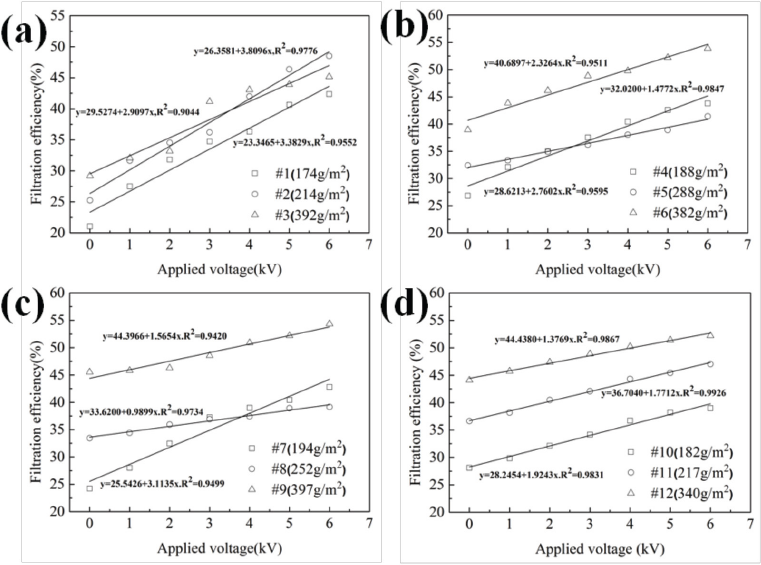
The relationship between filtration efficiency and voltage of the filter material. (a) 90/10 blend ratio, (b) 80/20 blend ratio, (c) 70/30 blend ratio, and (d) 60/40 blend ratio.
From Fig. 4, the filtration efficiency increased with the voltage raised from 0 to 6 kV. In Fig. 4a, the value of the filtration efficiency at Vdc = 0 kV was 20∼30%, but the filtration efficiency at Vdc = 6.0 kV was 40∼50%. With an increase in Vdc, the filtration efficiency of samples #1, #2, and #3 increased more sharply than other samples with the same basis weight. In addition, the filtration efficiency of the low-weight filter material increased more rapidly. All the conductive fibrous filters tested indicated the same characteristics that the filtration efficiency increased more slowly when the blend ratio of conductive fiber was high. At high dc voltage, the conductive fibrous filter surface may be charged more positively, and a space-charge field may be formed inside the fibrous filters between the charged fibers, because the conductive fibers served as electrodes. The electric field may contribute to the collection of particles. When the conductive fiber content was greater, the effect of static enhancement was not necessarily better. On the contrary, when the conductive fiber content was smaller, the electrostatic effect was more significant.
Fig. 5 shows the pressure drop of samples at different flow rates. When the thickness of the material varied, the filtration efficiency and pressure drop were different. Filters with different thicknesses had different initial pressure drops, and there was an approximately linear relationship between pressure drop and flow rate. For filter materials prepared from the same raw materials and the same process, the thickness increased with increased areal density (basis weight). According to filtration theory, as the thickness increases, the path of the airflow through the filter material becomes longer at a certain face velocity (filtration airflow speed), and as the airflow speed decreases, the pressure drop between upstream and downstream increases.
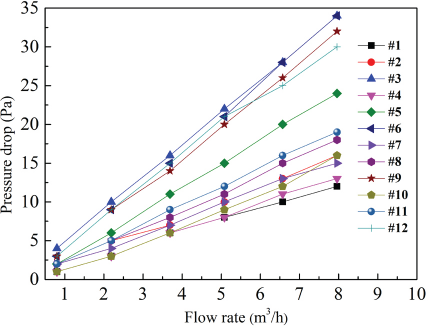
Pressure drop of the samples at different flow rates.
Conclusions
The authors proposed an electrostatic filter using conductive fibrous filters for particle collection by applying a high dc voltage. The following conclusions were drawn from the experiments. There was an approximately linear relationship between the filtration efficiency and the applied voltage value (from 0 to 6 kV). The conductivity of filter material increased with increased blending ratio of the conductive fibers, basis weight, and thickness of the filter material. These indicated that the conductive fibers became electrodes and all the fibers were electrets once a dc voltage was applied. The electric field inside the conductive fibrous filters formed and could affect particle collection performance. However, the growth trend of the filtration efficiency was more obvious when the basis weight and blending ratio of the filters were relatively low. Further studies are necessary on the filtration mechanism for this filter, and the filtration efficiencies of different particle sizes need to be tested in the near future to get a rigorous result.