






Abstract
Cotton fiber wax extraction yields of the contemporary accelerated solvent extraction (ASE) method were compared to the reference Soxhlet extraction method. Two Upland cotton varieties, referred to as the STV5458 B2F and the FM9180 B2F varieties grown in Lubbock, TX, USA, were examined. Effects of ASE extraction time and temperature were investigated. Characteristic environmental scanning electron microscopic (ESEM) images revealed fiber damage following both extraction methods, with the ASE method showing the least damage. A one-way ANOVA showed the two methods to be statistically different according to a 95% confidence level (p < 0.05) when combining analyses of the two cotton varieties.
Introduction
Cotton fibers contain a number of non-cellulosic hydrophobic components, such as waxes, fats, and resins, 1 which exist on the surface and cuticle layer of the fiber. Of these components, wax is typically found in concentrations of 0.4-1.2%, 2 which hinders the uniform uptake of dyes. 3 To combat this uptake limitation, scouring to remove excess cotton wax is typically performed before additional wet processing.4-7 Nevertheless, maintaining a residual amount of cotton wax is critical to mechanical processing because it reduces fiber-to-metal friction and fiber breakage. 3 To better understand this balance between wax amounts, researchers have used analytical methods to strip, collect, and quantify the amount of wax present on cotton. These determinations are usually performed on a smaller, representative sample set, which is used to guide large-scale treatment and processing.
One method for removing and quantifying wax is the Soxhlet extraction method. 8 This method was originally used to isolate fractions of solid materials, and it offers a few advantages such as ease of use, affordability of equipment, and efficacy of wax removal. Although this technique is widely used, it is not without disadvantages. For example, the Soxhlet method used for cotton wax extraction (termed the Conrad Soxhlet method) is time consuming and it requires large amounts of solvent, a relatively large sample size, and high operational temperatures. 9
Recent studies are focused on developing alternative extraction methods, 10 such as the microwave extraction method11,12 and the supercritical fluid extraction (SFE) method. 13 The microwave method uses short heating/cooling processes that improve the extraction yield.11,12 The SFE method had a high correlation coefficient as compared with the Conrad Soxhlet method. 13 However, a recent study comparing these methods with the newer accelerated solvent extraction (ASE) method, showed that ASE had s superior extraction yield for polycyclic aromatic hydrocarbons present in soils. 14 The ASE method is typically performed at temperatures in the range of 40 to 200 °C and pressures in the range of 1000 to 2500 psi, enhancing the speed of elution and keeping the solvents in the liquid state. 15
Given that previous studies that found ASE to be highly effective in the removal of some hydrophobic substances, it is of interest to determine the applicability of ASE on the removal of cotton waxes. This study had two goals: 1) to optimize temperature and extraction time effects for cotton wax removal using the ASE method; and 2) to compare total cotton wax removal results from the widely-used Conrad Soxhlet method with the ASE method.
Experimental
Cotton Samples
A total of 36 raw Upland cotton (
ASE Extraction
For each run, 4 g of cotton were placed in a 26 × 60 mm cellulose extraction thimble (Foss Analytical Co. Ltd.). The fiber sample size with the ASE was limited since the sample cells could only hold a maximum of 4 g of cotton fiber. The thimble was then placed in a stainless steel sample holder and transferred to the Dionex ASE 350 unit (Thermo Fisher Scientific) for automated analysis. All ASE extractions were performed using ∼100 mL of ethanol (200 proof; Decon Labs Inc.) under nitrogen at 150 psi. To establish optimal operational conditions, two extraction temperatures (125 and 140 °C) were investigated. The higher temperatures were used to see if they led to higher wax yields when compared to the Soxhlet method. Extractions were carried out for 1 h, using triplicate samples from each of the cotton varieties STV5458 B2F and FM9180 B2F. Tree extraction times (0.5, 1, and 1.5 h) were investigated using an extraction temperature of 140 °C, with each extraction time examined in triplicate using each of the two cotton varieties. For the purpose of this study, optimal extraction conditions were defined as ASE extraction yields which overlapped well with the Soxhlet method. During each experiment, the wax-ethanol extracts were collected in 250-mL vessels, with each run producing ∼85 mL of extract. Ethanol was chosen for the ASE experiments as it was also used for the Conrad Soxhlet method optimized wax recovery.
The ethanol extract was transferred into a 500-mL separatory funnel and liquid-liquid extraction was performed. A 100 mL aliquot of chloroform was added to the funnel and the mixture was shaken vigorously. Next, 75 mL of water was added to the separatory funnel, and the mixture was then shaken gently and vented three times. The resulting mixture was allowed to separate overnight until the two layers were visibly separate. The chloroform layer was transferred into a 300-mL Erlenmeyer flask, while the aqueous layer was mixed with a fresh 50 mL portion of chloroform in the separatory funnel. The mixture was shaken slightly, and the phases allowed to separate (3 h). The chloroform layer was collected and the remaining aqueous layer was discarded. The combined chloroform layers were extracted with water (100 mL) and the resulting emulsion was allowed to separate (3 h). The chloroform layers were collected in a 500-mL round-bottom flask and excess solvent was removed using a rotary evaporator set at 60 °C. The round-bottom flask with the wax residue was then placed in a vacuum oven at 70 °C overnight. The round-bottom flask was allowed to reach room temperature in a desiccator, and the wax percentage was calculated by weight of the initial cotton analyzed, as shown in Eq. 1. 9

Wt. is the weight and RBF is the round-bottom flask.
Soxhlet Extraction
The Soxhlet extraction method was modified from the Conrad Soxhlet method 9 for extracting wax from cotton fibers. For each run, 10 g of cotton (from each of the two cotton varieties STV5458 B2F and FM9180 B2F) was placed in a 43 × 123 mm cellulose extraction thimble (Whatman), and the thimble was then placed in a Soxhlet extractor body (200 mL, Ace Glass Inc.). The top end of the extractor body was connected to a Friedrichs condenser (250-mm jacket length, Ace Glass Inc.), while the bottom end was connected to a 500-mL fat-bottom flask. The flat-bottom flask contained 250 mL of 200 proof ethanol (Decon Labs Inc.) and solid glass beads (Fisher Scientific). Ethanol was used as received from the manufacturer. A StableTemp hot plate (Cole-Parmer) was placed underneath the fat-bottom flask, and the temperature was adjusted until the liquid was siphoned through the thimble at 3 to 4 min intervals with the final temperature being 365 °C. The extraction was continued for 6 h, at which point the heat source was removed and the Soxhlet assembly was allowed to cool down for about 10 min. The condenser was then detached from the assembly, and the cotton sample and cellulose thimble removed from the Soxhlet extractor. For the second stage of the extraction, the condenser was re-connected to the extractor glassware and the contents were heated to boiling to allow excess solvent to fill the extractor compartment; about 85 mL of the extract was maintained in the fat-bottom flask. A second extraction step was used to maximize recovery of any remaining wax and took ∼10 min.
The concentrated extract in the fat-bottomed flask was transferred into a 500-mL separatory funnel and a liquid-liquid extraction was performed as previously described in the ASE Extraction section.
Environmental Scanning Electron Microscopic (ESEM) Images
ESEM of the cotton fiber was performed using a Philips/FEI XL 30 ESEM, with a 4.4 spot size, an acceleration voltage of 12 kV, and a working distance of ∼6.5 m. Two magnifications were used to study the arrangement of the extracted fibers (500× and 1200×).
Data Analyses
A Student's
Results and Discussion
Optimization and Characterization of ASE Extraction Parameters
The effect of the ASE extraction temperature on sample STV5458 B2F 1014 cotton percent wax yield was examined (Fig. 1). Two ASE extraction temperatures were investigated, 125 °C and 140 °C. The extraction performed at 125 °C yielded a percent wax yield of 0.39 ± 0.4%, while the extraction at 140 °C yielded a percent wax yield of 0.68 ± 0.12% (Fig. 1). While the extractions performed at 125 °C showed a narrower margin of error, the higher temperature extractions produced higher extraction yields. A
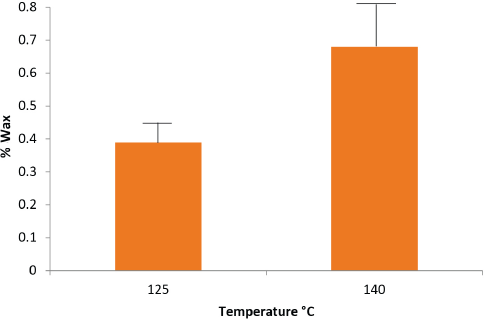
Determining the effects of temperature on sample STV5458 B2F 1014 ASE percent wax yield for a 1 h extraction time.
The effect of ASE extraction time on sample STV5458 B2F 1014 cotton percent wax yield was also examined (Fig. 2). Tree extraction times were investigated; the 1 h extraction time described above, along with 0.5 h and 1.5 h extraction times. The 0.5 h extractions gave a percent wax yield of 0.38 ± 0.06%, while the 1.5 h extractions gave a percent wax yield of 0.87 ± 0.27%. In comparison, an initial study using the Conrad Soxhlet extraction method gave a percent wax yield of 0.65 ± 0.05%. While the 0.5 h extraction showed a low margin of error, the percent wax yield was not in the range of values found in the initial test of the Conrad Soxhlet method. The 1 h and 1.5 h extraction time experiments did produce percent wax yields in the range seen for the Conrad method, however, the 1.5 h extraction experiments showed a disproportionally large margin of error. Based on these results, the 1 h ASE extraction time was maintained during subsequent experiments since the percent wax yield overlapped with the Soxhlet percent wax yield; while also minimizing the margin of error.
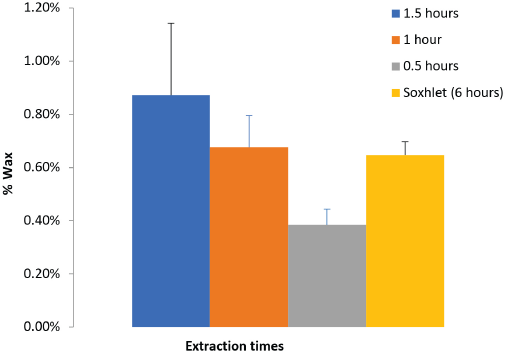
Determining the effects of ASE extraction time on percent wax yield compared to Soxhlet percent wax yield from sample STV5458 B2F 1014 at 140 °C.
Extraction Results
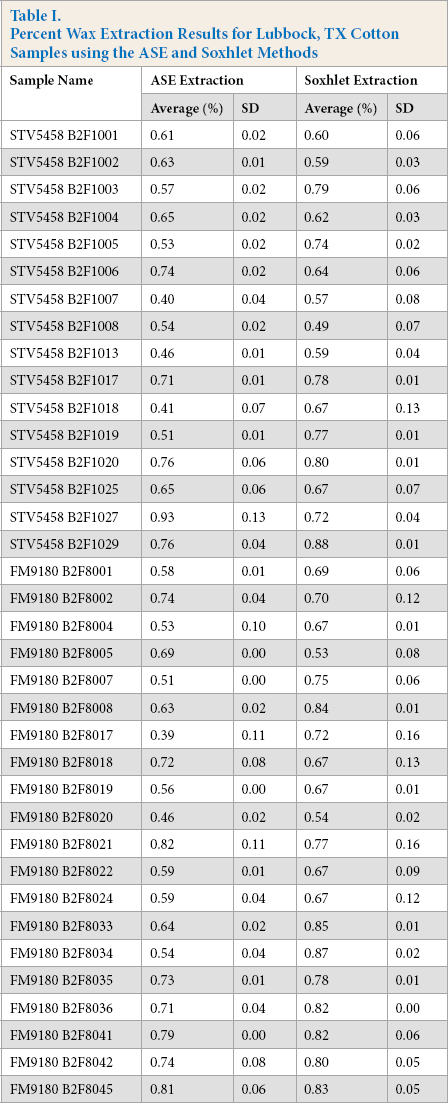
A comparison of the ASE and Soxhlet extraction methods was made using the 1 h extraction time criteria. A total of 36 samples were examined for each method, and the results are shown in Table I. The Soxhlet method showed a higher extraction mean (0.708 ± 0.102%) and a lower standard deviation. The ASE method showed a mean of 0.626 ± 0.130%. Each of the ASE and Soxhlet combined variety data sets were found to be absent of outliers and were assumed to have normal (Gaussian) distributions. Thus, further statistical analyses were performed.
Percent Wax Extraction Results for Lubbock, TX Cotton Samples using the ASE and Soxhlet Methods
Data Analysis
Diagnostic data (not shown) was generated on the overall ASE and Soxhlet data sets to show the goodness of fit; with the normal probability of each extraction method being nearly linear, indicating the distributions of the samples within each method were normal within the confidence limits. Once the percent wax data obtained for the ASE and Soxhlet methods were shown to have normal distributions, a one-way ANOVA was then performed to directly compare the two methods to determine if they yielded means which were statistically the same.
Tree different ANOVA statistical tests were performed (Fig. 3). First, a
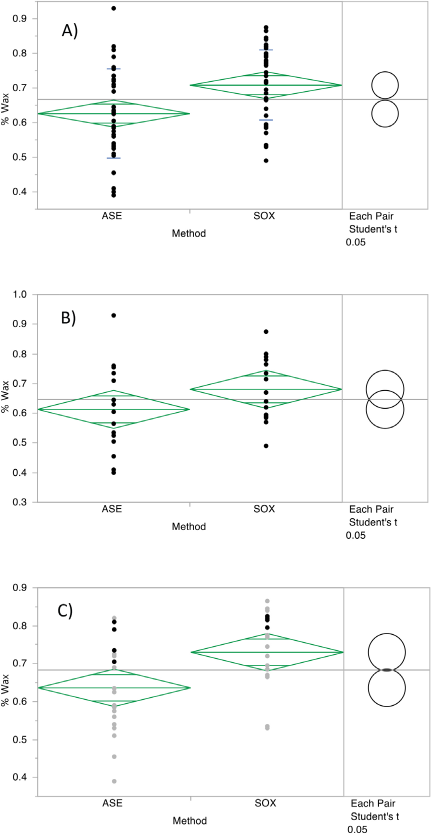
One-way ANOVA of percent wax by extraction method. A) across all cotton varieties (n = 36 for each method), B) by method for variety STV5458 B2F only (n = 16 for each method), and C) by method for variety FM9180 B2F only (n = 20 for each method).
An ANOVA using a
ESEM Images
Given the extended extraction time of the Conrad method, there was a question as to the potential destructive nature of each extraction method. Electron microscopy on cotton fibers has been previously used to examine fiber surface damage following chemical treatments or tensile tests.16,17 Still, little has been reported about the effect of standard wax removal techniques, like the Conrad Soxhlet method, on the cotton fiber surface.
Fig. 4 displays ESEM images for sample STV5458 B2F 1014 cotton fibers, before and following wax removal, using the ASE method as compared to the Conrad Soxhlet method. Each set of samples presented a diverse variety of surface features. This variety of surface damage is expected given the natural variability of cotton fibers. The most representative micrographs were selected for Fig. 4. Notably, wax removal from the ASE and Conrad Soxhlet methods resulted in fiber surface damage that was more extensive than for untreated fibers (Figs. 4A–B). The surface organization of the cotton microfibrils was particularly evident in the untreated micro-fibers. Untreated fibers generally showed negligible surface damage. The observed surface cracks appeared isolated and might arise from normal ESEM sample preparation. A small number of white dots were observed along the surface of the fibers. In contrast, fibers treated with the ASE method showed a number of small black spots (Figs. 4C–D). These spots varied in sizes from about 1 µm to 5 µm (Fig. 4C).
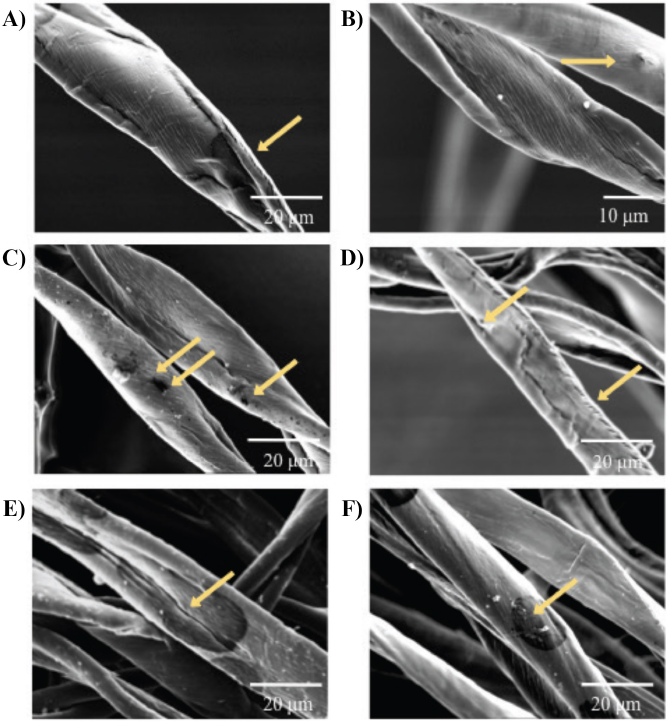
ESEM images of sample STV5458 B2F 1014 cotton fibers following wax removal with ASE and Soxhlet treatment (1500× magnification). A) and B) untreated cotton fibers, C) and D) fibers after the ASE extraction method, and E) and F) fibers after the Soxhlet extraction method. Surface damage is highlighted with arrows in each image.
These spots were likely a result of the high pressure and temperature the fibers were subjected to during wax removal. Surface cracks were also commonly observed (Fig. 4D). As with the untreated fibers, small white dots are commonly found on the fiber surface, but in higher numbers. These dots possibly result from fibrillation of microfibers near the surface of the cotton fiber.
Large circular dark spots were observed in fibers treated with the Conrad Soxhlet method (Figs. 4E–F). These spots were larger (15-25 µm for the Conrad Soxhlet method) than those observed in the fibers treated with the ASE methods (1-5 µm). Notably, the spots did not appear to go beyond the surface of the fiber. While the size of the dark spots was significant, the spots likely arose from the extended treatment that is typical of the Conrad Soxhlet method (6 h of extraction time). Once again, small white spots were observed on the surface of the treated cotton fibers in Figs. 4E–F. The prevalence of white specks mirrored those observed in the fibers treated with the ASE method. Our micrographs suggest that the ASE method for wax removal did not produce significant surface damage to the cotton fibers, and that the observed damage was smaller in size and scale than that observed from the Conrad Soxhlet treatment. Thus, the data showed merit and may be used in further analytical studies probing the effects of fiber damage due to wax extraction brought on by the two extraction methods discussed here.
Conclusions
In the current study, the ASE and Soxhlet methods were compared in the extraction of cotton wax. Some optimization of the ASE method was carried out by adjusting the extraction's temperature and time. The ASE method took 5 h less than the Soxhlet method to complete and used less solvent and sample. Statistical analyses showed the conditions under which the methods were different. When analysis data of the two cotton varieties were combined, the Soxhlet and ASE methods produced percent wax yields that were statistically different. When the two cotton varieties were analyzed separately, a
These results indicated that the ASE method must be customized for cotton varieties. Moreover, it has been reported by prior researchers that the characterization of cotton fiber properties should not be limited to conventional methods, such as use of the High Volume Instrument (HVI) and the Advanced Fiber Information System (AFIS), but should also consider fiber processing, wax content, and surface cohesion. 18 Therefore, an improved understanding of the effect of cotton waxes on fiber properties, and ultimately fiber processing, is needed for improved fabric performance. 19