






Abstract
For boll or small quantity seed cotton samples, fiber samples can be prepared by laboratory ginning methods, such as hand ginning (HG), laboratory-scale saw ginning (SG), and roller ginning (RG). Fiber blending is sometimes performed, which can impact fiber surface appearance. Interest was expressed on the impact of blending and laboratory ginning methods on Uster High Volume Instrument (HVI), Fibronaire, and near infrared (NIR) micronaire measurements. Blending impacts were slight but discernable by NIR only. Very good lint yield agreement was observed between the ginning methods (42–45%). Laboratory ginning impacts on the measured micronaire results were small, with between measurement method and between gin method agreements established. Thus, the use of any of the evaluated gin methods would yield acceptable and comparable micronaire results.
Introduction
The Agricultural Marketing Service (AMS) of the USDA classifies and assesses the quality of US cotton with the Uster High Volume Instrument (HVI). One of the quality classification parameters is micronaire. 1 Micronaire is a combination of the fiber's maturity (fiber thickness or secondary wall development) and fineness (fiber linear density), and it is determined on the HVI by measuring the fiber's resistance to air flow per unit mass.1–3 HVI measurements require a conditioned laboratory, expensive instrumentation, a significant quantity of fiber (∼10 g), and well-trained operators. Another technique that uses the air flow resistance method to measure micronaire is the Fibronaire unit. 4 The Fibronaire is low cost, low tech, and requires much less fiber mass (3.24 g). It does require air to operate, is not as fast as the HVI, and requires precise sample weight measurement.
Fiber micronaire can also be determined by near infrared (NIR) spectroscopy, using both bench-top (research grade) and portable instruments.2,5–8 NIR absorptions are due to combination and overtone bands found in the IR region (primarily 1100–2500 nm), often for NH, CHn, and OH chemical groups.
One distinct advantage of portable NIR analyzers is their potential for rapid, accurate, and cost effective micronaire measurements, both in the laboratory and in the cotton field. NIR analysis could complement HVI micronaire measurements. The capabilities and potential of portable NIR instrumentation to measure fiber micronaire has been established by Rodgers and colleagues, using a Brimrose Luminar 5030 NIR analyzer (Fig. 1).7,8 For laboratory measurements on lint, HVI-NIR methods agreement for micronaire was very good, with over 85% of the samples agreeing within ± 0.3 micronaire units between the two methods. Preliminary field NIR measurements were performed directly on the seed cotton in the cotton boll either in or near the cotton field. Micronaire trends were successfully determined and monitored (high-medium-low micronaires), with over 85% NIR-HVI trend accuracy observed between the NIR seed cotton micronaires and the HVI micronaires obtained from laboratory ginned lint.
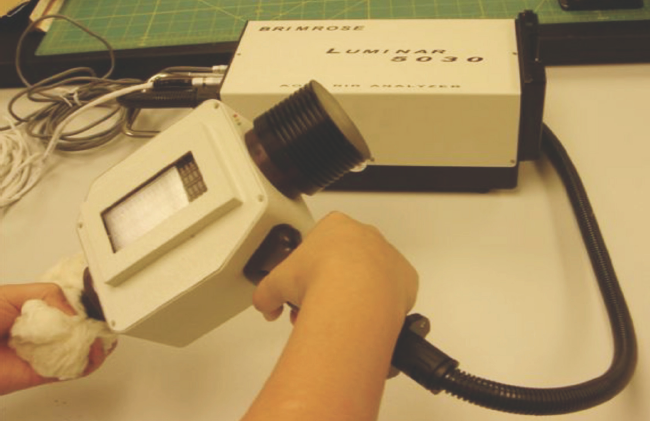
Brimrose Luminar 5030 portable NIR analyzer.
In the US, standard or routine cotton lint measured in the laboratory (by HVI, Fibronaire, and NIR) is ginned on commercial gins after being harvested by mechanical harvesters. However, small scale research or individual seed cotton samples (e.g., samples for breeders and geneticists) measured and/or collected in the field are normally harvested by hand (hand-picked, of insufficient quantity to be ginned at a commercial gin and often of insufficient quantity to be ginned on a microgin). Therefore, laboratory-scale ginning equipment (saw or roller gins) or hand ginning are used. If one wishes to obtain ginned lint from a single cotton boll (as used in NIR field evaluations), the seed cotton bolls must be ginned by laboratory means.
What are the impacts of different gin techniques/methods on HVI and NIR micronaire measurements and lint yield? Calhoun and colleagues examined the impacts on HVI micronaire and lint yield of hand-picked vs. mechanical-harvested cottons ginned by a laboratory saw gin and a commercial gin. Higher micronaire (∼ 0.5 micronaire units) and lint yield values were observed with the hand-picked samples that were laboratory saw ginned. 9 Boykin and colleagues examined the impacts on HVI micronaire and lint yield of hand-picked vs. mechanical-harvested cottons ginned by a laboratory saw gin, a laboratory microgin, and a commercial gin.10,11 Hand-picked samples normally overestimated HVI micronaire and lint yield or turnout values. Thus, differences in harvesting method and gin method/equipment type can impact HVI micronaire and lint yield values.
For a single cotton boll that was hand-picked, laboratory-scale saw ginning (SG), roller ginning (RG), or hand ginning (HG) are the primary sources of seed cotton ginning. Field NIR evaluations used cotton that was hand ginned to obtain the lint for HVI micronaire measurements. Since hand ginning can be very laborious and time consuming, interest was expressed in using SG or RG equipment to gin the individual bolls of hand-picked seed cotton.
Are the HVI, Fibronaire, and/or NIR micronaire results impacted by various laboratory ginning methods? Different types of ginning may impact sample packing and air flow through a fiber sample, which could lead to different HVI or Fibronaire micronaire results. Various ginning methods may impact the fiber surface reflectance, which may affect the NIR spectra and thus the NIR micronaire results. For similar reasons, blending the sample prior to analysis may also impact the micronaire results. This program was implemented to determine the impacts of blending and three laboratory ginning methods used in these experiments on lint yields and HVI, Fibronaire, and NIR micronaire measurements. All measurements were performed at the USDA-Agricultural Research Service (ARS)-Southern Regional Research Center (SRRC) facility in New Orleans, LA, USA.
Experimental
Materials and Procedures
For blending impact evaluations, nine AMS-supplied commercial cottons with wide micronaire ranges (∼2.6–5.8) were measured by HVI, Fibronaire, and portable NIR analyzer “as is” (no blending) and then blended. Blending was achieved by passing 12.0 ± 1.0 g of each sample through a mechanical fiber blender (Custom Scientific Inc.). Blending acts to align/orient the fiber in one direction, thereby changing the surface appearance and potentially the packing/openness of the fiber samples.
For laboratory gin method impact evaluations, seed cotton bolls from three varieties (FM958, DP393, and SG105) were used in this evaluation. The cottons were produced in Lubbock, TX, USA and were part of the 2009 Cotton Incorporated Regional Breeders Testing Network (RBTN). Bolls (90) of each variety were randomly selected, divided into 3 groups of 30 bolls each, and each 30-boll subset was laboratory ginned using the three laboratory ginning methods.
In HG, the fiber was removed from the seed cotton by the operator pulling the cotton fiber from the cotton seed. SG was performed on each boll using a 10-saw Dennis laboratory saw gin, and RG was performed on a Dennis laboratory roller gin (Dennis Manufacturing). The lint collected from each individual boll of each 30-boll subset was measured on a Mettler-Toledo MS204S balance (Mettler-Toledo Inc.) to determine lint yield/ginning turnout after the laboratory ginned fiber had been conditioned in a standard condition lab (21 ± 1 °C, 65 ± 2% relative humidity) for 24 h. The lint yield was the lint weight divided by the original weight of the seed cotton for each cotton boll, summed for the 30-boll subset per gin method per variety.
Analytical Methods and Instruments
Micronaire measurements were performed on the Brimrose Luminar 5030 portable NIR analyzer (Brimrose Corporation), Fibronaire (Motion Control), and Uster HVI-1000 (Uster Technologies) under standard conditions. Manufacturer recommended procedures were used. The NIR had previously been calibrated for micronaire, with HVI micro-naire being the reference values. A different mass of sample was required for each instrument—2.0 ± 0.5 g for “as is” blended samples and individual bolls of laboratory ginned samples on the NIR, 3.24 ± 0.03 g (50.0 ± 0.5 grains) samples for the Fibronaire, and 10.0 ± 0.4 g samples for the HVI. As a result, the instrument order for micronaire measurements was NIR → Fibronaire → HVI for each 30-boll cotton/ gin type subset for each variety. For each 30-boll subset, NIR measurements were first performed on each boll, then portions of random bolls combined to form the Fibronaire samples, and finally portions of random Fibronaire samples combined to form the HVI samples. Two replicates minimum were performed for each sample on each instrument. Additional statistical analyses were performed with Excel's Analysis ToolPak.
Results and Discussion
Blending Impact
“As is” and blended cotton lint samples were measured for micronaire by HVI, Fibronaire, and portable NIR analyzer. Blending aligns and orients the fiber along a common direction/axis and fattens/smooths the fiber surface, impacting the fiber's surface appearance and possibly impacting the fiber packing/openness. Fiber packing/openness differences could lead to differences in air flow resistance, which could affect the HVI and Fibronaire measurements. Fiber alignment/orientation could lead to differences in reflected light/ NIR radiation from the sample's surface that might impact NIR micronaire results.
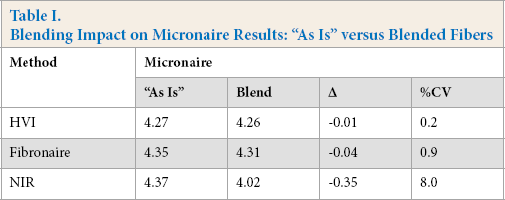
The micronaire results for the “as is” and blended samples for each micronaire method are given in Table I. The overall agreement among the micronaire results for the HVI, Fibronaire, and NIR methods was very good, especially for the “as is” samples (less than 0.1 mic unit range). The differences between the “as is” and blended micronaire results were minimal for the HVI and Fibronaire methods (less than 0.1 mic units). The differences between the “as is” and blended samples on the NIR micronaire results were small-to-moderate (∼0.35 mic units) but readily discernable, and the %CV for the NIR micronaires were higher than those observed for the HVI and Fibronaire micronaires. Therefore, mechanically blending fibers prior to micronaire measurements (increased fiber openness) yielded minimal impact on the micronaire results from air flow resistance measurements (e.g., HVI and Fibronaire). The change in surface appearance due to mechanically blending fibers prior to NIR micronaire measurements did impact the NIR micro-naire results. Changing the surface appearance impacted the fiber's diffuse reflectance, which impacted the NIR spectral reflectance response. In practice, blending the samples is a labor intensive and time-consuming process. In addition, the agreement between the HVI, Fibronaire, and NIR micro-naire results for the “as is” samples was very good. Therefore, the samples used in the laboratory gin method impact evaluations were “as is” samples.
Blending Impact on Micronaire Results: “As Is” versus Blended Fibers
Laboratory Gin Impact
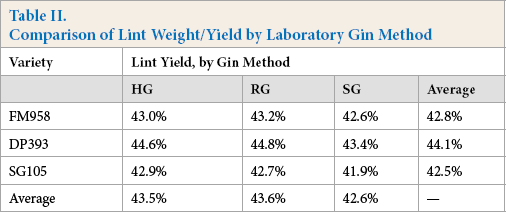
The lint yield for each 30-boll subset for each variety was determined for each laboratory ginning method, in which each individual boll sample for each variety was ginned using the three laboratory ginning methods. Overall, good lint yield agreement was observed for each variety across all three gin methods, with lint yield between 42.5% and 44.1% (Table II). The highest lint yield was for DP393 and lowest for SG105 for all three gin methods. Similar average lint yield results were observed for each gin method, with a range from 42.6% to 43.6%. Although very similar, the lowest yield for each variety was obtained with the SG method.
Comparison of Lint Weight/Yield by Laboratory Gin Method
The effect of the ginning method on the air flow resistance HVI and Fibronaire micronaire results was determined first. The standard micronaire reference method in the NIR evaluations was HVI. As noted earlier, laboratory ginned lint from individual bolls were measured by NIR, then portions of random bolls were combined to form the 3.24 g Fibronaire samples, and finally portions of random Fibronaire samples were combined to form the ∼10 g HVI samples. Thus, it is of interest to determine the agreement between the SRRC Fibronaire and HVI micronaire measurements, since use of the Fibronaire in place of HVI in future evaluations for micronaire would yield at least three times as many samples for comparison to NIR and other individual boll measurements.
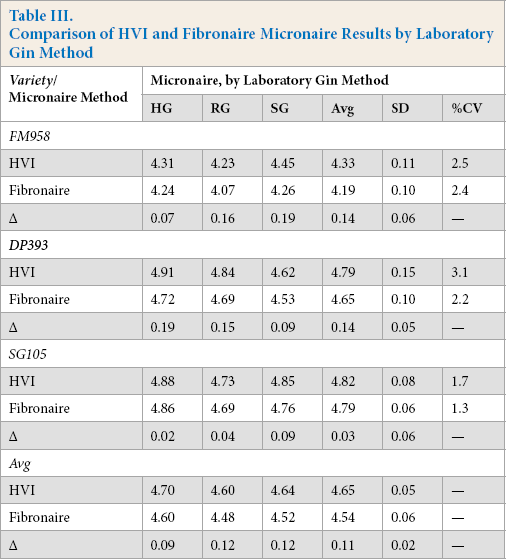
In addition, it was of interest to determine what laboratory ginning methods could influence the packing efficiency/ openness of the fiber mass, which may impact the air flow resistance and thus, HVI and Fibronaire micronaire results. The results are presented in Table III. Overall, good agreement was observed for each variety among the three laboratory ginning methods, with differences less than 0.2 mic units between HVI and Fibronaire micronaires in all cases. The HVI method for these laboratory ginned fibers yielded micronaire results that were slightly higher than those obtained with the Fibronaire method, with higher HVI micronaires observed for all gin methods and all varieties. Similar micronaires were observed for HVI and Fibronaire of DP393 and SG105 regardless of the gin method used, with FM958 yielding the lowest micronaire results for all measurement methods and all laboratory gin methods. The results demonstrate 1) that the three laboratory ginning methods had minimal impact on air flow resistance and the resulting micronaire and 2) that Fibronaire can be used in place of HVI micronaire measurements for future single-boll evaluations.
Comparison of HVI and Fibronaire Micronaire Results by Laboratory Gin Method
The impact of ginning method on the NIR micronaire results was determined next. In NIR measurements, the diffuse reflectance from the sample's surface is measured, which is converted into absorbance for quantitative and qualitative analyses. Thus, NIR measurements can be influenced by surface effects (e.g., smoothness and orientation), and it was of interest to determine if different laboratory ginning methods could influence the sample's surface (and resulting diffuse reflectance) and thus, NIR micronaire results.
Using the portable Brimrose 5030 NIR instrument, the cotton was placed against the sapphire glass-covered sampling port, and the NIR spectral and micronaire measurements performed. NIR spectral comparison were performed among the three laboratory ginning methods, as shown for FM958 in Figs. 2 (absorbance) and 3 (first derivative). Overall, excellent spectral agreement was observed between the three ginning methods. Slight differences were observed between the NIR absorbance spectra in Fig. 2. Derivative spectra are used to accentuate small differences and to remove baseline differences among samples. The first-deriv-ative spectra in Fig. 3 indicated that the spectral differences observed in Fig. 2 were due primarily to baseline differences. Similar results were observed for DP393 and SG105.
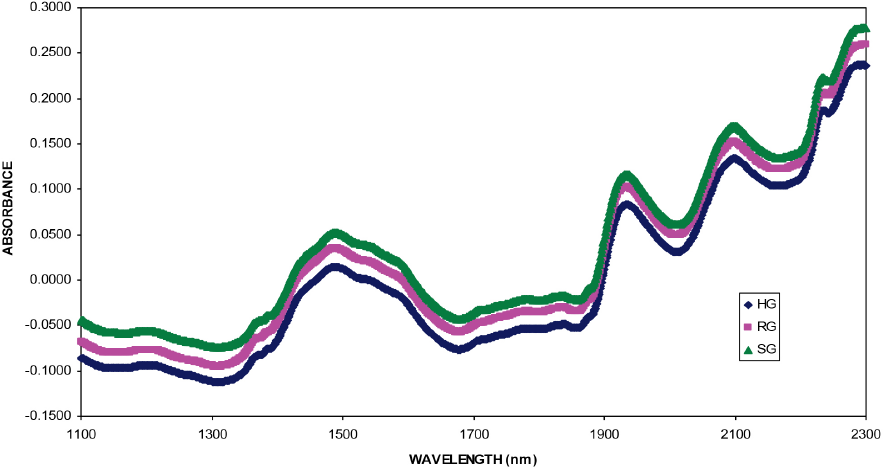
Representative NIR absorbance spectra, HG-RG-SG, FM 958.
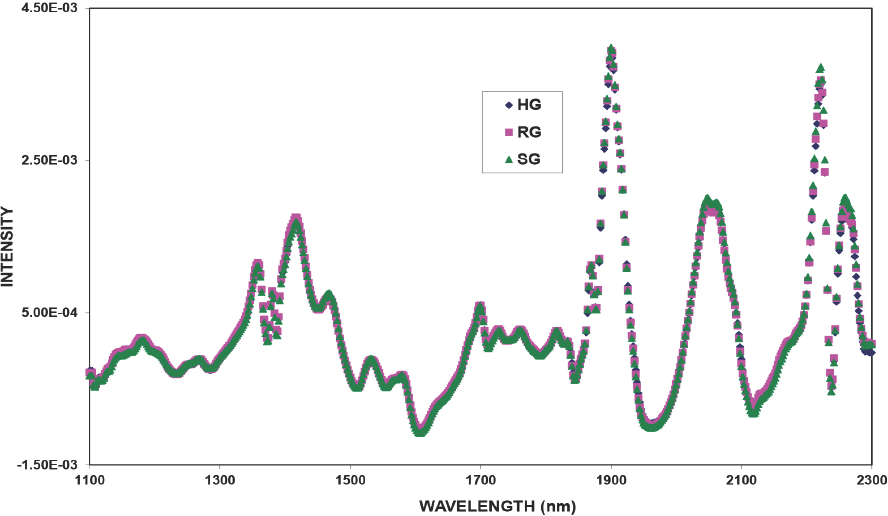
Representative NIR first derivative spectra, HG-RG-SG, FM 958.
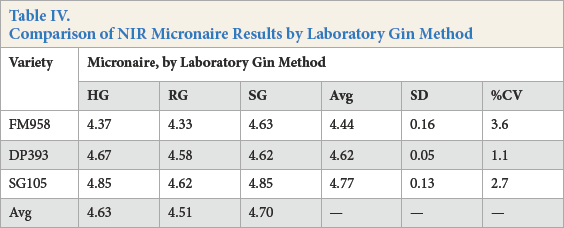
NIR spectral agreement can indicate micronaire agreement among laboratory gin methods, but it cannot by itself discern the actual NIR micronaire agreement among laboratory gin methods. NIR first-derivative calculations were performed to obtain the NIR micronaires for the three laboratory ginned samples (Table IV). Overall, good agreement was observed for each variety among the three laboratory gin methods and the NIR micronaires, with differences of less than 0.3 mic units among NIR micronaires for the three laboratory gin methods in all cases. The varietal micronaire differences were normally higher than the micronaire differences between laboratory ginning methods. The highest micronaires were observed for SG105 and the lowest normally for FM958, and the differences between DP393 and SG105 were slight (normally less than 0.2 mic units). The results demonstrate that the three laboratory gin methods had minimal impact on NIR micronaires.
Comparison of NIR Micronaire Results by Laboratory Gin Method
The effects of the laboratory ginning method on the composite HVI, Fibronaire, and NIR micronaire results is presented in Fig. 4. The results demonstrate that the impact of HG, RG, and SG laboratory gin methods on the HVI, Fibronaire, and NIR micro-naire results was minimal.
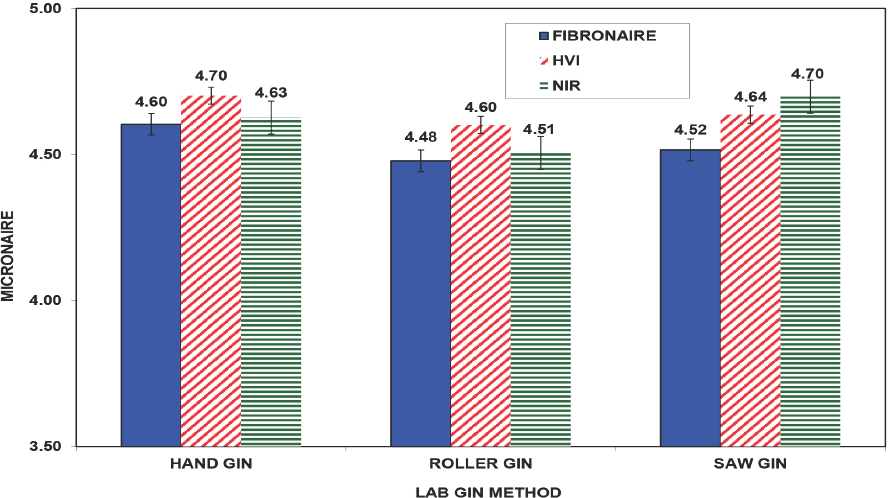
Comparison of Fibronaire, HVI, and NIR micronaire results by laboratory gin method for all varieties.
A statistical analysis of the three laboratory gin methods and micronaire analysis methods (HVI, Fibronaire, NIR) is presented in Tables V and VI. For the regression p-values, the differences among the laboratory gin methods and micronaire measurement methods were small and not significant. Thus, the slopes of the best ft lines in Table VI were not statistically significantly different from zero. The R 2 values were highest overall for the Fibronaire and HVI methods. This result was not unexpected, as both the HVI and Fibronaire methods use the same operation principle in the measurements of micronaire, and the micronaire range was small (less than 1.0 mic unit).
Comparison of Micronaire Measurement Method-Laboratory Gin Method and Statistical Analysis a
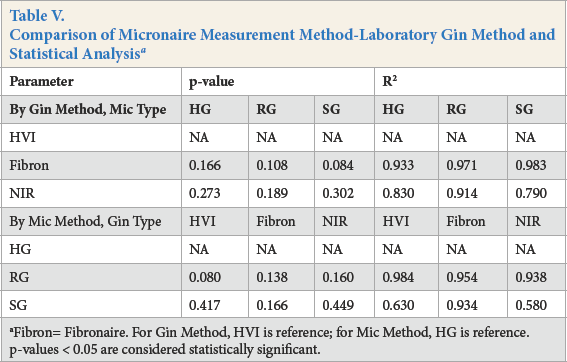
Fibron= Fibronaire. For Gin Method, HVI is reference; for Mic Method, HG is reference. p-values < 0.05 are considered statistically significant.
Comparison of Micronaire Measurement Method-Laboratory Gin Method and Statistical Analysis a
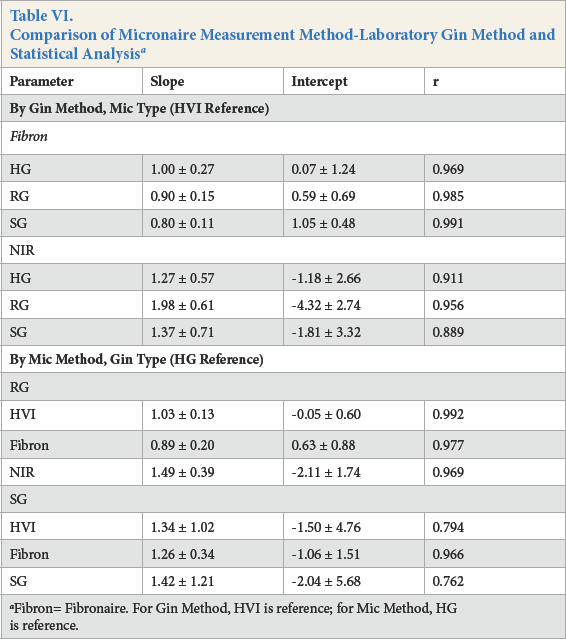
Fibron= Fibronaire. For Gin Method, HVI is reference; for Mic Method, HG is reference.
Conclusions
The impacts of laboratory blending and the laboratory gin methods tested (HG, RG, and SG) on the micronaire results from HVI, Fibronaire, and portable NIR analyzer were determined. The effect of fiber blending on the HVI and Fibronaire micronaire results was minimal, but readily discernable differences in micronaire with blending were observed for the portable NIR method. Lint weight/yield for the seed cottons from three varieties was very similar for the three laboratory gin methods, with all lint yields less than 40% and less than 2% lint yield range among the three laboratory gin methods. Very good agreement was observed between the HVI and Fibronaire micronaire results for each laboratory gin method, which will permit the use of Fibronaire in place of HVI micronaire measurements for future single boll evaluations. Due to measurement sample quantity differences between the HVI and Fibronaire, a minimum of three times more sample can be used for comparative evaluations to the NIR micronaire results when the Fibronaire is used as the reference micronaire method. Minimal, insignificant differences in micronaire due to laboratory gin method were obtained between the HVI, Fibronaire, and NIR methods. Therefore, for micronaire measurements, the use of as received lint and any of the three laboratory gin methods evaluated will yield comparable micronaire results.
Footnotes
Acknowledgements
The authors wish to acknowledge Jeannine Moraitis of CSQ for her outstanding work in preparing and running all samples. The authors also wish to acknowledge the support and assistance of Jane Dever of Texas A&M University and Cotton Incorporated for the cotton boll samples.