






Abstract

Dear Editor,
The international system for human cytogenetic nomenclature (ISCN) contains recommendations that have been developed with the understanding that not all situations can be fully described using the recommended conventions. One problem not fixed in the new ISCN 2009 (Shaffer et al. 2009) is that difficulties are encountered when a definition of subpopulations of small supernumerary marker chromosomes (sSMCs) is to be formulated. No uniform regulations are available concerning the order of sSMC cell lines in the karyotype formula, and keeping the sSMC literature in mind, describing the three main shapes of sSMCs (centric minute, inverted duplication, and ring) has been problematic since ISCN 2005 (Shaffer and Tommerup 2005). Here, these problems are outlined, and solutions are suggested.
sSMCs are a heterogeneous group with regard to their clinical effects as well as their chromosomal origin and their shape (Liehr et al. 2006; Tsuchiya et al. 2008). sSMCs were recently defined as structurally abnormal chromosomes that cannot be identified or characterized unambiguously by conventional banding cytogenetics alone, and are (in general) equal in size to or smaller than a chromosome 20 of the same metaphase spread (Liehr et al. 2004).
Owing to the progress made in the characterization of sSMCs, especially by multicolor molecular cytogenetic techniques (Liehr 2006) and array techniques (Tsuchiya et al. 2008), their composition has become more accurately describable over the past decade. Also, the frequent presence of previously undetectable cryptic mosaicism has become obvious in this context (Starke et al. 2003; Liehr et al. 2004,2006; von Beust et al. 2005; Tsuchiya et al. 2008; Liehr 2009) (see Figure 1). Particularly in connection with such complex sSMC karyoytpes, we came repeatedly into conflict with the suggestions provided by ISCNs 2005 and 2009 for their description. Thus, here we want to point out the problems and suggest some solutions. As an example and a basis for discussion, a case of a normal female with cryptic sSMC mosaicism and nine variants of an sSMC derived from chromosome 20 is shown in Figure 1 (for reasons of lucidity the different sSMCs specified in Table 1 are abbreviated as mar1 through mar9).
Many cytogeneticists have in mind that according to ISCN 2009, a cellular subpopulation is only to be described in a karyotype formula if “at least two cells with the same aberration” are detected. However, reading ISCN 2009 carefully, this refers only to clonal abnormalities in cancer. Thus, in cases with cryptic sSMCs, like that in the example shown in Figure 1, with nine sSMC variants, all of them can and have to be described in the karyotype, even though five of nine variants were found only once each. Also, the fact that for example, mar8 and mar9 of Figure 1 were present confirmed that a cell line with mar6 did exist, even though each one was a unique finding in the available material (Figure 1; Table 1 and karyotype given in the next paragraph).
Looking at ISCN 2009, an unanswered question regarding an sSMC karyotype is the order of the different cell lines. The rule for unrelated clones is not applicable, also coming from neoplasia cytogenetics; it states that the different related cell lines shall be arranged according to the clone size. As shown in Figure 1, subpopulations in sSMC cases can be related and deduced from each other. Here we suggest sorting the clones first by their modal chromosome number, second according to the number of cells containing the marker, and finally by the size of the imbalance they cause. A karyotyope 46,XX or 46,XY is then always to be mentioned last. That would mean in the present case: 48,XX,+mar3,+mar9[1]/47,XX,+mar5[7]/47,XX, +mar3[5]/47,XX,+mar1 [5]/47,XX,+mar7[1]/47,XX, +mar8[1]/47,XX,+mar2[1]/47,XX,+mar5[1]/47,XX, +mar6[1]/47,XX,+mar4[1]/46,XX[3].
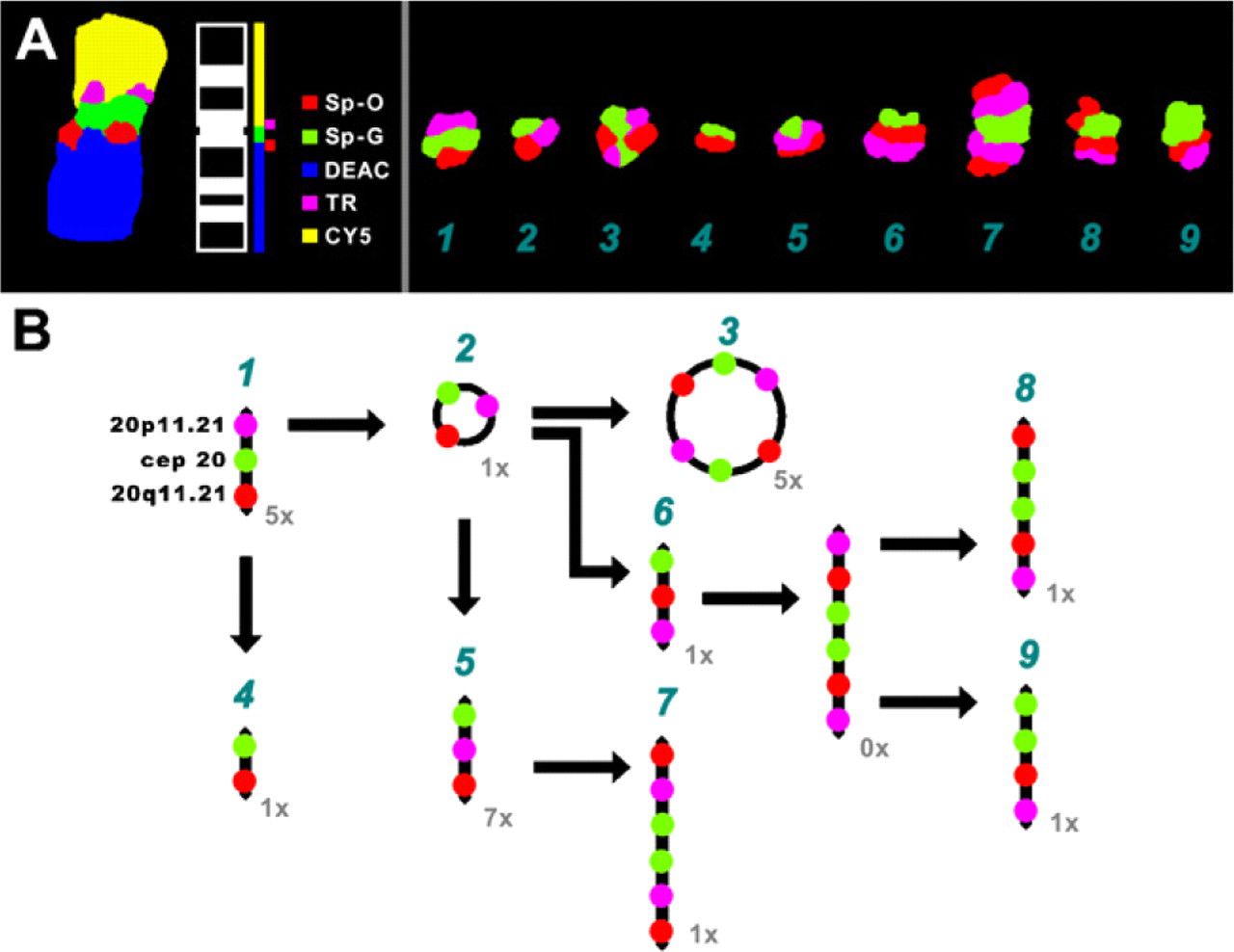
Application of subcentromere-specific multicolor fluorescence in situ hybridization (subcenM-FISH) (Starke et al. 2003) revealed cryptic mosaicism and the presence of at least nine differently shaped small supernumerary marker chromosome 20s [sSMC(20)s] in a clinically normal woman studied cytogenetically in connection with fertility problems, as reported in Manvelyan et al. (2008) case 96. (
The real problem one faces when establishing an sSMC karyotype occurs when the marker chromosome “mar” becomes a well-characterized sSMC and its special shape must be described. The only possibility of doing that correctly is to use the abbreviation “der” (for “derivative”) according to ISCN 2009. Thus, a “der” is either formed by multiple aberrations within a single chromosome, or generated by the involvement of two chromosomes. This definition makes all sSMCs now primarily “der”s. However, prior to ISCN 2005, this abbreviation was practically never used to describe an sSMC. Also sSMCs are very specific and clearly definable, in contrast to the heterogeneous group of derivative chromosomes.
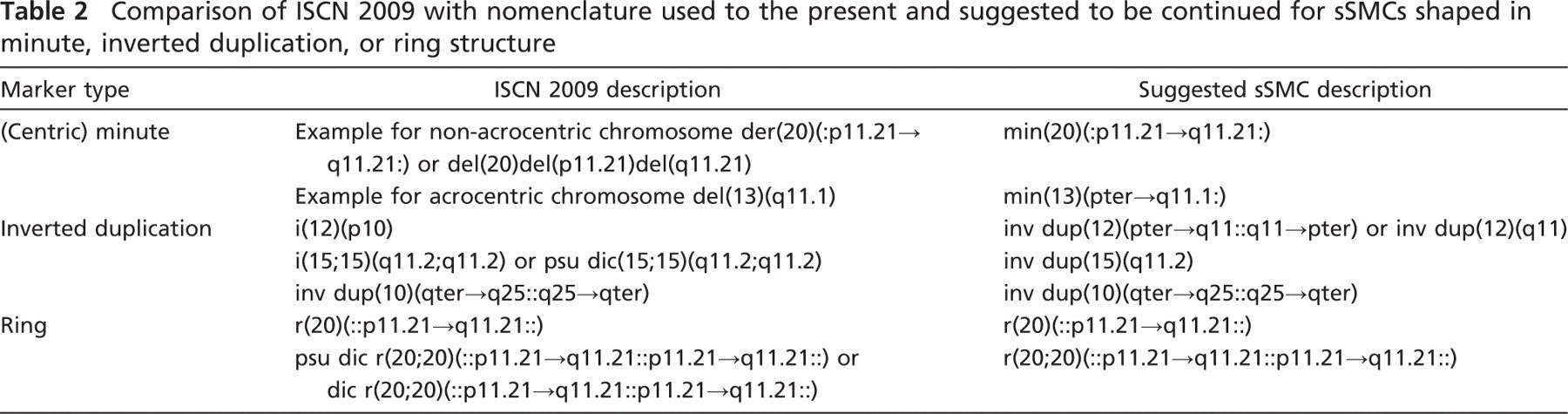
As recently reviewed, sSMCs can form three basic types of shapes: ring-structure (r), inverted duplication (inv dup), and centric minute (min) (Liehr et al. 2004). According to ISCN 2009, only the terms “r” for “ring-shaped” and “der” for all other sSMCs would now be allowed. For inverted duplicated sSMCs, the most commonly applied abbreviation “inv dup” is called “historical” in ISCN 2009, and “inv dup(15)(q11.2),” for example, should be replaced by idic(15;15)(q11.2; q11.2) or, if tested by antibodies for activeness of the centromeres, psu dic(15; 15)(q11.2; q11.2). The only applicable way, according to ISCN 2009, to use “inv dup” is in neocentric sSMCs. We favor continuing to apply to any inverted duplicated sSMC the abbreviation “inv dup,” for two reasons: (1) “inv dup” is a widely used, accepted, and understandable term in sSMC description; and (2), according to ISCN 2009, currently, four completely different abbreviations could be used to describe an inverted duplication-shaped sSMC (Table 2), which is confusing.
The main problem with ISCN 2009 is the description of centric but minute-shaped sSMCs. Here it is stated that the abbreviation “‘min’ is discouraged — if such information is relevant, it must be described in words in the text.” Furthermore, a “min” is defined as an “acentric fragment smaller than the width of a single chromatide.” However, in major parts of the sSMC literature of the previous decades, “min” was used to describe the centric minute-shaped chromosomes (see, e.g., Crolla 1998). To describe a minute such as that shown in Figure 1 as mar1, which up to now was reported as min(20)(:20p11.21→20q11.21:) in ISCN 2005, the use of der (20)(:20p11.21→20q11.21:) or der(20)del(p11.21)del(20)(q11.21) is suggested. We have to stress that in the case of an sSMC, we are not dealing with an unspecified type of unique derivative chromosome. If that were so, the use of the designation “der” would be justified. To the contrary, centric minute-shaped sSMCs constitute ~10% of all sSMCs. Thus, they are a clearly definable group of the huge and heterogeneous group “derivative chromosomes.” Furthermore, not all minute-shaped centric marker chromosomes can be called “derivatives” according to ISCN 2009; an acrocentric-derived minute-shaped sSMC like a min(13)(pter→q11.1:) could not be a “der,” because it only has one breakpoint, not “multiple aberrations within a single chromosome.” Thus, this would be a del(13)(q11.1), also a type of description, extremely rarely used, if at all, to describe the presence of an sSMC. As summarized in Table 2, four completely different abbreviations are to be applied to a minute-shaped sSMC, according to ISCN 2009.
The nine different variants of sSMC(20) (= marker) detected in the case described in Figure 1
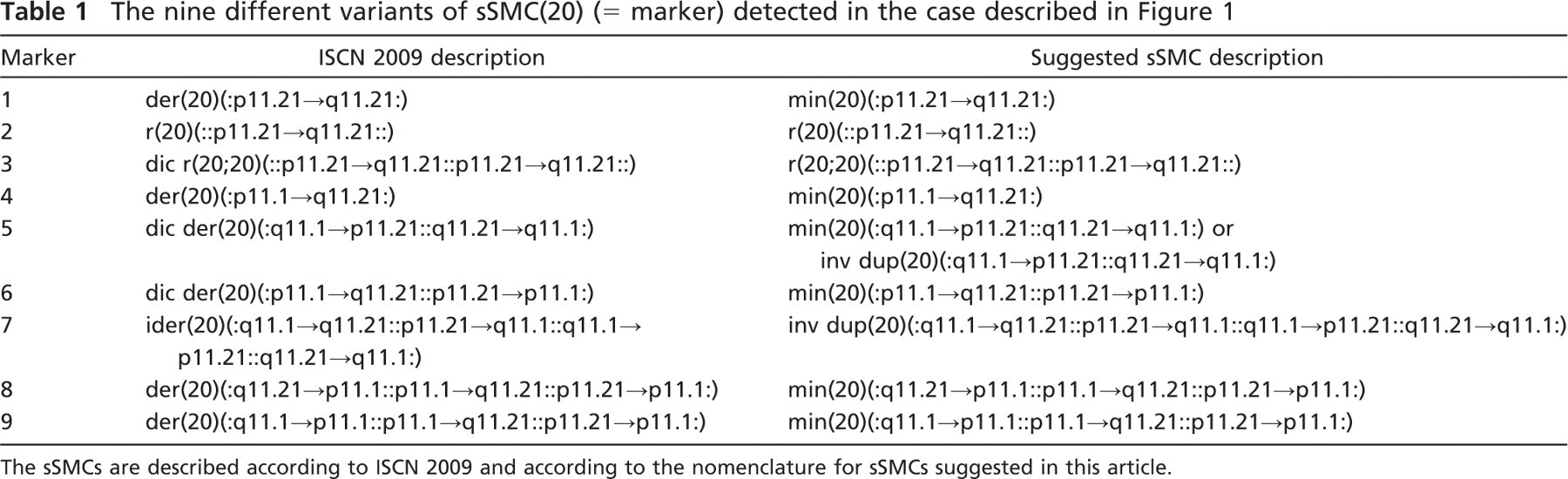
The sSMCs are described according to ISCN 2009 and according to the nomenclature for sSMCs suggested in this article.
Comparison of ISCN 2009 with nomenclature used to the present and suggested to be continued for sSMCs shaped in minute, inverted duplication, or ring structure
In summary, we have shown that there might appear to be problems with the nomenclature suggested in ISCN 2009 in regard to the definition of subpopulations, the order of sSMC cell lines in the karyotype formula, and the way to describe the three main shapes of sSMCs. We have suggested solutions for all three problems and primarily would emphasize the point that for uniformity and understandability of the sSMC literature, the abbreviations “min” for minute-shaped centric sSMCs, “inv dup” for inverted duplicated sSMCs, and “r” for ring-shaped sSMCs should continue to be applied. In particular, the use of “der” should be avoided in the clearly defined subgroup of minute-shaped centric sSMCs.
Footnotes
Acknowledgements
This study was supported in part by Deutsche Forschungsgemeinschaft grants 436 RUS 17/109/04, 436 RUS 17/22/06, and LI820/11-1; Deutscher Akademischer Austauschdienst grant D07/00070; DLR/Bundesministerium für Bildung und Forschung grants ARM 08/001 and BLR 08/004; the Boehringer Ingelheim Fonds; and the Evangelische Studienwerk e.V. Villigst.
The complex sSMC case was provided by Drs. Prager and Junge, Dresden, Germany.