




Abstract
The wealth of knowledge available at our fingertips only magnifies the missed opportunities of the past. With information technologies that allow not only seamless communications, but travel and interaction, the knowledge, and experience base of any individual is no longer limited to their immediate sphere—their local town, county, state, or nation, but allows close, relationships, at a diversity of levels globally.
I am a member of several “micro-communities” that span the globe. These micro-communities share specific interest that in the absence of the Internet would have been unable to share experience and knowledge. In function, they are the antithesis of diversity—people bound by a common interest. But, in fact, the micro-communities are just the opposite, unfettered by geography and anonymous to identifying features, should the member choose to be. Some of these micro-communities may be focused on hobbies, where the value is personal, but others, include animal health, human health, and a diversity of interest. Often, we have no idea, what the other members of the community do in their professional or personal lives, with identities limited to an on-line “handle,” name, or a thumbnail photo, than can be any image the person chooses. Yet, these communities serve vital purposes of sharing, vetting (peer-reviewing), educating, and expanding the community.
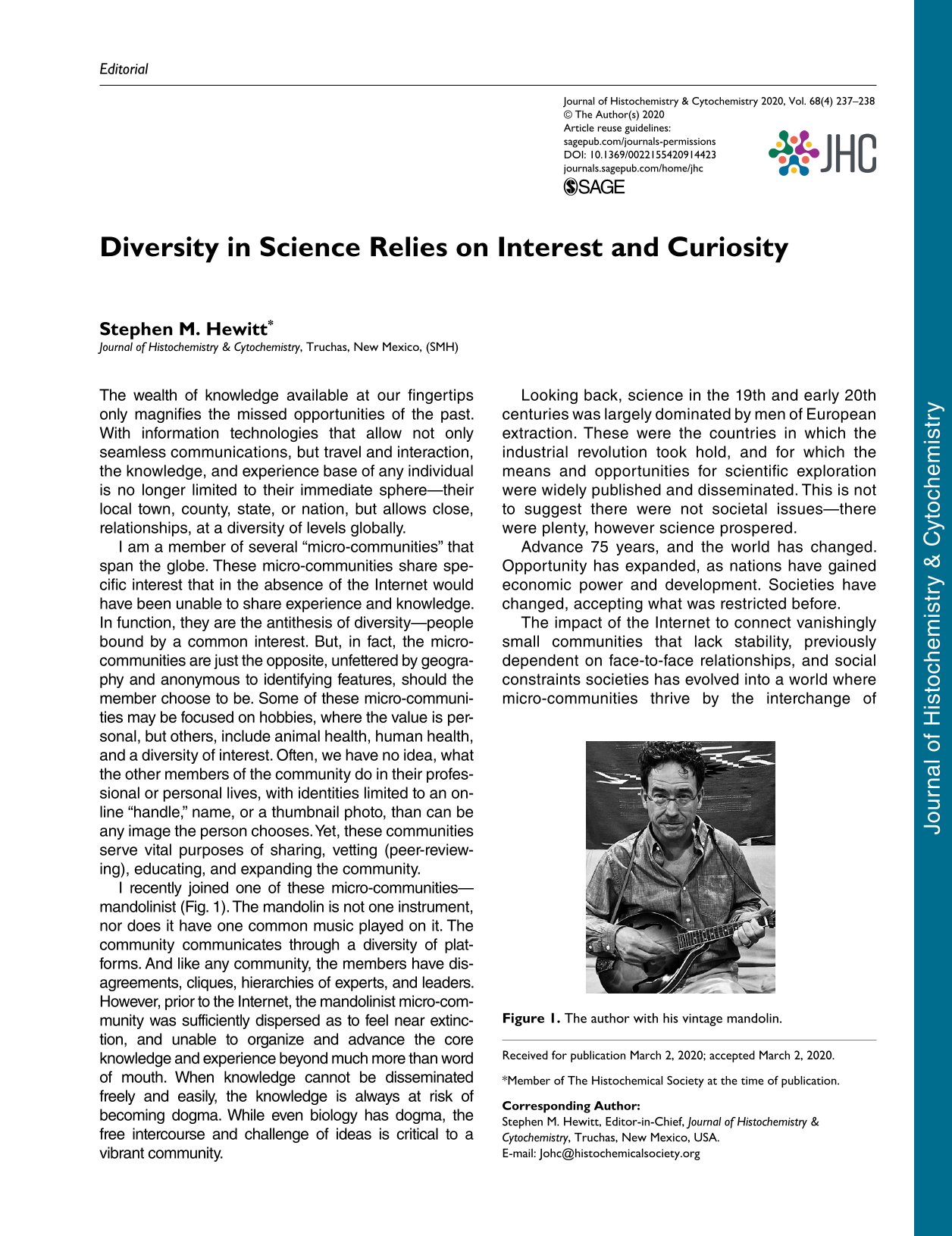
I recently joined one of these micro-communities—mandolinist (Fig. 1). The mandolin is not one instrument, nor does it have one common music played on it. The community communicates through a diversity of platforms. And like any community, the members have disagreements, cliques, hierarchies of experts, and leaders. However, prior to the Internet, the mandolinist micro-community was sufficiently dispersed as to feel near extinction, and unable to organize and advance the core knowledge and experience beyond much more than word of mouth. When knowledge cannot be disseminated freely and easily, the knowledge is always at risk of becoming dogma. While even biology has dogma, the free intercourse and challenge of ideas is critical to a vibrant community.

The author with his vintage mandolin.
Looking back, science in the 19th and early 20th centuries was largely dominated by men of European extraction. These were the countries in which the industrial revolution took hold, and for which the means and opportunities for scientific exploration were widely published and disseminated. This is not to suggest there were not societal issues—there were plenty, however science prospered.
Advance 75 years, and the world has changed. Opportunity has expanded, as nations have gained economic power and development. Societies have changed, accepting what was restricted before.
The impact of the Internet to connect vanishingly small communities that lack stability, previously dependent on face-to-face relationships, and social constraints societies has evolved into a world where micro-communities thrive by the interchange of knowledge, unfettered by previous societal boundaries. This is not to say this evolution is perfect—by definition evolution is based on evaluation of change for benefit (cost-benefit ratio) to advance. However, it is clear, the interchange of knowledge across more diverse communities, that share definition not by geography, but by interest and fueled by curiosity, is what offers the greatest opportunities for advancement. To accomplish this, diversity is no longer defined by the person, but by interest and curiosity.
Footnotes
Acknowledgements
The author wishes to thank Mercedes K. Meyer Ph.D., JD for her valuable input.