



Abstract
A copy-editing error occurred in our August issue in the article “Wavelength Modulated Cavity Enhanced Absorption Spectroscopy of Water in the 1.37 μm Region”, by R. Vasudev [Appl. Spectrosc.
TABLE II. Comparison of detection limits for methane on Mars with a Herriot cell instrument and a CEAS instrument in the 3.3 lm region. A mirror separation of 20 cm is used in both cases. The parameters here are those of the Tunable Laser Spectrometer (TLS) to be deployed aboard NASA's Mars Science Laboratory (C.R. Webster, TLS Principal Investigator, private communication, 2006). The TLS instrument is designed to detect methane, water, nitrous oxide, hydrogen peroxide, and carbon dioxide. ΔI/I0 here corresponds to the minimum detectable signal level (three times the noise level). We assume a ΔI/I0 similar to the value achieved in this work. Further improvement is possible, so better detection limits than the ones estimated here are possible. Assuming a mirror reflectivity that is the same as in this work. Calculation based on the HITRAN (2004) database,23 for a Mars surface temperature of 220 K and pressure of 7 mbar. The detection limits are based on the detectable fractional absorption in the first row of this table. Note that although the detectable ΔI/I0 is higher in our current instrument than in the Herriot cell, the higher sensitivity in CEAS arises from the much longer path length. ppb: parts-per-billion. In the TLS instrument, the detection limit will be enhanced by pre-concentration, so that the realizable detection limit will be in the parts-per-trillion (ppt) range. The CEAS instrument, on the other hand, will have a ppt-level detection capability without pre-concentration.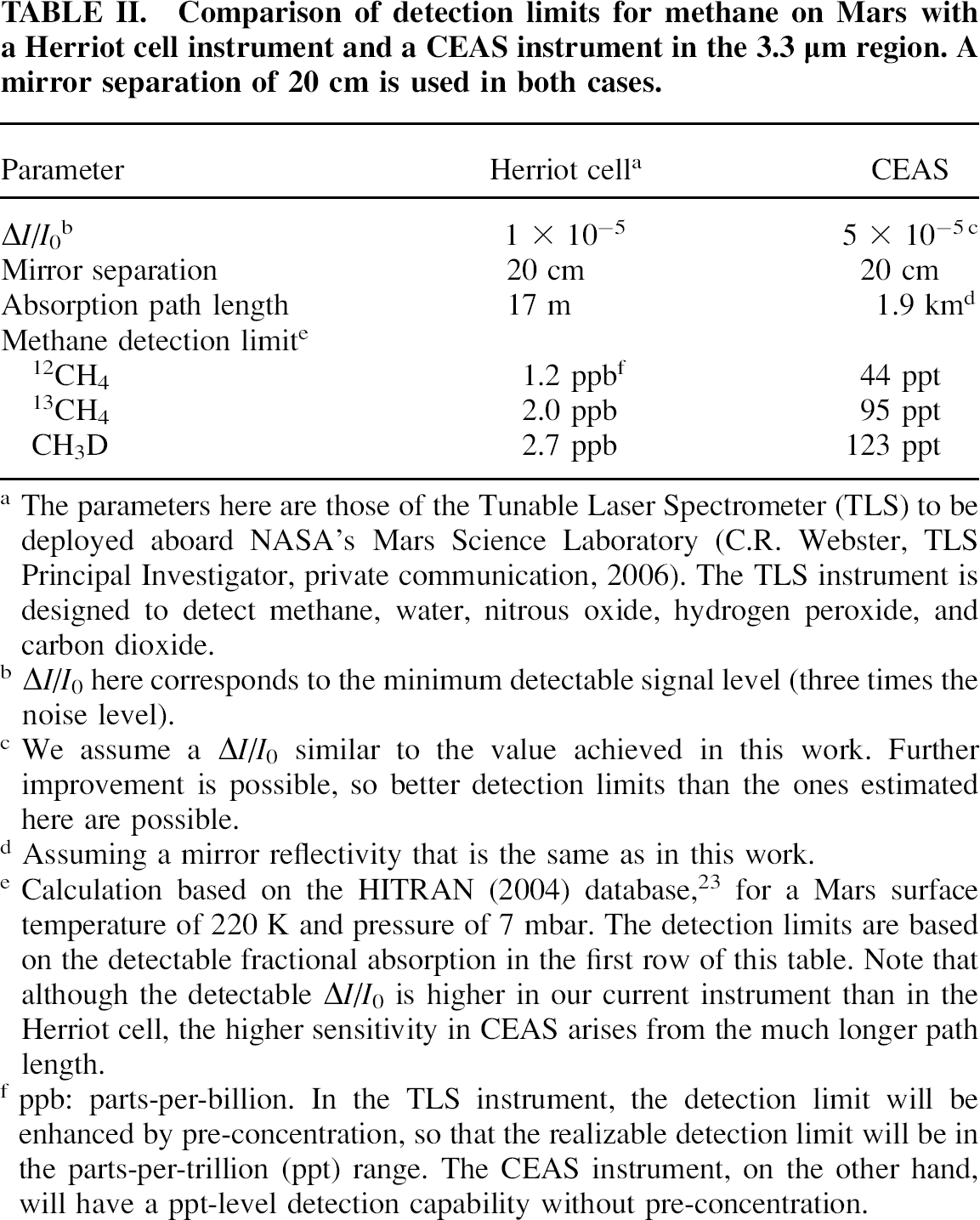
Parameter
Herriot cell
a
CEAS
ΔI/I0
b
1 × 10⁻⁵
5 × 10⁻⁵
c
Mirror separation
20 cm
20 cm
Absorption path length
17 m
1.9 km
d
Methane detection limit
e
12CH4
1.2 ppb
f
44 ppt
13CH4
2.0 ppb
95 ppt
CH3D
2.7 ppb
123 ppt
Get full access to this article
View all access options for this article.