






Abstract
Summary
Objectives
The ability to deliver public presentations is important for doctors of all specialities. Despite this, there is little emphasis on training in presentation skills within medical curriculae. The aim of this paper was to establish the current standard of presentations being delivered by surgical trainees at a national conference and to confirm the need for further training.
Design
An observational study of 96 six-minute research presentations.
Setting
A national surgical conference in the United Kingdom.
Participants
Four independent observers each appraised 24 six-minute presentations by surgical trainees against a pre-determined standard.
Main outcome measures
A set of 19 audit criteria were established after a literature search to ascertain commonly accepted presentation standards. These outcome measures included keeping to time, number of slides used, the nature of slide content, methods of data representation, use of images and presentation style.
Results
A total of 61 (64%) presenters overran. The median number of slides used was 13 (range 6–28). Thirty-three (34%) presenters displayed slides with more than six bullet points on two or more occasions. Sixty-four (67%) presenters displayed whole paragraphs of text on two or more occasions. Sixty-eight (71%) presenters displayed raw numerical data in the course of their presentations. Seventy (73%) presenters used images. Thirty-one (32%) presenters repeatedly read out sentences word-for-word from their slides. Nineteen (20%) presenters appeared not to know their presentation content well.
Conclusions
Presentation skills amongst surgical trainees are well below those that should be aspired to. Efforts to improve training, motivation and the examples set by senior surgeons should be instigated in order to improve this situation.
DECLARATIONS
None declared
Not applicable
Not applicable
Edward Watts
All the authors (EW, OP, SL, EL&JL) made a substantial contribution to the conception and design, acquisition of data, analysis and interpretation of the data, whilst also drafting the article or revising it critically and granting final approval of the version to be published.
Sharief Aboelmagd
Introduction
‘A poor surgeon hurts one person at a time. A poor teacher hurts one hundred and thirty’
Ernest Boyer, American Educator.
The ability to deliver public presentations is important for doctors of all specialities. The General Medical Council considers teaching and training to be a core standard of good medical practice. 1 For most consultants this involves the delivery of lectures or seminars to medical students and junior doctors. Those involved in research must be able to convey their message through conference presentations. Much of the success of those who undertake management roles will depend on their ability to communicate with other clinical and administrative staff by means of public presentation.
The required public speaking skills have traditionally been ‘caught’ rather than ‘taught’, with very little formal training within the higher surgical training curriculum. However, in recent years, a greater emphasis on presentation skills has been developing. The new Intercollegiate Surgical Curriculum Project syllabus lists ‘teaching others’ as a professional skill required at all stages of training. 2 The Teaching Improvement Project System (TIPS) course has now become a requirement for completion of specialist training in many deaneries. The presentation of an audit or hot topic is commonly a central part of the consultant interview process. Short-listing criteria for speciality training include presentations at local, regional, national and international conferences.
So at a time when presentation skills are growing in importance, how are surgical trainees performing? Does today's training adequately tutor junior surgeons in the skills of public presentation? The aim of this paper was to establish the current standard of presentations being delivered by surgical trainees at a major national conference.
Methods
At a major national surgical conference 96 six-minute presentations of previously unpublished research were analyzed. Four independent observers each appraised 24 six-minute presentations against a pre-determined standard. The data was collated into a database for analysis.
Establishing the audit standards
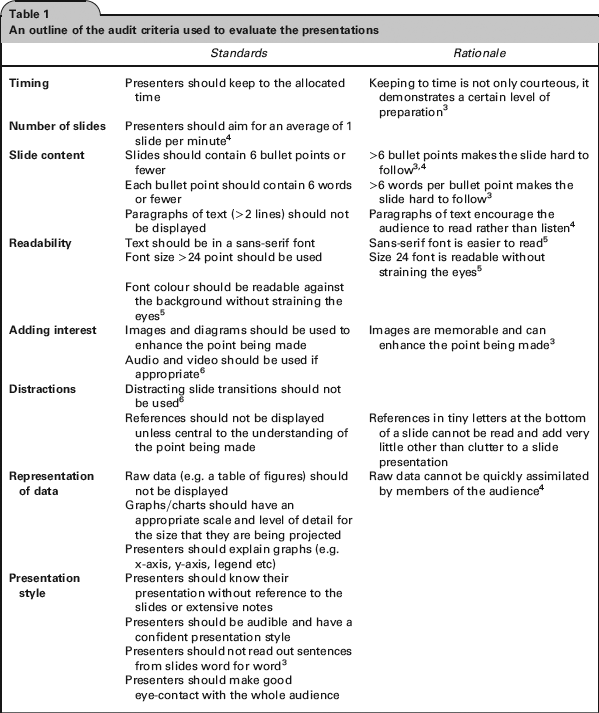
Because giving a public presentation is idiosyncratic, no ‘gold standard’ for the perfect presentation exists. The appropriate approach is dependent upon the subject matter, the experience of the presenter and the composition of the audience. However, there are many accepted standards that are well recognized to improve slide-based presentations. These were brought together with the aim to establish a set of criteria by which the presentations could be appraised (Table 1).
An outline of the audit criteria used to evaluate the presentations
Results
Timing and number of slides
Sixty-one (64%) presenters overran; 49 (52%) overran by over a minute (Figure 1). The mean presentation time was 6 minutes 57 seconds. The median number of slides used was 13 (range 6–28).
Timing and slide content of the presentations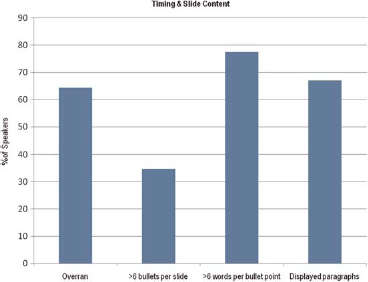
Slide content
Thirty-three (34%) presenters displayed slides with more than 6 bullet points on two or more occasions (Figure 1). Seventy-nine (82%) displayed slides with more than 6 words per bullet point on two or more occasions. Sixty-four (67%) displayed whole paragraphs of text on two or more occasions.
Readability
Thirty-three (34%) presenters used a serif font (Figure 2). Twenty-three (24%) used a font size too small to be readable without straining. Eight (8%) used font and background colours that made reading the text difficult.
Readability of the presentations
Distractions
Only 2 (2%) presenters used distracting slide transitions. Thirty-six (37%) displayed references in tiny font at the bottom of slides (Figure 2). In the majority of cases these were not readable nor displayed for an adequate period of time.
Use of multimedia
Only 6/96 presenters used video within their presentations, on one occasion with accompanying audio (Figure 3). Only 4/96 presentations experienced a significant technical hitch, one of these occasions related to the use of video.
Multimedia and data used in the presentations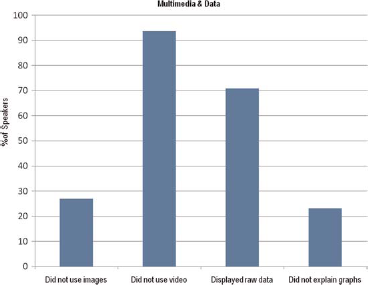
Representation of data
A total of 68/96 presenters displayed raw numerical data in the course of their presentations (Figure 3). Of those who did display data in a graphical fashion (e.g. bar chart, line graph, pie chart), only 22 (23%) gave a clear explanation of the graph (for example what the x axis and y axis represent, what the colours represent).
Use of images
Only 70 (73%) presenters used any images at all (Range 0–12). Seventy-seven (81%) images used served to enhance the point being made (Figure 3).
Presentation style
Thirty-one (33%) presenters regularly read out sentences word-for-word from their slides (Figure 4). Nineteen (20%) presenters appeared not to know their presentation well. Seventeen (18%) did not present with confidence. Twenty-seven (28%) did not have good eye-contact with the audience.
Presentation styles
Discussion
Timing and number of slides
‘Most speakers speak 10 minutes too long’
James Humes, Presidential speech writer
This study demonstrates that the standard of presentation by surgical trainees at a national surgical conference could be improved considerably across all domains measured. The allocated length for each presentation was six minutes. Over-running demonstrates a lack of preparation and planning. A high average number of slides used in this study suggest that many presenters attempted to fit too much information into their presentations, a likely contributing factor to being over time. A median of thirteen slides for a six minute presentation, makes it very difficult for an audience to read and assimilate information. This may lead to a loss of the message of the presentation.
Amount of information per slide
‘If everything is important, then nothing is important’
Garr Reynolds, Presentation Zen. 7
The display of too much information means that presenters fail to highlight the important results and conclusions of their study. Presentations should augment the printed abstract and are not just about conveying facts, but about conveying the story of the facts. 7 The presentation is an opportunity to bring the facts to life, explaining their origins, their implications and the further research that they demand. Presentations provide an opportunity for interaction between the presenter and the audience. Research is subjected to public scrutiny and questions and clarifications can be addressed.
Reading out slide content
‘The audience will either read your slides or listen to you. They will not do both’
Nancy Duarte, Slide:ology. 8
Thirty-one (33%) of presenters read out content directly from their slides. This is uninteresting and detracts from speaker/audience interaction. If presentation slides are used as speaking notes, presenters may be tempted to simply read out bullet points from the slide. The slides may also double as a handout. Audience members frequently ask presenters for copies of their slides for future reference, because it is assumed that slides should stand alone. However, a well constructed series of slides will probably have little meaning without the presenter present. Speech and slides should be pillars of the presentation, each contributing something slightly different to the whole. 7 It is suggested that slides should be pictorial and contain keywords rather than full sentences or paragraphs. These should augment rather than replicate the spoken words of the presenter. If notes are required, they should be separate from the slides, and presenters should prepare an accompanying handout for those audience members who require information for future reference. 7
The use of images and multimedia
Nearly 30% of presenters did not use any image in their presentation and slides consisted of text only. Images are recognized as being associated with improved factual recall and understanding. 9
The Presentation of Data
‘Data slides are not really about the data. They are about the meaning of the data.’
Nancy Duarte, Slide:ology. 8
Over 2/3 presenters displayed data in raw numerical format. Because of the nature and necessary time pressures of a presentation the audience do not have time to closely examine a large table of figures as they would if the same data were presented in the same way on the pages of a scientific journal. 8 Slides are not a good medium for displaying complex data. 8 Data slides should have a clear message which can be assimilated quickly and easily by the audience. Effective communication of findings may be facilitated by an appropriate graph or chart. Audience members are enabled to understand the findings quickly, allowing them to give their full attention to the spoken part of the presentation. By contrast audience members presented with large data sets are distracted from the spoken presentation whist trying to digest the large amount of information presented to them visually.
Readability and Distractions
Three quarters of speakers used appropriate font sizes and colours. Sans-serif fonts are considerably easier to read from a distance and were used by the majority of presenters. Very few distracting slide transitions were used. However, a significant minority displayed distracting and unreadable references at the bottom of their slides. A reference is superfluous in most presentations. If the reference is particularly pertinent to the presentation, then it should be displayed in readable font with other text. Display of references in tiny font at the bottom of slides distracts listeners, clutters the slides and adds very little.
Presentation style
‘Grasp the subject, the words will follow.’
Cato The Elder.
The majority of presenters spoke with confidence and good eye-contact. The majority appeared to know their subject well. However, many seemed to rely on their slides as speaking notes, with 20% appearing not to know their slides. A high level of familiarity with the material gives greater credibility to the speaker. 10
Many senior presenters and plenary speakers set poor examples. At the same conference, our observers noted that invited speakers frequently spoke over their allocated time, and commonly used slides packed with far too much information. This may set a poor example for less experienced presenters.
Although not assessed in this study, training in presentation skills may be lacking. Trainees within the corporate world receive instruction on presentation skills and constructive feedback on their performances. Junior surgeons receive very little formal training and are unlikely to receive feedback from experienced public speakers. The ability to deliver presentations whilst in a teaching, training, research, or management role is critically important. Dedicated workshops have been shown to improve the presentation skills of healthcare professionals. 11 Surgical curriculae should adapt to provide appropriate training in this field. There has been a recent move towards work-place based assessment of curriculum competencies in surgical training. In line with this, presentation skills should also be regularly assessed in a formative manner. This would enable trainees to learn from constructive feedback from experienced presenters. Organizers of conferences may facilitate improvement by the presentation of more prizes for presentation (whilst being conscious of not allowing style to triumph over content).
Conclusions
The standard of presentation skills demonstrated at a national surgical conference often left room for improvement. In many areas, a substantial proportion of presenters failed to meet accepted presentation standards. To our knowledge this is the first study of this nature within the medical field. The paucity of literature in this area may demonstrate the perceived unimportance of the subject amongst medical professionals. However, much effort, time and expense has gone into the performance of the studies presented at medical conferences and a similar effort should be put into conveying the results and implications of those studies to a wider audience. Sharing of ideas and dissemination of results is a core purpose of medical conferences and it is the responsibility of those presenting to make sure that this goal is achieved effectively. Presentation skills amongst surgical trainees are well below those that should be aspired to. Efforts to improve training, motivation and the examples set by senior surgeons should be instigated in order to improve this situation.
Footnotes
Acknowledgements
None