






Abstract
Objectives
To conduct a systematic review of strategies to optimize immunisation uptake within preschool children in developed countries.
Design
Systematic review.
Setting
Developed countries
Participants
Preschool children who were due, or overdue, one or more of their routine primary immunisations.
Main outcome measures
Increase in the proportion of the target population up to date with standard recommended universal vaccinations.
Results
Forty-six studies were included for analysis, published between 1980 and 2009. Twenty-six studies were randomized controlled trials, 11 were before and after trials, and nine were controlled intervention trials. Parental reminders showed a statistically significant increase in immunisation rates in 34% of included intervention arms. These effects were reported with both generic and specific reminders and with all methods of reminders and recall. Strategies aimed at immunisation providers were also shown to improve immunisation rates with a median change in immunisation rates of 7% when reminders were used, 8% when educational programmes were used and 19% when feedback programmes were used.
Conclusion
General practitioners are uniquely positioned to influence parental decisions on childhood immunisation. A variety of strategies studied in primary care settings have been shown to improve immunisation rates, including parental and healthcare provider reminders.
DECLARATIONS
All authors contributed equally
Introduction
Childhood vaccines currently save 3 million lives a year globally and are among the most successful and cost-effective public health interventions of the 20th century. 1 Immunisation has been responsible for substantial falls in serious bacterial infectious diseases in children including tetanus, diphtheria, meningococcal serogroup C (MenC), measles and Haemophilus Influenzae B (HiB), since their inclusion in the UK primary vaccination schedule. 2 Immunising children not only protects individuals from infection but also contributes to population-based immunity by reducing the circulation of infectious agents leading to community-wide health gains. 3
To maximize the potential population-wide benefits of routine vaccination through herd immunity, the World Health Organization (WHO) has set national targets of 95% coverage annually for each antigen in the routine immunisation schedule by 2 years of age. 4 Yet recent figures show that these targets are not being met in many countries. In England, in the quarter between January and March 2010, vaccination coverage for the measles, mumps and rubella vaccine (MMR), pneumococcal vaccine (PCV) booster and the Hib/MenC vaccines were 88%, 88% and 90%, respectively, at 24 months of age. 5
Coverage tends to be lowest in deprived, urban areas with mobile populations.6–8 For example, childhood immunisation rates for London are substantially below the national average with levels in one East London borough (Bexley) of just 63%, 71% and 74% for the PCV (Pneumococcal conjugate vaccine) booster, MMR and Hib/MenC, respectively. 5 In areas of low MMR coverage, this has resulted in outbreaks, with a high proportion of those affected being under 1 year of age, who were most likely infected by unimmunised older contacts. One consequence of this is that measles and mumps have once again become endemic in the UK, with over 1100 cases of measles and over 7000 cases of mumps reported in the UK in 2009, 14 years after local transmission of measles was halted. 9
Barriers to immunisation can stem from parental concerns about risks, inadequate knowledge and provision by providers, and generalized systemic barriers involving the organization of the health system and access to services. 10 Ninety-eight percent of infants born in the UK are registered with a UK general practitioner (GP) 11 and their first contact with their GP is often at the primary vaccination. Hence, GPs and practice nurses are uniquely positioned to influence a parent's decisions to have their child immunised.
Our objective was to conduct a systematic literature review aimed at providing GPs with up-to-date, evidence-based guidelines on how to improve uptake rates of primary immunisations for children registered under their care. Our research question was ‘How can primary care practitioners in developed countries improve preschool immunization uptake?'
Methods
Search strategy and data sources
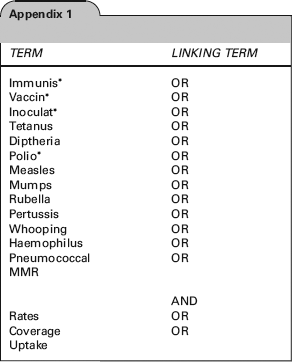
We systematically searched electronic databases including MEDLINE, EMBASE, PsycInfo, Cochrane and OpenSIGL from inception to 1 June 2010 using MESH and Key Terms including immunis*, vaccin*, innoc* and rates, uptake and coverage (Appendix 1) to identify studies reporting interventions to improve preschool immunisation uptake and to evaluate their effectiveness in children in developed countries.
We hand-searched the reference lists from retrieved studies and reviews to find additional studies and contacted experts in the field. We also identified relevant grey literature such as conference papers, dissertations and government guidelines.
Study selection
Two reviewers (NW and HW) independently screened titles and abstracts of all citations for eligibility and retrieved those that met the inclusion criteria. If insufficient information was available in the abstract to decide on eligibility the whole article was retrieved for review. Discrepancies were resolved by discussion and by involving a third reviewer (SS) when necessary.
We included experimental studies reporting original research including randomized controlled trials, controlled clinical trials, before and after studies and interrupted time-series studies, published in English. Our target population was children under the age of 5 years living in developed countries. We included studies reporting our main outcome measure; the increase in the proportion of the target population who were up to date with standard recommended universal vaccinations. Outcomes could be for either single vaccinations or combinations of vaccines due. We excluded studies for which the full article was not available, and studies that did not contain any original data such as review articles, commentaries and correspondence.
Data extraction and quality assessment
The two reviewers independently extracted data from included studies on study setting, participant characteristics, clinical setting, interventions and outcomes measured. Included studies were graded for methodological quality using 26 points from the 27 point score devised by Downs and Black (Appendix 2). 12
Results
A total of 32,624 studies were retrieved from the electronic searches of which 32,410 were excluded after reviewing their titles and abstracts. The remaining 214 papers were retrieved for full text review. Recommendations from experts in the field and reviews of reference lists identified a further 14 studies. A total of 46 papers met the inclusion criteria (Figure 1).
Quorom diagram
The commonest reasons for exclusion were failure to report interventions or outcomes of interest and poor study design.
The 46 included studies were published between 1980 and 2009. Twenty-six were randomized controlled trials, 11 were before and after trials and nine were controlled intervention trials. The studies originated mainly from the USA (36) and the remainder originated from the UK and Ireland (7), Australia (1), New Zealand (1) and Finland (1). The study participants ranged in age from 6 weeks to 11 years of age but the majority of studies focused on preschool children. Studies were conducted in different settings including paediatric outpatient clinics, family practices, primary care clinics, community health centres, managed care organizations and health maintenance organizations in the USA; and community clinics and general practices in the UK, New Zealand and Australia.
Studied interventions aimed to remind and/or recall parents of upcoming or overdue vaccinations; targeted providers to improve uptake through feedback, audit or chart prompts; provided simple education to parents within a general practice setting or consisted of multicomponent interventions.
Client-based interventions
Client-based interventions target the parent and child to increase the demand for immunisation services. Educating parents and communities on the benefits of vaccinating their children can empower parents to practice preventative healthcare and thereby improving immunisation uptake.
Reminder and recall
Reminders aim to advise parents of upcoming vaccinations that are due and remind parents of those children that are overdue. They vary in methodology from automated telephone calls and generic postcards to personalized letters and even home visits.
Twenty-two included papers reported on 41 intervention arms studying parental reminders and recalls. 13 – 34 Details of the included studies are seen in Table 1. The average score for study quality using Down and Black's quality scoring framework was 24.8 out of a potential 31 (range 21– 29.5). Fourteen (34%) of the 41 intervention arms showed a statistically significant (P < 0.05) increase in immunisation rates (Szilagyi et al. 29 did not report significance). Overall, these studies reported a median point change of 11% (mean 10%, range -11% to 24%). Studies comparing usual care with postal reminders alone17,19,20,23–26,30,33,34 reported an overall median point change of 10% (mean 8.6%, range -11% to 19%). Studies looking at telephone reminders alone14,17,28,31 reported an overall median point change of 9.5% (mean 12%; range 3-24%). Those studies looking at the effect of the combination of postal and telephone reminders on vaccination rates13,15–17,21,31 reported an overall median point change of 10.5% (mean 10.8%, range 2.8-19%). One study 18 compared a traditional reminder card with a card designed with health belief model in mind. Hawe reported a 12% increase in immunisation rates when the health belief model reminder card was used.
Study characteristics of reminder and recall studies

Parental reminders have been shown to have an overall positive effect on immunisation uptake. These effects have been reported with both generic and specific reminders and with all methods of reminders and recall.
Parental education
In the context of this review, we considered only educational programmes that could feasibly be delivered within the setting of primary care and we excluded studies reporting national or regional education programmes.
Two of the included papers reported on two intervention arms studying the effect of simple parental education programmes on immunisation uptake (Table 2).35,36 One study assessed the impact of a promotional teddy bear featuring the address of an information website for MMR and one studied the impact of an interactive graphic card and verbal explanation on immunisation uptake. The quality of these two studies averaged at 23.8 points from a possible 31. Neither study showed a significant effect on immunisation rates and the limited number of studies precludes us from reaching an evidenced-based conclusion on the effect of these strategies on parental behaviour.
Study characteristics of parental education studies

Patient-held records
Only one study 37 assessing the impact of patient-held records effect on immunisation rates fulfilled the inclusion criteria (Table 3); it scored 22 from a possible 31 points on study quality. This study did not demonstrate a significant difference between usual care and a home-based record booklet. Therefore, it is not possible to come to an evidence-based conclusion on the effect of this strategy on immunisation uptake.
Study characteristics of patient-held record studies

Provider-based interventions
Provider-based interventions aim to improve vaccination rates by reducing opportunities missed by the medical professional to immunise children. These include provider reminder/recall, assessment and feedback, provider education and a combination of some or all of these strategies.
Provider reminder/recall
This strategy aims to investigate client's immunisation status either by manual searching of notes or by automatic computer notifications. Providers are then notified either with paper or computer-based chart prompts that the vaccination is due or overdue.
Five of the included papers38–42 reported on six intervention arms studying provider reminder/ recall strategies (Table 4). The studies averaged a quality score of 23.7 from a possible 31 (range 21-27). Overall, these studies reported a median point change of 7% (mean 10%, range -2% to 33%). Both manual searching and electronic reminders were shown to have a positive effect on immunisation rates.
Study characteristics of provider-based interventions

Provider education
Provider education strategies aim to enhance the knowledge of the immunisation provider through a variety of methods including peer support and the use of educational resources. Educational tools may be one-off sessions or part of continuing medical education.
Four of the included papers43–46 reported on four intervention arms studying the effect of educating the provider of vaccinations on immunisation rates (Table 3). The average quality score for included studies was 22.4 (range 20-28). Overall, these studies reported a median point change of 8% (mean 10%, range 1-25%). The educational interventions varied from 1-hour peer education sessions to regular continuing medical education within the practice. Two studies looked at provider education alone and two studies looked at education in combination with other interventions such as patient reminders.
Feedback
This strategy retrospectively evaluates the performance of providers in childhood immunisations and feeds this information back to the medical practitioner. Feedback can also be combined with other strategies for example financial incentives or provider education.
Four of the included papers (Taylor, Sinn, Harper, Fairbrother) reported on six intervention arms studying the effect of provider feedback combined with other strategies on immunisation rates (Table 3). The average quality score for these papers was 24.1 (range 21–28). Overall, these studies reported a median point change of 19% (mean 17%, range 12–19%).
Multicomponent interventions
Multicomponent interventions encompass strategies that use a combination of techniques to improve immunisation uptake. These strategies include combining interventions aimed at both the client and the provider.
Eight of the included studies reported on eight intervention arms that combined a variety of interventions aimed at improving immunisation uptake (Table 5).51–58 The average score for study quality was 20.5 from a possible 31 (range 17.5–24). Overall, these studies reported a median point change of 15% (mean 19%, range –4% to 47%). Three (38%) of the eight intervention arms reported a statistically significant difference in immunisation rate. Four (50%) studies did not report the significance level for their intervention arms. It is not possible to distinguish which component of the intervention has had the greatest effect on immunisation rates.
Study characteristics of multicomponent intervention

Discussion
Numerous studies have reported interventions to improve primary immunisation uptake in children. Effective interventions include parental reminders, which can increase uptake by 11% in the intervention arms. These effects were reported with both generic and specific reminders and with all methods of reminders and recall. Strategies aimed at immunisati on providers were also shown to improve immunisation rates with a median change in immunisation rates of 7% when reminders were studied, 8% when educational programmes were studied and 19% when feedback programmes were studied.
Providers who were educated by peers and who received feedback on their performance as vaccine providers were shown to have improved immunisation uptake within their practice. There was limited evidence for patient-held records and parental education alone as strategies for improving immunisation uptake.
Multicomponent strategy studies included interventions aimed at parents alone (e.g. reminder cards plus educational posters) as well as those that combined parental and healthcare provider strategies (e.g. parental reminders plus provider education). Melinkovich showed when studying community and school health centres in Denver, USA that combining parental and provider strategies led to the greatest point increase in immunisation coverage in the multicomponent strategy group of studies. 53 The most successful strategies appear to be those that target both the healthcare provider and those that are to be immunised.
Our search methods yielded more studies than any similar previous review. We combined studies from a variety of clinical settings and a range of socioeconomic populations in developed countries, which makes the results generalisable in this setting. Included studies were heterogenous in setting, service delivery, intervention delivery and quality which made meta-analysis difficult. We did not include studies from developing countries as the barriers to immunisation are different from those in developed countries and include financial barriers that are generally not relevant to parents and general practitioners in many developed countries that offer universal access to primary care services. Grey literature, conference papers and government documents were also included in the review as well as research published in peer-reviewed journals to ensure the broadest possible range of studies and to minimize publication bias. We excluded studies published in languages other than English, which is the main weakness of this study.
We did not examine the effect of GP financial incentives on immunisation uptake. There is a large literature of ‘pay for performance’ in healthcare and this has been a subject of previous systematic reviews, the inclusion of which is outside the scope of this paper.59,60
Various sociodemographic factors have been shown to reduce the likelihood of a child being up to date with recommended vaccinations including being from a lone parent family61,62 from an ethnic minority63,64 and living in urban areas. 65 The high level of mobility seen in these populations is thought to contribute to these differences.66,67 Interventions to increase vaccination rates have a greater effect on those who are most at risk of being under-immunised. Hence, it is important that vaccine coverage data are collected in a way that highlights differences in uptake rates between socioeconomic and ethnic groups. This would help in the implementation and evaluation of public health programmes to improve immunisation rates in the groups in the most need of intervention.
Childhood immunisation can continue to benefit the health of children. For example, the UK has seen a successful campaign to add pneu-mococcal vaccination to the primary schedule with a catch-up campaign for older children. This has resulted in a substantial reversal of previously increasing trends with falls in hospital admissions for bacterial pneumonia (20%) and empyema (22%) in the 2 years after implementation, linked with uptake rates of 80% and 98% after the first and second years of the campaign, respectively. 68
Conclusions
Maintaining high vaccine uptake rates is an essential component of the success of any vaccination programme and in improving the health status of children. Health planners and professionals must engage actively with parents and the public and invest in process measures that ensure children receive primary prevention. Our review has highlighted a number of interventions that can help improve childhood immunisation rates in developed countries. These include reminding parents and providers of upcoming and overdue immunisations and educating and providing feedback to the vaccination providers. Some additional research is required to test the cost-effectiveness of these interventions and their impact in groups with poor immunisation rates or high risks of complications from vaccine preventable diseases.
Footnotes
Appendix 1
| TERM | LINKING TERM |
|---|---|
| Immunis* | OR |
| Vaccin* | OR |
| Inoculat* | OR |
| Tetanus | OR |
| Diptheria | OR |
| Polio* | OR |
| Measles | OR |
| Mumps | OR |
| Rubella | OR |
| Pertussis | OR |
| Whooping | OR |
| Haemophilus | OR |
| Pneumococcal | OR |
| MMR | |
| AND | |
| Rates | OR |
| Coverage | OR |
| Uptake |
Appendix 2
Is the hypothesis/aim/objective of the study clearly described? Yes =1 No = 0 Are the main outcomes to be measured clearly described in the Introduction or Methods section? If the main outcomes are first mentioned in the Results section, the question should be answered no. Yes =1 No = 0 Are the characteristics of the patients included in the study clearly described? Inclusion and/or exclusion criteria should be given. Yes =1 No = 0 Are the interventions of interest clearly described? Treatments and placebo (where relevant) that are to be compared should be clearly defined. Yes =1 No = 0 Are the distributions of principal confounders in each group of subjects to be compared clearly described? Yes =2 Partially = 1 No = 0 Are the main findings of the study clearly described? Simple outcome data (including denominators and numerators) should be reported for all major analyses and conclusions. (This question does not cover statistical tests which are considered below). Yes =1 No = 0 Does this study provide estimates of the random variability in the data for the main outcomes? In non normally distributed data the inter quartile range of results should be reported. In normally distributed data the standard error, standard deviation or confidence intervals should be reported. If the distribution of the data is not described, it must assume that the estimates used were appropriate and the question should be answered yes. Yes =1 No = 0 Have all important adverse events that may be a consequence of the intervention been reported? Not going to use this one. Yes =1 No = 0 Have the characteristics of patients lost to follow up been described? Yes =1 No = 0 Have actual probability values been reported (eg 0.035 rather than < 0.05) for the main out comes except where the probability value is less than 0.001? Yes =1 No = 0